
The Lamborghini Countach ran from 1974 to 1990 and set the shape of the mid-engined supercar for a generation. Bertone showed the LP500 prototype at Geneva in 1971; the production LP400 that followed three years later kept the wedge and the forward-hinged doors but was rebuilt underneath around a full welded steel spaceframe carrying a 3,929 cc V12 laid out by Giotto Bizzarrini in 1963 and adapted by Paolo Stanzani. The car grew steadily wider, heavier and more powerful: the LP400 S of 1978 brought Pirelli P7 tires and riveted arch extensions, the LP500 S of 1982 a 4,754 cc engine, the 5000 QV of 1985 four valves per cylinder and 5,167 cc, and the 25th Anniversary of 1988 a Horacio Pagani restyle and the only genuinely habitable cabin of the run. Total production is stated as either 1,999 or 1,983 depending on whose count is followed, and the per-variant figures are contested in the same way. The market splits sharply between the early narrow-body cars and everything after.
Countach
Countach (LP400 to 25th Anniversary)
History
The Show Car and the Production Car
Lamborghini's own heritage account places the Countach's first public appearance as a concept in 1971 and the start of series production in 1974, with a sixteen-year run to follow. The prototype and the production car shared a silhouette and very little else. Wikipedia's technical summary gives the LP500 prototype 2,491 lb on a partial spaceframe of sheet steel and square-section tubing, 401 cm long; the production car went to 414 cm on a full spaceframe of welded round-section steel tubing in 1.18 in (30 mm), 0.98 in (25 mm) and 0.59 in (15 mm) diameters, every tube of 0.04 in (1 mm) wall thickness, the bare frame weighing about 198 lb. The engine was not new either: Lamborghini credits the 60-degree V12 to Giotto Bizzarrini in 1963, adapted for this installation by Paolo Stanzani, with the gearbox placed longitudinally between the seats and drive taken back through the sump.
The LP400 and the Periscopio Roof
The first production cars used a recessed channel in the roof to give a periscopic view rearwards, a direct admission that the car had almost no three-quarter vision. The Countach Register, which documents cars individually, records deliveries of periscope-roof cars from December 1974 to February 1978. Motor Sport tested one in July 1977 at three weeks and 1,056 miles old, listing 375 hp DIN at 8,000 rpm, 10.5:1 compression, 267 lb-ft at 5,500 rpm and 43/57 weight distribution; Sports Car Market gives the LP400's original US list price as $52,000. Clive Richardson found the steering 'kart-like in its directness and precision' and the trunk genuinely usable, and was blunt about the rest: brake fade on road and circuit, a spongy pedal, tail break-away at modest speeds, first and reverse hard to select from rest, carpets already curling at the edges on a new car.
Wider Every Time
The LP400 S arrived at Geneva in March 1978 on Pirelli P7 tires and Campagnolo wheels widened to 8.5 inches front and 12 inches rear, with thicker anti-roll bars and reversed lower wishbones at the rear. It came in three series: 50 cars from chassis 1121001, then 105 from 1121102, then 82 from June 1981, and brought the riveted arch extensions and the optional rear wing that most people now picture when they picture a Countach. The Walter Wolf cars, engineered through Dallara, sat behind much of that development. In 1982 the V12 went to 4,754 cc for the LP500 S, badged 5000 S in some markets and a lasting source of confusion with what came next.
Quattrovalvole and the Downdraft
The 5000 QV of 1985 took the engine to 5,167 cc with four valves per cylinder. European cars moved from sidedraft to downdraft Weber carburetors, which required the power dome on the engine cover and, by RM Sotheby's account, lifted output to 455 hp, roughly 87 more than the European 5000 S. That change is the origin of the 'Downdraft' shorthand. US cars ran Bosch injection at a quoted 420 hp. The QV is the variant most often described as the one to drive rather than the one to look at.
Pagani, the Anniversary and the End
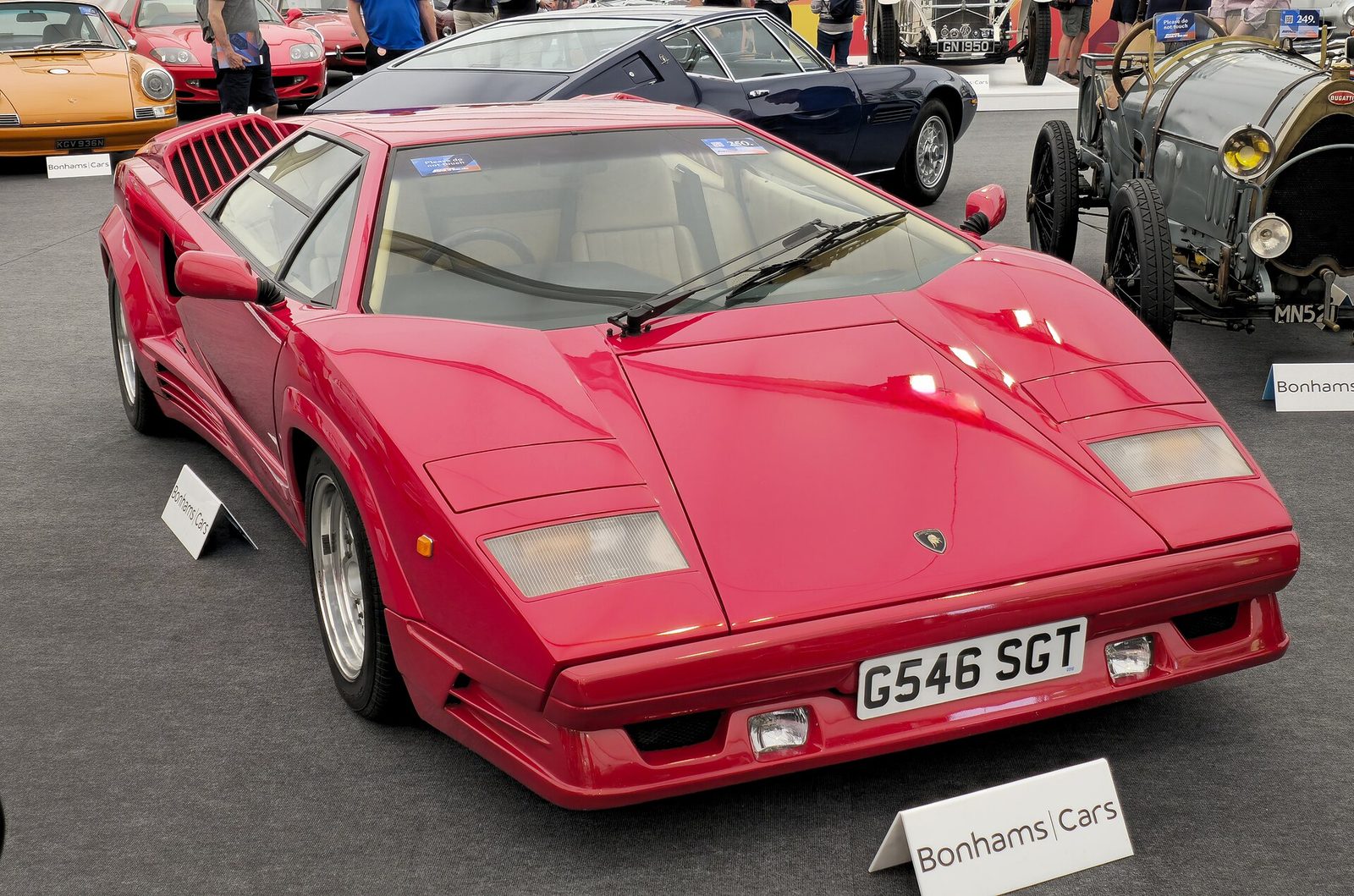
For the marque's silver jubilee Lamborghini set Horacio Pagani, then working in-house, to restyling the car. The 25th Anniversary of 1988 raised the nose, added strakes to the front bumper, reworked the tail and set vertical slats over the radiator intakes, while 1977 World Rally champion Sandro Munari developed the chassis. Electric windows, sound deadening and power-reclining seats made it the only Countach that could be called accommodating. It ran roughly twenty months to 657 cars and was replaced by the Diablo in 1990. Lamborghini notes that the car was entered in the Library of Congress as historically significant to American culture, which is a fair measure of how far the shape traveled beyond the people who could buy one.
Common Problems
The V12 is durable when serviced and ruinous when not. A rebuild is the largest bill the car can present, and no US price for one was fetched here. Magneto notes that a full oil change takes sixteen liters, which is also why the car takes so long to warm through. Faulty Magneti Marelli electronic ignition is described as a common fault, as are oil leaks from the feed pipes running between the front-mounted radiator and the engine; on four-liter cars the oil cooler pipes perish along their run down the chassis and have to be replaced in length. Valve clearance adjustment falls due every 15,000 miles. The gearbox is noisy by design and awkward into second when cold; genuine bearing wear announces itself as noise beyond that. Clutch replacement requires the engine out. Rose joints throughout the suspension wear quickly and produce wayward handling, and the rear brakes and handbrake are prone to seizing. The brakes need a firm pedal even in health, and Motor Sport recorded fade and a spongy, feel-less pedal on a new car in 1977. Air conditioning was temperamental when new and is frequently inoperative now. Steel roof and headlight pods rust, aluminum panels corrode where glassfiber meets them, and trim is the one area where specialist support runs out, and Classic & Sports Car states plainly that trim parts remain unavailable.
What to Look For
The spaceframe is the car. Floors, bulkheads and the spare-wheel well are bonded to it, so corrosion in the steel tubes and evidence of past accident damage are the first things an inspection should settle, and the hardest to put right afterwards. Body materials vary across one car: aluminum panels, a steel roof and headlight pods, glassfiber engine cover and, from LP400 S, glassfiber arch extensions, and the aluminum corrodes readily where it meets the glassfiber. Original paint shows the weave of the glassfiber through it, which is a useful check on whether a car has been resprayed. Establish the variant precisely and check it against the paperwork: periscope roof and narrow body on an LP400, arch extensions and P7-era wheels on an S, the power dome on a European downdraft QV against Bosch injection on a US car. That last distinction moves real money as of September 2026. Rose joints wear quickly and take the handling with them, so listen for noise from the rear and have them assessed rather than assumed. Front tie-rods are easily bent by jacking in the wrong place and stub axles have been known to fracture, though replacements exist. Ask when the clutch was last changed, because the answer sets the size of the next bill, and when the valve clearances were last set; the interval is quoted at 15,000 miles and the job is labor-heavy. Check that the air conditioning works, since it rarely does. Match chassis and engine numbers against the Countach Register, which documents cars individually and is the closest thing to an independent census.
Market Notes
As of September 2026, classic.com records an average sale price of $665,963 across the Countach model line, a lowest recorded sale of $257,600 for a 1982 5000 S in September 2021 and a highest recorded sale of $2,370,000 for a 1979 LP400 S Series I in August 2026. Per-variant benchmarks as of the same date read LP400 $891,662, LP400 S $1,032,715, LP500 S / 5000 S $655,913, LP5000 QV $696,927 and 25th Anniversary $602,837, with variant averages below every benchmark: $878,007, $792,628, $616,228, $624,863 and $578,889 respectively. The LP400 is the only one of the five on a falling trend. Auction and sale evidence fetched as of September 2026: at RM Sotheby's Monterey in August 2026 a 1,120 miles original-paint LP400 S Series I, chassis 1121086, made $2,370,000, a restored 1985 QV Downdraft made $1,325,000 and a 952 miles 25th Anniversary made $797,000; classic.com also records a 25th Anniversary at $593,500 through Broad Arrow in August 2026 and an LP400 S Series II at $1,249,979 in July 2026. Earlier results still frame the early cars: RM Sotheby's failed to sell LP400 Periscopio chassis 1120172 against a $1,100,000 to $1,400,000 estimate at Miami 2024. Those are published sold prices, not hammer; buyer's premium is added on top of hammer.
Where sources differ
Total Countach production between 1974 and 1990 is stated as either 1,999 cars or 1,983 cars depending on the source, and no single figure is asserted here.
Lamborghini's own heritage page states 1,999 units and Magneto's buying guide independently states 1,999. Wikipedia states 1,983 but cites LamboCARS.com for it, and LamboCARS states 1,983, so those two are a single source rather than two. The Countach Register declines to publish a total and describes the population only as 'almost 2000'. Classic & Sports Car says approximately 2,000. Not resolved by any source consulted here, so productionTotal is null.
The number of LP400s built with the periscopic roof is contested: the Countach Register states 150 while RM Sotheby's and classic.com state 157.
The Countach Register states 'Only 150 cars were built with this unique and collectable feature' and catalogs chassis 1120298 as 'the 149th of only 150 LP 400 Periscopio Countachs built'. RM Sotheby's Paris 2025 catalog describes chassis 1120142 as 'One of only 157 examples of the LP400 Periscopio model produced', and classic.com's LP400 page states 157 produced 1974-1978. Wikipedia gives 157 for the LP400 without distinguishing periscope cars; LamboCARS gives 150 in its text and 157 in its table. No source consulted establishes whether 157 is a periscope-only count or an LP400 total including later non-periscope cars, so the difference is left unresolved.
The 5000 QV production count is contested between roughly 610 and roughly 631 cars, with the higher figure attributed to approximately 300 European carbureted examples plus the remainder.
RM Sotheby's Monaco 2024 catalog states 'Just 610 examples were made'. The same auction house's Monterey 2026 catalog states approximately 631 built through mid-1988, roughly 300 of them European carbureted cars. Wikipedia and LamboCARS both give 610, of which Wikipedia says 66 were fuel-injected. The discrepancy sits within one auction house's own catalogs and is not explained by either. No QV total is asserted.
The LP400 S was built in three series, 50 cars from chassis 1121001, 105 from chassis 1121102 and 82 from June 1981, totaling 237, although LamboCARS's narrative text gives 235.
Supercar Nostalgia, Wikipedia and classic.com all give 237, and Wikipedia's series breakdown of 50, 105 and 82 sums to that. LamboCARS's narrative text gives 235 while its own specification table gives 237. The two-car difference is internal to LamboCARS and unexplained there; it is recorded rather than resolved.
The LP400 S power output is not agreed across sources, with published figures of 375 hp at 8,000 rpm, 353 hp for Series III export cars, 352 hp, 345 hp at 7,500 rpm and 340 hp.
Supercar Nostalgia states 375 hp at 8,000 rpm with 353 hp for Series III export cars on smaller carburetors. Wikipedia states 345 hp at 7,500 rpm. Lamborghini's own heritage page states 340 hp for the 400 S. LamboCARS states 352 hp for standard cars, notes some retained the 375 hp LP400 engine, and puts US imports at roughly 325 hp on emissions equipment. These are not reconcilable without knowing which market and series each figure describes, and no source consulted supplies that.
The Countach's top speed was never cleanly measured in period and published figures diverge widely, from 163 mph observed by Road & Track in 1976 to a factory projection of 192 mph.
Road & Track in 1976 recorded a brief 7,000 rpm equating to 163 mph while its own fifth-gear gearing data of 23.3 mph per 1,000 rpm calculates to 186 mph, against a projected 192 mph at 8,000 rpm. Motor Sport in 1977 reported a maximum of over 180 mph without running the car to it. Wikipedia lists 179 mph for the LP400 and 183 mph for the 25th Anniversary. Autozine records 5000 QV results between 166 and 190 mph and identifies an Italian Ministry of Transportation run at Nardo giving 181.6 mph as the most credible. None of these is reconciled with the others.
Sources
- Countach, Lamborghini History, Automobili Lamborghini S.p.A. · manufacturer
- LP400, the Countach Register, Countach Register · registry
- the Countach Register, Countach Register · registry
- Lamborghini Countach, Wikipedia · encyclopedia
- Lamborghini Countach: Review, Price, Specs and Models, LamboCARS · specialist
- Lamborghini Countach LP400 S Guide & History, LamboCARS · specialist
- Lamborghini Countach Market, classic.com · market-data
- Lamborghini Countach LP400 Market, classic.com · market-data
- Lamborghini Countach LP400 S Market, classic.com · market-data
- Lamborghini Countach 25th Anniversary Edition Market, classic.com · market-data
- Lamborghini Countach LP500 S / LP5000 S Market, classic.com · market-data
- Lamborghini Countach LP5000 Quattrovalvole Market, classic.com · market-data
- Buyer's Guide to the Lamborghini Countach, Sports Car Market · market-data
- Two Record-Setting 1975 Lamborghini Countach LP400 Periscopios, Sports Car Market · journalism
- 1979 Lamborghini Countach LP400 S Series I by Bertone, The Monterey Auction 2026, RM Sotheby's · auction-house
- 1975 Lamborghini Countach LP400 'Periscopio' by Bertone, Paris 2025, RM Sotheby's · auction-house
- 1976 Lamborghini Countach LP400 'Periscopio' by Bertone, Miami 2024, RM Sotheby's · auction-house
- 1985 Lamborghini Countach LP5000 QV 'Downdraft' by Bertone, The Monterey Auction 2026, RM Sotheby's · auction-house
- 1988 Lamborghini Countach 5000 Quattrovalvole by Bertone, Monaco 2024, RM Sotheby's · auction-house
- 1990 Lamborghini Countach 25th Anniversary Edition by Bertone, The Monterey Auction 2026, RM Sotheby's · auction-house
- The Lamborghini Countach, Motor Sport, December 1977, Motor Sport · journalism
- Road & Track Vintage Road Test: 1976 Lamborghini Countach, Curbside Classic · journalism
- Lamborghini Countach buyer's guide: what to pay and what to look for, Classic & Sports Car · journalism
- 1971-1990 Lamborghini Countach buying guide, Magneto · journalism
- Lamborghini Countach LP400 S Guide, Supercar Nostalgia · specialist
- Lamborghini Countach, performance data, Autozine · specialist
Synthesized from the sources above and cross-checked. We cite and link out; we do not republish other databases verbatim.
Fully Sorted is an independent publisher and is not affiliated with, endorsed by or sponsored by Lamborghini. Lamborghini and the model names on this page are trademarks of their respective owners and are used here only to identify the cars being described.
Chassis register
Nobody has recorded a car here yet. Own one, or know one? Chassis number, what you can prove about it, and a source if there is one. Every entry is reviewed before it appears.
Nerd Notes
What owners know that the sources don't. Every note is read and checked before it appears here.
Key Specs
- Body
- Aluminum panels over the spaceframe with a steel roof and headlight pods; glassfiber engine cover and, from LP400 S, riveted wheel-arch extensions
- Power
- 370 hp at 8,000 rpm claimed for the LP400; LP400 S variously quoted at 375, 353, 352, 350 and 345 - see claims; 370 hp for the LP500 S; 449 hp carbureted and 420 hp injected for the QV. All manufacturer or catalog claims
- Brakes
- 10.51-inch ventilated discs with Girling aluminum calipers on the LP400
- Engine
- 60-degree V12 laid out by Giotto Bizzarrini in 1963 and adapted for this installation by Paolo Stanzani; 3,929 cc (type L 406), then 4,754 cc, then 5,167 cc
- Layout
- Longitudinally mid-mounted engine ahead of the rear axle, gearbox forward between the seats, rear-wheel drive (LP = Longitudinale Posteriore)
- Torque
- 267 lb-ft at 5,500 rpm for the LP400 per Motor Sport; 269 lb-ft at 5,000 rpm quoted for the LP400 S by Supercar Nostalgia
- Weight
- 2,867 lb LP400, 2,978 lb LP400 S and 3,280 lb LP5000 QV per Wikipedia. Weight distribution 43 percent front, 57 percent rear as measured by Motor Sport
- Chassis
- Full spaceframe of welded round-section steel tubing in 1.18 in (30 mm), 0.98 in (25 mm) and 0.59 in (15 mm) diameters at 0.04 in (1 mm) wall thickness, approximately 198 lb bare; floors, bulkheads and spare-wheel well bonded to the frame
- Suspension
- Double wishbones with coil springs and telescopic dampers front; upper lateral links, reversed lower wishbones and trailing arms with twinned spring-damper units rear; Koni dampers; rose joints throughout
- Valvetrain
- Twin overhead camshafts per bank; two valves per cylinder to 1985, four on the Quattrovalvole
- Bore stroke
- 82 mm x 62 mm on the 3,929 cc unit
- Compression
- 10.5:1 on the LP400 as tested by Motor Sport in 1977
- Fuel system
- Six Weber carburetors, sidedraft then downdraft on European Quattrovalvole cars; Bosch fuel injection on US-specification QV
- Acceleration
- 0-60 mph recorded between 5.6 and 6.8 seconds for the LP400 and between 4.2 and 5.2 seconds for the 5000 QV across period tests collated by Autozine; RM Sotheby's quotes 4.8 seconds to 62 mph for a European QV
- Transmission
- Five-speed manual with gated shift, gearbox longitudinal between the seats, drive taken rearwards through the sump
- Wheels tires
- LP400: 7.5J front and 9.5J rear magnesium on Michelin XWX 205/70VR14 and 215/70VR14. LP400 S: Campagnolo 8.5in and 12in on Pirelli P7. Later cars ran 345/35R15 at the rear
- Top speed tested
- Contested. Road & Track saw 163 mph in 1976 while its own gearing data implied 186 mph; Motor Sport reported a maximum of over 180 mph in 1977 without running the car to it; Wikipedia lists 179 mph for the LP400 and 183 mph for the 25th Anniversary; Autozine cites an Italian Ministry of Transportation run at Nardo giving 181.6 mph for the 5000 QV
- Top speed claimed
- 192 mph at 8,000 rpm projected for the LP400; approximately 186 mph for the 25th Anniversary. Catalog and manufacturer claims, not measured figures
Notable Variants
LP400 'Periscopio' (1974-1978)
The narrow-body original on Michelin XWX 205/70 and 215/70 VR14 and 7.5J/9.5J magnesium wheels. The recessed roof channel gave a periscopic view rearwards, a direct answer to the car's near-total lack of three-quarter vision. The Countach Register counts 150 cars with the feature; RM Sotheby's and classic.com say 157. Deliveries ran December 1974 to February 1978.
LP400 S Series I (1978-1979)
Fifty cars from chassis 1121001, the Geneva show car of March 1978. Pirelli P7 tires on Campagnolo wheels widened to 8.5in front and 12in rear, thicker anti-roll bars, reversed lower rear wishbones and trailing arms. The riveted arch extensions and the optional rear wing, not offered at launch, date from here.
LP400 S Series II and III (1979-1982)
Series II ran 105 cars from chassis 1121102 on concave wheels, the last 81 in aluminum rather than magnesium. Series III added 82 cars from June 1981 to spring 1982 and closed out the four-liter S; Supercar Nostalgia quotes 353 hp for Series III export specification against 375 hp elsewhere.
LP500 S / 5000 S (1982-1985)
The V12 enlarged to 4,754 cc for mid-range flexibility rather than peak output, still quoted at 370 hp. Badged 5000 S in some markets, which is the root of a lasting confusion with the later 5000 QV. It holds the lowest recorded classic.com sale for the model line as of September 2026.
5000 QV Quattrovalvole 'Downdraft' (1985-1988)
Four valves per cylinder on 5,167 cc. European cars moved from sidedraft to downdraft Weber carburetors, which required the power dome on the engine cover and gave the variant its nickname; RM Sotheby's puts the European car at 455 hp, about 87 more than the European 5000 S. US cars ran Bosch injection at a quoted 420 hp, with Wikipedia counting 66 injected examples.
25th Anniversary (1988-1990)
657 cars in roughly twenty months, restyled in-house by Horacio Pagani with a raised nose, strake-cooled front bumper, revised tail and vertical radiator intake slats, and with chassis development by 1977 World Rally champion Sandro Munari. Electric windows, added sound deadening and power-reclining seats made it the only genuinely habitable Countach. Superseded by the Diablo.
Value Trajectory
The Countach market is not one market. As of September 2026 classic.com's LP400 benchmark of $891,662 is the only one of the five variant benchmarks on a falling trend, while the LP400 S at $1,032,715, the LP500 S at $655,913, the LP5000 QV at $696,927 and the 25th Anniversary at $602,837 are all rising. The gap between the earliest cars and everything after has narrowed rather than widened. Sports Car Market's auction database, read in September 2026, shows spread rather than a level: 1981 LP400 S cars between $559,965 and $731,205, a 1984 5000 S between $497,644 and $841,000, 1987 Quattrovalvoles between $516,500 and $802,500 and 25th Anniversary cars between $326,064 and $1,838,678. The strongest recent evidence sits at the top of each variant rather than in the middle: $2,370,000 for a 1,120 miles original-paint LP400 S Series I and $1,325,000 for a restored European QV Downdraft, both at RM Sotheby's Monterey in August 2026, against variant averages of $792,628 and $624,863. Against that, an LP400 Periscopio failed to sell at Miami in 2024 on a $1,100,000 to $1,400,000 estimate. Condition, documented chassis identity and correct variant specification account for most of the spread.
Market Snapshot
3 recorded sales, too few for a median worth standing behind, so here is the range instead.
Range $380,000 – $520,000
Next
Shopping for one?
Browse Lamborghini listings, or decode a VIN before you buy.