Tractors first
Ferruccio Lamborghini was born in 1916 in Renazzo, near Bologna, and spent the war supervising an Italian Army vehicle maintenance unit on Rhodes. Back home he bought surplus military vehicles and turned them into tractors, and the business did well enough that he bought a proper factory in 1948. Through the 1950s the tractors sold across a rebuilding Europe, and he branched into heating and air conditioning. The usual explanation for why a tractor maker started building grand tourers is a quarrel with Enzo Ferrari over a faulty part in Ferruccio's own Ferrari. The company history that repeats it calls it a well-circulated tale, which is about the right weight to give it.
1963: an engine bought from outside
Automobili Lamborghini was established on May 7, 1963, in Sant'Agata Bolognese. The engine came before the company. Ferruccio commissioned Giotto Bizzarrini, recently out of Ferrari, to design a 3.5-liter V12 with four overhead camshafts. Bizzarrini delivered something close to a racing engine, high revving and dry sumped, which was not what Ferruccio had ordered; he refused to pay the agreed fee, and a court made him. Descendants of that V12 then powered Lamborghinis until 2010. The 350 GTV prototype, styled by Franco Scaglione and built by Sargiotto, appeared at Turin in October 1963. The production 350 GT followed at Geneva in March 1964 with a chassis engineered by Gian Paolo Dallara, the engine tamed for the road by Paolo Stanzani, and a body refined and built by Carrozzeria Touring in Milan. The early Touring bodies were aluminum and lost the company money on every car, so later ones were steel.
The engineers' car
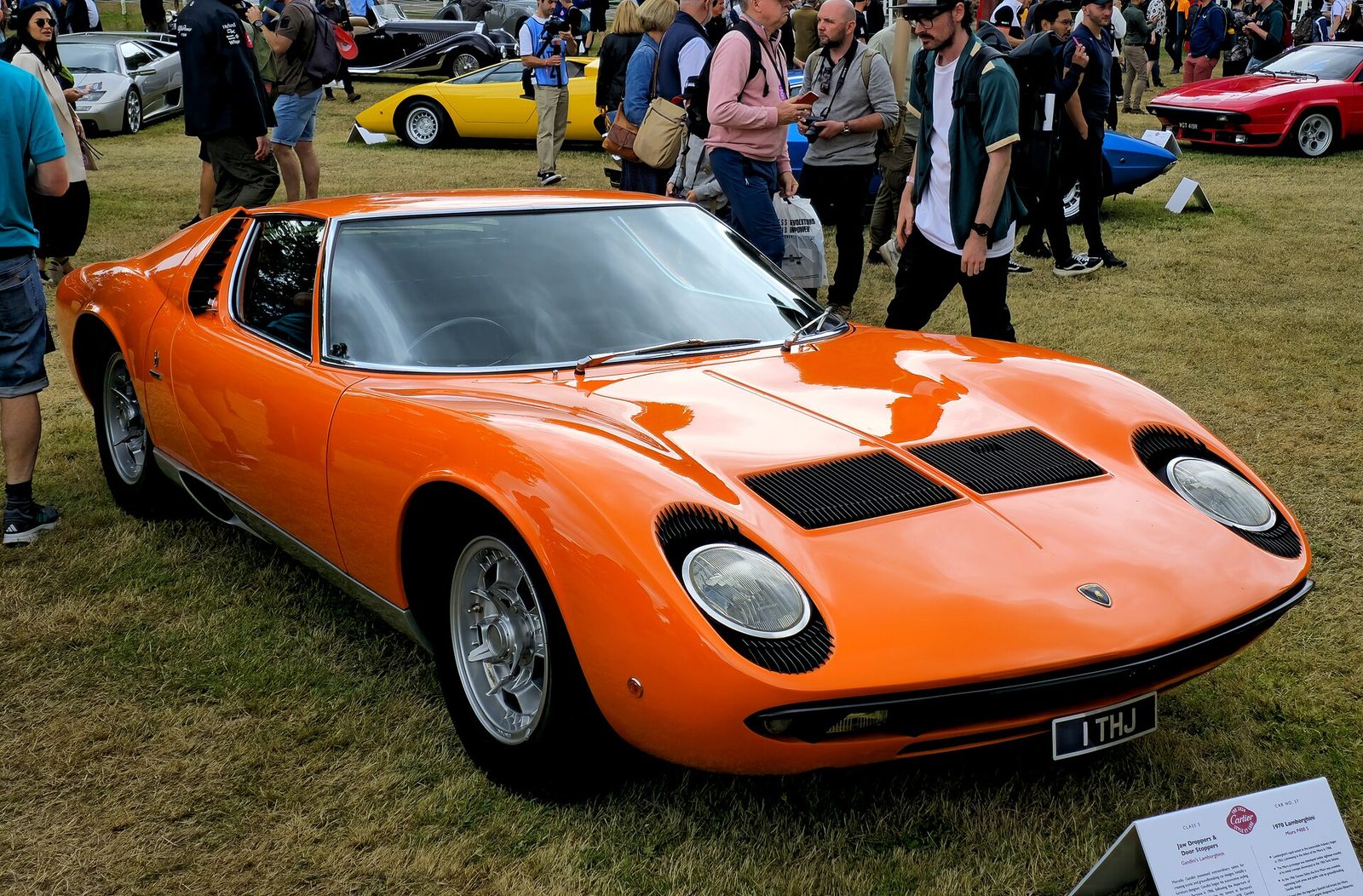
Ferruccio would not race. The young men he hired came from racing anyway: Dallara, Stanzani and Bob Wallace, a New Zealander who had made his name as a development driver at Maserati. In 1965 the three spent their own time on a chassis with the V12 mounted crosswise behind the cabin, and Ferruccio let it proceed as a marketing exercise. The rolling chassis was shown at Turin in 1965; with a Bertone body it became the Miura at Geneva in 1966. The front-engine line carried on beside it: the 400 GT, then the Islero and the four-seat Espada in 1968, and the Jarama in 1970, drawn with the American market in mind. The Urraco brought a compact V8 and a cheaper way in, and its line ran on through the Silhouette and the Jalpa.
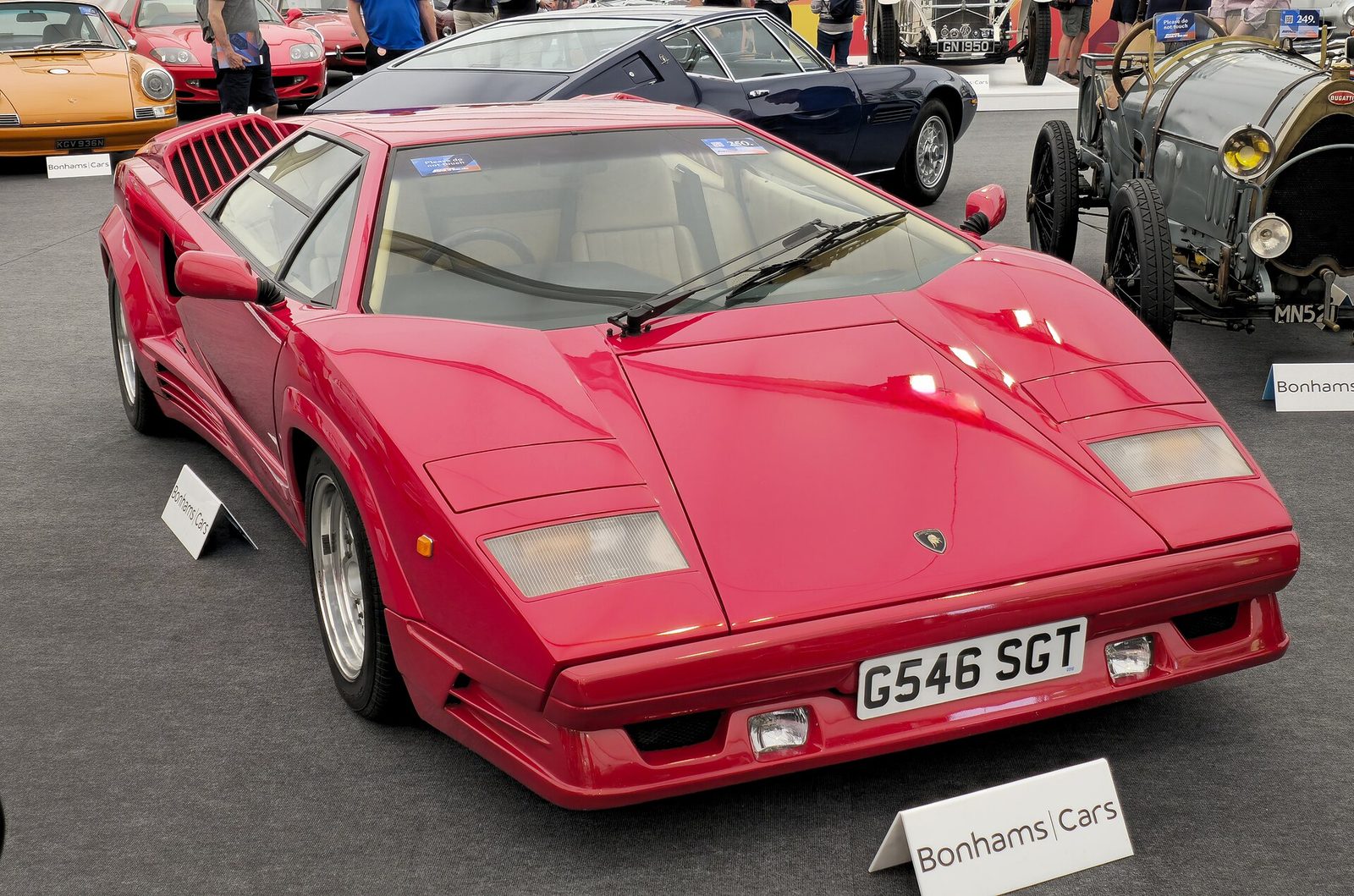
The Countach was shown as the LP500 prototype at Geneva in 1971, just as the tractor business took a hit. Ferruccio made his engineers a deal: Wallace would drive the prototype to the Targa Florio in Sicily and back, and if it survived the trip the car would be built. Wallace returned in May 1972 with the car still running. Sources differ on whether series production began in 1973 or 1974. The rear wing that later became the Countach's signature was never an official option; employees bolted it on in the factory parking lot while cars waited for dealer transport.
Six owners in twenty-five years
In 1972 Ferruccio sold 51 percent of the car company to Georges-Henri Rossetti, a Swiss businessman and Lamborghini owner, and the tractor business went to SAME the same year. In 1974 he sold the remaining 49 percent to Rossetti's friend Rene Leimer and retired to an estate on Lake Trasimeno. The oil crisis did the rest: the company went bankrupt in 1978 and the Italian courts took control. The Swiss brothers Jean-Claude and Patrick Mimran, food entrepreneurs, took it over out of receivership; the sources disagree on whether that was 1980 or 1981. They funded the Countach 5000S and Quattrovalvole, the Jalpa, marine engines, and the LM002, an off-roader that grew out of a failed military vehicle project.
In April 1987 Chrysler, under Lee Iacocca, bought Lamborghini and put fresh capital in. The Diablo was finished on Chrysler's watch, with Tom Gale's design team softening Marcello Gandini's lines, and Lamborghini entered Formula 1 as an engine supplier. The traffic ran both ways: Chrysler leaned on Lamborghini's experience with large aluminum castings when it built the Dodge Viper's V10. Production reached 673 cars in 1991 and fell to 166 the next year. Chrysler sold to MegaTech, a Bermuda company owned by the Indonesian group SEDTCO of Setiawan Djody and Tommy Suharto, in a deal that closed in February 1994. A 1995 restructuring left Suharto's V'Power holding 60 percent and the Malaysian MyCom 40 percent. In 1998 Volkswagen bought the company and placed it under Audi.
Under Audi
The first car of the Audi era was a revised Diablo with a 6.0-liter V12. The first new design was the Murcielago of 2001, a V12 with standard four-wheel drive drawn by Luc Donckerwolke. The Gallardo of 2003 brought a V10 and four-wheel drive to the smaller car that the Urraco, Silhouette and Jalpa had tried to be. Since then the line has run through the Aventador, the Huracan, the Urus sport utility and the hybrid Temerario. Automobili Lamborghini S.p.A. is today a company with Audi AG as its sole shareholder, still building its cars in Sant'Agata Bolognese.