
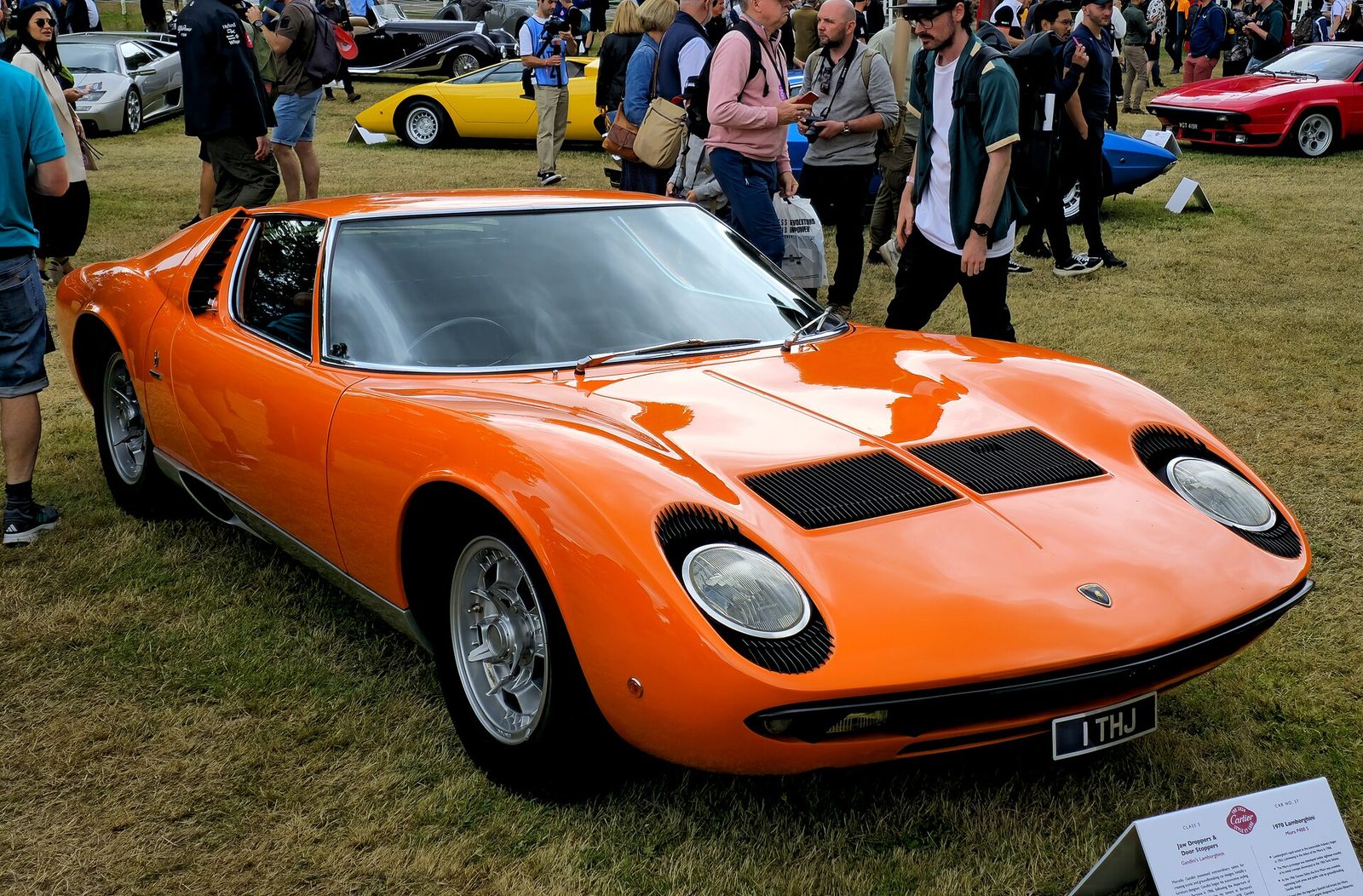
The Lamborghini Miura ran from 1966 to 1973 and settled the argument about where the engine of a fast road car belongs. It began as an out-of-hours project by Gian Paolo Dallara, Paolo Stanzani and the test driver Bob Wallace: a bare rolling chassis, shown with no body at all at the Turin Salon in late 1965, which took orders on the strength of its engineering. Bertone clothed it, and Marcello Gandini's shape appeared at Geneva in March 1966 with ballast in the engine bay and the hood locked, because nobody had yet confirmed the V12 would fit. That V12 - Giotto Bizzarrini's 3,929 cc quad-cam design - sat transversely behind the cabin, cast in common with the gearbox and final drive and sharing one oil supply with them in the manner of a Mini. Three series followed: P400, P400 S and P400 SV, the last with a wider rear track and, on later engines, gearbox lubrication separated from the engine's. It was fast, unstable at the top end and never raced by the factory.
History
A Chassis With No Body
Ferruccio Lamborghini had not asked for the Miura. It was conceived in 1965 by three young employees - the engineer Gian Paolo Dallara, his colleague Paolo Stanzani and the test driver Bob Wallace - who worked up a mid-engined chassis outside their normal duties and presented it to him afterwards. What went to the Turin Salon in late 1965 was that bare rolling chassis: no body, no interior, the transverse V12 and gearbox visible on a drilled sheet-steel platform. Show visitors ordered it anyway, and Lamborghini, whose business case for the car had been thin, had a queue.
Gandini's Shape and the Ballasted Engine Bay
Bertone took the commission and Marcello Gandini produced the body in roughly three months for the Geneva show of March 1966. The proportions came straight from the chassis, and the radiator was laid back in the nose like a contemporary racing car's. The prototype was finished so late that the engine had never been trial-fitted to the bay, so Geneva saw a Miura with the compartment filled with ballast and the rear clamshell locked shut. It did not matter: evo records seventeen orders over the Monaco Grand Prix weekend that followed, the moment the category later called the supercar acquired a market.
One Sump for Everything
The packaging idea was borrowed from the Mini and executed at four times the cylinder count. Bizzarrini's 3,929 cc V12 was cast in unit with its five-speed gearbox and final drive and, on P400, P400 S and the first SVs, the whole assembly ran on one supply of oil. It saved length and height and it worked, but it circulated whatever the gearbox shed through the engine's bearings and forced a compromise between the oil an engine wants and the oil a gearbox wants. Owners who change the oil often enough report no trouble; the design was abandoned anyway. The chassis was equally daring - folded and welded sheet steel drilled for lightness, about 265 lb complete - and equally marginal, with the gauge raised from 0.04 in (0.9 mm) to 0.04 in (1.0 mm) from around the 125th car to stop it flexing.
The Faults the Series Kept Trying to Fix
The Miura was quick and never entirely settled. The nose generated lift, and evo's account has it wandering alarmingly above about 150 mph, with brakes it calls inadequate and a chassis that flexed when pressed. The P400 S of December 1968 answered with more power - 365 hp, bigger inlet ports, 10.7:1 compression - ventilated discs partway through, and electric windows. The SV of 1971 went further: longer rear wishbones, a rear track widened to about 60.6 in (1,540 mm), nine-inch rear rims under flared arches, a stiffened structure and, on the later engines, a split sump that finally gave the gearbox its own oil and made a limited-slip differential practical. The eyelashes around the headlamps went. The nose lift was reduced rather than cured.
Jota, and the Cars Built to Look Like It
In 1970 Bob Wallace built himself the car the factory would not race. The Jota used a light-alloy frame, lightweight panels, fuel tanks in the sills and a V12 reworked for something near 440 hp, and weighed several hundred kilogrammes less than a road Miura. Lamborghini never entered it. It was sold to a private buyer and destroyed in a crash near Brescia within roughly a year, and the sources disagree on whether that was 1971 or 1972. What survives is imitation: a small number of factory SV/J conversions and a less well-defined population of cars modified in the same direction. The count of genuine factory SV/J cars is given as four, five or six depending on the authority.
Handing Over to the Countach
Bertone showed the LP500 Countach prototype at Geneva in 1971, while the SV was still being built, and the production Countach LP400 arrived in 1974. The two are usually read as one lineage, but they are not the same engineering: the Miura is transverse-engined on a folded-steel platform with its gearbox in the sump, the Countach a longitudinal, gearbox-forward layout on a welded tubular spaceframe. The Miura is the more beautiful and the less resolved; the Countach had fifteen years of development. Both have production totals their manufacturer's own figures do not settle.
Common Problems
Corrosion of the sheet-steel structure is the defining liability. The battery tray, engine frame and floor pan are the known hotspots, and the guides are consistent that once rust is visible there is usually more inside the sections. Shiny paint over a rotten frame is a recognized trap, as is a frame pulled out of alignment by an old accident and never reset. The shared engine and gearbox oil on P400, P400 S and early SV cars means gearbox debris passes through the engine; the mitigation is frequent oil changes, and specialists report a well-maintained single-sump car used on the road gives no particular trouble. Neglected ones are a different matter. Gearboxes are slow to engage until warm and worn synchromesh is common. Four Weber carburetors out of balance make the car undriveable at low revs. Cars that sit develop seized calipers and corroded discs. Original fuel lines harden and crack, and ethanol content accelerates it, which is why owners seek ethanol-free fuel and carry an extinguisher. The plastic headlamp lift gears break with age, though brass replacements exist, and the Ducellier switchgear is poor.
What to Look For
Start with identity rather than condition. A large proportion of P400 and P400 S cars were upgraded towards S or SV specification over sixty years, and the Goodwood guide is blunt that anyone buying an SV should establish it is an original and not a standard car dressed to look like one. Lamborghini Polo Storico holds the factory archive of chassis, engine, gearbox and axle numbers with original color, trim and equipment, and certifies cars built between 1963 and 2001, recording non-original components explicitly; Classic and Sports Car puts the cost at EUR 7,000 to EUR 10,000. A car with that paperwork is a different proposition from one without it. Establish where in the run the car sits: whether it is a pre- or post-ventilated-disc S, and for an SV whether the engine is a shared-sump or split-sump unit. On the car itself the frame is the expensive part. Look at the battery tray, the engine frame and the floors, and treat any rust found as a sample rather than the total. Check the frame is straight and that historic accident repair was done properly. Oil condition matters more than usual on a shared-sump car because that oil has also been through the gearbox. Expect a gearbox stiff until warm and some noise when cold; anything beyond that needs investigation, and most serious work is an engine-out job on this car.
Market Notes
As of August 2026, classic.com records a benchmark of $1,980,265 for the P400 with an average sale of $1,717,155, $2,175,551 for the P400 S, and $4,474,074 for the SV with an average of $3,839,844 - all trending upward, the SV carrying roughly double the benchmark of the earlier cars. Tracked results as of August 2026 run from $610,000 for a 1967 P400 in October 2024 to $6,605,000 for a 1972 SV at Broad Arrow's Amelia Concours sale on 7 March 2026, an original car in single ownership for 52 years that the house reported as beating the previous auction record for any Miura by more than $1,700,000. RM Sotheby's sold chassis 4946, a split-sump, air-conditioned, US-delivered SV, for EUR 3,942,500 at Milan on 22 May 2025 against a EUR 3.2 million estimate, and chassis 4840 - altered in the 1970s to imitate the Jota and returned to factory appearance in 2016 - for EUR 3,717,500 at Paris in late January 2026. RM Sotheby's Monterey in August 2026 took $3,030,000 for a 1967 P400. These are published sale totals, not hammer prices.
Where sources differ
Later SV engines separated gearbox lubrication from engine lubrication, which stopped gearbox debris reaching the engine and made a limited-slip differential practical, but sources disagree over whether this applied to every SV or only the final part of the run.
Lamborghini's heritage page presents independent gearbox lubrication as an SV feature without qualification. Wikipedia and Classic Trader state that only the last 96 SV engines had the split sump. Supercars.net states the first 52 SVs shared a sump and roughly 96 later cars had split systems. Whether every SV received the change is not resolved by any source consulted here.
Published production figures for the P400 range from 265 to 275 cars.
Lamborghini's heritage page states 265 P400. Wikipedia, classic.com and Classic Trader state 275. The Miura Register, credited to Dr Stefano Pasini working from factory records, lists 274. The difference is not resolved by any source consulted here.
Published production figures for the P400 SV range from 147 to 150 cars, with the factory figure at the top of that range.
Lamborghini, Wikipedia and Classic Trader state 150 SV. Supercars.net states 148. The Miura Register lists 147. Because P400 and S cars were later rebuilt to SV specification outside the factory, the line between an original and a converted SV is unclear in the record, and the discrepancy is not resolved by any source consulted here.
Total Miura production is variously stated as 753 (the sum of Lamborghini's own per-variant figures), more than 760, 763 and 764, while one auction-house source declines a figure altogether and says fewer than 800.
Lamborghini's per-variant figures sum to 753. classic.com states 764, LamboCARS 763, Goodwood over 760, and Sotheby's fewer than 800 without committing. These figures are not resolved by any source consulted here, so productionTotal is left null.
Bob Wallace built a single Jota from 1970 with a light-alloy frame, lightweight panels, relocated fuel tanks and a reworked V12 of around 440 hp; it was sold to a private buyer and destroyed in a crash near Brescia, and the sources agree on neither the year nor the figures.
Wikipedia gives roughly 794 lb saved, 418-440 hp at 8,800 rpm and a crash near Brescia in 1971. Below The Radar gives about 551 lb saved for roughly 1,940 lb, 440 hp at 8,500 rpm, and a sale in 1972 followed promptly by the crash. Sotheby's gives 440 hp and destruction in 1971. Neither the date nor the figures is resolved by any source consulted here; the conflict is unresolved.
The number of factory-built SV/J cars is stated as four, five or six depending on the source, with a further and less well-defined population of period and later conversions.
Lamborghini's heritage page and Goodwood both say four. Wikipedia says six factory SV/J were built during production. Supercars.net names five factory conversions by chassis and estimates ten to sixteen cars in total received SVJ modification officially or through Bob Wallace. Classic Trader says about six. The count is not resolved by any source consulted here.
Sources
- Lamborghini History - Miura, Automobili Lamborghini · manufacturer
- Lamborghini Miura, Wikipedia · encyclopedia
- THE MIURA REGISTER - P400 List, The Miura Register · registry
- THE MIURA REGISTER - P400SV List, The Miura Register · registry
- Lamborghini Miura Market, classic.com · market-data
- Lamborghini Miura - P400 Market, classic.com · market-data
- Lamborghini Miura - P400SV Market, classic.com · market-data
- 1971 Lamborghini Miura SV, Paris 2026, RM Sotheby's · auction-house
- 1971 Lamborghini Miura P400 SV by Bertone, Milan, RM Sotheby's · auction-house
- A Record-Setting Saturday as Broad Arrow Closes $107M+ Amelia Concours Auction with $6,605,000 Lamborghini Miura SV, Broad Arrow Group via GlobeNewswire · auction-house
- Everything You Need to Know About the Lamborghini Miura, Sotheby's · auction-house
- A-Z Supercars: Lamborghini Miura, evo · journalism
- Lamborghini Miura Buyer's Guide, Goodwood Classic Solutions · specialist
- Lamborghini Miura Buying Guide, Classic Trader · specialist
- Lamborghini Miura 60th Anniversary: Engineering Deep Dive, LamboCARS · specialist
- Lamborghini Miura P400 SV, Supercars.net · specialist
- Lamborghini Miura SVJ, Supercars.net · specialist
- Lamborghini Miura P400 S Guide, Supercar Nostalgia · specialist
- The story of the Lamborghini Miura Jota, Below The Radar · specialist
- Driving and Maintaining a Lamborghini Miura S, VeloceToday · specialist
- The specialist: Lamborghini Polo Storico, Classic & Sports Car · journalism
- Lamborghinis lead RM Sotheby's EUR 16.5m Milan sale, Octane · journalism
Synthesized from the sources above and cross-checked. We cite and link out; we do not republish other databases verbatim.
Fully Sorted is an independent publisher and is not affiliated with, endorsed by or sponsored by Lamborghini. Lamborghini and the model names on this page are trademarks of their respective owners and are used here only to identify the cars being described.
Chassis register
Nobody has recorded a car here yet. Own one, or know one? Chassis number, what you can prove about it, and a source if there is one. Every entry is reviewed before it appears.
Nerd Notes
What owners know that the sources don't. Every note is read and checked before it appears here.
Key Specs
- Body
- Bertone coachwork by Marcello Gandini; aluminum panels with steel structure, front and rear clamshells hinged at the extremities
- Power
- 345 hp at 7,000 rpm (P400), 365 hp at 7,700 rpm (S), 380 hp at 7,850 rpm (SV) per Lamborghini; independent sources quote 345, 365 and 375-380 hp
- Brakes
- Girling discs all round, ventilated from partway through the P400 S run
- Engine
- 3,929 cc 60-degree V12 laid out by Giotto Bizzarrini, seven main bearings, counter-rotating crankshaft, cast in common with the gearbox and final drive
- Layout
- Transverse mid-mounted engine, rear-wheel drive
- Torque
- About 271 lb-ft (P400), 287 lb-ft at 5,500 rpm (S), 295 lb-ft / 295 lb-ft at 5,750 rpm (SV)
- Weight
- Sources differ widely: Supercars.net gives 2,903 lb curb for the SV, Goodwood 2,524 lb; the bare chassis is quoted at about 265 lb
- Chassis
- Folded and welded sheet-steel platform drilled for lightness, about 265 lb; wall thickness quoted between 0.03 in (0.8 mm) and 0.04 in (1.0 mm) by source and build date
- Induction
- Four triple-choke Weber carburetors, twelve throttle valves
- Suspension
- Independent front and rear by unequal-length wishbones, coil springs and telescopic dampers; the SV gains longer rear wishbones adding about 1.5 in
- Valvetrain
- Twin overhead camshafts per bank, two valves per cylinder, chain driven
- Compression
- 9.5:1 on the P400, raised to 10.7:1 for the P400 S
- Lubrication
- One oil supply shared by engine, gearbox and differential on P400, P400 S and early SV; separate gearbox lubrication on later SV engines
- Acceleration
- 0-62 mph in about 6.7 s (P400) and 5.9 s (S) per published figures; about 5.75 s quoted for the SV
- Transmission
- 5-speed manual in unit with the engine and final drive
- Wheels tires
- Campagnolo cast magnesium; SV rear rims 9 in wide with Pirelli Cinturato, original P400 fitment Pirelli Cinturato 205VR15 (CN72)
- Top speed claimed
- 172-186 mph depending on variant and source - manufacturer and magazine claims, with independent commentary putting the realistic figure nearer 170 mph
Notable Variants
P400 (1966-1969)
The original series at 345 hp, with the thinnest chassis steel and the lightest cars of the run. Lamborghini states 265 built, other sources 274 or 275. Many were later rebuilt to S or SV specification, which makes a documented, unconverted P400 scarcer than the production figure suggests.
P400 S (1968-1971)
The most numerous version at 338 cars, December 1968 to March 1971, of which 21 were right-hand drive. Enlarged inlet ports, higher-lift cams and raised compression for 365 hp, plus a full-length console, electric windows and optional air conditioning. Ventilated discs arrived during the run.
P400 SV, early (shared sump)
Wider rear track, nine-inch rear rims, longer rear wishbones, flared arches and the deleted headlamp eyelashes. The first SVs still shared one oil supply between engine and gearbox; Supercars.net puts that group at the first 52 cars.
P400 SV, late (split sump)
The last SV engines separate gearbox lubrication from the engine's, stopping gearbox debris circulating through the V12 and allowing a limited-slip differential. Wikipedia and Classic Trader put this group at the final 96 engines, and split-sump provenance is now a stated selling point in auction catalogs.
SV/J
Factory conversions of SV cars to Jota-derived engine, suspension and part-aerodynamic specification. Counts differ sharply - four per Lamborghini, six per Wikipedia, five named chassis per Supercars.net - and a further group of period and later conversions muddies the water. Chassis 4934 was the Shah of Iran's car.
Jota
One car, built by Bob Wallace from 1970 under Paolo Stanzani with a light-alloy frame, lightweight panels, sill fuel tanks and a heavily reworked V12. Sold to a private buyer and destroyed in a crash near Brescia within roughly a year. Everything wearing the name today is a conversion.
Value Trajectory
The Miura's rise has been long and, unusually for a car of its fame, still steepening. classic.com shows all three series trending upward as of August 2026, with the P400 benchmark at $1,980,265, the P400 S at $2,175,551 and the SV at $4,474,074. The spread between the early cars and the SV is the story: an SV is worth roughly twice a P400, and Classic Trader's guidance is that an SV can reach three times the price of a P400 while an S sits about fifty per cent above one. The last two years have moved the ceiling rather than the floor. A 1967 P400 changed hands for $610,000 in October 2024, close to the bottom of the tracked range, while the top has gone to $6,605,000 at Broad Arrow's Amelia sale in March 2026, a record the house reported as more than $1,700,000 clear of the previous best. Originality and documentation separate the results, and cars with unbroken ownership and Polo Storico certification are pulling away from restored and converted examples.
Next
Shopping for one?
Browse Lamborghini listings, or decode a VIN before you buy.