
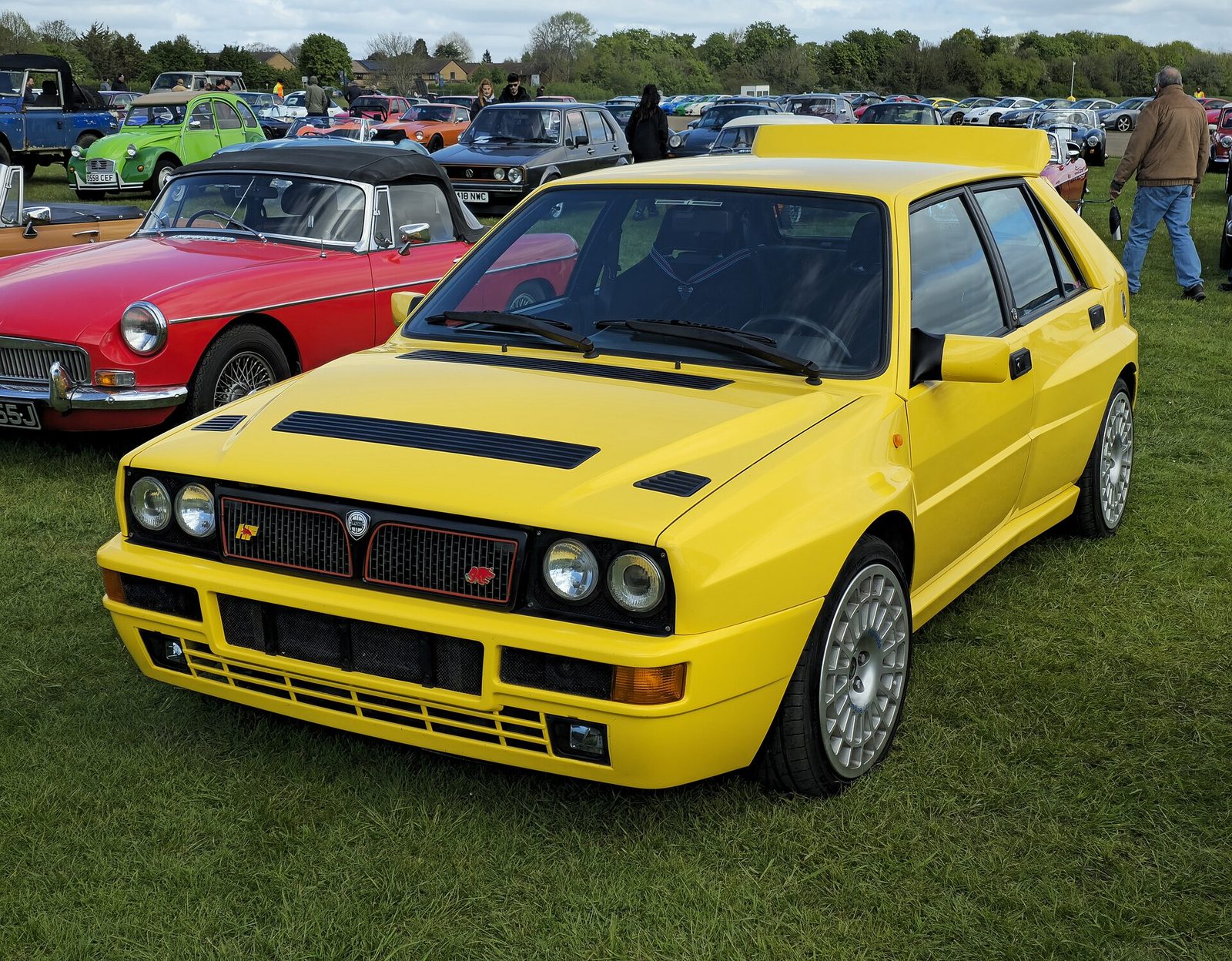
The Lancia Delta HF Integrale is the road-going basis for the most successful car in World Rally Championship history. It began as the Delta HF 4WD of 1986, a transverse-engined 1,995 cc turbocharged hatchback with an epicyclic center differential, Ferguson viscous coupling and Torsen rear diff, built to satisfy Group A's requirement for 5,000 cars in twelve months. Successive homologation steps produced the blistered-arch Integrale 8v of September 1987 (~182 hp), the 16v of March 1989 (~197 hp, rear-biased torque split), the wider-tracked Evoluzione of October 1991 (~207 hp) and the catalyzed Evoluzione II of June 1993 (~212 hp). Roughly 44,296 were built, all left-hand drive, including around a dozen numbered special editions on the Evoluzione platform. Lancia took six consecutive WRC manufacturers' titles with the Delta family between 1987 and 1992, a record. The car was never officially sold in the United States and reaches it only through the 25-year import exemption.
Delta
HF Integrale (Type 831)
44,296 built · 5-door Hatchback
How rare is it?
With about 44,296 built, the Lancia Delta is rarer than a 240Z (~160k) yet more common than a DeLorean (~9k).
Approximate total production placed on a log scale against well-known reference cars, for scale only. Figures and any disputes are detailed in the production notes and sources.
Production by variant
How the Deltarun breaks down, and which variants are the scarce ones. Approximate figures from this model’s cited sources.
Rarest of the bunch: the Delta HF 4WD, only about 5,298 built, roughly 1 in every 8 Deltas. If provenance and rarity drive your buy, this is the one to hunt.
Variants shown ≈ 63% of the ~44,296 built. Figures approximate; see Sources below.
History
Group A and the Delta HF 4WD
When the FIA abolished Group B at the end of 1986, Lancia needed a Group A car and needed 5,000 of them built within twelve months. The answer was already in the range: the Giugiaro-styled Delta hatchback, into which Lancia had dropped a transverse 1,995 cc turbocharged four and a permanent four-wheel-drive system for the HF 4WD of April 1986. The driveline combined an epicyclic center differential with a Ferguson viscous coupling, a Torsen limited-slip rear differential and a free front differential, with torque split roughly 56 percent front to 44 percent rear. Output was around 163 hp. Some 5,298 were built, and in its first full Group A season the car took the 1987 manufacturers' title.
The Integrale Arrives
September 1987 brought the HF Integrale proper. Blistered arches covered wider tracks and 15-inch wheels, brakes and suspension were uprated, and a larger Garrett T3 turbocharger lifted output to about 182 hp. Around 9,841 were built, plus roughly 2,700 catalyzed cars for Switzerland and Germany with reduced output. In March 1989 the 16v followed: a sixteen-valve head under a bulged hood, Weber-Marelli IAW engine management shared in principle with the Ferrari F40 and Sierra RS Cosworth, about 197 hp, a lower ride height and a torque split moved rearward to roughly 47/53. Handling became noticeably sharper and less forgiving than the 8v's.
Evoluzione and Evoluzione II
The Evoluzione of October 1991 was the last true homologation step. Track was widened by roughly 2.1 in (54 mm) at the front and 2.4 in (60 mm) at the rear, the arches grew again, the exhaust was enlarged, brakes moved to four-piston alloy calipers and an adjustable rear wing appeared. Output rose to about 207 hp. The Evoluzione II of June 1993 was a road-car exercise rather than a competition one: a three-way catalyst, a revised ECU, a red cam cover, 16-inch wheels and about 212 hp. Production ended in late 1994.
The Championship Record
Lancia took six consecutive WRC manufacturers' championships with the Delta family, from 1987 to 1992, a record that still stands, and the car is credited with 46 world championship rally wins. The drivers' titles are more often misstated: the Delta carried Juha Kankkunen to the 1987 and 1991 crowns and Miki Biasion to 1988 and 1989, but in 1990 and 1992 the drivers' championship went to Carlos Sainz in a Toyota Celica while Lancia still took the manufacturers' title. The 1992 campaign was run by the Martini-backed Jolly Club after Lancia had formally withdrawn its works effort at the end of 1991.
Special Editions, the End, and the Route to America
From 1992 Lancia used the Evoluzione as the basis for roughly a dozen numbered limited editions: the Martini-liveried Martini 5 and Martini 6, color runs such as Verde York, Giallo Ginestra, Blu Lagos and Bianco Perlato, and club and dealer series including Club Italia, Dealers Collection and the Edizione Finale. Most were built in runs of 15 to 400 cars, and they now command substantial premiums over standard examples. Zagato also built a small run of Hyena coupes on the Integrale floorpan. None of it was sold in the United States: Lancia had left the American market in 1982 and never returned, so the Integrale arrived only once individual cars aged past the 25-year threshold that lets a vehicle be imported without regard to Federal Motor Vehicle Safety Standards compliance. The 8v cars became eligible in the early 2010s and the Evoluzione II cars have been crossing the line through the mid-2020s.
Common Problems
Corrosion is the dominant structural issue: sills, inner rear wings, arches, subframes, suspension turret tops, glass surrounds, the rear edge of the roof, the tailgate below the window, the cowl below the windshield, front chassis legs, the rear crossmember and jacking points. The shell is not especially rigid and stress cracks develop at the A-pillars and sometimes the B-pillars. Mechanically, the upper sump gasket is a common oil leak and on 8v cars leaks onto the exhaust manifold; camshaft and cam lobe wear affects 16v engines, often from metal filings in the oil; valve guides wear; the Garrett turbo can seize if oil level drops, and oil consumption of around a liter per 1,000 miles under hard use is not unusual. Gearboxes lose synchromesh on second and third first, with fifth-gear brass synchro cones also a known wear point. Front differential noise and viscous coupling problems occur. Evoluzione front anti-roll bar drop links are poor quality and can fail in very short mileage. Front brake hoses crack, rear brakes seize and the rear brake compensator often needs replacement. Interiors suffer sagging headlinings, worn Alcantara bolsters and delaminating badges that are hard to replace, and the Weber-Marelli ECU can be troublesome with age and after amateur tuning. Parts are specialist items sourced from Europe, so a full engine-out job is a long wait as well as a large bill.
What to Look For
Verify the car is what it is sold as. Every Integrale left the factory left-hand drive, so right-hand-drive cars are conversions, some using unsuitable Regata steering racks; converted cars are worth less and can handle worse. Lesser Deltas are routinely dressed up, and Hagerty and Autocar both note 8v cars passed off as 16v and Evo I cars as Evo II, the latter being easy because the visual changes are minor. Standard Evoluziones are also made up as special editions, so check build numbers, plaques and documentation against the claimed run. Because no Integrale was federalized, the paperwork is part of the inspection: confirm the date of manufacture supports 25-year eligibility, that the car entered under that exemption rather than a show-or-display or off-road claim, and that the title and VIN agree. State and local emissions rules still apply; RM Sotheby's offered its 2025 Monterey Evoluzione on the condition that it be sold to a dealer or an out-of-state resident under California rules. Structurally, inspect the sills, wheel arches, subframes and suspension turret tops, the windshield and rear window surrounds, the rear of the roof, the tailgate below the glass, the front chassis legs and the rear crossmember; look for stress cracks at the top of the A-pillar, especially on lowered cars, and for evidence of accident damage and poor repair on European and Japanese imports. Mechanically, confirm cambelt history (roughly 36,000 miles on 8v cars, 24,000 miles on 16v), listen for bottom-end rumble and check for white smoke from a tired turbo, worn cam lobes on 16v engines, and second and third gear synchro wear. Check for performance chips and a disconnected overboost solenoid. Solid service history matters more than mileage.
Market Notes
The Integrale was never sold new in the United States, so every US car is an import and US market figures describe imported examples rather than a domestic model run. The market is stratified sharply by variant. As of September 2026, classic.com market benchmarks stood at approximately $26,181 for the 8v (trending down), $46,007 for the 16v (trending up), $94,098 for the Evoluzione I (trending down) and $108,982 for the Evoluzione II (trending up). US results inside those markets show the spread: a 16v brought $41,000 in Portland, Oregon in October 2025 and $62,500 there in March 2026, while a 1989 car made $75,500 in Miami Beach in October 2025. Evoluzione I sales included $59,000 in California and $71,500 in North Carolina, both February 2026. Evoluzione II cars reached $139,000 in May 2026 and $163,500 in July 2026, both in Thousand Oaks, California, with a modified car at $84,000 in Los Angeles in June 2026. Exceptional and special-edition cars sit well above the benchmarks: RM Sotheby's reported $173,600 for a 4,070 miles 1991 Evoluzione at its Monterey sale in 2025 and $117,600 for a Martini 6, one of 310, at Monterey in 2023. Hagerty puts unusual-color editions at roughly double an equivalent standard car and rally-liveried editions at two and a half times or more, and a 4,000-mile Giallo Ferrari Evoluzione made $190,400 at RM Sotheby's in late 2017.
Where sources differ
The Evoluzione of October 1991 widened front and rear track by approximately 2.1 in (54 mm) and 2.4 in (60 mm) respectively over the 16v, with wider arches, a larger exhaust, four-piston alloy calipers and an adjustable rear wing.
Wikipedia and Supercar Nostalgia both give +2.1 in (54 mm) front and +2.4 in (60 mm) rear. Hagerty's US guide instead states increases of 3.0 in (76 mm) front and 3.7 in (94 mm) rear. The 2.1/2.4 in (54/60 mm) figures are the more widely repeated and are used here; the discrepancy is not resolved by any source consulted.
Total production of the Delta HF 4WD and HF Integrale family was approximately 44,296 cars, comprising 5,298 HF 4WD, 9,841 Integrale 8v, 2,700 catalyzed 8v, 12,860 16v and 13,597 Evoluzione I and II.
The 44,296 total and the HF 4WD, 8v and 16v sub-totals are consistent across Hagerty, Wikipedia, Petrolicious and Classic & Sports Car. The Evoluzione split is not: Hagerty gives 13,597 for Evo I and II combined, Supercar Nostalgia gives 5,619 and 4,223 (9,842) and Petrolicious gives 6,451 and 2,481 (8,932). Only Hagerty's breakdown reconciles with the 44,296 total, and no source consulted here explains the shortfall in the other two.
Sources
- Your definitive Lancia Delta HF Integrale buyer's guide, Hagerty · journalism
- Buying guide: Lancia Delta Integrale, Hagerty UK · journalism
- Lancia Delta, Wikipedia · encyclopedia
- Lancia Delta HF, Wikipedia · encyclopedia
- List of World Rally Championship records, Wikipedia · encyclopedia
- Lancia Delta HF Integrale in the World Rally Championship, Rallypedia · encyclopedia
- Used car buying guide: Lancia Delta HF Integrale, Autocar · journalism
- Lancia Integrale Buyer's Guide, Petrolicious · journalism
- Lancia Delta Integrale buyer's guide: what to pay and what to look for, Classic & Sports Car · journalism
- Lancia Delta HF Integrale Evoluzione 1 Guide, Supercar Nostalgia · journalism
- Lancia Delta HF Integrale Evoluzione 2 Guide, Supercar Nostalgia · journalism
- Lancia Delta HF Integrale 8V - 1st Gen Market, classic.com · market-data
- Lancia Delta HF Integrale 16V - 1st Gen Market, classic.com · market-data
- Lancia Delta HF Integrale Evo I - 1st Gen Market, classic.com · market-data
- Lancia Delta HF Integrale Evo II - 1st Gen Market, classic.com · market-data
- 1991 Lancia Delta HF Integrale Evoluzione | Monterey 2025, RM Sotheby's · auction-house
- 1992 Lancia Delta HF Integrale Evoluzione 'Martini 6' | Monterey 2023, RM Sotheby's · auction-house
- Importation and Certification FAQs, NHTSA (US Department of Transportation) · government
Synthesized from the sources above and cross-checked. We cite and link out; we do not republish other databases verbatim.
Fully Sorted is an independent publisher and is not affiliated with, endorsed by or sponsored by Lancia. Lancia and the model names on this page are trademarks of their respective owners and are used here only to identify the cars being described.
Chassis register
Nobody has recorded a car here yet. Own one, or know one? Chassis number, what you can prove about it, and a source if there is one. Every entry is reviewed before it appears.
Nerd Notes
What owners know that the sources don't. Every note is read and checked before it appears here.
Key Specs
- Power
- ~163 hp HF 4WD; ~182 hp Integrale 8v; ~197 hp 16v; ~207 hp at ~5,750 rpm Evoluzione; ~212 hp catalyzed Evoluzione II
- Engine
- 1,995 cc DOHC inline-4, belt-driven camshafts, turbocharged and intercooled
- Layout
- Front transverse engine, permanent four-wheel drive
- Torque
- ~224 lb-ft at 2,500 rpm on the 8v, ~220 lb-ft on the 16v and Evoluzione, ~232 lb-ft at 2,500 rpm on the Evoluzione II
- Weight
- ~2,954 lb (~2,954 lb) curb weight, Evoluzione II
- Wheels
- 15-inch on the Integrale 8v (195/55 VR 15), 7x15 five-bolt on the 16v (205/50 VR 15), 7.5x15 on the Evoluzione, 16-inch on the Evoluzione II (205/45 ZR 16)
- Chassis
- Steel unitary body, five-door hatchback, MacPherson strut independent suspension at all four corners
- Drivetrain
- Epicyclic center differential with Ferguson viscous coupling, Torsen rear differential, free front differential
- Acceleration
- ~5.7 s 0-62 mph, ~137 mph top speed, both manufacturer claims for the Evoluzione II
- Homologation
- FIA Group A, requiring 5,000 units built in twelve months
- Transmission
- 5-speed manual; left-hand drive only from the factory
- Torque split 8v
- Approximately 56 percent front / 44 percent rear
- Track evoluzione
- Front and rear track widened by roughly 2.1 in (54 mm) and 2.4 in (60 mm) over the 16v
- Brakes evoluzione
- Approximately 11.1 in (281 mm) ventilated front discs, 9.9 in (251 mm) rear, four-piston alloy calipers
- Torque split 16v onwards
- Approximately 47 percent front / 53 percent rear
Notable Variants
Delta HF 4WD
April 1986, ~163 hp, 5,298 built. The Group A basis and the car that took the 1987 manufacturers' title; narrow-body, no blistered arches.
HF Integrale 8v
September 1987, ~182 hp, blistered arches, larger Garrett T3, bigger brakes. 9,841 built plus roughly 2,700 catalyzed cars for Switzerland and Germany.
HF Integrale 16v
March 1989, ~197 hp, hood bulge, Weber-Marelli IAW injection, sits lower, torque split moved rearward to roughly 47/53. 12,860 built.
HF Integrale Evoluzione
October 1991, ~207 hp, track widened front and rear, wider blistered arches, adjustable rear wing, 7.5x15 five-bolt wheels.
HF Integrale Evoluzione II
June 1993, ~212 hp with a three-way catalyst, red cam cover, 16-inch wheels, body-color roof gutter. The final development.
Martini 5 / Martini 6
Martini-liveried Evoluzione limited editions of roughly 400 and 310 cars, launched 1992; among the most sought-after variants, and the ones that draw the strongest US auction money.
Color-run and club editions
Verde York, Giallo Ginestra, Giallo Ferrari, Blu Lagos, Bianco Perlato, Dealers Collection, Club Italia (15), Lancia Club, HiFi and Edizione Finale (250); numbers vary by source.
Value Trajectory
The Integrale has appreciated steeply from a low base. Hagerty reported that condition #3 Evoluzione values nearly tripled in the five years to 2019, from about $19,000 to about $56,000. As of September 2026, classic.com benchmarks placed the Evoluzione II near $109,000 and the Evoluzione I near $94,000, with the 16v around $46,000 and the 8v around $26,000. Direction is no longer uniform: classic.com showed the 16v and Evo II benchmarks trending up while the 8v and Evo I benchmarks were trending down, which is consistent with a market that has begun to separate the best-documented, most desirable cars from ordinary ones. Because the model was never sold new in the United States, US supply depends entirely on imports, and the 25-year exemption keeps adding eligible cars year by year, the Evoluzione II now among them, so the domestic pool grows without any new domestic demand having to be created. Originality, documentation and verified special-edition status are the main determinants of where a given car sits in the range, and the gap between a well-papered car and a cheap one is wider than the variant hierarchy alone suggests.
Next
Shopping for one?
Browse Lancia listings, or decode a VIN before you buy.