
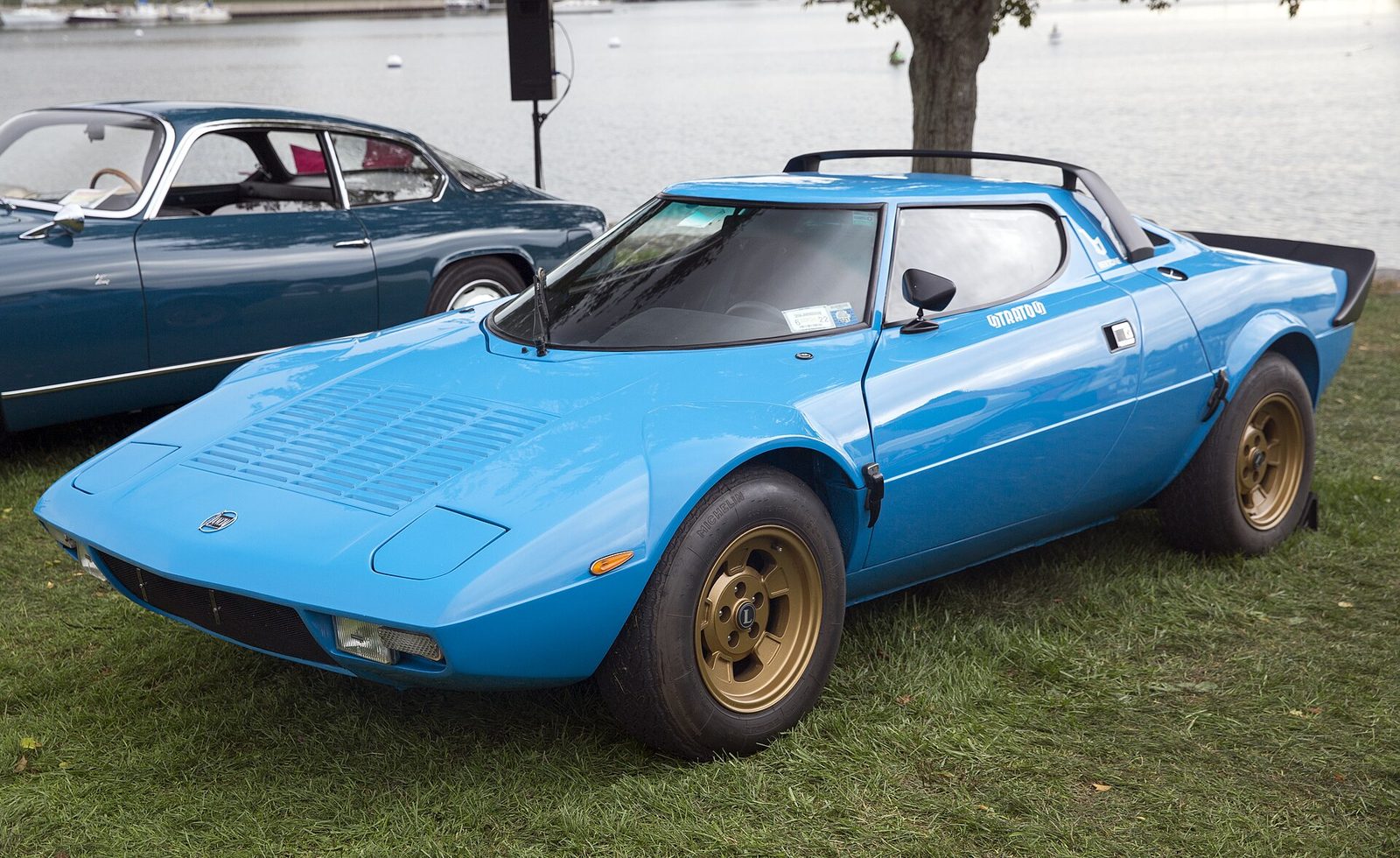
The Lancia Stratos HF (1973-1978) is usually described as the first car designed from nothing to win rallies, with the road version existing only because Group 4 homologation demanded a production run. It began as a Bertone exercise: the Stratos Zero, a wedge 84 cm tall shown at Turin in October 1970 on the running gear of a crashed Fulvia, which shares little beyond its name with what followed. Cesare Fiorio's competition department turned that attention into a rally program, and Enzo Ferrari eventually agreed to supply the 2,418 cc Dino V6, an arrangement that took most of 1972 to settle and that Fiat sanctioned only in December of that year. The production car put that engine transversely behind the seats in a steel monocoque with glass-fiber clamshells, on a 85.8 in (2,180 mm) wheelbase. Lancia took the World Rally Championship for manufacturers in 1974, 1975 and 1976. How many road cars were actually finished has never been settled.
History
A Show Car With The Wrong Name
Bertone unveiled the Stratos Zero at the Turin show on 28 October 1970. It was a running car, built on the reversed floorpan of a crashed Fulvia HF 1600 with the 1,584 cc narrow-angle V4 behind the seats, and it stood 84 cm high - lower even than Pininfarina's Modulo. There were no doors in the ordinary sense; the driver climbed in over the hinged windshield, and Nuccio Bertone wanted to call it the Stratolimite. It shares a name, a designer in Marcello Gandini and a wedge silhouette with the production Stratos, and almost nothing else: not the engine, not the structure, not the wheelbase. RM Sotheby's put the relationship correctly when it sold the Zero in 2011 - without it the rally car would likely never have been, but it is not an early draft of it.
Built Backwards, From The Stage Inwards
What Lancia took from Turin was a relationship with Bertone and an audience. Cesare Fiorio needed a replacement for the Fulvia HF and reversed the usual order: specify the rally car, then build whatever road cars the rulebook required. The definitive Stratos HF was shown in November 1971. Its structure was a central steel monocoque with tubular subframes at each end and glass-fiber clamshells that hinged clear for access. Mike Parkes, the former Ferrari driver and engineer, led development until his death in a road accident in August 1977; Nicola Materazzi did the calculations. Nothing in the layout was a compromise with road use, and the car's shortcomings as transport were consequences rather than oversights.
Ferrari's Engine, Given Slowly
The Fulvia V4 was never going to be enough, and the engine Fiorio wanted belonged to a company that had just been absorbed into the same group. On lanciastratos.com's dated account, Enzo Ferrari telephoned Lancia's Pier Ugo Gobbato on 2 February 1972 indicating willingness to supply 500 Dino V6 units; difficulties surfaced within a month; ten prototype engines followed between May and August 1972; and Fiat removed its objections only on 14 December 1972. Motor Sport's 2007 profile adds that the first engine Lancia obtained came out of a crashed Dino rather than through any supply channel, and that Fiat-Abarth was chasing a Ferrari V8 for a rival program at the same time. The 2,418 cc 65-degree V6 arrived transversely mounted, on three Weber carburetors, at 190 hp in road tune.
85.8 in (2,180 mm), And What It Did
The wheelbase is the car's defining number. At 85.8 in (2,180 mm) it is roughly 8.7 in (220 mm) shorter than a Volkswagen Golf and 5.3 in (135 mm) shorter than the Alpine A110 it was built to beat, with about sixty per cent of the mass over the driven axle. On sealed stages the effect was decisive; Walter Rohrl's judgement, quoted by Motor Sport, was that on twisty asphalt there was nothing to compare. On gravel and ice the same geometry demanded a driver willing to work, and Motor Sport's 2010 assessment is that the car's reputation for being evil is overstated but that getting the best from one requires genuine ability. Motor Sport's own 1976 road test found the road car surprisingly civilized and quicker than the Dino it drew its engine from.
Three Titles, Then A Corporate Decision
Homologation came on 1 October 1974 and the car took the manufacturers' title that season, then again in 1975 and in 1976. Munari won the Monte Carlo three years running from 1975; Waldegard and Darniche added wins; the tally is usually given as seventeen world championship victories. What ended the works program was not the opposition but Fiat's marketing, which wanted the 131 Abarth winning instead. Privateers carried on, Darniche taking the 1979 Monte Carlo, and the homologation ran until 1 January 1982.
Common Problems
The structural weakness is corrosion in the central steel monocoque and at the clamshell mountings. Car & Classic's buyer's guide singles out both, and the point is that the glass-fiber front and rear sections are non-structural: they neither stiffen the car nor protect the steel they cover, and a car that looks sound from ten feet can be poor where it matters. Cooling is the usual mid-engined problem set - a transverse V6 behind the cabin, long coolant runs, limited airflow - and Car & Classic flags it as an area demanding diligent maintenance. Brakes are ventilated discs at all four corners with no servo, so a system in poor condition is immediately obvious from the pedal; the same guide lists brakes and electrics among the areas to test carefully. Parts supply is uneven: the Ferrari-sourced V6 and its transaxle are supported by the Dino community, but Stratos-specific body, trim and glass items are scarce. Recorded specialist bills from DK Engineering and Girardo & Co show recommissioning a stored car running well into five figures.
What to Look For
Identity first. Every road car is left-hand drive and carries a chassis number prefixed 829AR0, an engine number in the 829A series and a separate body or scocca number - Girardo's March 1977 car is chassis 829AR0 001744, engine 829A 000 001097, body 252 - and a car whose three numbers cannot be reconciled to each other and to a delivery record needs explaining before anything else is discussed. Lancia Classiche certification exists and was cited by RM Sotheby's on its 2024 Monaco car; its absence is not disqualifying but its presence removes an argument. The replica question is unavoidable, since Stratos-bodied cars have been built by specialists for decades, so provenance documentation matters more here than on almost any comparable car. Competition history cuts both ways: a documented works or Chardonnet car is worth a large multiple, while an undocumented rallied car has been crashed and repaired an unknown number of times, and Car & Classic's guidance is to treat racing history as a greater risk than high mileage. Inspect the steel center section and the clamshell mountings for corrosion, since the glass-fiber panels carry no load and hide what is underneath.
Market Notes
As of August 2026, classic.com records a Lancia Stratos market benchmark of approximately $720,600 on a rising trend, with an average recorded sale near $595,589. The tracked spread runs from $298,125 for a 1975 car in November 2024 to 815,000 euros for a 1975 HF Stradale on 29 January 2026, the highest the site holds. Auction evidence in between is consistent. RM Sotheby's sold chassis 829AR0 001832 - the 323rd car built, under 7,456 miles, Lancia Classiche certified in 2020 - for 590,000 euros at Monaco in May 2024, and had earlier sold chassis 829AR0 001571, an unrestored ex-factory car in its original pistachio green, for 431,200 euros at Villa Erba in 2015. Both are the house's published sold-for results rather than hammer prices. The show car sits in a category of its own: the Stratos Zero made 761,600 euros at RM Sotheby's Villa d'Este sale in 2011. Certification, matching body and chassis numbers, unbroken delivery records and originality of paint are what separate the top of the range from the bottom, and an undocumented ex-competition car is a different proposition from a documented one.
Where sources differ
The commonly stated production figure for the Lancia Stratos HF road car is 492, but the sources that repeat it and the sources that examine it do not agree, and no total is asserted here.
Wikipedia, Car & Classic, Girardo and DK Engineering state 492. RM Sotheby's Monaco 2024 catalog states between 491 and 498. Motor Sport (February 2010) states production ended in May 1975 after 457 cars with about 502 chassis completed. Motor Sport's own July 1976 road test states 400. WhichCar says the 492 figure is still debated and Secret Classics says nobody knows for sure. Not resolved by any source consulted here, so productionTotal is null.
Far fewer cars were physically complete when Group 4 homologation was granted in October 1974 than the 500 the regulations required, and published counts of what existed at that moment differ.
WhichCar reports Bertone records showing about 141 shells finished; RM Sotheby's states 147 completed cars; Motor Sport says roughly 150; Secret Classics counts 183 built by the end of 1974. Lancia's own heritage archive says FIA delegates counted cars parked in different locations. These figures cannot be reconciled from the sources consulted here and are left unresolved.
Sources
- Lancia Stratos, Wikipedia · encyclopedia
- Lancia Stratos HF | Stories | FCA Heritage, Stellantis Heritage · manufacturer
- The story from birth to now - Lancia Stratos, lanciastratos.com · specialist
- Lancia Stratos HF - FIA Historic Database, Federation Internationale de l'Automobile · registry
- The Lancia Stratos V6 (July 1976), Motor Sport · journalism
- Profile: Lancia Stratos (March 2007), Motor Sport · journalism
- Lancia Stratos (February 2010), Motor Sport · journalism
- Feature: The Lancia Stratos - a history, RallySport Magazine · journalism
- Lancia Stratos - Ultimate Guide & Research Hub, Supercars.net · specialist
- Lancia Stratos HF Stradale Guide, Supercar Nostalgia · specialist
- How the Lancia Stratos became a modern classic, WhichCar · journalism
- Lancia Stratos HF, Secret Classics · specialist
- Lancia Stratos: Models, Specs, and Buyer's Guide, Car & Classic · specialist
- 1975 Lancia Stratos HF Stradale by Bertone, Monaco 2024, RM Sotheby's · auction-house
- 1974 Lancia Stratos HF Stradale by Bertone, Villa Erba 2015, RM Sotheby's · auction-house
- 1970 Lancia Stratos HF Zero, Villa d'Este 2011, RM Sotheby's · auction-house
- 1977 Lancia Stratos HF Stradale, Girardo & Co · specialist
- Lancia Stratos HF Stradale - Vehicle Sales, DK Engineering · specialist
- Lancia Stratos Market, classic.com · market-data
Synthesized from the sources above and cross-checked. We cite and link out; we do not republish other databases verbatim.
Fully Sorted is an independent publisher and is not affiliated with, endorsed by or sponsored by Lancia. Lancia and the model names on this page are trademarks of their respective owners and are used here only to identify the cars being described.
Chassis register
Nobody has recorded a car here yet. Own one, or know one? Chassis number, what you can prove about it, and a source if there is one. Every entry is reviewed before it appears.
Nerd Notes
What owners know that the sources don't. Every note is read and checked before it appears here.
Key Specs
- Power
- 190 hp claimed for the Stradale; quoted at 7,000 rpm by the Lancia Motor Club and at 7,400 rpm by Motor Sport's 1976 road test and by DK Engineering
- Brakes
- Ventilated discs all round, 10.7 in (271 mm) Girling with twin-piston ATE calipers, no servo assistance
- Engine
- 2,418 cc Ferrari Dino 65-degree V6, cast-iron block, aluminum heads, twin overhead camshafts per bank, twelve valves
- Layout
- Transverse mid-mounted engine ahead of the rear axle, rear-wheel drive
- Torque
- 166 lb-ft at 4,000 rpm per Motor Sport and the Lancia Motor Club; DK Engineering quotes 169 lb-ft at the same crank speed
- Weight
- 2,161 lb quoted by Lancia for the Stradale; approximately 1,940 lb quoted for Group 4 specification
- Chassis
- Central steel monocoque with front and rear tubular subframes; hinged glass-fiber clamshells front and rear, non-structural
- Top speed
- Approximately 143 mph claimed for the road car; Lancia's heritage archive quotes 115-137 mph across competition specifications
- Wheelbase
- 85.8 in (2,180 mm) (85.8 in) - about 220 mm shorter than a contemporary Volkswagen Golf
- Dimensions
- 146.1 in (3,710 mm) long, 68.9 in (1,750 mm) wide, 43.7 in (1,110 mm) high per supercars.net; Motor Sport's 1976 test recorded 12 ft 2 in, 68.9 in and 43.9 in
- Suspension
- Front: coil spring/damper units on lower arms with forward struts and anti-roll bar. Rear: long strut units with triangulated radius arms and adjustable anti-roll bar
- Bore stroke
- 92.5 mm x 60.0 mm
- Compression
- 9.0:1
- Fuel system
- Three Weber 40 IDF twin-choke carburetors; two fuel tanks, 80 liters combined
- Acceleration
- 0-62 mph in 6.8-7.5 seconds for the Stradale per Car & Classic; no independently timed period figure was located in this research
- Homologation
- FIA Group 4, homologation number 640, dated 2 October 1974 in the FIA historic database, with ten extensions before homologation ended on 1 January 1982
- Transmission
- Five-speed Ferrari manual transaxle with limited-slip differential, 3.824:1 final drive
Notable Variants
Stratos HF Stradale
The road car, and the only reason the rally car existed. 190 hp, three Weber carburetors, no servo on the brakes, glass-fiber clamshells over a steel center section. All left-hand drive. Body (scocca) numbers run in parallel with chassis numbers and are the usual identity check.
Stratos HF Gruppo 4, 12-valve
The car that took the 1974 and 1975 titles. Competition tune quoted between roughly 230 and 280 hp on the same 2,418 cc block, with a claimed Group 4 curb weight around 1,940 lb against the Stradale's 2,161 lb.
Stratos HF Gruppo 4, 24-valve
Four-valve heads introduced for 1976, quoted by Lancia at 320 hp at 8,500 rpm. Wikipedia notes the FIA restricted the 24-valve specification from 1978. Works 24-valve provenance carries a substantial premium over a converted road car.
Works Alitalia cars, 1975-77
The green-and-white Alitalia livery replaced the Marlboro red and white after 1974. These are the cars of Munari's Monte Carlo run and Waldegard's Sanremo; documented works history is the single largest value multiplier on a competition Stratos.
Chardonnet and other privateer cars
After the works effort was wound down in favor of the Fiat 131 Abarth, privateers kept the car winning. Bernard Darniche took the 1979 Monte Carlo for Chardonnet and, per RallySport Magazine, contested 49 rallies with two retirements.
Stratos Zero (Bertone, 1970)
The one-off show car, not a variant of the production run. 84 cm tall, Fulvia V4, entered through a hinged windshield. Sold for 761,600 euros at RM Sotheby's Villa d'Este in 2011.
Value Trajectory
The Stratos was hard to sell when it was new. Motor Sport reported in July 1976 that around fifty cars remained unsold, that the fuel crisis and tightening type approval had cut off most export markets, that the car lacked the crash approval needed for straightforward registration outside Italy. Only four road cars and one damaged rally car were then in Britain, all held by one dealer. That commercial failure is the reason the production figure is contested at all, and it kept values modest for decades. The re-rating came with the wider homologation-special market: as of August 2026, classic.com's benchmark of roughly $720,600 is trending upward, against a tracked low of $298,125 as recently as November 2024 and a high of 815,000 euros in January 2026. The shape of that spread matters more than its midpoint: a certified, low-mileage car and an undocumented ex-rally car now sit at opposite ends of a range that has widened considerably, and the works competition cars have decoupled from the road cars entirely.
Next
Shopping for one?
Browse Lancia listings, or decode a VIN before you buy.