
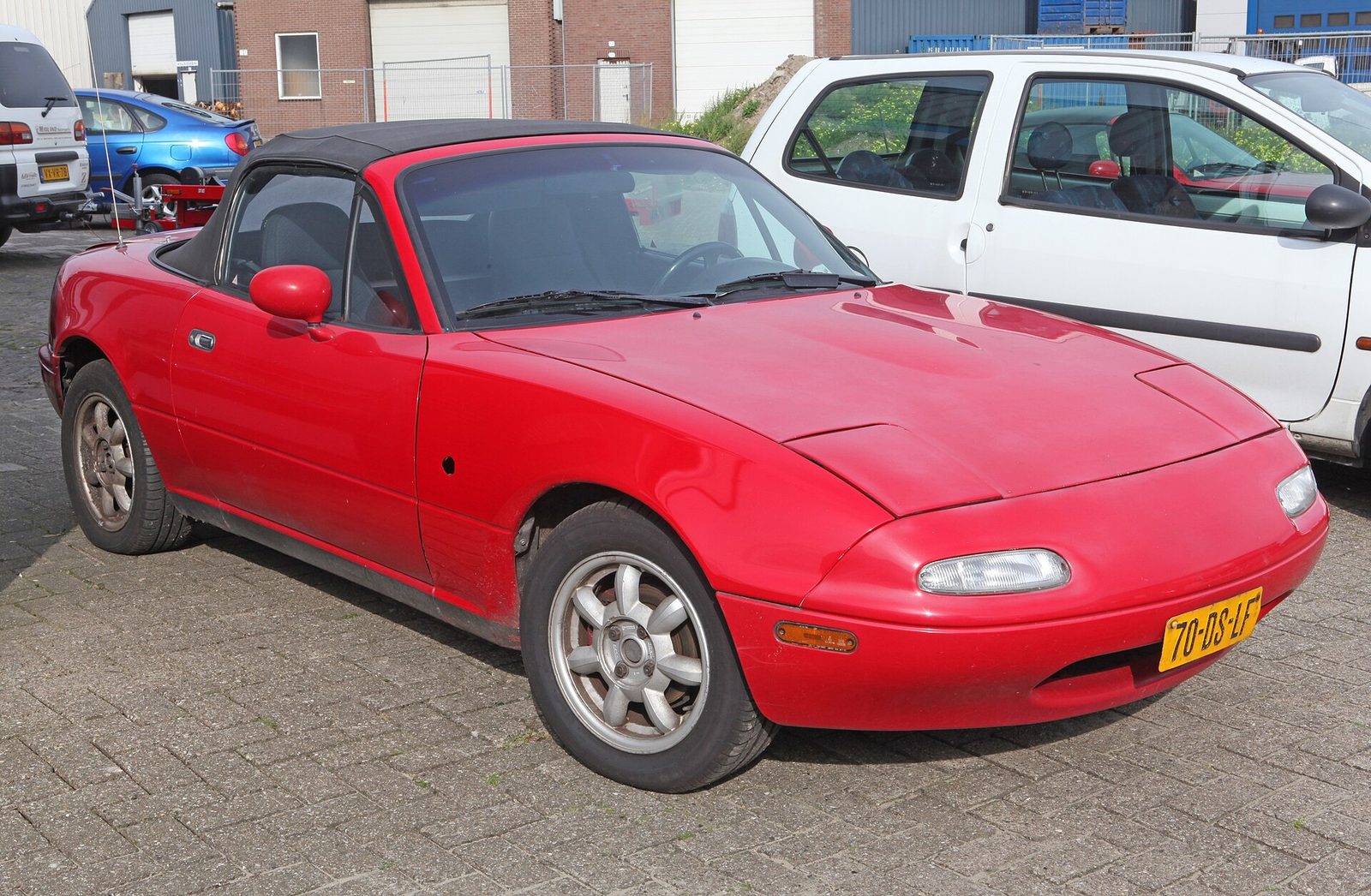
The Mazda MX-5, sold in the US as the Miata and in Japan as the Eunos Roadster, was shown at the Chicago Auto Show in February 1989 and put a small, cheap, front-engine rear-drive roadster back on sale after the MGB, the Triumph Spitfire and the Fiat 124 Spider had all gone. The idea belonged to an American motoring journalist, Bob Hall, who put it to Mazda's research chief Kenichi Yamamoto and was later hired to develop it; the shape came out of a design competition between Mazda's Californian studio and its Tokyo team, with the original Lotus Elan studied openly as the benchmark. A 1,598 cc twin-cam four drove the rear wheels through a five-speed gearbox and an aluminum power plant frame that tied engine to differential, double wishbones sat at each corner, and the car weighed under 2,205 lb. From the 1994 model year came a 1,839 cc engine, a substantially braced shell and larger brakes, with a reduced-output 1.6 kept below it in some markets. It is the best-selling two-seat sports car ever built, and the cheapest examples are the ones most likely to be structurally rotten.
MX-5
NA (Miata / MX-5 / Eunos Roadster)
History
An American Idea Put to a Japanese Company
Bob Hall was a Californian motoring journalist, fluent in self-taught Japanese, whose father had run MGs, Triumphs and Austin-Healeys. Hagerty places the decisive conversation in 1978, when Hall was at AutoWeek and met Kenichi Yamamoto, then head of Mazda research and development, and suggested recasting the rear-drive 323 as a two-seat roadster. Yamamoto was noncommittal. In 1981 he asked Hall to study it properly; Hall joined Mazda's Californian research organization as a product planner and argued in an early-1982 position paper that recycling existing components was the only way to make the numbers work. The program ran off-line, and the American position was that it should be a front-engine, rear-drive roadster or nothing at all.
Duo 101, V705 and the Elan on the Bench
From 1983 the concept became an internal competition between the Californian studio and the Tokyo team. At the first judging in 1984 California's front-engine rear-drive proposal, Duo 101, beat Tokyo's front-drive and mid-engine alternatives, the mid-engine layout having struggled against noise and vibration targets. Mazda's own account confirms the reasoning: the linear responses of the original lightweight sports cars were judged unobtainable without rear drive, and a new powertrain accepted rather than compromise. A running prototype, V705, was completed by the British consultancy IAD in August 1985 with a fiberglass body over 323 mechanicals. Production approval brought the codename P729 and Toshihiko Hirai as chief engineer. Mark Jordan drew the exterior in California and Masao Yagi pushed the styling further towards the Lotus Elan; Tom Matano and Koichi Hayashi settled the detail once the project moved back to Japan. The Elan was not a vague influence, it was the reference object.
Jinba Ittai and the Power Plant Frame
Mazda's design principle was jinba ittai, horse and rider as one. The engineering that carries it is mostly unglamorous: double wishbones at all four corners, near-equal weight distribution, a five-speed gearbox lifted from the rear-drive 929/Luce with a very short throw, and an aluminum power plant frame bolting engine and gearbox rigidly to the differential housing so that driveline movement is taken out of the response. Mazda still calls the frame unique to its sports cars and essential to their directness, while conceding it is awkward to assemble on a mixed line. The car reached the United States as the Miata in May 1989 as a 1990 model, at a base price of $13,800, and Japan on 1 September 1989. Autocar recorded 9.1 seconds to 60 mph and 114 mph, called the gearshift the car's real advantage and scored it nine out of ten.
The 1994 Rebuild
For the 1994 model year the car was reworked around new side-impact legislation. The 1,839 cc BP-ZE arrived at 129 hp, rising to 133 hp for 1996; brakes grew, and the shell was braced, most visibly by a track bar between the seatbelt towers but also through both subframes. Dual airbags went into a redesigned dashboard. The car gained weight and, on the published figures, very little speed. In some markets, Europe among them, the 1.6 was kept on below the 1.8 as the cheap option in reduced-output form, by how much is genuinely unsettled, with published figures ranging from 89 hp to 110 hp.
Three Names and the End of the Run
In Japan the car was sold as the Eunos Roadster, Eunos being a separate premium channel Mazda was building in the manner of Acura or Lexus; in North America it was the Mazda Miata, elsewhere the MX-5. Japanese specials came thick and fast, along with M2 Corporation's low-volume conversions, and Britain received a long series of named editions ending with the Berkeley in 1998. The American price climbed from $13,800 at launch to $19,125 for the last 1997 cars. Mainstream production closed in 1997, replaced by the NB, which kept the layout and dropped the pop-up headlamps.
Common Problems
Two faults decide what an NA Miata is worth. The first is rust: rocker panels, rear arches and floors, developing from the inside, expensive to put right properly and frequently disguised. LucaCarMods, a restoration specialist, explains the mechanism: the rockers are double-skinned and spot-welded, trapped moisture cannot escape, and a proper repair means cutting back to sound metal, zinc coating and welding in new steel. Owner-reported costs on the Grassroots Motorsports forum run from $370 for rust cut out and fresh metal let in at a local shop to under $1,000 for both rockers done in primer, with worse cars quoted high enough that a better shell becomes the cheaper route. The second is the short-nose crankshaft on early 1.6 engines. Miata.net puts the keyway engagement area at 0.045 square inches against 0.087 on the long-nose part, notes that the timing cog acts as a structural member so the small pulley bolt carries both timing and accessory belt loads, and records the change to the large-bolt big-nose crankshaft at US VIN 209447 during 1991. Hagerty reckons it reached about 1 percent of 1990 and early 1991 owners, usually after the pulley key was reassembled wrong at a timing belt service. Worn keyways are not repairable; the fix is a later crankshaft assembly, which on a big-nose conversion also means the oil pump and possibly the front cover. Away from those two the mechanical package is durable, with Hagerty UK reporting serviced examples past 124,000 miles. The recurring smaller faults are a silted radiator causing head gasket failure, a rattle on start-up from the hydraulic tappets, rear calipers sticking on cars that sit, and soft tops that cloud and split.
What to Look For
Structure first. The rocker panels are double-skinned and spot-welded and corrode from the inside, where trapped moisture cannot escape, so a clean-looking rocker proves very little. Hagerty's US guide calls them notorious for rust, worst ahead of the rear wheel arches, and warns that body drains plug up and back water into the cabin, taking the floors with the carpets. Hagerty's UK guide ranks the bottoms of the rear fenders ahead of the wheels as the worst area, because moisture sits behind the panel, followed by inner and outer rear arches, floorpans, the bases and tops of the front fenders and the feet of the windshield pillars. Classic & Sports Car adds that rockers are rarely repaired properly and that clear drain channels are the best available proxy for an attentive owner. Panels welded over existing rust are common and leave the corrosion running underneath. Then the crankshaft. On early 1.6 cars the pulley nose is short and the small pulley bolt carries both timing and accessory loads; the MX-5 Owners Club identifies the short-nose crank by four slots in the pulley against eight on the later part. Look for a wobbling pulley, ferrous powder around the bolt or key, a bent or rusted key, and an engine running poorly because the timing has crept. Beyond that, check the radiator is not silted; check the top for clouding and rot; check the rear calipers on a car that has stood. Twenty-five-year import rules have put Japanese-market Eunos Roadsters on American roads alongside home-market Miatas, so establish origin from the rear license plate recess, square on a Eunos and rectangular on a European car, and from the VIN prefix, JM1 North American, JMZ European, JM0 Australian, with Eunos cars carrying a shorter Japanese chassis number instead.
Market Notes
As of September 2026, classic.com's NA sub-markets separate more usefully than any single aggregate figure. Across the generation the benchmark sits at $12,255, with the lowest recorded sale at $1,450 for a 1995 Eunos-badged import in December 2021. The base model sits below that at an $11,138 benchmark and an $11,183 average on a rising trend, its lowest recorded result $2,475 in April 2022, and current asking prices spread from $9,500 to $30,500, a much wider band than the sales data supports. The M-Edition is the strongest sub-market, at a $15,218 benchmark and a $14,807 average, also rising, over results running from $3,500 in October 2023 to $24,250 in September 2026. Two sub-markets trend the other way on very thin evidence: the 1993 Limited Edition at a $12,611 benchmark against a $13,011 average across three comparable sales, between $7,025 in August 2023 and $13,000 in March 2026, and the R-Package at a $12,640 benchmark against a $13,098 average across four, between $7,000 in October 2022 and $14,500 in May 2026. A sub-market counted in single-digit sales moves on one car, so those downward arrows say considerably less than the base model's upward one.
Where sources differ
A running prototype designated V705 was completed by the British consultancy IAD in August 1985 with a fiberglass body over Mazda 323 mechanicals, after which the program was renamed P729 and Toshihiko Hirai was appointed chief engineer.
evo dates final production approval and the P729 codename to January 1986. Hagerty states the project received production approval in late 1985 on president Yamamoto's recommendation, with Hirai appointed chief engineer at that point. The accounts differ by a matter of months and are not resolved by any source consulted here, so no single approval date is asserted.
The 1.6-liter engine was retained below the 1.8 in some markets after 1993 in reduced-output form, but the output figure is not settled across sources.
Wikipedia states the European 1.6 was detuned to 89 hp. MX5parts gives 90 hp for UK 1.6 cars from 1993. Petrolicious states it was reduced to 110 hp from 1995. Classic & Sports Car gives a band of 89-105 hp for post-1993 cars. These cannot be resolved from the sources consulted here and no single detuned output is asserted.
No consistent total production figure for the NA generation exists across the sources consulted, so no total is asserted.
Wikipedia's Mazda MX-5 page carries a production table headed 'First Generation (NA) (Total Production 431,506)' and, in its running text, the statement that 'The first generation MX-5 sold 228,961 units between 1989 and 1997'. JDMBUYSELL repeats 431,506; BOFI Racing states only that production exceeded 400,000. Miata.net's US-only model-year figures sum to 215,364 and cover no other market. Nothing consulted here explains the gap, and it is not resolved.
Sources
- MX-5(1989~) | HISTORY OF MAZDA, Mazda Motor Corporation · manufacturer
- Mazda: MX-5 900,000 Roadsters produced, Mazda Motor Corporation · manufacturer
- Mazda MX-5 (NA), Wikipedia · encyclopedia
- Mazda MX-5, Wikipedia · encyclopedia
- Birth of an icon: 1989: Mazda MX-5, evo · journalism
- The unlikely American origin of the Mazda Miata, Hagerty Media · journalism
- 1990 Mazda MX-5 road test - Throwback Thursday, Autocar · journalism
- Mazda MX-5 (NA) buyer's guide: what to pay and what to look for, Classic & Sports Car · journalism
- Your handy (1990-97) Mazda Miata buyer's guide, Hagerty Media · journalism
- $27,500, low-mile NA confirms Miata's collectible status, Hagerty Media · journalism
- You're Paying Less For A New Miata Now Than 36 Years Ago, Carscoops · journalism
- Buying Guide: Mazda MX-5 Mk1 (1989 - 1998), Hagerty UK · journalism
- Mazda MX-5 Mk1 Buying Guide, Petrolicious · journalism
- Mazda MX-5 Production Information, Miata.net · specialist
- Miata Crankshafts, Miata.net · specialist
- How to identify short and long nosed crankshafts with pics of pulleys - NA (Mk1), MX-5 Owners Club (UK) · club-forum
- Another Miata bodywork thread, Grassroots Motorsports · club-forum
- Mazda MX-5 Mk1 NA Model Guide, BOFI Racing · specialist
- Which Mk1 MX-5 Have I Got? NA Guide, MX5parts · specialist
- 2026 Mazda Roadster NA Buyer's Guide, JDMBUYSELL · specialist
- Mazda MX-5 1.8 (NA) specs (1994-1998), encyCARpedia · encyclopedia
- Mazda MX-5 Miata NA 1st Gen Market, classic.com · market-data
- Mazda MX-5 Miata - Base Model - NA Market, classic.com · market-data
- Mazda MX-5 Miata 'M-Edition' - NA Market, classic.com · market-data
- Mazda MX-5 Miata 'Limited Edition' - NA Market, classic.com · market-data
- Mazda MX-5 Miata - R-Package - NA Market, classic.com · market-data
- Repairing rusty sills on a Mazda MX-5 NA and NB, LucaCarMods · specialist
Synthesized from the sources above and cross-checked. We cite and link out; we do not republish other databases verbatim.
Fully Sorted is an independent publisher and is not affiliated with, endorsed by or sponsored by Mazda. Mazda and the model names on this page are trademarks of their respective owners and are used here only to identify the cars being described.
Chassis register
Nobody has recorded a car here yet. Own one, or know one? Chassis number, what you can prove about it, and a source if there is one. Every entry is reviewed before it appears.
Nerd Notes
What owners know that the sources don't. Every note is read and checked before it appears here.
Key Specs
- Power
- 1.6: 115 hp at 6,500 rpm as launched, later reduced to a figure sources dispute. 1.8: 129 hp from 1994, 133 hp from 1996
- Brakes
- Discs all round, ventilated front and solid rear on the 1.8; larger brakes from 1994
- Engine
- 1,598 cc B6-ZE(RS) DOHC 16-valve four (1989-1997); 1,839 cc BP-ZE DOHC 16-valve four from 1994 (encyCARpedia states 1,840 cc)
- Layout
- Front longitudinal engine, rear-wheel drive, two seats
- Torque
- 1.6: 100 lb-ft at 5,500 rpm. 1.8: 110 lb-ft at 5,500 rpm from 1994, 114 lb-ft from 1996
- Weight
- 2,161 lb at launch and 2,183 lb from 1994 per Wikipedia; evo quotes 2,072 lb, BOFI Racing about 2,116 lb. Sources do not agree
- Chassis
- Unitary steel monocoque with an aluminum power plant frame bolting engine and gearbox rigidly to the differential housing; braced from 1994 with a track bar between the seatbelt towers and reinforced subframes
- Top speed
- 116.8 mph claimed for the 1.6; 116 mph by Car and Driver with hardtop, 114 mph by Autocar. encyCARpedia gives 122 mph for the 1.8
- Dimensions
- 156.3 in (3,970 mm) long (encyCARpedia gives 156.5 in (3,975 mm) for the 1.8), 65.9 in (1,675 mm) wide, 48.6 in (1,235 mm) high, 89.2 in (2,265 mm) wheelbase; Cd 0.38
- Suspension
- Independent double wishbones front and rear with anti-roll bars at both ends
- Acceleration
- Mazda claimed 8.6 s to 60 mph; Car and Driver recorded 9.2 s, Motor Trend 8.9 s, Autocar 9.1 s. encyCARpedia gives 7.9 s for the 1.8
- Differential
- Open as standard, viscous limited-slip on some specifications, Torsen on the 1994-1997 R-Package
- Transmission
- 5-speed manual derived from the rear-drive Mazda 929/Luce; 4-speed automatic optional in the American and Japanese markets
- Fuel capacity
- 48 liters for the 1.8 per encyCARpedia, larger than the early 1.6
- Bore stroke compression
- 1.8 BP-ZE: 83.0 x 85.0 mm and 9.4:1 per encyCARpedia; no fetched figure for the 1.6 is asserted
Notable Variants
Limited Edition (United Kingdom, 1991)
250 cars in British Racing Green with tan trim and color-matched 15-inch OZ alloys, on the 115 hp 1.6. The first UK special, and the template for a decade of them
Limited Edition (United States and Canada, 1993)
1,505 US cars and 300 Canadian, black with red leather, sports suspension, spoilers and 14-inch BBS wheels. Wikipedia gives 1,500 in one place and 1,505 in another, so treat the figure as approximate.
R-Package (United States, 1994-1997)
1,841 cars with a Torsen limited-slip differential, stiffer springs and bars, Bilstein dampers and a front air dam. Never marketed as a special edition, and the one factory NA specification aimed at track use rather than trim.
M-Edition (United States, 1994-1997)
An annual color-and-equipment package - Montego Blue Mica 1994, Merlot Mica 1995, Starlight Blue Mica 1996, Marina Green Mica 1997 - at roughly 3,000 to 3,500 cars a year, and the best-known NA special in America.
Special Touring Option (United States, 1997)
1,500 cars in Twilight Blue Mica carrying the 1996 M-Edition exterior equipment, sold as the American send-off for the generation.
Eunos Roadster J Limited and J Limited II (Japan, 1991 and 1993)
800 cars each in sunburst yellow, the second with blacked-out A-pillars. Specials of this kind are why an imported Eunos often carries equipment no US-market Miata was given.
M2-1001 Cafe Roadster and M2-1028 Street Competition (Japan, 1991 and 1994)
300 cars each from Mazda's M2 Corporation subsidiary. The 1001 was quoted at 131 hp at 7,000 rpm; the 1028 had a six-point cage, an aluminum duck-tail trunklid and close to 150 hp.
Berkeley (United Kingdom, 1998)
400 cars in Sparkle Green with numbered plaques, unique alloys and a chrome luggage rack, sold after mainstream production had ended.
Value Trajectory
The Miata spent two decades as a cheap car and the bottom of the market still behaves like one. It launched in the United States at $13,800 for 1990 and left at $19,125 for 1997, cheap in its own period and part of why so many were simply used up. Hagerty's US buyer's guide, working from condition rather than sales, puts #3 (Good) base cars in the $6,000 to $7,000 range and a 1995 M Edition at about $12,500; those are the guide's own figures rather than current observations. What the sales data shows as of September 2026 is separation rather than a general rise. classic.com has the base car at an $11,138 benchmark on a rising trend and the M-Edition at $15,218, also rising, while the thinly traded 1993 Limited Edition and R-Package sub-markets trend down at $12,611 and $12,640. The mechanism is straightforward: attrition has been severe, sound dry cars are finite, and doing rockers and arches properly now costs more than a mediocre example is worth, so good cars are pulled up while rotten ones are written off. At the top, Hagerty records a 28,000-mile 1990 car making $27,500 at Barrett-Jackson and names $36,750 for a 1993 Limited Edition as the unmodified record, and dates the turn upward to about 2018 rather than the pandemic.
Next
Shopping for one?
Browse Mazda listings, or decode a VIN before you buy.