
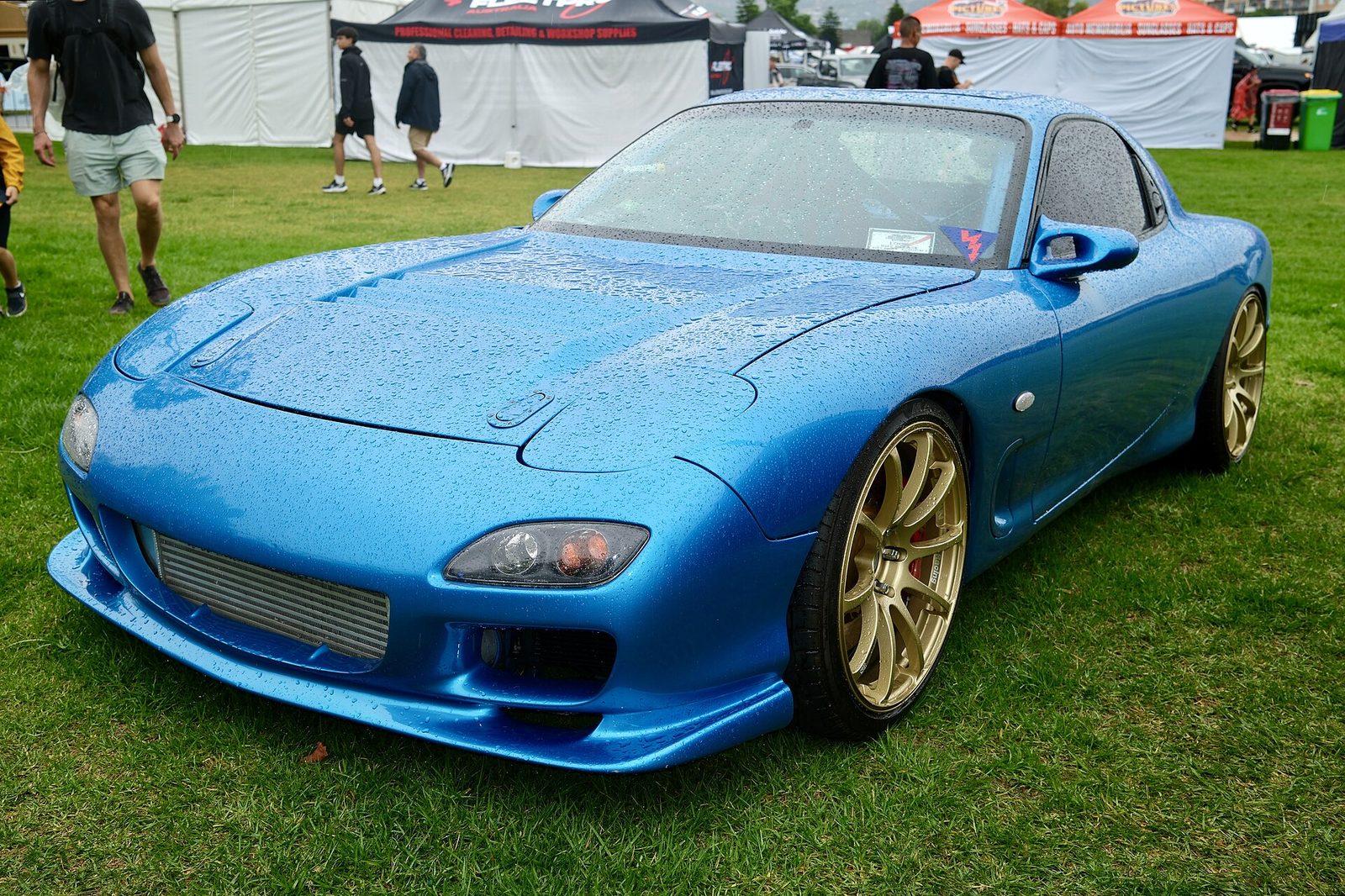
The third-generation Mazda RX-7 (FD3S, 1992-2002) is widely regarded as the high-water mark of the rotary sports car and one of the finest Japanese designs of the 1990s. Developed under a 'weight first, power second' philosophy, it paired a taut, curvaceous body with a front-midship layout and near-perfect balance. Its defining feature is the 13B-REW twin-rotor rotary breathing through the world's first mass-produced sequential twin-turbocharger system, delivering roughly 255 hp in US trim and building to 276 hp in later Japanese Series 8 cars. Sold in the US only for 1993-1995 before rising prices and tightening emissions ended exports, the FD lived on in Japan through 2002, closing with the 1,500-unit Spirit R. Celebrated for steering feel and delicacy, it also carries the rotary's well-known burdens: heat, apex-seal wear, and a culture of periodic engine rebuilds. Clean, unmodified examples have become genuine modern collectibles.
RX-7
FD (FD3S)
68,589 built · Coupe
How rare is it?
With about 68,589 built, the Mazda RX-7 is rarer than a 240Z (~160k) yet more common than a DeLorean (~9k).
Approximate total production placed on a log scale against well-known reference cars, for scale only. Figures and any disputes are detailed in the production notes and sources.
History
Origins and design
The FD arrived for the 1992 model year (US 1993) as the third and final RX-7 generation. Chief engineer Takao Kijima pursued relentless mass reduction, using aluminum, magnesium and composite components to keep curb weight near 2,712-2,888 lb. The compact 13B-REW rotary, weighing well under 441 lb, sat low and behind the front axle for a front-midship balance that gave the car its celebrated agility. Its bodywork is frequently ranked among the greatest Japanese automotive designs.
The sequential twin-turbo rotary
The 13B-REW's headline innovation was sequential turbocharging: a primary turbo supplies boost from low rpm while a second spools in at higher rpm, smoothing the classic rotary power delivery. Mazda marketed it as the first mass-produced sequential twin-turbo system exported from Japan. US cars were rated around 255 hp and 217 lb-ft; the complex vacuum-controlled changeover, however, became a notorious long-term reliability weak point.
Series and evolution
Enthusiasts divide the FD into Series 6 (1992-1995), Series 7 (1996-1998) and Series 8 (1999-2002). Series 7 brought ECU and drivetrain refinements; Series 8 raised output to the Japanese 276 hp ceiling and added the sharpest trims (Type RS, Type RZ, Bathurst R).
End of US sales and Japanese finale
Mazda withdrew the RX-7 from the US after 1995 as prices climbed past $30,000 and emissions/certification pressures mounted against slow sales; roughly 500 cars were sold for 1995. Japanese production continued to 2002, ending with the collectible 1,500-unit Spirit R special edition.
Common Problems
The rotary's defining issues are heat-driven: apex and side seal wear leading to lost compression and eventual engine refresh/rebuild, chronic under-hood heat that hardens the many small vacuum hoses controlling the sequential turbos (causing boost-control faults), and cooling-system stress. The engine burns some oil by design, so lax oil maintenance accelerates seal wear. A rebuild culture is normal for these cars; many surviving examples have had at least one engine refresh. Neglected or heavily boosted cars are high-risk. Owner and marque sources consistently identify seal life and the vacuum/turbo control system as the top concerns.
What to Look For
Prioritize a documented compression test using rotary-specific equipment (healthy chambers near ~100 psi; readings below ~85 psi flag worn apex/side seals and a likely rebuild). Seek full service records with frequent (3,000-5,000 mile) oil changes, evidence the sequential-turbo vacuum 'rat's nest' hoses have been renewed (e.g. Viton/synthetic), a temperature gauge that holds mid-scale, and boost that peaks near 10 psi. Sensible 'reliability mods' (upgraded fan switch, aluminum radiator, pre-cat delete) are a plus. Verify originality and matching numbers; heavily modified cars trade at a discount to clean, stock examples. Confirm rust-free chassis and honest history given the FD's collectible status and import complexity.
Market Notes
As of mid-2026, the FD RX-7 is firmly established as a blue-chip 1990s Japanese collectible. Classic.com data for the 3rd-gen shows an average sale price around $48,750, with clean US-spec and desirable JDM trims regularly trading in the $40,000-$70,000+ range and standout Series 8 cars (Type RZ, Spirit R) reaching six figures. This marks a dramatic climb from Hagerty's 2018 figures, when #1 Concours cars averaged about $34,500 and #2 Excellent examples about $22,600. Values have been buoyed by the broader JDM surge; a widely noted no-sale at $40,500 in the mid-2020s suggests the top of the market may be testing buyer limits rather than collapsing.
Where sources differ
US-spec 1993-1995 FDs were rated at approximately 255 hp and 217 lb-ft of torque, while later JDM Series 8 cars reached 276 hp.
Figures vary by market and series: US ~255 hp; UK cited at 237 hp; JDM launch 252 hp rising to the 276 hp Japanese limit. Ratings differ across sources and trims.
Total third-generation FD production is commonly cited as 68,589 units across all markets (1992-2002).
68,589 is the most-cited figure but is an estimate; evo states 'fewer than 70,000,' and market-by-market breakdowns are inconsistent across sources.
Roughly 13,879 FD RX-7s were imported to the US across the 1993-1995 model years, with only about 500 sold for the final 1995 model year.
US import/sales totals vary among sources; figures should be treated as widely quoted estimates rather than confirmed factory records.
Sources
- Mazda RX-7, Wikipedia · reference-book
- Your definitive Mazda RX-7 FD buyer's guide, Hagerty Media · journalism
- The 1993-95 Mazda (FD) RX-7 Is a Legitimate Modern Collector Car, Hagerty Media · journalism
- Mazda RX-7 FD (1992-2002): a '90s Japanese icon, evo · journalism
- Mazda RX-7 - FD - 3rd Gen Market, Classic.com · journalism
- Mazda RX-7 FD3S Complete History, Project JDM · club-forum
- 1993 Mazda RX-7 - Specs, Prices, Reviews, Cars.com · journalism
Synthesized from the sources above and cross-checked. We cite and link out; we do not republish other databases verbatim.
Fully Sorted is an independent publisher and is not affiliated with, endorsed by or sponsored by Mazda. Mazda and the model names on this page are trademarks of their respective owners and are used here only to identify the cars being described.
Chassis register
Nobody has recorded a car here yet. Own one, or know one? Chassis number, what you can prove about it, and a source if there is one. Every entry is reviewed before it appears.
Nerd Notes
What owners know that the sources don't. Every note is read and checked before it appears here.
Key Specs
- Engine
- 13B-REW twin-rotor Wankel rotary, 654cc x2
- Layout
- Front-midship engine, rear-wheel drive
- PowerUS
- 252 hp / ~252 hp at 6,500 rpm (1993-95 US)
- Redline
- ~8,000 rpm
- TorqueUS
- 217 lb-ft at 5,000 rpm
- Induction
- Sequential twin-turbo (two Hitachi turbos; primary from low rpm, secondary ~4,000-4,500 rpm)
- CurbWeight
- ~2,712-2,888 lb depending on trim
- ZeroToSixty
- ~5.0-5.4 seconds
- PowerJDMlate
- 276 hp / 276 hp (Series 8, from 1999)
- Transmission
- 5-speed manual (4-speed automatic optional)
- OriginalPriceUS
- $31,300 base (1993, before options)
Notable Variants
Type R / Type RS (JDM)
Lightweight, track-focused JDM trims; Series 8 Type RS made 276 hp with firmer suspension and larger brakes.
Type RZ (JDM, Series 8)
Ultra-light limited variant (~2,800 lb) with BBS wheels, Bilstein dampers and Recaro seats.
R1 / R2 (US)
US performance/handling package with stiffer suspension, additional cooling and aero; ~57 R2 units arrived for 1995.
Spirit R (2002, JDM)
Final-edition run limited to 1,500 units (Type A 2-seat manual, Type B 2+2 manual, Type C automatic) with cross-drilled rotors and Recaro seats.
Bathurst R (2001, JDM)
500-unit Series 8 commemorative edition with adjustable dampers and carbon-look trim.
Value Trajectory
The FD has moved from an affordable used sports car in the 2010s to a mainstream collector car in the 2020s. Values roughly doubled-plus from Hagerty's 2018 benchmarks to mid-2020s levels, driven by 1990s-JDM nostalgia, thin surviving supply of unmodified US cars, and demand for late Japanese specials. Trajectory into 2026 remains strong but is showing signs of a plateau at the top end, with occasional high-profile no-sales suggesting price discovery rather than a downturn.
Market Snapshot
4 recorded sales, too few for a median worth standing behind, so here is the range instead.
Range $48,000 – $72,000
Next
Shopping for one?
Browse Mazda listings, or decode a VIN before you buy.