
The Mercedes-Benz 190 E 2.3-16 and the 2.5-liter cars that followed it were the sixteen-valve homologation specials built on the compact W201 sedan from 1984 to 1993. The four-valve head was designed by Cosworth for a rally program that never ran: by the time the engine was right, Audi's quattro had made a rear-drive naturally aspirated rally car pointless, and Mercedes-Benz redirected the work to the revived German Touring Car Championship, whose Group A rules required a production car underneath the racer. Three pre-production cars announced the model at Nardo in August 1983 by covering 31,000 miles at an average of about 154 mph, and the road car was launched at the Nurburgring on 12 May 1984 in a one-make race contested by nine of the twelve living Formula One world champions and won by a rookie named Ayrton Senna. The line ran from a 182 hp 2.3 through the 2.5-16 to the Evolution I and the winged Evolution II, each Evolution capped at 502 cars by the homologation rules that created them.
190E Cosworth
190 E 16-valve (2.3-16, 2.5-16, Evolution I, Evolution II)
Production by variant
How the 190E Cosworthrun breaks down, and which variants are the scarce ones. Approximate figures from this model’s cited sources.
Rarest of the bunch: the 190 E 2.5-16 Evolution II (1990), only about 502 built, roughly 1 in every 2 190E Cosworths. If provenance and rarity drive your buy, this is the one to hunt.
Figures approximate; see Sources below.
History
A Rally Engine Without a Rally
Mercedes-Benz spent the late 1970s looking for a way back into competition and, having tried the 5.0-liter V8 450 SLC in rallying, commissioned Cosworth Engineering to build a four-cylinder capable of comfortably more than 300 hp for a works rally car. Cosworth's answer was a light-alloy twin-cam head with four valves per cylinder on the existing Mercedes M102 iron block, cast at Worcester and shipped to Germany for assembly. By the time the engine was ready the ground had moved. Audi's quattro had made a two-wheel-drive naturally aspirated rally car a waste of an entry fee, and the rally plan was abandoned. The engine was not. The revived Deutsche Tourenwagen Meisterschaft ran to Group A rules, which required a production basis, so a detuned version of the Cosworth motor went into a series-production sixteen-valve W201 to make the racing car legal.
Nardo, August 1983
Before the car was shown, it was proved. Between 13 and 21 August 1983 three lightly modified pre-production 2.3-16s ran continuously around the 7.8 miles banked bowl at Nardo, eighteen drivers rotating six to a car, 243 pit stops, ambient temperatures between 35 and 42 degrees. They covered 31,000 miles in a little over 201 hours at an average near 154 mph, reverse gear removed to save four-tenths of a km/h and the final drive at 2.65:1 against the road car's 3.27:1. One car lost about three hours to a broken distributor rotor arm. The 2.3-16 was shown at Frankfurt the following month.
The Nurburgring, 12 May 1984
To open the Nurburgring's new Grand Prix circuit, Mercedes-Benz put a field of Formula One drivers into identical race-prepared 2.3-16s for a twelve-lap race: nine of the twelve living world champions, with Juan Manuel Fangio as master of ceremonies and a rookie who had failed to qualify at Imola days earlier. Ayrton Senna won in the wet, having traded the lead with Niki Lauda, by 1.58 seconds. Senna's car is in the Mercedes-Benz Museum, and he liked the model enough to collect a smoke silver road-going 2.3-16 from the factory in October 1985.
From 2.3 to 2.5, and the Evolutions
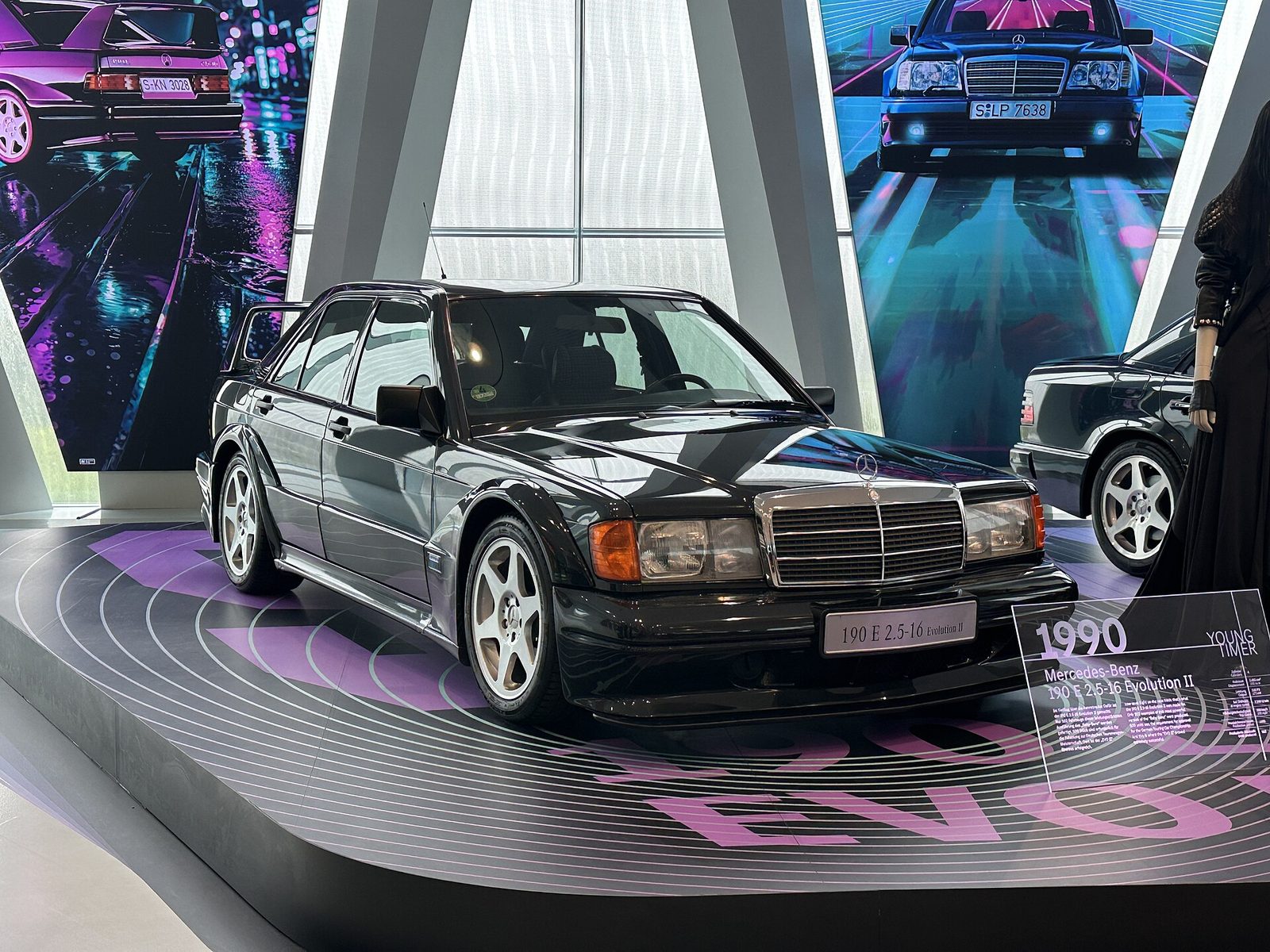
The 2.5-16 arrived in 1988 with a longer stroke, a duplex timing chain answering the single-chain weakness of the early 2.3, and the ASD variable limited-slip differential. It was not enough: BMW's M3 kept moving, and Group A allowed 500-car evolution batches. The Evolution I of March 1989 reversed the bore-stroke relationship to permit higher revs, stiffened the suspension by around a quarter and enlarged the brakes. The Evolution II of March 1990 went further: bodywork developed in the wind tunnel by Professor Richard Eppler of the University of Stuttgart, a rear wing so large that a trim strip had to be added to the rear window to satisfy a rule about obscuring the driver's view, the AMG Power Pack as standard, and a drag figure below the plain sedan's despite the downforce. All 502 were sold before the show car was uncovered.
Group A, AMG and the End of the Formula
On track the Evolution II debuted at the Nurburgring in June 1990 and took time to come good. Its best season was also Group A's last: in 1992 Mercedes-Benz drivers took 16 wins, 17 second places and 13 thirds from 24 races, Klaus Ludwig took the drivers' title, Roland Asch and Bernd Schneider filled the next two places, and AMG-Mercedes took the manufacturers' honours. That season formalized the AMG relationship Mercedes-Benz would later buy outright. The road cars were left behind quickly, and for two decades these were simply used-up sedans. The reappraisal came late, and it separated the Evolutions from everything else.
Common Problems
Rust is the defining structural fault and is described by British buyer's guides as capable of being rampant, the inner wings around the washer bottle and battery being the usual starting point, along with broken rear coils. The M102 has a strong reputation for durability, but early 2.3 units used a single timing chain that can stretch and break; replacement is quoted at roughly 70,000 miles, and the 2.5-16's duplex chain exists precisely because of the problem. Head-gasket failure is common and is usually traced to neglected corrosion-inhibitor levels in the coolant rather than to any inherent weakness. The hydro-pneumatic self-levelling rear suspension is the model-specific liability: accumulator spheres lose their charge, springs break and struts wear, and owners report that most failures are leaks from corroded pipework running the length of the car rather than from the pump. The dog-leg Getrag was heavily sprung when new and gets vaguer with wear - a period road test complained that even a straight-line change was a two-stage operation. Air conditioning failures and broken door-card mountings round out the list; parts specific to the sixteen-valve cars are not cheap.
What to Look For
Establish which car is in front of you before anything else, because the four specifications are separated by large sums. An Evolution I without its AMG Power Pack is a materially different car from one with it, and on a wide-arch car the serialized gearknob and the small EVOLUTION plate on the front wings are the quickest confirmation that it is genuine rather than a re-bodied 2.5-16. Every Evolution left the factory in left-hand drive; a right-hand-drive Evolution does not exist. On the 2.3-16, check the color against the year - only blue-black and smoke silver metallic were offered at first, with almandine red and astral silver arriving later. Corrosion is the first mechanical question: the inner wings under the washer bottle and battery, the rear subframe mounts, jacking points and door bottoms. Ask for the self-levelling suspension to be demonstrated cold and again after a drive, and look for fluid on the rear struts and along the pipe runs forward; interiors are model-specific and the contoured rear seat and checkered cloth are hard to replace. Original, unmodified cars with continuous history are what the market pays for; the 2.5-16 has been a popular basis for engine swaps and track builds, and reversing that work is rarely economic.
Market Notes
As of August 2026, classic.com puts the 190 E 2.3-16 market benchmark at approximately $25,957 with an average sale near $31,482 on a falling trend. Recorded 2.3-16 results run from $5,900 for a 1986 project car in September 2025 to the ex-Ayrton Senna 1985 example, a provenance result rather than a market one, on a car showing 154,302 miles. The Evolutions sit in a different market. As of August 2026 classic.com records an Evolution I benchmark of approximately $138,889 against an average of $125,732, with sales from $80,500 in May 2024, and an Evolution II benchmark of approximately $286,198 against an average of $281,201, trending upward, with a low of $155,250 in August 2022. Auction evidence tracks that: RM Sotheby's sold Evolution II serial 168 of 502 for $329,500 at Monterey in August 2024, while Niki Lauda's 1984 Race of Champions car made CHF 308,750 at St. Moritz in 2023. All auction figures are the houses' published results, which include buyer's premium.
Where sources differ
Sources disagree on the number of international class records set alongside the three outright records at Nardo.
Classic Driver states nine international class records, placing them in the 2000-3000 cc category A group I gasoline class, and Supercar Nostalgia also gives nine. Project 190 states twelve. No source consulted here resolves the difference.
Published totals for the standard sixteen-valve cars do not agree: the 2.3-16 is given as either 19,487 or 17,037 cars and the 2.5-16 as either 5,743 or 4,784, so no production total is asserted here.
Wikipedia's W201 article, mb190e16v.com and Supercar Nostalgia all state 19,487 2.3-16s and 5,743 2.5-16s, with mb190e16v.com supplying a year-by-year breakdown summing to those figures. Classic & Sports Car states 17,037 and 4,784. The difference is roughly 2,450 and 960 cars, too large to be rounding, and is not resolved by any source consulted here, so productionTotal is null.
Accounts of the two Evolution II cars finished outside the standard blue-black metallic differ, and what those cars were is not established.
Wikipedia states 500 cars in blauschwarz with numbers 501 and 502 in astral silver. mb190e16v.com calls the two silver cars test cars. Octane says one went to AMG and one was kept by Mercedes-Benz. Supercar Nostalgia refers to two VIP examples in another scheme. The gearknobs run 001/500 to 500/500, yet RM Sotheby's catalogs describe cars as serial 168 and 283 'of 502'. No source consulted resolves this.
Published performance figures for the European 2.3-16 vary by source and are best read as a range rather than a single set of numbers.
Motor Sport's August 1985 test gives 168 lb-ft, 142 mph and 0-60 mph in 7.5 s. Wikipedia gives 174 lb-ft, 143 mph and under eight seconds to 62 mph. Supercar Nostalgia gives 174 lb-ft, 146 mph and 0-62 mph in 7.2 s. mb190e16v.com gives 173 lb-ft, 143 mph and 7.5 s. The spread is not resolved by any source consulted here.
Whether Mercedes-Benz took manufacturers' honours in the 1991 DTM season is stated differently by different sources.
RM Sotheby's catalogs state the model secured constructors' titles in both 1991 and 1992, and autoevolution states AMG-Mercedes lifted the manufacturers' trophy in 1991. Octane says the 1991 championship went to BMW. Wikipedia records Frank Biela's Audi V8 quattro as 1991 drivers' champion, which settles the drivers' title but not the manufacturers' award. The question is not resolved by any source consulted here.
Sources
- Mercedes-Benz 190E, Wikipedia · encyclopedia
- Mercedes-Benz W201, Wikipedia · encyclopedia
- 1991 Deutsche Tourenwagen Meisterschaft, Wikipedia · encyclopedia
- Mercedes-Benz W201 190 E 2.3-16 Guide, Supercar Nostalgia · specialist
- Mercedes-Benz W201 190 E 2.5-16 Evolution 2 Guide, Supercar Nostalgia · specialist
- History - MB190e16v, mb190e16v.com · specialist
- Nardo 1983 - Project 190, Project 190 · specialist
- A long-playing record: 31,000 miles in 201 hours in a Mercedes 190 E 2.3-16, Classic Driver · journalism
- 1984 Mercedes-Benz 190 E 2.3-16 'Nurburgring', St. Moritz 2023, RM Sotheby's · auction-house
- 1985 Mercedes-Benz 190 E 2.3-16, London 2025, RM Sotheby's · auction-house
- 1990 Mercedes-Benz 190 E 2.5-16 Evolution II, Monterey 2024, RM Sotheby's · auction-house
- Mercedes-Benz 190E 2.3-16 - W201 Market, classic.com · market-data
- Mercedes-Benz 190E 2.5-16 Evolution - W201 Market, classic.com · market-data
- Mercedes-Benz 190E 2.5-16 Evolution II - W201 Market, classic.com · market-data
- Mercedes-Benz W201 buyer's guide: what to pay and what to look for, Classic & Sports Car · journalism
- Mercedes-Benz 190 E 2.3-16 (August 1985), Motor Sport · journalism
- Mercedes-Benz 190E Evo II - Earning its wings, Octane · journalism
- Mercedes-Benz 190E 2.5-16 Evo II: The Story of the Cosworth-Powered, AMG-Tuned Legend, autoevolution · journalism
- With 16 Victories To The 1992 DTM Championship: DTM Season Of Successes For Mercedes-Benz, conceptcarz · journalism
- Self levelling suspension - W201, MBClub UK · club-forum
Synthesized from the sources above and cross-checked. We cite and link out; we do not republish other databases verbatim.
Fully Sorted is an independent publisher and is not affiliated with, endorsed by or sponsored by Mercedes-Benz. Mercedes-Benz and the model names on this page are trademarks of their respective owners and are used here only to identify the cars being described.
Chassis register
Nobody has recorded a car here yet. Own one, or know one? Chassis number, what you can prove about it, and a source if there is one. Every entry is reviewed before it appears.
Nerd Notes
What owners know that the sources don't. Every note is read and checked before it appears here.
Key Specs
- Power
- 182 hp at 6,200 rpm (2.3-16 European); 168-175 hp catalyzed or unleaded; 167 hp at 5,800 rpm (US); 192-201 hp (2.5-16 and Evolution I); 222 hp with the AMG Power Pack; 232 hp at 7,200 rpm (Evolution II)
- Brakes
- 11.2 in (284 mm) ventilated front and 10.2 in (258 mm) solid rear discs on the 2.3-16; 11.8 in (300 mm) front and 10.9 in (278 mm) rear on both Evolutions, the Evolution II adding lighter alloy four-piston calipers
- Engine
- Mercedes M102 iron-block inline-four with a Cosworth-designed light-alloy twin-cam 16-valve head; 2,299 cc for the 2.3-16 and 2,463 cc for the 2.5-16 and Evolutions, the Evolution II using the short-stroke M102.992
- Layout
- Front-mounted longitudinal inline-four, rear-wheel drive
- Torque
- 2.3-16 quoted at 173-174 lb-ft at 4,500 rpm, though Motor Sport's 1985 road test printed 168 lb-ft; Evolution II 181 lb-ft at 5,000 rpm
- Weight
- 2,976 lb quoted for the 2.3-16; Evolution I 2,910 lb; Evolution II 2,954 lb
- Chassis
- Unitary steel monocoque W201 shell, 104.9 in (2,665 mm) wheelbase; MacPherson strut front with the coil springs mounted separately from the dampers, anti-dive geometry, front and rear anti-roll bars
- Top speed
- 143 mph claimed for the 2.3-16, 142 mph in Motor Sport's 1985 test, 146 mph per Supercar Nostalgia; 153 mph for the Evolution II
- Compression
- 10.5:1 European 2.3-16; 9.7:1 US 2.3-16 and Evolution I; 10.5:1 Evolution II
- Acceleration
- 0-62 mph quoted between 7.1 and 8.0 seconds for the 2.3-16 depending on source and market; Motor Sport recorded 0-60 mph in 7.5 seconds in 1985; Evolution II quoted at 6.1 seconds
- Aerodynamics
- Drag coefficient given as 0.32 for the 2.3-16 kit and 0.29 for the Evolution II after Eppler's wind-tunnel work; Octane quotes the standard car at 0.33 and mb190e16v.com the Evolution II at 0.32
- Transmission
- Getrag five-speed manual with a dog-leg first gear; ASD electronically controlled limited-slip differential from the 2.5-16, varying lock from 15 to 100 per cent
- Wheels tires
- 7x15 in Fuchs 'Gullideckel' alloys on the 2.3-16; 8x16 in on the Evolution I; 8.25x17 in six-spoke alloys on Dunlop SP Sport D40 for the Evolution II
- Suspension rear
- Five-link independent axle with anti-squat geometry and hydro-pneumatic self-levelling (SLS): levelling valve on the rear anti-roll bar, nitrogen accumulator spheres, pump and reservoir under the hood
Notable Variants
190 E 2.3-16 (European, 1984-1988)
The car the program existed to legalize. 182 hp on 98 RON, dog-leg Getrag five-speed, ride height down 0.59 in (15 mm) front and 0.47 in (12 mm) rear, 7x15 in Fuchs 'Gullideckel' alloys, and at first only two colors.
190 E 2.3-16 (US federalized, 1986-1987 model years)
Compression dropped to 9.7:1 for 167 hp at 5,800 rpm, with US headlamps, side impact bars and a wood-trimmed dashboard not offered in Europe. Two model years only, which is why the American population is small.
190 E 2.3-16 'Nurburgring' (Sport-Technik, 1984)
Competition cars for the 12 May 1984 opening race on the new Grand Prix circuit: revised exhaust, four-piston front brakes, roll cage, Recaro seats and harnesses, Pirelli racing tires. Senna's is in the Mercedes-Benz Museum.
190 E 2.5-16 (1988-1993)
Longer-stroke 2,463 cc engine with a duplex timing chain answering the single-chain weakness of early 2.3s. 201 hp without catalyst, 192 hp with, plus the ASD variable limited-slip differential and two further colors.
190 E 2.5-16 Evolution (Evolution I, 1989)
Homologation car launched at Geneva in March 1989 to answer the BMW M3 Evolution. Short-stroke bottom end for higher revs, springs and dampers around 23 per cent stiffer, 300/278 mm discs, 8x16 in wheels, 502 built, all blue-black.
190 E 2.5-16 Evolution II (1990)
The winged car. Aerodynamics by Professor Richard Eppler of the University of Stuttgart, AMG Power Pack standard at 232 hp, 8.25x17 in wheels, ride height adjustable through 45 mm, 502 built May to July 1990 and sold out before Geneva.
AMG Power Pack
Optional on the Evolution I, giving 222 hp at 7,200 rpm; standard on the Evolution II. Its presence or absence is the biggest single specification question on an Evolution I.
Value Trajectory
For roughly twenty years after production ended these were simply old Mercedes sedans with an awkward gearbox, and they were used accordingly. The standard 2.3-16 remains the most accessible route into a factory homologation program: as of August 2026 the classic.com benchmark of roughly $25,957 sits within reach of an ordinary enthusiast, and its trend is falling rather than rising. The Evolutions moved on a different curve: as of August 2026 the classic.com Evolution II benchmark of approximately $286,198 is trending upward against an Evolution I benchmark near $138,889, an order of magnitude above the cars they were homologated from. The practical consequence is a gap widening on two axes at once: between the Evolutions and the standard cars, and within the standard cars between documented, rust-free examples and the many that were modified or left to corrode. Provenance can override the market entirely, as the Senna 2.3-16 demonstrated in November 2025.
Next
Shopping for one?
Browse Mercedes-Benz listings, or decode a VIN before you buy.