
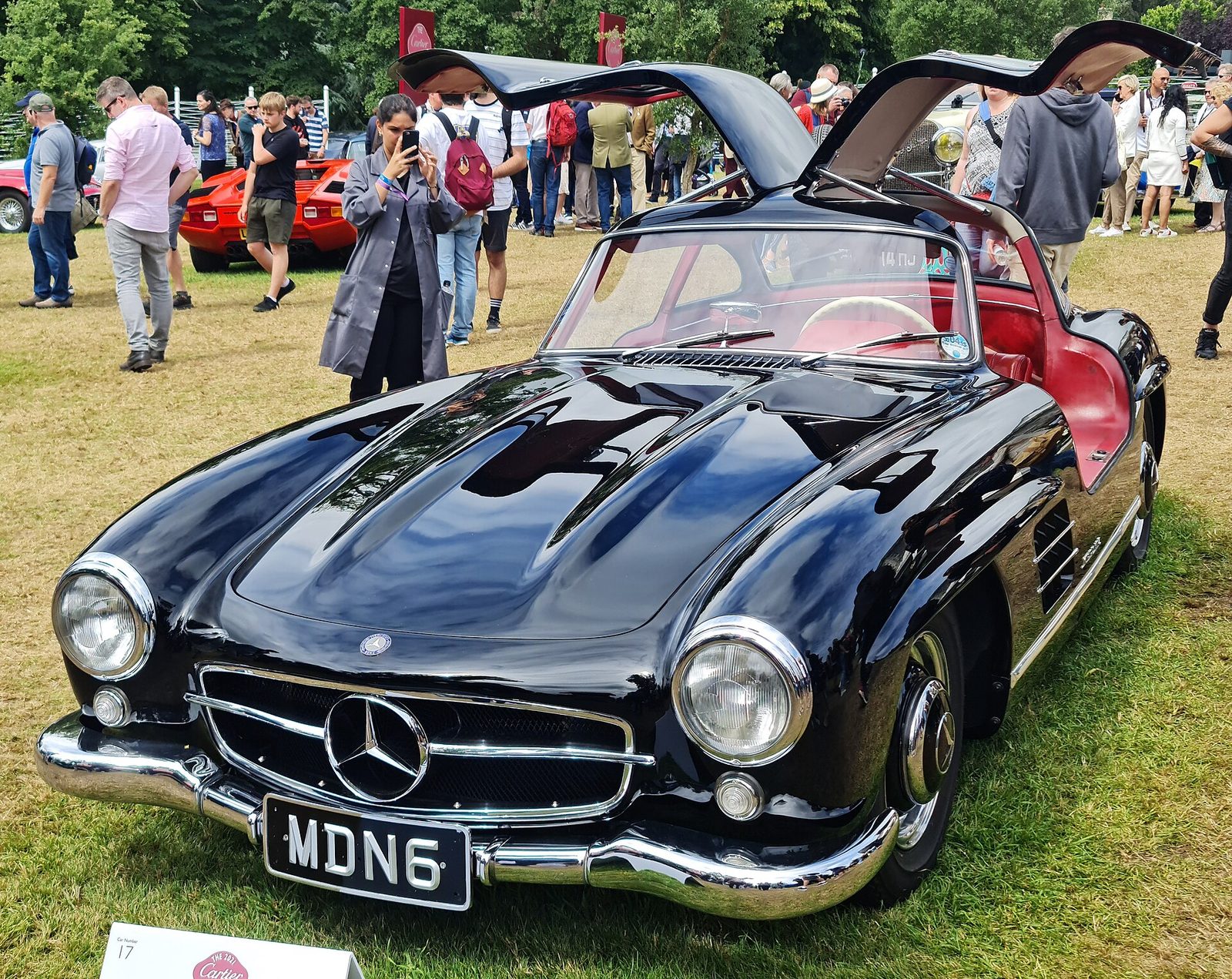
The Mercedes-Benz 300 SL (W198) is the road car that followed the W194 sports racer into showrooms at the insistence of US importer Max Hoffman, who committed to an order of 1,000 cars and secured a February 1954 New York introduction. Its tubular spaceframe carried deep, load-bearing sills that left no room for conventional hinges, producing the roof-hinged doors that named the car. Beneath the long hood sat a 2,996 cc single-overhead-cam six canted 50 degrees to clear the hood line, dry-sumped to suit that angle and fed by Bosch mechanical direct fuel injection - the first such system on a series-production gasoline car. Coupe production ran to 1957, followed by the Roadster, which lowered the sill tubes for conventional doors and replaced the high-pivot swing axle with a low-pivot design that markedly reduced the coupe's oversteer. Twenty-nine coupes received all-aluminum bodies and occupy a separate market entirely. Values here follow documentation and originality more closely than cosmetic condition.
History
From W194 to Showroom
The 300 SL began as a competition project. The W194, built around a tubular spaceframe and powered by a carbureted 3.0-liter six derived from the 300 sedan, contested the 1952 season and took a one-two at Le Mans and victory in the Carrera Panamericana. Ten were built. Mercedes-Benz had no plan to sell a road version; the impetus came from Max Hoffman, the Austrian-born New York importer, who argued in a September 1953 meeting in Stuttgart that American buyers would take the car and backed the position with an order for 1,000 units. The production 300 SL was shown at the New York International Motor Sports Show in February 1954, with series assembly beginning at Sindelfingen that August.
The Spaceframe and the Doors
The gullwing doors were a consequence, not a styling decision. The spaceframe's rigidity depended on deep triangulated sill sections running along each flank, and those sills sat too high for a conventional door aperture. Hinging the doors at the roof was the available answer. The arrangement brought its own compromises: awkward entry, a fixed side window on early cars, and a cabin that trapped heat. The frame's virtues were considerable stiffness at low weight, but it also made accident damage expensive, since a bent tube cannot be pulled straight in the way a monocoque can be repaired.
Injection and the Engine
The M198 six carried the significant technical claim. Where the W194 used triple Solex carburetors, the road car adopted Bosch mechanical direct injection, spraying fuel into the combustion chamber rather than the inlet tract - a genuine production first for a gasoline engine, and derived from wartime aero-engine practice. To keep the hood line low the engine was canted 50 degrees toward the left, which in turn required dry-sump lubrication. Output is quoted variously depending on the measurement standard and camshaft: roughly 215 hp DIN, with SAE figures of 220 hp at 5,800 rpm and 240 hp at 6,100 rpm both appearing in catalog and reference material. The optional NSL 'Sonderteile' sports camshaft raised output further and later became standard on the Roadster.
The Roadster and the End of the Line
Coupe production stopped in May 1957 and the Roadster took over. Engineers halved the height of the sill tubes and added bracing elsewhere to recover the lost rigidity, permitting conventional doors with wind-down windows. The more consequential change was underneath: the coupe's high-pivot single-joint swing axle, which produced sharp camber change and a reputation for sudden oversteer at the limit, gave way to a low-pivot design with the pivot dropped roughly 3.4 in (87 mm) below the differential centreline and a compensating spring added. Handling became notably more neutral. A smaller fuel tank freed genuine luggage space, a removable steel hardtop was offered from late 1958, Dunlop discs replaced drums all round in March 1961, and an aluminum block arrived in March 1962. Production ended in February 1963 after 1,858 Roadsters, all left-hand drive, with the W113 'Pagoda' 230 SL taking over as a very different proposition.
Collector Standing
The 300 SL became a blue-chip collectible early and has stayed there. Because so many cars have been restored, and because factory build records and data cards allow chassis, engine and original specification to be checked, the market rewards documented originality more than presentation. A 2023 chassis fraud episode sharpened that sensitivity further.
Common Problems
Spaceframe damage and previous repair is the defining structural concern, and correcting it properly is specialist work. Corrosion concentrates in the headlight buckets, wheel arches, trunk floor, rear roof pillars, the areas behind the rear wheels and the inner wheel aprons. The Bosch mechanical injection pump requires specialist setup and calibration and is not a system for general workshops; poor injection adjustment can wash oil with fuel, which is why oil condition and change discipline matter more here than on a carbureted contemporary. The dry-sump system adds its own service complexity. The coupe's high-pivot swing axle demands respect at the limit and is a handling characteristic rather than a fault. Drum brakes on coupes and early roadsters need careful adjustment to work as intended. Restoration costs run well into six figures, so a compromised car is rarely the cheaper route to ownership.
What to Look For
Verify identity first. Chassis prefixes are 198040 for the steel coupe, 198043 for the alloy coupe and 198042 for the roadster, with M198 engine prefixes throughout; a factory build record or data card confirming original engine, color, camshaft specification and options is the single most valuable document in the file, and the 2023 chassis fraud case makes independent verification worth paying for. Put the car on a lift and inspect the tubular spaceframe for welded repairs, replaced tubes or evidence of straightening, since accident damage here is both common and costly. Check corrosion in the headlight buckets, wheel arches, trunk floor, the areas behind the rear wheels, the rear roof pillars and the inner wheel aprons front and rear. Stand back and read panel alignment: hood, headlight, door and boot-lid fit reveal restoration quality and past damage. Confirm whether an NSL/Sonderteile camshaft and Rudge wheels are factory-fitted rather than retrofitted, as both carry real money. On roadsters establish where the car sits relative to the March 1961 disc-brake and March 1962 alloy-block changes. Buy the best car available rather than a restoration project.
Market Notes
As of August 2026, classic.com records a Gullwing market benchmark of approximately $1,848,000 against an average sale near $1,741,000, with recent results spanning roughly $1,105,000 to $2,975,000 and a trend marked upward. The Roadster sits lower: a benchmark near $1,372,000, an average close to $1,388,000, and a recent range from about $657,500 (a 1958 car in July 2025) to $2,040,000 (August 2026). Individual results bracket those figures - Gooding & Company sold a 1955 Gullwing retaining its original engine per factory build record for $1,501,000 at Amelia Island in 2025, against a $1.3-1.5m estimate. Alloy cars are a separate market: Hagerty has put an excellent alloy example around $6.7 million against roughly $1.4 million for its steel equivalent, and RM Sotheby's sold an alloy car with Sonderteile engine, sports suspension and Rudge wheels for $5,010,000 at Monterey in 2022. Sotheby's editorial cites European guidance of roughly EUR 1.3 million for a standard steel car, about EUR 100,000 more for Rudge wheels, and EUR 5-7 million for alloy cars. Documentation drives these spreads more than paint and chrome.
Where sources differ
Quoted power is approximately 215 hp DIN, with SAE figures of 220 hp at 5,800 rpm and 240 hp at 6,100 rpm both appearing in reputable sources.
Figures differ by measurement standard (DIN versus SAE gross) and by camshaft specification. RM Sotheby's cites 215 hp for a Sonderteile engine, Gooding's catalog 220 hp at 5,800 rpm, and Wikipedia and Supercar Nostalgia 240 hp at 6,100 rpm. No single figure is asserted as canonical.
Coupe production totaled 1,400 cars between August 1954 and May 1957 according to the Gull Wing Group registry, but Sotheby's states 1,408, so no single W198 total is asserted.
The Gull Wing Group registry records 1,400 coupes; RM Sotheby's catalog material is consistent with that at 1,371 steel plus 29 alloy. Sotheby's editorial gives 1,408, a difference of eight cars most plausibly explained by the inclusion of prototypes or pre-production examples.
Twenty-nine coupes were built with all-aluminum bodywork and Plexiglas glazing, saving roughly 209 lb over a steel car.
The Gull Wing Group registry (26 in 1955 plus 3 in 1956), RM Sotheby's and Sotheby's all give 29. A Hagerty auction report instead states 24 were built in 1955. The 29 figure has the stronger corroboration.
Sources
- 300 SL Production History, Gull Wing Group International · club-forum
- Mercedes-Benz 300 SL 60th Anniversary, Hagerty · journalism
- Everything You Need to Know about the Mercedes-Benz 300 SL Gullwing, Sotheby's · auction-house
- 1955 Mercedes-Benz 300 SL Alloy Gullwing, Monterey 2022, RM Sotheby's · auction-house
- 1955 Mercedes-Benz 300 SL Gullwing, Amelia Island Auctions 2025, Gooding & Company · auction-house
- Mercedes-Benz 300SL Gullwing - W198 Market, classic.com · market-data
- Mercedes-Benz 300 SL Roadster - W198 Market, classic.com · market-data
- What 300SL Gullwing Sales Tell Us About Broader Market Behavior, Hagerty · market-data
- This rare alloy Gullwing could become the most expensive one ever sold, Hagerty · journalism
- Mercedes-Benz W198 300 SL Roadster Guide, Supercar Nostalgia · journalism
- Mercedes-Benz 300 SL, Wikipedia · reference-book
- Buyer Information 300 SL, Silver Star Restorations · specialist
Synthesized from the sources above and cross-checked. We cite and link out; we do not republish other databases verbatim.
Fully Sorted is an independent publisher and is not affiliated with, endorsed by or sponsored by Mercedes-Benz. Mercedes-Benz and the model names on this page are trademarks of their respective owners and are used here only to identify the cars being described.
Chassis register
Nobody has recorded a car here yet. Own one, or know one? Chassis number, what you can prove about it, and a source if there is one. Every entry is reviewed before it appears.
Nerd Notes
What owners know that the sources don't. Every note is read and checked before it appears here.
Key Specs
- Engine
- 2,996 cc M198 SOHC inline-6, canted 50 degrees to the left
- Layout
- Front engine, rear-wheel drive
- Chassis
- Tubular steel spaceframe with triangulated sections and deep sills
- Power din
- Approximately 215 hp (DIN)
- Top speed
- Up to roughly 163 mph with the tallest final drive; approximately 155 mph on typical gearing
- Fuel system
- Bosch mechanical direct fuel injection into the combustion chamber
- Lubrication
- Dry sump, adopted to suit the 50-degree engine tilt
- Brakes coupe
- Servo-assisted hydraulic drums all round
- Transmission
- 4-speed manual
- Body material
- Steel with aluminum panels; all-aluminum on 29 coupes
- Torque roadster
- 202 lb-ft at 4,600 rpm (Sonderteile engine, 9.5:1 compression)
- Chassis prefixes
- 198040 (steel coupe), 198043 (alloy coupe), 198042 (roadster); 194010 denotes the W194 racing cars
- Front suspension
- Independent, double wishbones and coil springs
- Power sae quoted
- 220 hp at 5,800 rpm (Gooding catalog); 240 hp SAE gross at 6,100 rpm (Wikipedia, Sonderteile specification)
- Brakes roadster late
- 11.4 in (290 mm) Dunlop discs all round from March 1961
- Rear suspension coupe
- Single-joint swing axle, high pivot
- Rear suspension roadster
- Single-joint swing axle with pivot lowered about 3.4 in (87 mm) below the differential centreline, plus compensating spring
Notable Variants
300 SL Coupe (Gullwing, W198 I)
1954-1957. Roof-hinged doors dictated by the deep spaceframe sills. Steel body with aluminum hood, doors and trunk lid; drum brakes throughout; high-pivot single-joint swing axle.
300 SL Coupe, Leichtmetallausfuehrung (alloy body)
All-aluminum bodywork and Plexiglas side and rear glazing, saving roughly 209 lb. 29 built per the Gull Wing Group registry. Trades in an entirely separate market from steel cars.
NSL / Sonderteile sports camshaft
Optional competition-specification camshaft on the Coupe, standard on the Roadster. A documented factory NSL engine materially lifts a coupe's value.
Rudge knock-off wheels
Factory center-lock option on both bodies. Widely cited as adding a six-figure premium to an otherwise comparable car.
300 SL Roadster (W198 II)
1957-1963. Lowered sill tubes and added bracing for conventional doors with wind-down windows, low-pivot single-joint swing axle, smaller fuel tank and usable luggage space.
300 SL Roadster, disc-braked / alloy-block
Dunlop discs all round from March 1961 (chassis 2780 on); aluminum engine block from March 1962 (chassis 3049 on). The last and most usable specification.
Value Trajectory
The 300 SL is a mature blue-chip asset rather than a growth story. Hagerty's analysis notes the market rating peaked in 2022 and fell in most months afterwards, with the recent boom retreating toward pre-pandemic levels, and identifies a widening gap between exceptional cars and merely good ones alongside softer prices further down the condition scale. A repeat sale illustrates the pattern: a 1960 roadster made $1.1 million in 2017 and $1,270,000 in 2023, an annualized return of about 2.3 percent, and sold roughly 15 percent below condition-appropriate value on both occasions. Fresh-to-market and exceptional cars behave differently - an untraded 1962 roadster achieved $1,792,500 in 2023, and a record non-alloy Gullwing brought $3,410,000 at Barrett-Jackson in January 2024. Classic.com benchmarks for both bodies were trending upward as of August 2026. Alloy cars have moved on a separate and steeper track. The consistent observation from specialists is that capital is preserved here rather than compounded.
Next
Shopping for one?
Browse Mercedes-Benz listings, or decode a VIN before you buy.