
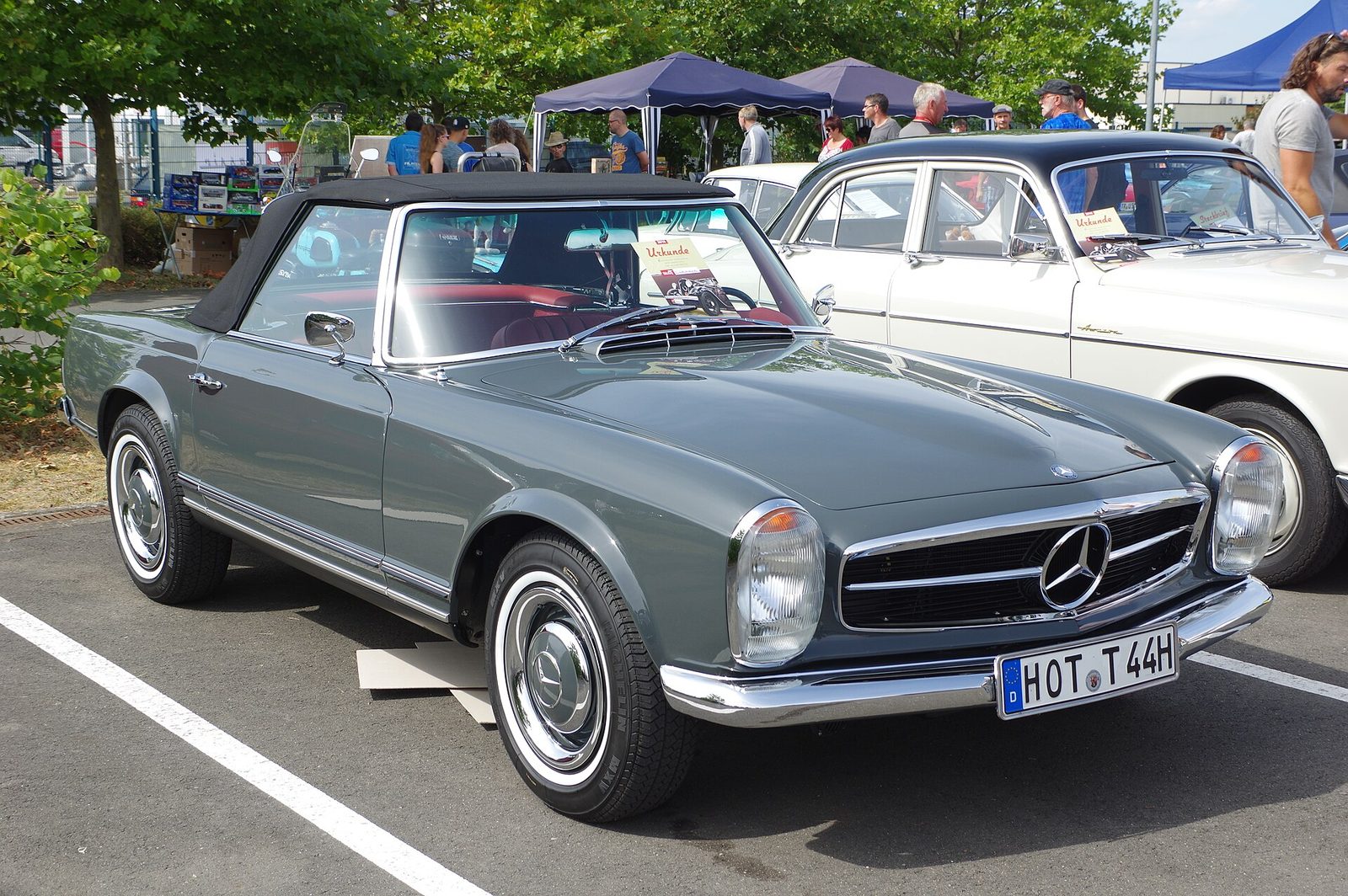
The Mercedes-Benz W113 SL (1963-1971) replaced both the 300 SL and 190 SL with a single, elegant grand-touring roadster. Styled under Paul Bracq's hand at Mercedes' design studio, it earned the enduring nickname 'Pagoda' from the gently concave center of its removable hardtop, whose raised edges recall the upswept eaves of an Asian temple. The line progressed through three closely related straight-six models: the 230 SL, the one-year 250 SL, and the larger-engined 280 SL, gaining rear disc brakes and more torque along the way. It was the first mass-produced SL to use a six-cylinder engine and pioneered Bela Barenyi's rigid safety-cell body. Roughly 48,912 were built, about half sold in the USA. Refined, well-engineered and beautiful, the Pagoda has matured into a blue-chip classic, with the 280 SL commanding a clear premium.
SL
W113 'Pagoda'
48,912 built · Roadster/Convertible · Coupe (removable hardtop)
How rare is it?
With about 48,912 built, the Mercedes-Benz SL is rarer than a 240Z (~160k) yet more common than a DeLorean (~9k).
Approximate total production placed on a log scale against well-known reference cars, for scale only. Figures and any disputes are detailed in the production notes and sources.
History
Origins
Launched at the March 1963 Geneva Motor Show, the W113 replaced two very different cars at once: the exotic 300 SL and the modest four-cylinder 190 SL. It rode on a shortened version of the W111 'Fintail' sedan platform and borrowed technology from the W112, hence the W113 code. It was the first mass-produced SL with a six-cylinder engine, and no SL would use a four-cylinder again until the SLK of the mid-1990s.
Design and the 'Pagoda' name
Styling is most often credited to Paul Bracq, working within a Mercedes team that also involved Friedrich Geiger and safety engineer Bela Barenyi. The car's signature is its optional removable hardtop, whose roofline dips in the center and rises at the edges. Journalists and enthusiasts, not the factory, coined the 'Pagoda' nickname from this concave shape; the form was functional as well as pretty, stiffening the top, aiding rollover strength, and allowing taller side glass and easier entry.
230 to 250 to 280
The 230 SL used a 2.3-liter injected six with front discs and rear drums. The 1967-only 250 SL grew to 2.5 liters with a seven-main-bearing crank and, importantly, added rear disc brakes for all-round discs. The 280 SL (from late 1967) enlarged the engine to 2.8 liters and more torque, becoming the definitive and most-produced version. A four-speed manual was standard, a four-speed automatic was popular (dominant in the US), and a rare ZF five-speed manual was offered to a small number of buyers.
Motorsport and legacy
Despite its GT character, a 230 SL driven by Eugen Bohringer took a strong result on the demanding 1963 Spa-Sofia-Liege rally, showing the car's toughness. Production ended in 1971 after 48,912 cars, giving way to the larger R107.
Common Problems
Rust is the primary enemy, hiding in unibody cavities, floors, sills and arches. The Bosch mechanical fuel-injection pump wears and needs specialist rebuilding. Head gasket failure is noted, particularly on cars left standing. Driveshaft U-joints and wheel bearings can fail with age. US emissions-spec 280 SL engines make less power than European versions. Poor past restorations and non-original replacement panels can hide problems.
What to Look For
Prioritize a rust-free, honest body: check unibody box sections, floors, sills, trunk/spare-well and wheel arches, as proper metalwork is very expensive. Confirm matching numbers and a documented history. Ensure the Bosch mechanical injection pump runs correctly (cold and hot starting, smooth idle) as rebuilds are costly and specialist. Both hardtop and soft top present and fitting well add value. Manual gearbox cars, and especially the rare ZF five-speed, are more desirable than automatics. Inspect for prior accident repair and confirm brake type matches the model (all-round discs on 250/280).
Market Notes
As of mid-2026, the Pagoda is a firmly established blue-chip classic. Classic.com's market benchmark for the 280 SL sat around $96,800 with a much higher trailing average sale price (skewed upward by exceptional cars), and roughly 40+ examples listed at any time, spanning about $35,000 for projects to $250,000 for the very best. Hagerty condition #2 (excellent) guide values in this period ran near $88,900 (230 SL), $95,200 (250 SL) and $150,000 (280 SL), showing a persistent 280 SL premium. In the UK, show-standard cars were quoted around GBP 100,000-130,000+, average cars GBP 40,000-70,000, and projects from GBP 15,000. Matching-numbers, well-documented, manual and ZF five-speed cars command the strongest money.
Where sources differ
Exterior styling is most commonly credited to Paul Bracq, though it was a Mercedes team effort also involving Friedrich Geiger and safety engineer Bela Barenyi, and exact credit is debated.
Sources variously headline Paul Bracq as the stylist while others emphasize Geiger's leadership and Barenyi's safety-body role; precise individual attribution is not settled.
Quoted power is around 150 hp DIN for the 230 and 250 SL and around 170 hp DIN for the 280 SL, with US emissions-spec figures notably lower.
Figures vary by measurement standard and market: DIN vs SAE gross and European vs US emissions tune yield differing numbers (e.g. 280 SL cited from ~160 hp SAE US to ~180 hp).
Sources
- Your Handy 1963-71 Mercedes-Benz SL Buyer's Guide, Hagerty · journalism
- The W113 Pagoda Mercedes: A History, The SL Shop · club-forum
- 60 Facts About the Mercedes Pagoda, The SL Shop · club-forum
- Mercedes-Benz 280SL 'Pagoda' (W113) Market, Classic.com · registry
- Mercedes-Benz W113 230-280SL 'Pagoda' buyer's guide, Classic & Sports Car · journalism
- Where the Pagoda Name Comes From for W113, Cannstatt Classic Mercedes Parts · club-forum
Synthesized from the sources above and cross-checked. We cite and link out; we do not republish other databases verbatim.
Fully Sorted is an independent publisher and is not affiliated with, endorsed by or sponsored by Mercedes-Benz. Mercedes-Benz and the model names on this page are trademarks of their respective owners and are used here only to identify the cars being described.
Chassis register
Nobody has recorded a car here yet. Own one, or know one? Chassis number, what you can prove about it, and a source if there is one. Every entry is reviewed before it appears.
Nerd Notes
What owners know that the sources don't. Every note is read and checked before it appears here.
Key Specs
- Layout
- Front engine, rear-wheel drive
- Power 230
- ~150 hp DIN (US SAE figures lower)
- Power 280
- ~170 hp DIN (US emissions-spec ~160 hp SAE)
- Top speed
- Approx. 120 mph (280 SL)
- Brakes 230
- Front discs, rear drums
- 230SL engine
- 2,306cc SOHC inline-6, Bosch mechanical fuel injection
- 250SL engine
- 2,496cc SOHC inline-6, seven main bearings
- 280SL engine
- 2,778cc SOHC inline-6
- Construction
- Steel unibody (monocoque)
- Transmissions
- 4-speed manual (standard), 4-speed automatic (common, esp. US), rare ZF 5-speed manual
- Brakes 250 280
- Four-wheel disc brakes
Notable Variants
250 SL
One-year-only transitional model (1967); rarest of the three at 5,196 built. Added rear disc brakes and a seven-main-bearing crank over the 230.
280 SL
Final and most numerous variant (23,885), largest 2.8L engine; today the most valuable and collectible of the range.
ZF 5-speed cars
Optional ZF five-speed manual gearbox fitted to only ~882 cars; a sought-after rarity, especially in the US market where it was very seldom ordered.
California Coupe
280 SL variant that deleted the folding soft top, was supplied only with the removable hardtop, and added a small transverse rear bench (2+2). Not universally prized versus the full-convertible cars.
Value Trajectory
Values climbed strongly through the 2010s and have plateaued at a high, stable level in the mid-2020s, behaving like an established blue-chip rather than a speculative riser. The 280 SL leads, the one-year 250 SL is scarce, and the 230 SL is the accessible entry point. Manual and ZF five-speed cars, plus documented originality, drive the top of the market; automatics and needy projects anchor the bottom.
Market Snapshot
5 recorded sales, too few for a median worth standing behind, so here is the range instead.
Range $104,000 – $118,000
Next
Shopping for one?
Browse Mercedes-Benz listings, or decode a VIN before you buy.