
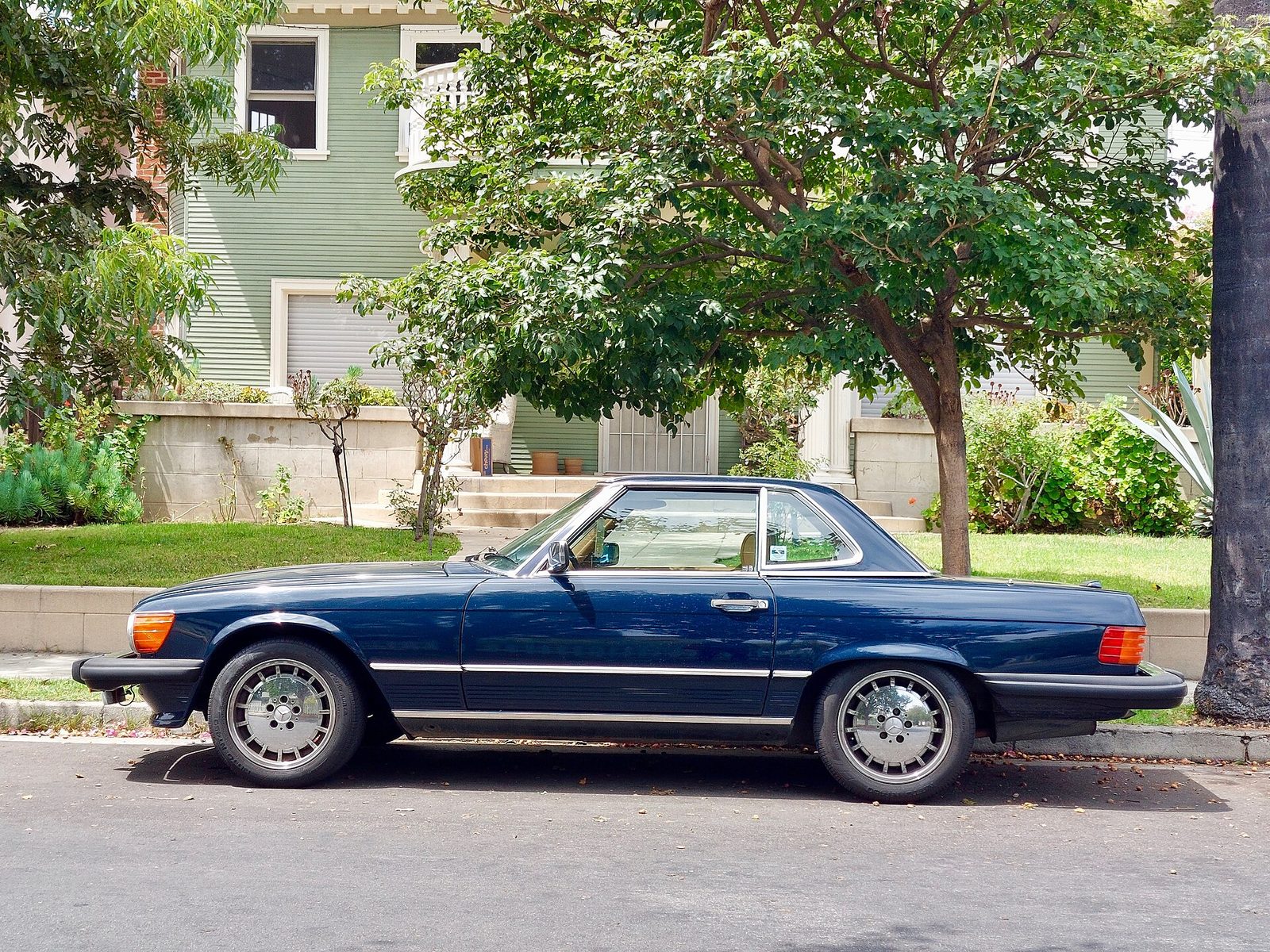
The Mercedes-Benz SL of the 107 series replaced the W113 Pagoda in spring 1971 and stayed in production until August 1989 - eighteen years, an internal record for the marque. It was the first SL with a V8 and the first to carry the factory's R prefix rather than W. Where the Pagoda had been light, upright and spare, the R107 was longer, heavier and aimed squarely at North America, which took roughly two thirds of the 237,287 roadsters built. The engine ladder ran from a 2.8-liter twin-cam six through 3.5, 3.8, 4.2, 4.5, 5.0 and finally 5.6 liters of V8, with American cars federalized to sealed-beam headlamps, extended impact bumpers and emissions calibrations that cost them much of the European output. A stretched four-seat coupe, the C107 SLC, ran alongside to September 1981 and gave Mercedes an improbable World Rally Championship winner. Eighteen years of running changes mean the market now sorts these cars by year, color and equipment as much as by badge.
SL
R107
237,287 built · 2-door roadster with folding fabric hood and removable steel hardtop (R107) · 2-door four-seat fixed-roof coupe on a 14.2 in (360 mm) longer wheelbase (C107 SLC, 1971-1981)
How rare is it?
With about 237,287 built, the Mercedes-Benz SL is rarer than a Mustang '65–'68 (~1.3M) yet more common than a 240Z (~160k).
Approximate total production placed on a log scale against well-known reference cars, for scale only. Figures and any disputes are detailed in the production notes and sources.
Production by variant
How the SLrun breaks down, and which variants are the scarce ones. Approximate figures from this model’s cited sources.
Rarest of the bunch: the 500 SL (1980-1989), only about 11,812 built, roughly 1 in every 20 SLs. If provenance and rarity drive your buy, this is the one to hunt.
Variants shown ≈ 55% of the ~237,287 built. Figures approximate; see Sources below.
History
From Pagoda to Grand Tourer
The 107 series was approved by the Mercedes-Benz board on 18 June 1968 and shown in spring 1971, replacing a W113 in production since January 1968. The change of character was deliberate. The Pagoda had been a light, upright six-cylinder car; the R107 was the first SL with a V8, the first to carry the factory's R prefix rather than W, and in United States specification close to 772 lb heavier. The engineering case rested on Bela Barenyi's crumple-zone work: a rigid passenger cell, A-pillars and screen surround about fifty per cent stronger than before and bonded in for stiffness, the fuel tank moved above the rear axle out of the collision zone, a padded dash with recessed switchgear, and large ribbed tail lamps shaped to shed road dirt and stay visible. What the SL had been was a sports car; what it became was a grand tourer with a hardtop.
The Engine Ladder
No other Mercedes passenger car carried so many powertrains under one body. The 350 SL launched with a 3.5-liter M116 V8 at 197 hp. A 4,520 cc M117 followed for export, badged 450 SL from 1973 and by far the best-seller at 66,298 cars. The oil crises brought the 2.8-liter M110 twin-cam six in July 1974. March 1980 brought the first substantial update: the alloy-block 380 SL replaced the 350 SL after nine years, the 500 SL replaced the 450, the three-speed automatic gave way to a four-speed, the hardtop became standard and ABS appeared on the options list. September 1985 brought the second: a 3.0-liter M103 six revived the 300 SL name after twenty-two years, the 420 SL replaced the 380 SL in Europe, the 560 SL arrived for export markets, and the front axle and brakes were reworked.
Federalizing the SL
North America took about two thirds of production, and the American cars are a distinct machine. Four round sealed-beam headlamps replaced the European composite units. From 1974 the bumpers grew by roughly 8.0 in (203 mm) at each end to meet the NHTSA five-mile-per-hour impact standard, and Mercedes kept them until 1989 even after the requirement was relaxed in 1981. Emissions hardware did the rest: the early 450 SL's 192 hp SAE fell away through the decade, and the 380 SL that followed made 155 to 157 hp against 215 hp for the identical European car - Wikipedia records 9.3 seconds to 60 mph, Sports Car Market 11.5. Only with the 560 SL of 1986, sold in North America, Japan and Australia but not Europe, did American buyers get the biggest engine in the range, and even then the European 500 SL remained the faster car.
The SLC and an Improbable Rally Car
From late 1971 the roadster was joined by the C107 SLC, a four-seat fixed-roof coupe on a wheelbase stretched 14.2 in (360 mm), with pillarless side glass and louvred rear quarter windows. It is the only time Mercedes built its S-Class coupe on a stretched SL platform, and it ended in September 1981 after 62,888 cars when the W126-based SEC took over. Its afterlife was strange. Mercedes took the SLC rallying, with an all-aluminum five-liter V8 and alloy opening panels, homologated by building 1,636 road-going 450 SLC 5.0s from September 1977. The works cars took the top five places on the 1978 Vuelta a la America del Sud and finished 1-2-3-4 on the 1979 Bandama Rally in the Ivory Coast - the first World Rally Championship win for a V8 and for an automatic.
Eighteen Years, One Silhouette
Because the body barely changed, the differences that matter are underneath and inside: D-Jetronic to K-Jetronic to KE-Jetronic, three speeds to four, better steel from about 1976, cavity wax from 1980, galvanized components from 1986, and a 1986 front air dam that cut front-end lift by around thirty per cent. Color tells the same story - the SLSHOP counts over a hundred factory shades, five of which ran the whole eighteen years, while Mimosa Yellow, Apricot Orange and Cayenne Orange lasted a single season each. The last car left Sindelfingen in August 1989 and the R129 took over.
Common Problems
The 3,839 cc M116 fitted to 1981-1983 cars used a single-row timing chain that stretched and, in service, broke. Mercedes redesigned the engine around a double-row chain for 1984, and Wikipedia records that failures on affected cars were rectified free of charge at the time; Sports Car Market put a retrofit conversion at around $3,000. This matters because these are interference engines: Pelican Parts is explicit that a skipped tooth is worth twenty degrees of crankshaft rotation and will almost certainly put pistons into valves. Chain stretch is read at the crankshaft timing indicator, with the caveat that the reading can be out by up to three degrees, and the plastic upper guide rails are the more common actual failure, a broken rail jamming against the cam sprocket. Chains are treated as a 100,000-mile item across the V8 range, not only on the 380. Beyond that the engines have a good reputation: Hagerty's UK guide calls them all very reliable, with noisy tappets the usual V8 complaint and worn rocker arms the expensive version of it. The unprotected radiator is vulnerable to stone damage, suspension bushes squeak as they age, and the recirculating-ball steering box goes vague and eventually needs rebuilding.
What to Look For
Corrosion first, and in the places the R107 hides it. The Car Classic guide lists sills and lower skirts, the panel above the headlamps, hood, doors, boot, floors, wheel arches - rear especially - front subframe and wishbones. Hagerty's UK guide adds the screen surround and bulkhead, and notes the bumpers rot from behind, so look behind them rather than at them. Protection improved over the run - better steel from about 1976, cavity wax from 1980, galvanized components from 1986 - which is one practical reason late cars sell for more than early ones. On V8 cars check the front subframe for cracking and listen for chain rattle on start-up; Car Classic treats corrosion, subframe cracking and chain noise as three reasons to walk away rather than negotiate. Establish which timing chain a 380 is running, since 1981-1983 cars left the factory with the single-row design and many but not all have since been converted. Both roofs matter. The steel hardtop should latch and release without force and its chrome should be intact; a car sold without one is a car that needs one found. Fabric hoods shrink in storage, so check the front mounts engage and that the seals are not letting damp into the footwells. Inside, the checked cloth trim is scarce and hard to match, dashboard tops crack in sun, and air conditioning repairs can need the interior out.
Market Notes
As of August 2026, classic.com's aggregate 107-series page records an average sale of $26,347 across 258 listed cars, with the lowest tracked result a 1979 450 SLC at $500 in September 2025. The per-model benchmarks show how far the range has separated. The 560 SL sits at a CLASSIC.COM Market Benchmark of $30,529 on a rising trend, average sale $30,363, with the deepest supply at 112 cars. The 350 SL benchmarks at $19,492. The two high-volume middle cars are the weak ones: the 450 SL at $14,801 and the 380 SL at $13,737, both falling. Scarce European variants sit above both, the 300 SL at $31,768 and the 500 SL at $28,459, each on single-figure supply. Spread within a model is wider than the gap between models: tracked 380 SL results run from $900 for a 1982 car in October 2023 to $40,464 for a 1985 in June 2026, and 450 SL results from $1,450 to $78,900. Auction evidence tracks the benchmark rather than exceeding it - RM Sotheby's sold a 1989 560 SL in Arctic White over Royal Blue, chassis WDBBA48D5KA100661, under 53,000 miles with a color-matched hardtop, for $30,800 including buyer's premium at Arizona in 2026.
Where sources differ
Mercedes homologated the C107 for international rallying with road-going five-liter coupes using an all-aluminum M117 V8 and alloy opening panels, but published counts of those cars do not agree.
Classic & Sports Car and Wikipedia both split the five-liter coupes into 1,636 badged 450 SLC 5.0 and 1,133 badged 500 SLC, summing to 2,769. The mb107.com table carries no separate 450 SLC 5.0 line and attributes the whole 2,769 to a '500 SLC 1980-81' entry. RM Sotheby's separately states 19 cars were built exclusively for rallying, only seven badged 450 SLC 5.0. Whether mb107.com folds the earlier cars into one line or counts differently is not resolved by any source consulted here.
Published outputs for the North American 450 SL are not consistent between sources for the later cars.
Both sources rate the early car at 192 hp SAE at 4,750 rpm. Wikipedia then states output declined to 162 hp at 4,200 rpm with 230 lb-ft, while Classic Trim Parts lists the 1976-1980 M117.985 at 187 hp at 4,750 rpm with 220 lb-ft; the two also disagree on early torque, at 240 against 259 lb-ft. No source consulted here reconciles the figures, so no late-car output is asserted.
Published outputs for the North American 560 SL differ by about eleven horsepower between sources.
Hagerty states 227 hp and 287 lb-ft; Classic Trim Parts lists the M117.967 at 238 hp at 4,750 rpm and 279 lb-ft at 3,250 rpm; eMercedesBenz gives 228 hp at 4,750 rpm, about 228 hp. Neither a difference in rating standard nor a year-to-year revision is explained by the sources consulted here, and the conflict is not resolved.
Sources
- 107 series SL Roadsters, 1971 - 1985, Mercedes-Benz Group AG · manufacturer
- Mercedes-Benz History: The Mercedes-Benz SL-Class 107 Series 1971 to 1989, eMercedesBenz · specialist
- Mercedes-Benz R107 and C107, Wikipedia · encyclopedia
- Mercedes Benz R107 Production Statistics SL's SLC's, mb107.com · registry
- Mercedes-Benz R107 SL (1971-1989): Specs, Facts, and Figures, Classic Trim Parts · specialist
- Mercedes-Benz R107 or W107? Model History, The SLSHOP · specialist
- Fifty Essential Facts About the Mercedes R107, The SLSHOP · specialist
- The R107 SL: Where have all the colors gone?, The SLSHOP · specialist
- Market Review - Spring 2020, The SLSHOP · specialist
- Buying Guide: Mercedes-Benz SL R107 (1971-1989), Hagerty UK · journalism
- Buyer's guide: What to look for in a Mercedes SL R107 for sale, Car Classic · specialist
- Mercedes-Benz R107 Timing Chain Replacement | 1972-1986 - 450SL, 380SL, 500SL, 560SL, Pelican Parts · specialist
- 1980-85 Mercedes-Benz 380SL Convertible, Sports Car Market · journalism
- Is the 1986-89 Mercedes-Benz 560SL ready to rebound?, Hagerty Media · journalism
- Mercedes-Benz 450SLC 5.0: the world's least likely rally car?, Classic & Sports Car · journalism
- 1979 Mercedes-Benz 450 SLC 5.0 'Rallyewagen', Monaco 2024, RM Sotheby's · auction-house
- 1989 Mercedes-Benz 560 SL, Arizona 2026, RM Sotheby's · auction-house
- Mercedes-Benz SL - R107/C107 Market, classic.com · market-data
- Mercedes-Benz 560SL - R107 Market, classic.com · market-data
- Mercedes-Benz 450SL - R107 Market, classic.com · market-data
- Mercedes-Benz 380SL - R107 Market, classic.com · market-data
Synthesized from the sources above and cross-checked. We cite and link out; we do not republish other databases verbatim.
Fully Sorted is an independent publisher and is not affiliated with, endorsed by or sponsored by Mercedes-Benz. Mercedes-Benz and the model names on this page are trademarks of their respective owners and are used here only to identify the cars being described.
Chassis register
Nobody has recorded a car here yet. Own one, or know one? Chassis number, what you can prove about it, and a source if there is one. Every entry is reviewed before it appears.
Nerd Notes
What owners know that the sources don't. Every note is read and checked before it appears here.
Key Specs
- Roof
- Folding fabric hood plus removable steel hardtop, standard from March 1980
- Power
- Europe 182 hp 280 SL to 237 hp 500 SL, 560 SL 228 hp; North America 192 hp early 450 SL falling through the 1970s, 155-157 hp 380 SL, 227 or 238 hp 560 SL by source
- Brakes
- Ventilated front and solid rear discs; ABS optional from March 1980, standard on the 560 SL
- Engine
- M116/M117 V8s of 3.5, 3,839, 4.2, 4,520, 5,025 and 5,547 cc plus M110 2.8 and M103 3.0 sixes - scoped by variant
- Layout
- Front longitudinal engine, rear-wheel drive
- Torque
- North America: 259 lb-ft at 3,000 rpm early 450 SL, 196 lb-ft 380 SL, 279-287 lb-ft 560 SL - values vary by source
- Weight
- About 3,395 lb curb European 450 SL; 3,781 lb United States 560 SL
- Chassis
- Steel unitary body-shell, Barenyi crumple zones, rigid passenger cell, bonded screen surround, fuel tank above the rear axle
- Top speed
- 500 SL 140 mph, US 380 SL 127 mph, US 560 SL about 140 mph - as published, not measured here
- Wheelbase
- 96.9 in (2,460 mm) roadster; C107 SLC 14.2 in (360 mm) longer
- Suspension
- Double wishbones front, semi-trailing-arm independent rear; revised front geometry and larger brakes from September 1985
- Acceleration
- 350 SL about 9 s to 60 mph, 300 SL 8.4 s, 500 SL 7.4 s; US 380 SL 9.3 s per Wikipedia, 11.5 s per Sports Car Market
- Transmission
- Three-speed automatic to March 1980, four-speed after; four- and five-speed manuals in Europe, now scarce
- Fuel injection
- Bosch D-Jetronic to late 1975, K-Jetronic from about December 1975, KE-Jetronic from September 1985
- Us specification
- Four round sealed-beam headlamps and, from 1974, bumpers extended about 8.0 in (203 mm) each end for the NHTSA 5 mph standard, kept to 1989
Notable Variants
350 SL (1971-1980)
The launch car and first V8 SL, 15,304 built, 197 hp on D-Jetronic then K-Jetronic from about December 1975. Chrome bumpers and the pre-1980 cabin make it the least diluted of the run.
450 SL (1972-1980)
The best-seller at 66,298 and the R107 most Americans bought. The 4,520 cc M117 reached the United States in low-compression export form, and its rated output fell through the decade as emissions hardware accumulated.
280 SL and 300 SL (1974-1989)
The six-cylinder cars: 25,436 M110 twin-cam 280 SLs from July 1974, then 13,742 M103-engined 300 SLs from September 1985. Neither was sold new in the United States.
380 SL (1980-1985)
53,200 built, and the variant with a specific caveat: 1981-1983 cars left the factory with a single-row timing chain, replaced by a double-row design for 1984. Also the weakest North American roadster at 155-157 hp.
500 SL (1980-1989)
11,812 built and never sold new in the United States. Wikipedia rates it the fastest production R107, quicker than the larger-engined 560 SL, at 7.4 seconds to 60 mph.
560 SL (1985-1989)
49,347 built for North America, Japan and Australia only, with limited-slip differential, ABS and a driver's airbag standard. The variant the current American market treats as the default R107.
420 SL (1985-1989)
European-market V8 replacing the 380 SL and the rarest R107 roadster at 2,148 cars, with the same 215 hp from 4.2 liters rather than 3.8.
450 SLC 5.0 and 500 SLC (C107, 1977-1981)
Homologation coupes with an all-aluminum five-liter V8 and alloy opening panels, built for Group 2 and Group 4 rallying. The works cars finished 1-2-3-4 on the 1979 Bandama Rally.
Value Trajectory
For most of the 2000s the R107 was the cheap way into a classic Mercedes, and the volume cars have not fully escaped that. Hagerty's profile of the 560 SL recorded values falling in every price guide update from January 2017 to September 2018 for a net decline of 12.58 per cent, with 71 per cent of insurance quotes going to owners aged fifty-five or over. What has happened since is stratification rather than a general rise. As of August 2026 classic.com has the 560 SL trending up at a benchmark of $30,529, while the 450 SL and 380 SL - the two highest-volume variants, together more than half the roadsters built - are both trending down at $14,801 and $13,737. The scarce European cars have pulled clear, the 300 SL at $31,768 and the 500 SL at $28,459 on almost no supply. The SLSHOP's own market commentary describes low-mileage late cars commanding the highest premiums while renewed interest in early cars follows rising W113 Pagoda values, which is the clearest statement of where the money now sits: at the two ends of an eighteen-year run rather than in its middle.
Market Snapshot
5 recorded sales, too few for a median worth standing behind, so here is the range instead.
Range $104,000 – $118,000
Next
Shopping for one?
Browse Mercedes-Benz listings, or decode a VIN before you buy.