
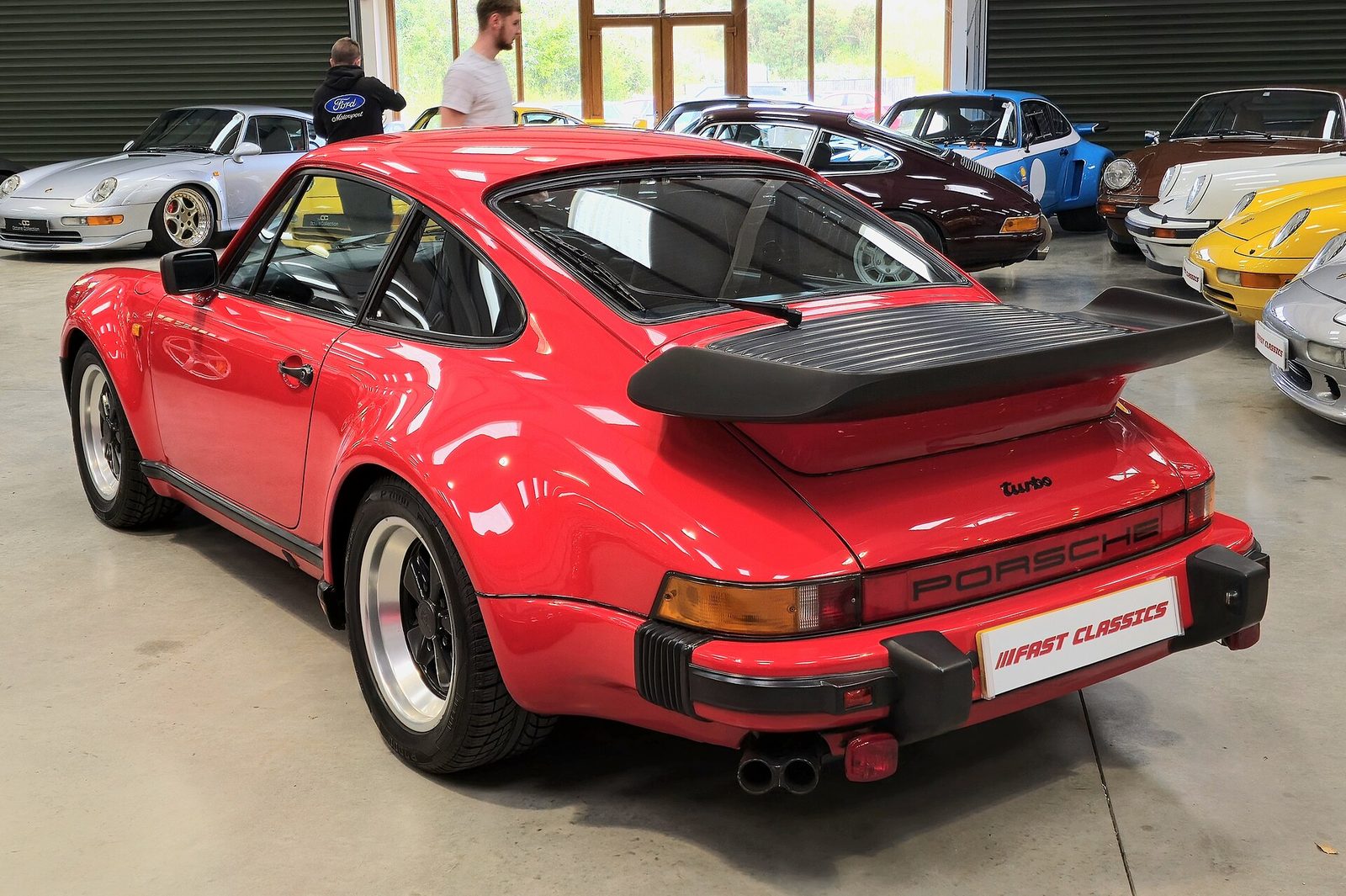
The Porsche 911 Turbo (Type 930) was the fastest production Porsche of its era and the car that made the turbocharged road-going 911 a fixture. Launched for 1975 (unveiled Paris 1974) with a 3.0-liter non-intercooled flat-six and the trademark 'whale-tail' spoiler, it was upgraded for 1978 to a 3.3-liter engine with an air-to-air intercooler nestled under a larger 'tea-tray' wing, lifting Euro output to about 296 hp. It kept a robust four-speed gearbox almost throughout, gaining the Getrag G50 five-speed only for its final 1989 model year. Prodigious turbo lag followed by a violent surge of boost, combined with rearward weight bias and lift-off oversteer, earned it a lasting 'widowmaker' reputation. US buyers lost the car after 1979 on emissions grounds and did not get it back until 1986. Coupe throughout, with Targa and Cabriolet bodies added late, plus rare factory slant-nose Flachbau cars. Today it is a blue-chip air-cooled collectible.
911 Turbo
930
21,589 built · Coupe · Targa · Cabriolet
How rare is it?
With about 21,589 built, the Porsche 911 Turbo is rarer than a 240Z (~160k) yet more common than a DeLorean (~9k).
Approximate total production placed on a log scale against well-known reference cars, for scale only. Figures and any disputes are detailed in the production notes and sources.
History
Origins and the 3.0 (1975-1977)
Conceived partly to homologate turbo racing technology, the 930 debuted at the 1974 Paris show and reached customers in 1975. Its 3.0-liter flat-six used a single KKK turbocharger and produced about 256 hp in European trim; it was the first production Porsche with a boost-pressure-controlled turbo. Fully trimmed with leather and air conditioning, it was a luxury flagship as much as a performance car, distinguished by flared arches and the rubber-lipped 'whale-tail'.
The 3.3 intercooled car (1978 on)
For 1978 Porsche enlarged the engine to 3.3 liters and added an air-to-air intercooler under a bigger, squared-off 'tea-tray' spoiler, raising Euro output to roughly 296 hp and adding cross-drilled brakes derived from the 917. Sources differ on the exact intercooler/3.3 changeover being an '78 model-year event, but agree it was the defining mid-life upgrade. The 'Carrera' suffix was dropped and the cars simply wore 'Turbo' script.
The widowmaker character
The 930's charm and menace came from the same trait: heavy turbo lag followed by an abrupt rush of boost, delivered to a tail-heavy chassis prone to lift-off oversteer. Mishandled, it bit hard, cementing the 'widowmaker' nickname. The tough four-speed gearbox stayed until the Getrag G50 five-speed arrived for the 1989 finale.
US gap and the slant-nose
Facing tightening US emissions rules, Porsche withdrew the Turbo from North America after the 1979 model year; it returned for 1986. During the gap and after, the factory's Sonderwunsch/Exclusive department built 935-style Flachbau 'slant-nose' cars to order (about 948 total). Targa and Cabriolet bodies joined the coupe late in the run.
Common Problems
Turbo lag is inherent, not a fault, but demands respect on the road. Watch for tired KKK turbochargers, boost leaks and heat-soaked intercoolers; oil leaks from the air-cooled flat-six; worn valve guides and top-end wear on high-mile 3.3s; and the fragility/notchiness of the four-speed if abused. Chassis and suspension bushings, plus prior crash damage from lift-off oversteer incidents, are key risks. Slant-nose and modified cars require careful authentication.
What to Look For
Documented service history and matching-numbers engine/gearbox; the 3.3 top-end and intercooler condition; evidence of proper turbo and boost-system health. Confirm originality of slant-nose cars (factory Flachbau vs later conversions) as this hugely affects value. Prize 1989 G50 five-speed coupes. Inspect for accident repair given the car's spin-prone reputation, and for rust in the usual G-body areas despite galvanizing. US 1986-on cars carry emissions equipment; verify completeness.
Market Notes
Snapshot mid-2020s (data through late 2024/2025): the 930 is an established air-cooled blue-chip. Marketplace aggregator classic.com listed an average sale near $215,000 across the 930 Turbo group, though that average is skewed upward by rare slant-nose and low-mile cars; ordinary coupes trade well below it, with a documented low around $33,600 (a 1976) and slant-noses reaching into the $400,000s (e.g., a 1989 slant-nose at $425,000). Hagerty's market history charts a rise from roughly $40,000 (2010) to a ~$148,000 average peak in 2016, a softening toward 2020, then a renewed surge in 2021-2022 when scores of cars cleared $200,000. Values are known for volatility. Premiums attach to 1989 G50 five-speed coupes, factory Flachbau cars, and unmodified, documented, matching-numbers examples.
Where sources differ
Total 930 Turbo production was approximately 21,589 (about 2,819 of the 3.0 and 18,770 of the 3.3).
Third-party references (Wikipedia, StuttCars) cite ~2,819 3.0-liter and ~18,770 3.3-liter cars (~21,589 total). Porsche's own retrospective cites ~2,850 first-version cars and 17,792 of the 3.3 (~20,600 total). Exact figures vary by source and by how special/Exclusive cars are counted.
Targa and Cabriolet body styles were added to the coupe line late in the run.
Wikipedia states the Targa and Cabriolet were introduced in 1986; StuttCars and several other outlets state the 1987 model year. The car remained a coupe-only line before this addition.
Sources
- A brief history of the Porsche 911 Turbo, Porsche AG · manufacturer
- Model Guide: Porsche 911 Turbo — 1976-2013, Porsche Club of America · club-forum
- 50 Years of the Porsche 911 Turbo, Hagerty · journalism
- The rise, fall, and resurgence of Porsche's 911 Turbo (930), Hagerty · journalism
- Porsche 911 (930), Wikipedia · reference-book
- Porsche 911 Turbo 3.3 (930) (1978-1989), StuttCars · journalism
- Porsche 911 3.3 Turbo (930) Guide, Supercar Nostalgia · journalism
- Porsche 911 Turbo — 930 Market, classic.com · registry
Synthesized from the sources above and cross-checked. We cite and link out; we do not republish other databases verbatim.
Fully Sorted is an independent publisher and is not affiliated with, endorsed by or sponsored by Dr. Ing. h.c. F. Porsche AG. Porsche and the model names on this page are trademarks of Dr. Ing. h.c. F. Porsche AG and are used here only to identify the cars being described.
Chassis register
Nobody has recorded a car here yet. Own one, or know one? Chassis number, what you can prove about it, and a source if there is one. Every entry is reviewed before it appears.
Nerd Notes
What owners know that the sources don't. Every note is read and checked before it appears here.
Key Specs
- Brakes
- Four-wheel discs; cross-drilled 917-derived discs from 1978
- Spoiler
- 'Whale-tail' rubber-lipped rear spoiler (1975-77), enlarged squared 'tea-tray' from 1978 to house the intercooler
- TopSpeed
- ~155-162 mph
- Torque3 3
- ~304 lb-ft / 304 lb-ft @ 4,000 rpm
- CurbWeight
- ~2,866 lb (3.3L; ~2,635 lb for early 3.0L)
- EngineLayout
- Rear-mounted, air-cooled turbocharged flat-six
- Transmission
- 4-speed manual (930-series) 1975-1988; Getrag G50 5-speed manual for 1989
- ZeroTo100kmh
- ~5.0-5.4 sec (Euro factory)
- Power3 0 euro
- 256 hp / 256 hp @ 5,500 rpm
- Power3 3 euro
- 296 hp / 296 hp @ 5,500 rpm
- Displacement3 0
- 2,994 cc
- Displacement3 3
- 3,299 cc
Notable Variants
911 Turbo Carrera 3.0
Original 1975-77 non-intercooled car; ~256 hp Euro spec, lower for early US 'Turbo Carrera' emissions versions.
911 Turbo 3.3
1978-on intercooled car with the enlarged 'tea-tray' whale-tail; ~296 hp Euro spec.
Flachbau / Turbo 'Slantnose' (Sonderwunsch/Exclusive)
935-style flat-nose bodywork built to order; about 948 made, roughly 160 US-imported; a Turbo S Flachbau was catalogued from 1987.
1989 G50 Turbo
Final model year, first and only 930 with the Getrag G50 five-speed gearbox; often the most sought coupe.
Value Trajectory
From cheap-to-modify used exotic in the 2000s to blue-chip collectible: values climbed sharply to a 2016 peak (~$148k average per Hagerty), corrected toward 2020, then surged again in 2021-2022. As of the mid-2020s the market is mature and stratified - strong for rare and original cars (slant-nose, 1989 G50, low-mileage), softer and more volatile for ordinary driver-grade coupes.
Market Snapshot
Range $46,000 – $214,000
Next
Shopping for one?
Browse Porsche listings, or decode a VIN before you buy.