
The 996 is the 911 that saved Porsche. Sold in the United States from the 1999 model year, it was the first water-cooled 911, the first with a completely new body since 1963, and the first to share its front end, interior and much of its engineering with the cheaper Boxster. The M96 flat-six made 296 hp from 3.4 liters, then 300 hp with electronic throttle for 2000, then 320 hp from 3,596 cc when the 2002 facelift swapped the Boxster-shared headlights for Turbo-style units. Carrera 4, Cabriolet, Targa, the wide-bodied Carrera 4S and a 1,963-car 40th Anniversary edition filled out the range, and the 2001-2005 Turbo and 2005 Turbo S used a different, race-derived Mezger engine with none of the M96's weaknesses. Those weaknesses, an intermediate shaft bearing that fails outright on a small share of cars, rear main seal leaks and bore scoring, are why the 996 is the cheapest way into a 911 as of September 2026. Porsche sold roughly 175,000 of them; the record of what has been done about the bearing is worth more than most options.
911
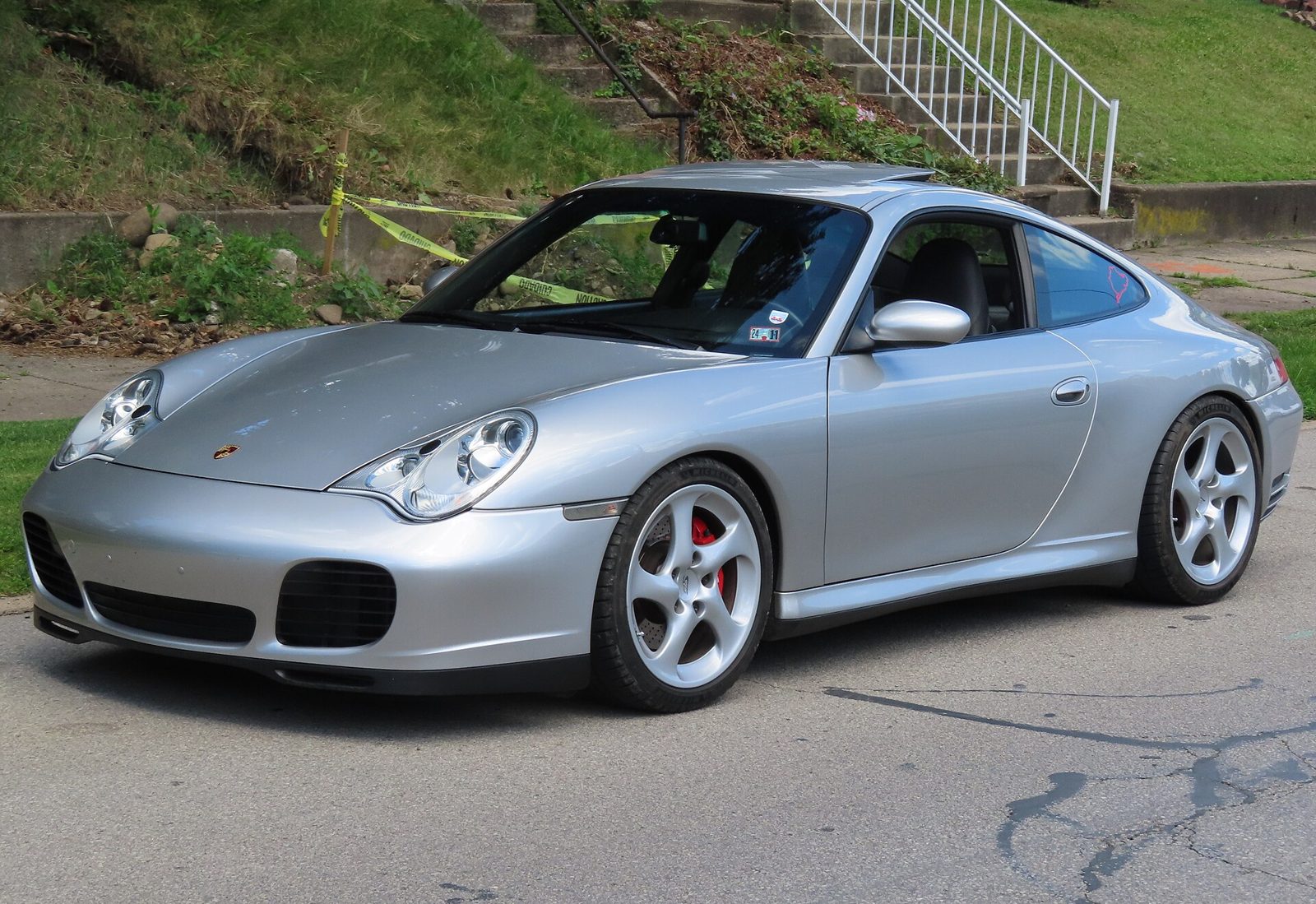
996 Carrera
History
Why Porsche built a 911 out of Boxster parts
By the mid-1990s Porsche was losing money on three separate car lines and its air-cooled flat-six could not meet the emissions and noise rules coming its way. August Achleitner, who ran vehicle concepts from 1989 to 2000, put it plainly in Porsche's 25th anniversary release: the company needed a cheaper car for volume, which led to the Boxster and the 996 sharing parts. The program was sized to sell at least 30,000 of the two cars a year with a good return. Under chief designer Harm Lagaay, Pinky Lai's 996 was built identically to the Boxster from the nose to the B-pillar, down to a headlight module that combined five functions in one cheap unit. The Boxster launched in 1996, the 996 was shown at Frankfurt in 1997, and Porsche sold more than 30,000 a year, roughly 175,000 in all.
1999-2001: the 3.4 and the cable throttle
The 996 Carrera arrived in the United States for the 1999 model year as a coupe and a Cabriolet, the first 911 with no air-cooled engine behind it. The M96 made 296 hp and 258 lb-ft, 24 hp and 15 lb-ft more than the 993, in a car PCA puts around 2,900 lb as an early manual coupe. Road & Track and Car and Driver both recorded 4.6 seconds to 60 mph. MotorWeek tested a 1999 Cabriolet at $75,225 and 5.0 seconds and noted the plastic rear window, replaced by heated glass for 2002. The 1999 car is the only 996 with a throttle cable; electronic throttle for 2000 brought 300 hp and the option of Porsche Stability Management. The narrow-body Carrera 4 followed about six months after the Cabriolet; its coupe ended after 2001. The press turned on the headlights within months, to the designers' surprise.
2001: the Turbo brings a different engine
The Turbo reached North America for the 2001 model year with the Carrera 4's viscous coupling moved into the front differential, which for the first time allowed a Tiptronic Turbo. Its engine was not an M96 but the Mezger flat-six from the Le Mans-winning 911 GT1, its intermediate shaft on pressure-fed plain bearings, rated at 415 hp and, by MotorWeek's figures, 415 lb-ft. MotorWeek ran it to 60 mph in 4.1 seconds and a 12.6-second quarter at 112 mph, at $111,000 base. From 2002 the X50 power kit with larger turbochargers and intercoolers gave 450 hp and 457 lb-ft. A Turbo Cabriolet came for 2004 and the Turbo S, with X50, carbon-ceramic brakes and a CD changer standard, for 2005.
2002: 3.6 liters, new lights, Targa and Carrera 4S
Displacement rose to 3,596 cc for 320 hp and 273 lb-ft, the body gained thicker-gauge metal in places, and the front end took the Turbo's Bi-Xenon headlights and a reshaped nose. MotorWeek's 2002 Carrera ran 5.0 seconds to 60 mph at $67,900 base. Two new bodies arrived: the Targa, with a sliding glass roof and a rear window that opened as a hatch, at $75,965 and about 150 lb over the coupe, and the Carrera 4S, the 3.6 and all-wheel drive in the Turbo's wide body with its brakes and 18-inch wheels, at $80,965. MotorWeek's C4S and Targa test prints 315 hp for both, five fewer than PCA gives the same engine, which no fetched source explains. A Carrera 4S Cabriolet followed for 2004.
2004: 1,963 silver cars and the end
For the 40th year of the 911 Porsche built 1,963 numbered Carrera coupes in GT Silver Metallic with gray leather, the Turbo front bumper, the X51 power kit at 345 hp by Stuttcars' figure (345 PS in Porsche's release), sport suspension, a limited-slip differential and a manual gearbox only, at $90,565. The 997 replaced the Carrera for 2005; a handful of Carrera 4S were sold as 2005 cars and the Turbo, Turbo S, GT2 and GT3 ran into 2005 and 2006. The GT3, which the US received only for the 2004 model year, and the GT2 are on the separate 911 GT3 (996) page.
Common Problems
The intermediate shaft bearing is the fault that defines the car. The M96 drives its camshafts through an intermediate shaft on a sealed ball bearing, revised three times: a dual row through 1999 and in some 2000 and 2001 engines, a smaller single row with significantly less load capacity from 2000 through 2005, and a larger non-serviceable bearing from 2006. Eisen class action documents cited by LN Engineering put the single-row failure rate at about 8 percent against under 1 percent for the dual row; LN's own projection is 10 percent by 90,000 miles. PCA's tech expert counters that nine of ten original bearings never fail, while conceding that the market prices them as if they will. A failure contaminates the whole engine. Prevention is a retrofit with the engine in the car: LN Engineering prices its ceramic retrofit under $1,000 and the oil-fed IMS Solution under $2,000 for parts, plus 10 to 14 hours of labor adding $500 to $3,000 or more at a US shop, and three to four more hours to borescope the cylinders first. The Turbo, GT2 and GT3 engines run their intermediate shaft on pressure-fed plain bearings and, as PCA states, did not suffer IMS failures. Rear main seal leaks: Wikipedia attributes chronic early cases to improper machining and says the current PTFE seal addresses most of them. Bore scoring and cracked cylinders on both the 3.4 and 3.6 are the other engine-out fault; some early 3.4 blocks left the factory sleeved and a slipped sleeve is a known failure. Water pumps and air-oil separators fail. No fetched US source prices a bore-scoring repair.
What to Look For
The first question on any M96 car is what has been done about the intermediate shaft bearing. A 1999 car has the dual row; a 2002-2004 car the single row; a 2000 or 2001 car could have either, and the only way to know is to look with the transmission out. A retrofit receipt names the kit (LN's ceramic retrofit, the IMS Solution plain bearing, or a Pelican kit) and should sit beside clutch, rear main seal and often air-oil separator invoices from the same visit. LN advises borescoping the cylinders before a retrofit, so a retrofitted car may have a record of its bores. Anything leaking from the bottom of the engine and gearbox, coolant or oil, is a walk-away in PCA's guide. Blue smoke on startup points at the air-oil separator. Cabriolets built through 2001 have a plastic rear window that clouds and cracks; 2002 and later cars have heated glass. On the Turbo there is no IMS exposure; PCA's checklist asks for corrosion checks, suspension on lowered cars and a diagnostic run on Tiptronic cars. A production specification settles X50 on a Turbo and X51 on a 2004 car. A DME over-rev report is standard on any manual 996. Headlights are the easy check: Boxster-shared units to 2001, Turbo-style Bi-Xenons from 2002.
Market Notes
All figures are US dollars, as of September 2026; classic.com figures came through a rendering fetch. classic.com benchmarks the 996.1 Carrera at $27,600, with manual coupes at $30,207 and Tiptronic cars at $22,057 to $22,270; its lowest recorded sale is $4,600 on January 18, 2026. It benchmarks the 996.2 Carrera 4S at $38,515; the only 4S sale fetched directly is RM Sotheby's $49,280 for an 11,700-mile 2004 Cabriolet in St. Louis in 2019. The Turbo page shows 679 sales averaging $60,721, from $23,425 to $182,047; no individual lot was fetched. Turbo S: classic.com's average is $83,050 across 88 sales with a $229,600 top; rows include $119,000 for a 19,000-mile manual coupe on June 7, 2025, $85,000 for a 13,000-mile manual cabriolet on June 10, 2025, $59,000 for a 66,000-mile cabriolet on June 3, 2025 and $70,496 for a 27,000-mile Tiptronic coupe on April 29, 2025. RM Sotheby's sold a 13,000-mile 2005 Turbo S Cabriolet for $112,000 in Atlanta in 2018. 40th Anniversary: benchmark $45,703; Bring a Trailer results of $66,666 (14,000 miles, June 24, 2026), $50,500 (53,000 miles, June 26, 2026), $54,444 (41,000 miles, February 19, 2026) and $40,299 (37,000 miles, March 31, 2026), $55,000 at Barrett-Jackson West Palm Beach on April 18, 2026 with 28,000 miles, $63,250 on PCARMARKET on February 26, 2026 with 13,000 miles, $36,333 on Cars and Bids with 98,000 miles, and a 59,070-mile car with a fresh IMS bearing at $40,500 on PCARMARKET, undated. No 996.2 Carrera result was fetched.
Where sources differ
Production of the 996 Turbo S is disputed: Stuttcars prints approximately 1,500 worldwide, approximately 1,558 sold in 2005 and 600 in total on the same page, while RM Sotheby's catalog copy says roughly 980 were built with 300 cabriolets.
Stuttcars states the Turbo S was limited to approximately 1,500 units worldwide (598 coupes, 960 cabriolets), elsewhere that approximately 1,558 were sold in 2005, and elsewhere a total of 600. RM Sotheby's states roughly 980 were built, 300 of them cabriolets. No manufacturer figure was fetched and the difference is not resolved by any source consulted here.
For 2002 the Carrera engine grew to 3,596 cc with Turbo-style headlights and a reshaped nose; PCA and MotorWeek's Carrera test rate it at 320 hp and 273 lb-ft, but MotorWeek's Carrera 4S and Targa test prints 315 hp for the same engine.
PCA and MotorWeek's 2002 Carrera test give 320 hp for the 3.6, and RM Sotheby's catalog gives 320 hp for the Carrera 4S. MotorWeek's 2002 Carrera 4S and Targa test prints 315 horsepower for both cars. Porsche's own release gives a metric figure equal to about 316 hp (320 PS). Whether the US-market C4S and Targa carried a different rating is not resolved by any source consulted here.
The 40th Anniversary's X51 power kit is printed at 345 hp and 341 hp in two paragraphs of the same Stuttcars page; Porsche's release gives about 340 hp as a metric 345 PS figure.
Porsche's release gives the 40 Years car a metric figure equal to about 340 hp (345 PS). Stuttcars prints 341hp in its model paragraph and 345 hp in its special editions section. No US source states the SAE rating, so the difference is not resolved here.
Sources
- Trailblazer for the future of the 911: 25 years of the 996 generation Porsche 911, Porsche Newsroom USA · manufacturer
- Model Guide: The 996-generation 911 - Part I, Porsche Club of America · club-forum
- Model Guide: Porsche 911 Turbo - 1976-2013, Porsche Club of America · club-forum
- 1999 Porsche 911 Cabriolet, MotorWeek (Maryland Public Television) · journalism
- 2002 Porsche 911 Carrera Program #2124, MotorWeek (Maryland Public Television) · journalism
- 2002 Porsche 911 Carrera 4S & 911 Targa Program #2206, MotorWeek (Maryland Public Television) · journalism
- 2001 Porsche 911 Turbo Program #2001, MotorWeek (Maryland Public Television) · journalism
- Porsche 911 (996) - Ultimate Model Guide, Stuttcars · specialist
- Porsche 911 (996), Wikipedia · encyclopedia
- IMS 101 - IMS Retrofit, LN Engineering (IMS Retrofit) · specialist
- IMS Bearing Replacement Costs - IMS Retrofit, LN Engineering (IMS Retrofit) · specialist
- 2005 Porsche 911 Turbo S Cabriolet | The Porsche 70th Anniversary Auction | RM Sotheby's, RM Sotheby's · auction-house
- 2004 Porsche 911 Carrera 4S Cabriolet | The Guyton Collection | RM Sotheby's, RM Sotheby's · auction-house
- 2004 Porsche 911 40th Anniversary | PCARMARKET, PCARMARKET · auction-house
- Porsche 911 Carrera - 996.1 Market - CLASSIC.COM, CLASSIC.COM · market-data
- Porsche 911 Turbo - 996.2 Market - CLASSIC.COM, CLASSIC.COM · market-data
- Porsche 911 Turbo S - 996.2 Market - CLASSIC.COM, CLASSIC.COM · market-data
- 2004 Porsche 911 40th Anniversary - 996.2 Market - CLASSIC.COM, CLASSIC.COM · market-data
- Porsche 911 Carrera 4S - 996.2 Market - CLASSIC.COM, CLASSIC.COM · market-data
Synthesized from the sources above and cross-checked. We cite and link out; we do not republish other databases verbatim.
Fully Sorted is an independent publisher and is not affiliated with, endorsed by or sponsored by Dr. Ing. h.c. F. Porsche AG. Porsche and the model names on this page are trademarks of Dr. Ing. h.c. F. Porsche AG and are used here only to identify the cars being described.
Chassis register
Nobody has recorded a car here yet. Own one, or know one? Chassis number, what you can prove about it, and a source if there is one. Every entry is reviewed before it appears.
Nerd Notes
What owners know that the sources don't. Every note is read and checked before it appears here.
Key Specs
- Power
- 296 hp (1999); 300 hp (2000-2001); 320 hp (2002-2004 3.6, with 315 hp printed by MotorWeek for the C4S and Targa); 345 hp (40th Anniversary, X51, per Stuttcars, and a metric 345 PS in Porsche's release); 415 hp (Turbo); 450 hp (Turbo X50 per PCA; Turbo S per RM Sotheby's, with PCA printing 444 hp)
- Engine
- M96 water-cooled flat-six, 3.4 liters (1999-2001) and 3,596 cc (2002-2004); Turbo and Turbo S use the 3.6-liter twin-turbocharged Mezger-architecture engine derived from the 911 GT1
- Layout
- Rear-mounted flat-six; rear-wheel drive (Carrera, Targa, 40th Anniversary) or all-wheel drive (Carrera 4, Carrera 4S, Turbo, Turbo S); 2+2
- Torque
- 258 lb-ft (3.4); 273 lb-ft (3.6); 415 lb-ft per MotorWeek or 413 lb-ft per PCA (Turbo); 457 lb-ft (X50 and Turbo S)
- Weight
- Around 2,900 lb for an early manual Carrera coupe, under 3,000 lb later, per PCA; Targa about 150 lb more per MotorWeek; no Turbo curb weight fetched
- Chassis
- Steel unibody shared with the 986 Boxster forward of the B-pillar; body reinforced for 2002; wide Turbo shell on Carrera 4S, Turbo and Turbo S
- Redline
- 7,300 rpm (3.6 Carrera 4S, MotorWeek)
- Us msrp
- $75,225 (1999 Carrera Cabriolet); $67,900 (2002 Carrera coupe); $75,965 (2002 Targa); $80,965 manual and $84,395 Tiptronic (2002 Carrera 4S); $111,000 (2001 Turbo); $90,565 (2004 40th Anniversary); each single-sourced, see productionNotes
- Top speed
- 189 mph (2001 Turbo, MotorWeek); 190 mph (Turbo S, RM Sotheby's catalog); no fetched US source gives a Carrera figure
- Headlights
- Boxster-shared units with integrated turn signals 1999-2001; Turbo-style Bi-Xenon HID units and a reshaped nose from 2002
- Acceleration
- 0-60 mph: 5.0 sec (1999 Cabriolet and 2002 Carrera, MotorWeek tests); 4.6 sec (1999 coupe, Road & Track and Car and Driver as cited by PCA); 5.2 sec (2002 Carrera 4S, MotorWeek); 4.1 sec (2001 Turbo, MotorWeek; 2005 Turbo S, RM Sotheby's catalog)
- Braking 60 0
- 103 ft (1999 Cabriolet); 118 ft (2002 Carrera); 124 ft (2002 Carrera 4S); 120 ft (2001 Turbo); MotorWeek
- Quarter mile
- 13.5 sec at 102 mph (1999 Cabriolet); 13.5 sec at 107 mph (2002 Carrera); 13.7 sec at 105 mph (2002 Carrera 4S); 12.6 sec at 112 mph (2001 Turbo); all MotorWeek
- Transmission
- Six-speed manual with cable shift linkage standard; five-speed Tiptronic S automatic optional on every variant except the 40th Anniversary
- Epa fuel economy
- 18 mpg city, 26 mpg highway (2002 Carrera and Carrera 4S, MotorWeek); 15 city, 22 highway (2001 Turbo, MotorWeek)
- Wheels and tires
- 18-inch Turbo wheels with 295/30 rear tires on the Carrera 4S; shot-blasted 18-inch Carrera II wheels on the 40th Anniversary
Notable Variants
1999 Carrera coupe (3.4, cable throttle)
The only 996 with a throttle cable, 296 hp and 258 lb-ft, and the lightest of the line at around 2,900 lb for an early manual coupe. Model year 1999 cars carry the dual-row IMS bearing, far more durable than the single row that followed.
2000-2001 Carrera and Carrera 4 (3.4, e-gas)
Electronic throttle brought 300 hp and made Porsche Stability Management available. IMS crossover years: dual-row or single-row, and only a visual inspection tells which. The narrow-body Carrera 4 coupe ended after 2001.
2002-2004 Carrera and Targa (3.6, facelift)
3,596 cc, 320 hp and 273 lb-ft, Turbo-style headlights replacing the Boxster-shared units, a stiffer shell and a heated glass rear window in the Cabriolet. MotorWeek tested the coupe at 5.0 seconds to 60 mph at $67,900.
2002-2005 Carrera 4S
Turbo body, brakes and 18-inch wheels on the naturally aspirated 3.6 with all-wheel drive. Coupe only in 2002 and 2003, Cabriolet from 2004, a few sold as 2005 models. $80,965 new with the manual. classic.com prints 23,055 built.
2004 40th Anniversary
1,963 cars, all GT Silver Metallic with gray leather, Turbo front bumper, X51 power kit, sport suspension, limited-slip differential and a six-speed manual only. $90,565 new. PCA's tech expert calls it his favorite 996.
2001-2005 Turbo
415 hp and 415 lb-ft from the GT1-derived Mezger engine, all-wheel drive, manual or Tiptronic, $111,000 in 2001. Not an M96, so no IMS bearing exposure. X50 power kit from 2002 gave 450 hp; Cabriolet added for 2004.
2005 Turbo S
A Turbo with the X50 kit, carbon-ceramic brakes and a CD changer as standard, 450 hp, coupe or cabriolet. Production is disputed: Stuttcars prints 1,500, 1,558 and 600 on one page and RM Sotheby's says roughly 980. classic.com averages it at $83,050 as of September 2026.
GT3 and GT2 (separate page)
The 996 GT3 came to the US for the 2004 model year only and the GT2 for 2002-2005; both use the Mezger engine and are covered on the 911 GT3 (996) page.
Value Trajectory
The 996 Carrera has been the entry point to the 911 for most of two decades, and as of September 2026 classic.com's $27,600 benchmark for a 996.1 Carrera, with a $4,600 floor in January 2026, says it still is. The gap between a manual coupe at $30,207 and a Tiptronic car around $22,000 is the spread that matters more than year. The special cars separated from that base some time ago. The 40th Anniversary, which cost $90,565 new, now benchmarks at $45,703 with the best low-mile cars at $63,250 to $66,666 in the first half of 2026 and high-mile cars in the high $30,000s to mid $40,000s. The Turbo S shows the same shape higher up: $112,000 for a 13,000-mile Cabriolet at RM Sotheby's in 2018, and in mid-2025 $119,000 for a 19,000-mile manual coupe against $59,000 for a 66,000-mile cabriolet, with an 88-sale average of $83,050. The Turbo averages $60,721 across 679 sales, and the Carrera 4S benchmarks at $38,515, less than half its list price. Mileage and IMS paperwork explain more of the spread than the year does. None of this is a forecast.
Market Snapshot
Range $46,000 – $214,000
Next
Shopping for one?
Browse Porsche listings, or decode a VIN before you buy.