
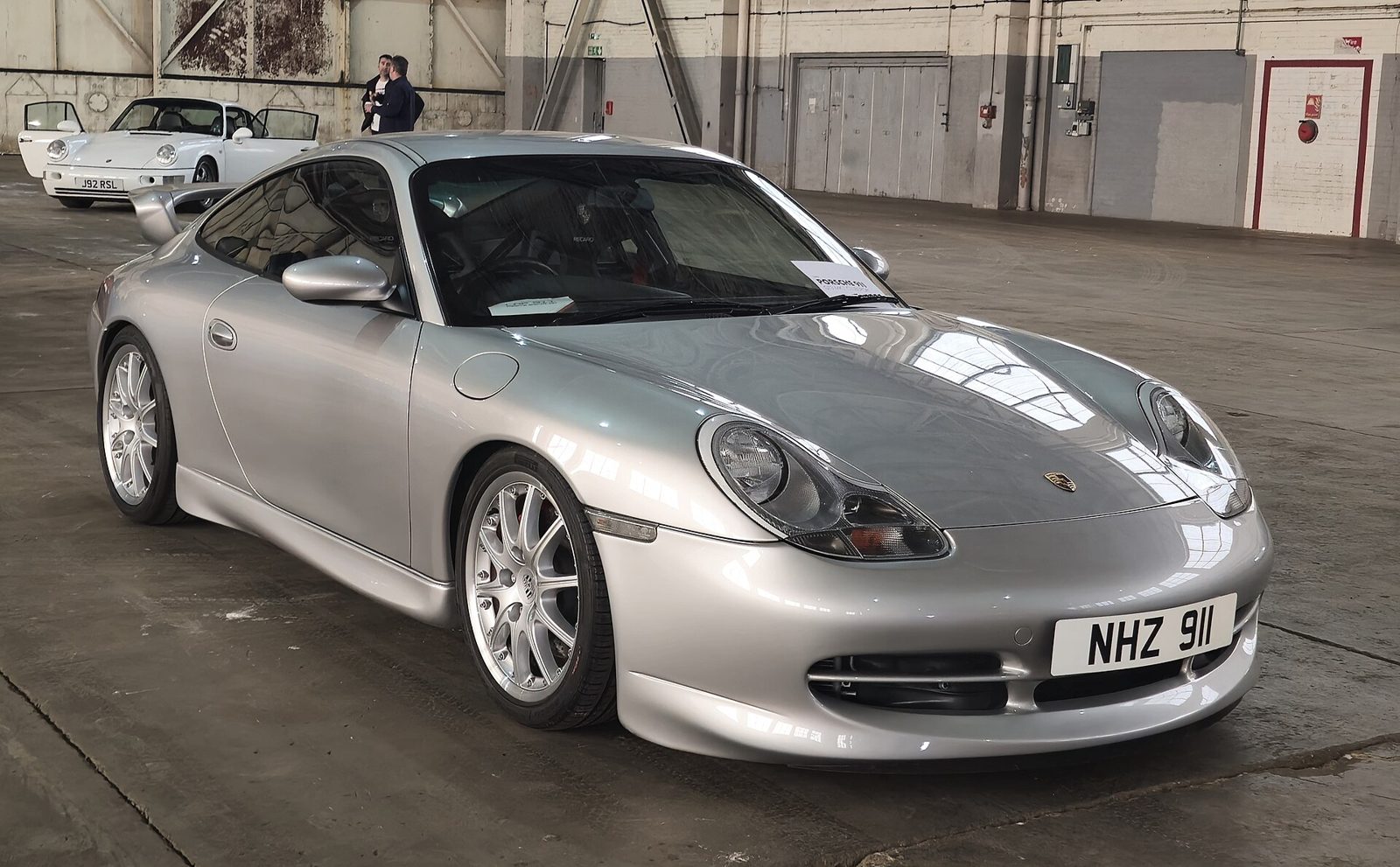
The 996-generation 911 GT3 reached the United States late and briefly. The original 1999 car, a 355 hp (360 PS) homologation special built around a dry-sump flat-six descended from the Le Mans-winning 911 GT1, was never sold here. The revised car arrived for the 2004 model year with 381 hp by Porsche's US rating, an 8,200 rpm redline, a six-speed manual and nothing else, and it was gone after 2005. A Porsche Club of America member's compilation of Porsche Cars North America's monthly announcements puts the US total at 959 cars. MotorWeek's test car carried a base sticker of $101,965 with freight and gas guzzler tax. Its engine is the point: this is the Hans Mezger architecture shared with the 996 Turbo and the rear-drive GT2, not the M96 of the Carrera, so the intermediate-shaft bearing that defines 996 ownership conversations does not apply. What does apply is a set of glued coolant fittings that every specialist wants pinned or welded. As of September 2026 classic.com benchmarks the 996.2 GT3 at $118,118 against $60,721 average for a 996 Turbo, and the twin-turbo GT2 at $184,329.
911 GT3
996
History
Why the GT3 exists, and why America waited
The GT3 was a homologation car named for the FIA's GT3 class, and its purpose was to give Porsche's customer racing program a production base. Porsche's own retrospective describes the first car, unveiled in 1999, as powered by a 3.6-liter naturally aspirated flat-six derived from the Le Mans-winning 911 GT1 race car, revving to 7,800 rpm, weighing 2,976 lb and reaching a top track speed of 187 mph, with a six-speed manual as the only gearbox. Classic Motorsports records that Porsche planned an initial run of 1,350 and the factory reported delivering 1,868. None of them came to the United States. Porsche's US newsroom is direct about it: the GT3 was offered in North America for the first time with the 2004 model year updates, and Stuttcars puts it the same way, that it was not until 2004 that North America got its first taste of the GT3 for local buyers.
The engine that skipped the IMS problem
The reason the car matters to a US buyer today is what sits behind the rear axle. RM Sotheby's catalog copy names it plainly: a water-cooled engine derived from the 911 GT1 racecar that won the 1998 24 Hours of Le Mans, named after its designer Hans Mezger. The Carrera of the same years used the M96, whose intermediate-shaft bearing has its own reputation. The GT3, the Turbo and the GT2 use the older race-derived block with a dry sump and a different bottom end, which is why a 996 GT3 ownership conversation is about coolant fittings, clutches and gearboxes, not bearings. The 997 GT3 that succeeded it kept the architecture through 2011.
996.2: the US car, 2004-2005
For the 2004 model year Porsche's retrospective gives horsepower of 381, torque up from 273 to 285 lb-ft, redline raised to 8,200 rpm, 0-60 mph in 4.3 seconds and a top track speed of 190 mph. MotorWeek tested one at 4.5 seconds to 60 and 12.9 seconds at 112 mph in the quarter mile, weighed it at 3,043 lb and stopped it from 60 in 114 ft, all on a base sticker of $101,965 with freight and gas guzzler tax. The Clubsport package with its roll cage was not offered here, and Classic Motorsports calls US production very limited because the car was sold here for the 2004 and 2005 model years only. The PCA member compilation of PCNA's monthly announcements tells the story in detail: 11 cars in May 2003, 257 by the end of that calendar year, 607 through 2004, and a trickle of 95 in 2005 ending at 959.
The RS that stayed home
The 2004 GT3 RS used the same 381 hp engine in a lighter shell: an acrylic rear window, carbon fiber reinforced hood and rear wing, suspension lowered 0.4 in (10 mm) on stiffer springs and dampers, and Pirelli P Zero Corsa tires. Stuttcars reproduces the launch text, which says the RS was to be sold worldwide with the exception of the USA and Canada, and gives 682 built; Wikipedia's table agrees. Any 996 RS in the US today is a later import, and that history is part of the car.
The GT2: the same engine, turbocharged
The GT2 is the Mezger engine with the Turbo's two turbochargers and the Turbo's wide body, but rear-wheel drive because, as classic.com's description puts it, GT2 class racing prohibited all-wheel drive. MotorWeek's 2002 test recorded 456 hp, 457 lb-ft, 3,175 lb, 0-60 in 3.9 seconds, a 12.4 second quarter mile at 118 mph, ceramic brakes as standard and a price of $180,665. Wikipedia records the later cars at 476 hp. Unlike the GT3 it was sold here from the start, and two US listings put the US share at about 303 cars, both hedged with reportedly.
Common Problems
The coolant fitting problem leads every guide because of how it fails. Sharkwerks explains that there is no metal-to-metal friction or press fit holding the tubes in the cast housings; after enough heat cycles the adhesive softens and the tube can come out of the block. The consequence is a sudden coolant dump, and on a track that is slippery coolant across the rear tires; Sharkwerks describes a GT3 that put out a cloud of steam and spun at a hairpin. Their fix drills through the casting into the tube and secures a bolt; other shops weld. Sharkwerks says the problem may eventually affect all 996 and 997 Turbo, GT2 and GT3 models, and Classic Motorsports puts it the same way for the GT3: if they get hot enough for long enough, the aluminum tubes epoxied into the housings come loose. Grassroots Motorsports' guide adds the rest of the list. Clutches, water pump and thermostat, brake consumables and wheel bearings are normal maintenance. Oil changes every 3,000 miles on a street car and every 1,200 miles with track use. The gearbox should be inspected on a schedule set by events and hours, and the limited-slip differential is a replacement item once it has timed out because the differential body can fracture. The non-RS cars have the dual-mass flywheel concerns of any manual 996. No source fetched for this page documents a GT3-specific rear main seal failure rate or a US dollar cost for the coolant fitting work, the clutch or a PCCB rotor set, so those are left unstated rather than guessed. Nothing fetched here associates the GT3, GT2 or Turbo with the intermediate-shaft bearing failures of the M96 Carrera engine.
What to Look For
Start with the engine's history rather than its reputation. The Mezger flat-six does not have the intermediate-shaft bearing, but it does have coolant fittings held in with adhesive, and the first question on any 996 GT3 or GT2 is whether they have been pinned or welded, by whom, and with what receipt. Grassroots Motorsports' technician says the water pipes are a must to have welded and that most still are not, which means most cars for sale have not had it done. A DME over-rev report is the second document. The 8,200 rpm redline and a manual gearbox mean a missed downshift leaves a record, and the ranges and their timestamps tell more about the car's life than the odometer does. Ask about the clutch and dual-mass flywheel, which Classic Motorsports flags on the non-RS cars, and about the limited-slip differential, which the Grassroots Motorsports guide says can fracture its body when it has timed out. On a car that has been raced or tracked, ask for the gearbox service history by events and hours, which is how the same guide says it should be judged. Check whether the brakes are iron or ceramic: PCCB was optional on the GT3 and standard on the GT2, and a set of ceramic rotors is the most expensive consumable on the car. The 996-wide items still apply: HVAC evaporator, ignition switch, coolant expansion tank, tie rod and control arm squeaks. On paperwork, a US-delivered car will show a build in the May 2003 to late 2005 window; a 996.1 or a GT3 RS in the US arrived by import and needs its entry documents. The RM Sotheby's Magnus Walker car shows a typical US option list: xenon headlamps, carbon interior trim, natural leather, carbon and aluminum shifter and hand brake. classic.com marks modified GT2s as such in its rows, and they trade below the unmodified cars.
Market Notes
All figures are US dollars, US sales only, as of September 2026. classic.com benchmarks the 996.2 GT3 at $118,118 with an average sale of $112,054 and a lowest recorded sale of $47,751 in June 2022. The recent rows it lists run in both directions: $209,996 on Bring a Trailer on August 25, 2026 for a 2004 car with 18,000 miles in New York, $152,996 on Bring a Trailer in June 2026 with 32,000 miles, $134,000 on Bring a Trailer on September 9, 2026 with 43,000 miles, and $85,000 on PCARMARKET on August 31, 2026 with 28,000 miles. A lot page fetched directly from RM Sotheby's adds a 66,753-mile Arctic Silver 2004 car from the Magnus Walker collection sold in Los Angeles in 2026 for $159,500; the page does not say whether that figure includes the buyer's premium. Against that, classic.com's 996.2 Turbo page shows an average of $60,721 across 679 sales, with a 2004 manual coupe at $69,911 in June 2025 and a 2001 Tiptronic at $56,993, so a GT3 has been trading at roughly twice a Turbo. The GT2 sits higher: classic.com benchmarks the standard car at $184,329 and the Clubsport at $171,440, with a 45,000-mile 2003 car at $262,777 on Bring a Trailer on August 27, 2026 and a modified 2002 at $174,996 in June 2026. A 15,000-mile 2002 GT2 sold on Bring a Trailer in November 2025 for $211,996 against the $186,205 its first owner paid in 2002, and a 37,722-mile 2002 car sold on PCARMARKET in Maryland for $146,000.
Where sources differ
Total production of the 996.2 GT3 is given as 2,589 by Stuttcars, 2,313 by the Wikipedia specification table and 4,457 by classic.com's model description; no manufacturer figure was found and the three do not agree.
Stuttcars prints 2,589 units for the 996.2 GT3. Wikipedia's table prints 2,313. classic.com's description states 4,457 units built over 2004-2005. None of the three names a Porsche document, and nothing fetched explains whether classic.com's figure includes another variant. Not resolved by any source consulted here.
Porsche's US retrospective rates the 2004 GT3 at 381 horsepower with an 8,200 rpm redline, while MotorWeek and Classic Motorsports print 380 horsepower and Wikipedia's table prints 376 hp as the conversion of 381 PS.
Porsche Newsroom USA states horsepower grew to 381. MotorWeek's test and the Classic Motorsports guide both say 380 horsepower. Wikipedia's table gives 376 hp (381 PS), treating 381 as a metric rating. Whether Porsche's US figure is SAE horsepower or the PS number relabeled is not settled by any page fetched here.
Porsche's US retrospective claims 0-60 mph in 4.3 seconds and a 190 mph top track speed for the 2004 GT3; Classic Motorsports attributes 4.5 seconds and 188 mph to Porsche, and MotorWeek tested 4.5 seconds with a 12.9 second quarter mile at 112 mph.
Porsche Newsroom USA states 4.3 seconds and 190 mph. Classic Motorsports says that according to Porsche the time fell from 4.8 to 4.5 seconds and the top speed is 188 mph. MotorWeek's instrumented 4.5 seconds is a test, not a claim. Which figure Porsche published in 2003 for the US car is not resolved by any page fetched here.
Sources
- Porsche celebrates the 911 GT3: 25 years of performance and passion, Porsche Newsroom USA · manufacturer
- 2004 Porsche 911 GT3 Program #2307, MotorWeek (Maryland Public Television) · journalism
- Tech Q&A - 996 Gt3 Production Numbers, Porsche Club of America · club-forum
- Porsche 911 GT3 (996.2) (2004 - 2005), Stuttcars · specialist
- How to keep a 996-Chassis Porsche 911 GT3 running like new, Grassroots Motorsports · journalism
- The Shark Werks GT1 Coolant Pipe Prevention / Fix on GT1 block (GT3, GT3RS, GT2, Turbo) Porsche Cars, Sharkwerks · specialist
- Porsche 911 GT3 - 996.2 Market - CLASSIC.COM, CLASSIC.COM · market-data
- 996 Porsche 911 GT3: Buy one now? | Buyer's Guide, Classic Motorsports · journalism
- Porsche 911 GT2 - 996.2 Market - CLASSIC.COM, CLASSIC.COM · market-data
- 2004 Porsche 911 GT3 | Magnus Walker: The Outlaw Collection | RM Sotheby's, RM Sotheby's · auction-house
- Man Buys New 2002 Porsche 911 GT2 for $186,205, Sells for $211,996 After 23 Years, autoevolution · journalism
- Porsche 911 Turbo - 996.2 Market - CLASSIC.COM, CLASSIC.COM · market-data
- Porsche 911 GT3 RS (996.2) (2004), Stuttcars · specialist
- Porsche 911 GT3, Wikipedia · encyclopedia
- Porsche 911 GT2, Wikipedia · encyclopedia
- 2002 Porsche GT2 - Audrain Auto Museum, Audrain Auto Museum · specialist
- 2002 Porsche 911 GT2 | PCARMARKET, PCARMARKET · market-data
- 2002 Porsche 911 GT2, MotorWeek (Maryland Public Television) · journalism
Synthesized from the sources above and cross-checked. We cite and link out; we do not republish other databases verbatim.
Fully Sorted is an independent publisher and is not affiliated with, endorsed by or sponsored by Dr. Ing. h.c. F. Porsche AG. Porsche and the model names on this page are trademarks of Dr. Ing. h.c. F. Porsche AG and are used here only to identify the cars being described.
Chassis register
Nobody has recorded a car here yet. Own one, or know one? Chassis number, what you can prove about it, and a source if there is one. Every entry is reviewed before it appears.
Nerd Notes
What owners know that the sources don't. Every note is read and checked before it appears here.
Key Specs
- Power
- 381 hp at 7,400 rpm (996.2 GT3 and RS, Porsche US rating; MotorWeek prints 380 and Wikipedia's table 376 hp); 355 hp (360 PS) at 7,800 rpm (996.1); 456 hp at 5,700 rpm, later 476 hp (GT2). Manufacturer figures
- Tires
- Pirelli P Zero Corsa on the GT3 RS per Porsche's launch text
- Brakes
- Six-piston front calipers with 13.8 in (350 mm) front rotors (996.2 GT3); PCCB ceramic rotors optional on the GT3 and standard on the GT2; 60-0 mph in 114 ft (GT3) and 121 ft (GT2) by MotorWeek
- Engine
- 3.6-liter naturally aspirated dry-sump flat-six, M96/79 code per Stuttcars, derived from the 911 GT1 race engine and credited to Hans Mezger; twin-turbocharged in the GT2
- Layout
- Rear-mounted flat-six, rear-wheel drive, two seats (GT3, GT3 RS and GT2 alike)
- Torque
- 284 lb-ft at 5,000 rpm (996.2 GT3, up from 273 lb-ft on the 996.1); 457 lb-ft at 3,500-4,500 rpm (GT2)
- Weight
- 3,043 lb (2004 GT3, MotorWeek); 3,042 lb (Wikipedia table); 2,976 lb (996.1, Porsche); 2,998 lb with a full tank (GT3 RS, Wikipedia); 3,175 lb (GT2, MotorWeek)
- Chassis
- Steel 996 unibody; narrow Carrera shell on the GT3 and RS, wide Turbo shell on the GT2; RS adds acrylic rear window and carbon fiber reinforced hood and wing
- Redline
- 8,200 rpm (996.2 GT3); 7,800 rpm (996.1)
- Us msrp
- $101,965 base sticker including freight and gas guzzler tax (2004 GT3, MotorWeek); pre-destination list price not documented; $180,665 (2002 GT2, MotorWeek)
- Top speed
- 190 mph top track speed (2004 GT3, Porsche); Classic Motorsports prints 188 mph; 187 mph (996.1); 198 mph (GT2). Manufacturer figures
- Acceleration
- 0-60 mph: 4.3 sec claimed by Porsche's US retrospective and 4.5 sec tested by MotorWeek (2004 GT3); Classic Motorsports attributes 4.5 sec to Porsche; 3.9 sec (GT2, MotorWeek)
- Quarter mile
- 12.9 sec at 112 mph (2004 GT3, MotorWeek test); 12.4 sec at 118 mph (2002 GT2, MotorWeek test)
- Transmission
- Six-speed manual only on every variant; limited-slip differential; dual-mass flywheel on the non-RS cars
- Us availability
- 996.2 GT3 sold in the US for the 2004 and 2005 model years only; 996.1 GT3 and 996 GT3 RS never sold new in the US or Canada; GT2 sold in the US
Notable Variants
996.2 GT3, US 2004-2005 model years
The only 996 GT3 sold new in the United States: 381 hp by Porsche's US rating, 8,200 rpm redline, six-speed manual only, cast iron brakes standard with PCCB optional. The Clubsport package with roll cage and buckets was not offered here. About 959 US cars by the PCA member compilation, most of them delivered in calendar 2003 and 2004.
996.1 GT3, 1999-2001 (not sold in the US)
The original GT3: 355 hp (360 PS), 7,800 rpm, 2,976 lb and a 187 mph top track speed by Porsche's retrospective. Porsche planned 1,350 and built 1,868. Any 996.1 in the US arrived by private import, so paperwork and federalization history matter more than options.
996 GT3 RS, 2004 (not sold in the US)
682 cars with the same 381 hp engine, an acrylic rear window, carbon fiber reinforced hood and wing, suspension lowered 0.4 in (10 mm) on stiffer springs and Pirelli P Zero Corsa tires. Porsche's launch text excluded the USA and Canada, so a US car is an import with a story to check.
996 GT2, US 2002-2003 model years
The Turbo's engine and wide body with the all-wheel drive removed, 456 hp and 457 lb-ft, ceramic brakes standard and 3,175 lb. MotorWeek priced it at $180,665. Two US listings put the US share at about 303 cars, both with the word reportedly attached.
996 GT2, 476 hp update
Wikipedia records the later cars at 476 hp, and classic.com's market page describes the model at that figure. Which model years carried the higher rating in the US is not settled by anything fetched here, so a buyer checks the individual car rather than the badge.
PCCB ceramic brakes (GT3 option, GT2 standard)
Optional on the GT3, standard on the GT2. Replacement rotors are the single most expensive consumable on either car, which is why a track-driven car on original ceramics gets inspected before it gets priced.
Value Trajectory
As of September 2026 the documented arc is short but clear. classic.com's lowest recorded 996.2 GT3 sale is $47,751 in June 2022, its current benchmark is $118,118, and its recent rows include $152,996, $209,996 and $134,000 on Bring a Trailer in the summer of 2026, with mileage and originality explaining most of the spread between any two of them. RM Sotheby's got $159,500 for a 66,753-mile car in Los Angeles in 2026, which says high mileage is not the discount on a GT3 that it is on a Carrera. The GT2 shows the same shape a step higher: a lowest sale of $70,000 for a Clubsport in September 2023 on classic.com, a benchmark of $184,329 now, and a 15,000-mile car that returned more in November 2025 than its first owner paid in 2002. The comparison that frames both is the 996 Turbo, which classic.com averages at $60,721 across 679 sales; the GT3 has separated from its all-wheel-drive sibling and the GT2 has separated further. None of this is a forecast, and the number of US cars is small enough that a few sales move the benchmark.
Market Snapshot
Range $46,000 – $214,000
Next
Shopping for one?
Browse Porsche listings, or decode a VIN before you buy.