
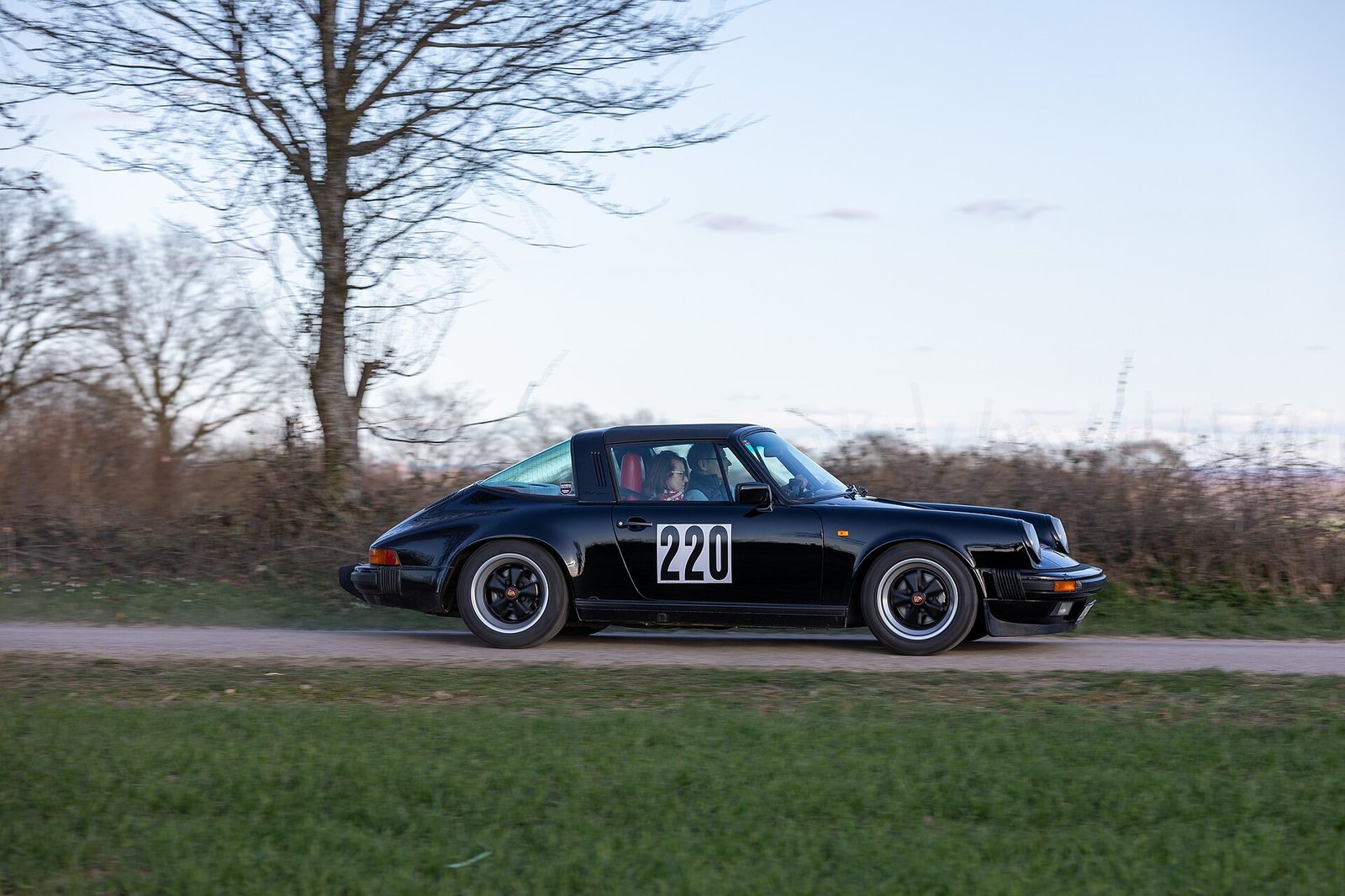
The 911 Carrera 3.2 (1984-1989) is the final and most developed version of Porsche's G-Series 911, and the last air-cooled 911 built on the original 1963 platform before the substantially re-engineered 964 arrived for 1989. It replaced the 3.0-liter SC with a 3,164 cc flat-six described by Porsche as around eighty percent new, managed by Bosch Motronic DME, the first 911 engine to run fuel and ignition from one control unit, and fitted with hydraulic cam chain tensioners that cured a long-standing weakness. Rest-of-world cars produced 228 hp; catalyzed US, Canadian and Japanese cars ran lower compression for roughly 207 hp, rising to about 217 hp for 1987. That same year the awkward Type 915 gearbox gave way to the Getrag G50, a change the market still prices. Coupe, Targa and Cabriolet bodies were offered, with the Turbo-look M491 option, a 340-car Club Sport and a 1989 Speedster on top.
911 Carrera 3.2
G-Series
History
Replacing the SC
Porsche had spent the late 1970s expecting the 911 to be superseded by the front-engined 928, and the 3.0-liter SC was engineered as a holding pattern. When management reversed that decision, the 911 needed a proper update rather than another stay of execution. For model year 1984 the SC was replaced by the Carrera 3.2, reviving a name Porsche had reserved for its more focused cars. The new 3,164 cc flat-six shared its architecture with the SC but was described as roughly eighty percent new, gaining the 3.3-liter Turbo's crankshaft dimensions, revised induction and exhaust, better oil cooling with a finned front cooler in place of the earlier serpentine arrangement, and hydraulic cam chain tensioners fed from the engine's oil supply. That last item mattered: chain tensioner failure had been the defining mechanical anxiety of earlier flat-sixes.
Motronic and the Market Split
The headline technical change was engine management. Where the SC used mechanical K-Jetronic, the 3.2 combined L-Jetronic air-flow metering with Bosch Motronic Digital Motor Electronics, the first 911 installation to govern fueling and ignition from a single processor. Emissions regulation then split the model in two. Rest-of-world cars (Type 930/20) ran 10.3:1 compression for 228 hp at 5,900 rpm. Cars for the United States, Canada and Japan (Type 930/21) carried a catalytic converter and 9.5:1 compression for roughly 207 hp. For 1987 those markets moved to the Type 930/25 with revised Motronic programming and a quoted increase to about 217 hp, although the Porsche Club of America has published dyno work finding no measurable difference between early and late control units on an otherwise standard engine. Switzerland took its own 930/26 variant with an auxiliary air pump.
The 1987 Gearbox Change
For model year 1987 Porsche replaced the Type 915 transaxle with the Getrag G50. The 915 was a design descended from the original 901 unit, with Porsche's own synchromesh, a cable-operated clutch and reverse down and to the right. The G50 used Borg-Warner synchros, a hydraulically operated clutch and moved reverse to the left and up, and it shifts markedly more cleanly. It also weighs around 26 lb more with clutch and flywheel, and pairs shorter intermediate ratios with a taller 3.444 final drive against the 915's 3.875, so the two are close on paper: roughly 6.1 seconds to 60 mph for a 915 car against 6.3 for a G50. The market nonetheless separates them clearly, and G50 cars command a premium, partly for the shift quality, partly because G50 cars are simply the youngest.
Turbo-look, Club Sport and Run-out
From 1986 the M491 Turbo-look option put 930 bodywork, whaletail, suspension, brakes and wheels on the normally aspirated car; it sold particularly well in the United States, where the 930 was off the market for much of the decade. Running the other way, the Club Sport (option M637, 340 cars from August 1987 to September 1989) deleted sound deadening, rear seats, electric windows, central locking and the radio, and used a blueprinted 930/20 with hollow intake valves revving to 6,850 rpm. Detail changes continued through the run: a revised dashboard and standard central locking for 1986, Fuchs wheels replacing Teledials for 1988, and 16-inch wheels standard for 1989, before the 1989 Speedster closed the line. The 964 that followed shared only a small fraction of its parts, which is why the 3.2 is generally treated as the last of the classic 911s.
Common Problems
Valve guide wear is the characteristic 3.2 failure, showing as heavy oil consumption and start-up smoke; the Porsche Club of America has quoted roughly $4,000-$6,000 in labor alone for a quality top-end rebuild before parts, and warns that the extent of associated work is not knowable until the engine is apart. Corrosion is the other major cost center: wings, A- and B-posts, sill kidney bowls, floors and bumper mountings. The hydraulic chain tensioners introduced with the 3.2 are a large improvement on earlier designs but are not immune to failure. On 915 cars, second- and third-gear synchromesh wear is common, and an obstructive shift is usually either worn linkage or evidence of abuse; rebuilds are expensive but generally regarded as worth doing. G50 boxes are notably more durable, though clutch replacement is a labor-heavy job. Heat exchangers corrode and are costly to replace. Oil leaks from a car of this age are near-universal and worth pricing rather than dismissing.
What to Look For
Establish the gearbox first: 915 cars (1984-1986) and G50 cars (1987-1989) are priced differently and drive differently, and a car advertised on year alone should be confirmed by the shift pattern: reverse sits down and right on the 915, left and up on the G50. Put the car on a lift and inspect inner and outer wings, the A- and B-posts, the 'kidney bowls' at the rear of the sills, cabin and front luggage compartment floors, and the bumper mountings; repair here is structural work rather than cosmetic patching, and it is priced before paint is considered. Check for blue smoke and oil consumption, which on a high-mileage 3.2 usually means valve guides. Confirm the heat exchangers are sound. Verify market specification against the claimed engine type (930/20, 930/21 or 930/25), since RoW and US cars are not interchangeable in value. On Turbo-look cars, confirm the M491 option is factory rather than a later bodykit. On Club Sports, confirm the M637 code on the option sticker and the deleted equipment, as the visual differences are slight and the production run is small.
Market Notes
As of September 2026, classic.com puts the Carrera 3.2 Coupe market benchmark at $83,173, with sales recorded in late August and early September 2026 at $67,500, $94,000, $98,000 and $102,000. The same source gives the Targa a $67,648 benchmark against a $65,133 average sale, with a Florida car at $73,000 on 9 September 2026 and a North Carolina car at $92,500 on 18 August 2026, and the Cabriolet a $61,043 benchmark against a $60,407 average, with US results running from $58,500 for a 1984 car in Tennessee to $104,900 for a 48,000-mile 1985 car in Florida. The ordering is consistent and long-standing: Coupe over Targa over Cabriolet, with a spread inside each body style that condition, mileage and history explain better than model year does. The premiums attach to the 1987-1989 G50 gearbox, documented service history, original paint and a factory Turbo-look specification; Sports Car Market adds that desirable factory blues, greens and certain yellows and oranges can add 20 to 30 percent over ordinary colors. Club Sports and Speedsters trade in a separate, much thinner market, averaging $204,079 and $229,287 respectively on classic.com as of September 2026. Elferspot's guide notes that despite the engineering, 3.2 values have not run away in the manner of pre-impact-bumper or Turbo cars.
Where sources differ
For 1987 the US, Canadian and Japanese cars moved to the Type 930/25 with revised Motronic programming and a quoted output of approximately 217 hp.
PCA, Supercar Nostalgia and StuttCars all state 217 hp; 911evolution states 214 hp for the same 1987-89 US/Japan cars. Separately, PCA reports dyno testing of early and late stock DME units that found no measurable power difference, so the quoted uplift may be nominal.
Total Carrera 3.2 production cannot be stated with confidence: body-style breakdowns sum to roughly 74,000-74,100 cars and are often rounded to 'over 76,000', while circulated model-year tables sum to about 80,400.
Elferspot gives approx. 35,670 Coupe / 19,987 Cabriolet / 18,468 Targa and calls the total 'over 76,000' although the components sum to 74,125. Prestige & Performance Car states 74,026 from 35,571 / 18,468 / 19,987. StuttCars and Supercar Nostalgia publish E- to J-series model-year tables summing to about 80,383, which appears to include G-Series output beyond the 3.2 Carrera. No reconciling manufacturer figure was located.
Sources
- Model 911 Carrera (911 G) - Porsche Classic, Porsche AG · manufacturer
- 2nd Generation 911 (G-Series), 1973-1989, Porsche Newsroom · manufacturer
- Porsche 911 Carrera 3.2 (1984-1989), StuttCars · journalism
- Porsche 911 3.2 Carrera Guide, Supercar Nostalgia · journalism
- Porsche 911 3.2 Carrera Club Sport, Supercar Nostalgia · journalism
- Type 915 Gearbox vs G50 Gearbox, Porsche 911 3.2 Carrera, Paul Stephens (Porsche specialist) · specialist
- Buyer's Guide: The Porsche 911 Carrera 3.2, Elferspot · specialist
- Porsche 911 3.2 Carrera model guide, Prestige & Performance Car · journalism
- 911 Carrera 3.2, Porsche 911 Evolution · encyclopedia
- Porsche 911 Carrera 3.2 buyer's guide, Classics World · journalism
- Tech Q&A - 911 3.2 Valve Guide Replacement, Porsche Club of America · club-forum
- Tech Q&A - 1984 911 Carrera DME Upgrade, Porsche Club of America · club-forum
- Porsche 911 Carrera Coupe - 3.2 Liter Market, classic.com · market-data
- Porsche 911 Carrera Targa - 3.2 Liter Market, classic.com · market-data
- Porsche 911 Carrera Cabriolet - 3.2 Liter Market, classic.com · market-data
- Porsche 911 Carrera - 3.2 Liter Market, classic.com · market-data
- Price Valuation Tips for the Porsche 911, Sports Car Market · journalism
Synthesized from the sources above and cross-checked. We cite and link out; we do not republish other databases verbatim.
Fully Sorted is an independent publisher and is not affiliated with, endorsed by or sponsored by Dr. Ing. h.c. F. Porsche AG. Porsche and the model names on this page are trademarks of Dr. Ing. h.c. F. Porsche AG and are used here only to identify the cars being described.
Chassis register
Nobody has recorded a car here yet. Own one, or know one? Chassis number, what you can prove about it, and a source if there is one. Every entry is reviewed before it appears.
Nerd Notes
What owners know that the sources don't. Every note is read and checked before it appears here.
Key Specs
- Power
- 228 hp @ 5,900 rpm (RoW, Type 930/20); approx. 207 hp (US, Canada and Japan 1984-1986, Type 930/21); approx. 217 hp (US, Canada and Japan 1987-1989, Type 930/25; some references state 214 hp)
- Engine
- 3,164 cc air-cooled SOHC flat-six (Type 930/20 and market variants)
- Layout
- Rear engine, rear-wheel drive
- Torque
- approx. 209 lb-ft @ 4,800 rpm (RoW)
- Weight
- approx. 2,557 lb (915 Coupe); approx. 2,668 lb (G50 Coupe, and open cars)
- Wheels
- 15-inch forged Fuchs standard; 16-inch standard from model year 1989
- Chassis
- Steel unit body-chassis carried over from the G-Series 911, offered as Coupe, Targa and Cabriolet
- Top speed
- approx. 150-152 mph (RoW)
- Compression
- 10.3:1 (RoW); 9.5:1 (catalyzed US, Canada and Japan)
- Final drive
- 3.875:1 (915) / 3.444:1 (G50)
- Acceleration
- approx. 6.1 s 0-60 mph (915 RoW); approx. 6.3 s (G50)
- Transmission
- Type 915 5-speed manual, cable clutch, reverse down and to the right (1984-1986); Getrag G50 5-speed manual, Borg-Warner synchromesh, hydraulic clutch, reverse left and up (1987-1989)
- Chain tensioners
- Hydraulic, pressure-fed from the engine oil system
- Engine management
- Bosch Motronic DME with L-Jetronic air-flow metering, the first 911 system to control fuel and ignition from a single unit
Notable Variants
Carrera 3.2 Coupe
The core car and the largest body-style cohort. Post-1986 G50 Coupes are the market's default reference point.
Carrera 3.2 Targa
Removable roof panel with fixed hoop. Consistently the cheapest of the three regular bodies in current US market data.
Carrera 3.2 Cabriolet
Full convertible, electric hood standard on later cars. Highest volume of the open cars, lowest benchmark values.
Turbo-look (M491)
Factory option adding 930 Turbo bodywork, whaletail, suspension, brakes and wheels to the normally aspirated 3.2. Coupe first, later extended across the range; a US favorite in years when the Turbo was absent from that market.
Club Sport (M637)
340 built, August 1987 to September 1989. Stripped interior, deleted sound deadening, electric windows, central locking and rear seats; blueprinted 930/20 with hollow intake valves and a rev limit raised from 6,520 to 6,850 rpm.
Speedster
1989 only. Cut-down windshield, humped double-bubble tonneau, mostly Turbo-look bodywork; the run-out car for the G-Series.
Value Trajectory
The 3.2 has followed the wider air-cooled market up but has not detached from it. It sits above the SC and well below the 930 Turbo and the early impact-bumper Carreras, and it competes directly with the 964, which offers more modern engineering for broadly comparable money and which caps the 3.2's upside. classic.com benchmarks as of September 2026, around $83,000 for a Coupe, $68,000 for a Targa and $61,000 for a Cabriolet, describe a mature and liquid market rather than a speculative one; recorded US sales in August and September 2026 ran from $58,500 for an ordinary Cabriolet to $104,900 for a low-mileage one, and Coupe results spanned $67,500 to $102,000 in the same weeks. The structural supports for value are the model's position as the last of the classic 911s before the 964, high-but-not-scarce production of roughly 74,000-76,000 cars, and good parts availability. The G50 premium looks durable, and Sports Car Market treats the later G50 cars as the most sought-after of the standard 3.2-liter Carreras. Club Sport and Speedster values follow rarity rather than the volume market.
Market Snapshot
Range $46,000 – $214,000
Next
Shopping for one?
Browse Porsche listings, or decode a VIN before you buy.