
The Porsche 911 of 1964-1973, the long-hood cars, established the shape and the mechanical logic that every 911 since has been measured against. Shown at Frankfurt in September 1963 as the 901 and renamed after Peugeot objected to the zero in the middle, it went into production on 14 September 1964 with a 1,991 cc air-cooled flat-six of 128 hp hung behind the rear axle, a dogleg five-speed gearbox and torsion-bar suspension. Over nine model years the engine grew to 2.2 and then 2.4 liters, the range split into T, E and S, the Targa arrived, and the wheelbase was stretched 2.2 in (57 mm) for 1969 to calm the handling. The run closed with the 1973 Carrera RS 2.7, a homologation special with 207 hp, a ducktail and, in Sport form, 2,116 lb, which sold three times its planned 500 units. Porsche says 81,100 911s had been built by its 1973 financial year; other sources say 80,352 to 89,652, and the disagreement is set out below. The RS is the market's headline, but the T, E and S coupes and Targas are the cars most people own, and the difference between good and bad examples is mostly in the steel.
911
Long-hood (incl. 2.7 RS)
History
From 356 to 901
Porsche's replacement for the 356 was shown at the Frankfurt Motor Show on 12 September 1963 as the Type 901, with a body by Ferdinand Alexander Porsche, Ferry Porsche's son, and his team. Peugeot held a trademark on three-digit names with a zero in the middle, so the car went on sale as the 911, although the engine type and parts prefixes stayed 901. Production began on 14 September 1964, the car listing at $6,500 in the United States and DM 21,900 in Germany. The Porsche Club of America records about 80 cars badged 901 before the change and roughly 150 more built before the end of 1964; Stuttcars' chassis table gives 235 cars for that first year. The engine was a 1,991 cc air-cooled flat-six with a single overhead camshaft per bank, twin Solex carburetors and 128 hp, good for 130 mph and 0-62 mph in 9.1 seconds by Porsche's own figures. The four-cylinder 912 followed in 1965.
S, Targa and the Short-Wheelbase Years
The 911S arrived for 1967 with 158 hp at 6,600 rpm on Weber carburetors and the forged five-spoke Fuchs wheel, which appeared here for the first time. A period road test recorded 139 mph and 0-60 mph in 7.6 seconds from 2,271 lb. The Targa, previewed at Frankfurt in 1965, entered production in December 1966 with a stainless-steel roll hoop and a zip-out plastic rear window, replaced by fixed glass for 1969. The A-series 1968 cars introduced the 911T with 108 hp and cast-iron cylinders, the 911L, and the Sportomatic clutchless semi-automatic. Stuttcars' chassis table lists 22 911R competition cars for 1968.
The Long-Wheelbase Chassis and Fuel Injection
For the 1969 B-series Porsche moved the rear wheels 2.2 in (57 mm) aft, taking the wheelbase from 87.0 in (2,211 mm) to 89.3 in (2,268 mm) without lengthening the body, the single largest change to the car's behavior in the run. The same year the E and S received Bosch mechanical fuel injection, and the E gained Boge hydropneumatic self-leveling front struts, which it kept until 1971. The 1970 C-series took the engine to 2,195 cc, giving 125, 155 and 178 hp for T, E and S, and the transaxle was updated with a 8.9 in (225 mm) clutch. The E-series of 1972 brought 2,341 cc and 130, 165 and 187 hp, and the new Type 915 gearbox with a conventional H-pattern for the first four gears; Classic & Sports Car calls it the stronger of the two boxes. Elferspot's comparison gives the 2.4 S 0-62 mph in 6.6 seconds, and it was this car, not a lighter one, that Porsche started from when the RS was needed.
Germany's Fastest Sports Car
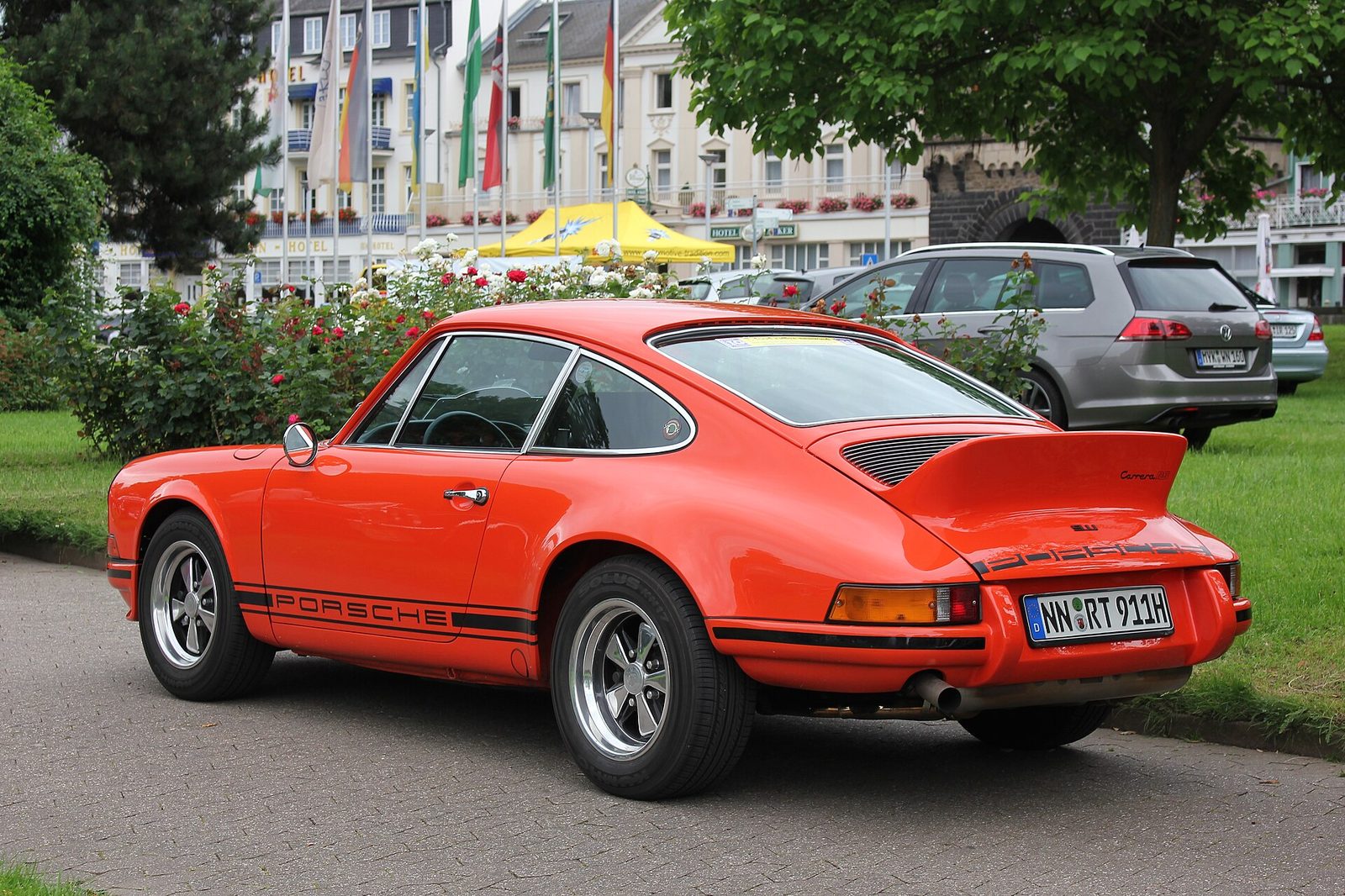
The Carrera RS 2.7 was conceived in May 1972 to homologate the 911 for Group 4, which needed 500 cars. Porsche's own account credits about fifteen engineers, with Hermann Burst and Tilman Brodbeck on the engineering side and Rolf Wiener and Harm Lagaaij on the styling. The engine went to 2,687 cc with Nikasil-lined cylinders and mechanical injection for 207 hp at 6,300 rpm and 188 lb-ft at 5,100 rpm; the rear arches were widened 1.65 in (42 mm) to take wider tires than the fronts, a first for Porsche, and the ducktail spoiler, patented on 5 August 1972, made it the first series production car with spoilers at both ends. The car was shown at Paris on 5 October 1972 at DM 34,000, with M471 Sport at DM 700 extra and M472 Touring at DM 2,500, and was not sold new in the US. The 500 were sold by the end of November, homologation moved to Group 3 after the thousandth car, and production ended at 1,580 in July 1973: 200 Sport, 1,308 Touring, 17 base cars and 55 racing RSRs. Porsche quoted 2,116 lb for the Sport and 0-62 mph in 5.8 seconds, claiming the first production car under six seconds, and advertised it as Germany's fastest sports car.
The Line Closes
The 1973 model year was the last with the short bumpers and the long hood that gave the cars their later name. American bumper rules for 1974 produced the impact-bumper G-series. By then Porsche's press material puts 81,100 911s built, a figure the Early 911 Registry, Sports Car Market and Classic & Sports Car each contradict in a different direction, which is why no single total appears on this page.
Common Problems
Almost all early flat-sixes leak oil, and the question is from where and how much; chain-box covers and the crankcase seams are the usual sources. Blue smoke on start-up points to worn valve guides. The camshaft chain tensioners are the mechanical weak point: the original spring-loaded units fail with age, the chain can jump the sprockets and the pistons meet the valves, and Pelican Parts quotes a $6,000-10,000 rebuild when that happens. Porsche's 1984 hydraulically fed Carrera tensioner can be retrofitted to 1969-1983 cars and its presence is now expected on a car that is used. From 1968 the crankcase was magnesium rather than aluminum, which Classic & Sports Car describes as easily weakened, and worn crankcase studs are a recognized consequence; the RM Sotheby's Paris 2026 RS Touring had been running on replacement aluminum case halves since 1987, which shows how long the problem has been addressed that way. Mechanical fuel injection on E and S cars needs proper setting up, and MFI Werks in Oregon lists a pump rebuild from $2,900 in labor as of September 2026. Gearboxes whine when synchros and bearings are worn, a US restoration-cost guide published in April 2025 brackets a transmission overhaul at $3,000-8,000, and a vague shift is often cured by rebushing the linkage. The Boge hydropneumatic front struts fitted to the 911E from 1969 to 1971 are a specialized item and a car that has been converted to conventional struts should say so. None of this is unusual for the period; what separates a good car is whether the work has been done by someone who knows the model.
What to Look For
The steel decides everything on a long-hood. Classic & Sports Car's guide says rust protection was limited and body condition is paramount, and Renndriver names the longitudinal chassis rails beneath the doors and the battery box area as the places to check first. A car with replaced floors and longitudinals can be sound, but the standard of the repair determines whether the suspension mounts are where Porsche put them and whether the car will pass a specialist's inspection, and the range of outcomes is wide: a US cost guide from April 2025 puts a basic refresh at $20,000-40,000 and a concours rebuild at $100,000-250,000 and above. Documentation comes next. A Porsche Certificate of Authenticity or the Kardex build record confirms the original engine and gearbox numbers, color and options, and the auction catalogs for the top results in 2025 and 2026 all lead with it. Matching numbers matter more here than on later 911s because so many early engines were replaced or upgraded in period; the RM Sotheby's Paris 2026 RS Touring carried replacement aluminum crankcase halves from 1987 with restamped numbers, and it sold for less than half the Monterey car. For the Carrera RS, Classic Driver warned as long ago as 2014 that rising values had put non-original cars on the market as the genuine article; the thin-gauge steel and glass of the M471 cars, the M-code on the build record and the engine and gearbox numbers against the Certificate are what a specialist checks, and the RM Sotheby's Monterey 2026 catalog's note that the last hundred or so cars carry an aluminum rather than magnesium crankcase shows how specific the questions get. Establish which gearbox is fitted, since the dogleg 901 and H-pattern 915 are different in feel and value, whether a Sportomatic car is still one, and whether a 1969-1971 E still has its hydropneumatic struts. A long file of invoices from a marque specialist is worth more than a fresh restoration of unknown scope.
Market Notes
As of September 2026, classic.com's 1964-1973 911 submarket shows an average recorded sale of $115,342 across the F-body, with the 1964-1965 cars benchmarked at $197,375 and the model's ceiling set by a Carrera RS 2.7 Lightweight at $2,425,000 in August 2022. The RS is a separate market. The Touring benchmark is $565,671 and the Lightweight benchmark $1,117,857, the latter trending downward against a Lightweight average sale of $1,229,455; classic.com's most recent Lightweight results are $1,200,000 on 7 July 2026, $805,000 on 20 August 2026 and a Broad Arrow private sale at 950,000 euros on 22 August 2026. RM Sotheby's sold a Tangerine Touring, chassis 9113601556, for $896,000 at Monterey in August 2026 and a Grand Prix White Touring, chassis 9113601272, for 353,750 euros at Paris in January 2026; both are quoted as the house published them and the lot pages do not state whether buyer's premium is included. For the 2.0 S, classic.com's short-wheelbase 911S page gives an average sale of $178,162, a 1967 coupe benchmark of $169,320 and a 1967 Targa benchmark of $211,330, with August 2026 results of $257,600 for a 1967 soft-window Targa at Gooding Christie's, $231,000 for a 1967 S at Mecum Monterey and $112,000 for a 1968 S at Gooding. Renndriver's 911T guide, dated June 2026, puts driver-quality cars at $80,000-120,000, matching-numbers cars at $120,000-175,000 and concours cars at $175,000 and above, and claims a 10-20 percent premium for Targas; Classic & Sports Car's 2018 guide said the opposite, valuing Targas 10 percent below coupes and Sportomatics 20 percent below manuals. That reversal on Targas is unexplained by either source.
Where sources differ
The total number of long-hood 911s built from 1964 to 1973 is stated as 81,100 by Porsche, 80,352 by the Early 911 Registry, approximately 89,000 by Sports Car Market and 89,652 by Classic & Sports Car.
Porsche's 60th-anniversary press kit states 81,100 examples of the 911 built by the 1973 financial year, and porsche.com repeats 81,100. The Early 911 Registry states 80,352 built between 1964 and 1973. Sports Car Market states approximately 89,000 long-hood 911s. Classic & Sports Car states 89,652 built 1964-1973. None of the four explains whether it counts by financial, calendar or model year or whether the 1973 Carrera RS is included. Not resolved by any source consulted here.
Sources
- 1st Generation Porsche 911 (original 911), 1963-1973, Porsche AG · manufacturer
- Fifty years of the Porsche 911 Carrera RS 2.7 - 'Germany's fastest sports car', Porsche AG · manufacturer
- A brief history of the Porsche 911, Porsche AG · manufacturer
- Porsche 911 (classic), Wikipedia · encyclopedia
- Porsche 911 (F-Series) Sales & Production Numbers, Stuttcars · specialist
- Model Guide: The first Porsche 911s, Porsche Club of America · club-forum
- Is it time to think about a long-hood 1964-1973 Porsche 911 again?, Porsche Club of America · club-forum
- Register your 1965-73 Porsche 911 Today!, The Early 911 Registry · registry
- Buyer's guide: Porsche 911 (1964-'73), Classic & Sports Car · journalism
- 1971 Porsche 911S 2.2-Liter Coupe, Sports Car Market · journalism
- 1968 Porsche 911 2.0S SWB road test, Drive-My · journalism
- Porsche 911T (1967-1973): Specs, T vs E vs S, Values, and Buyer's Guide, Renndriver · specialist
- Porsche 911 S 2.4 vs. 911 Carrera RS 2.7, Elferspot · specialist
- Is it too late to buy a Porsche 911 Carrera RS 2.7?, Classic Driver · journalism
- Porsche 911 F-Body Market, classic.com · market-data
- Porsche 911 Carrera RS - Lightweight Market, classic.com · market-data
- Porsche 911S - SWB Market, classic.com · market-data
- 1973 Porsche 911 Carrera RS 2.7 Touring, The Monterey Auction 2026, RM Sotheby's · auction-house
- 1973 Porsche 911 Carrera RS 2.7 Touring, Paris 2026, RM Sotheby's · auction-house
- Porsche 911 Carrera Chain Tensioner Installation, 911 (1965-89) and 930 Turbo (1975-89), Pelican Parts · specialist
- MFI Werks - Services, MFI Werks · specialist
- Porsche 911 Restoration: Costs, Process, and Expert Tips, Newbie911 · specialist
- Model Masterpiece: 1965 Porsche 911, Premier Financial Services · specialist
- 1968 Porsche 911 Soft-Window Targa, Sports Car Market · journalism
- 1968 Porsche 911S Coupe, Sports Car Market · journalism
Synthesized from the sources above and cross-checked. We cite and link out; we do not republish other databases verbatim.
Fully Sorted is an independent publisher and is not affiliated with, endorsed by or sponsored by Dr. Ing. h.c. F. Porsche AG. Porsche and the model names on this page are trademarks of Dr. Ing. h.c. F. Porsche AG and are used here only to identify the cars being described.
Chassis register
Nobody has recorded a car here yet. Own one, or know one? Chassis number, what you can prove about it, and a source if there is one. Every entry is reviewed before it appears.
Nerd Notes
What owners know that the sources don't. Every note is read and checked before it appears here.
Key Specs
- Power
- 128 hp (911 2.0), 108 hp (911T 2.0), 158 hp at 6,600 rpm (911S 2.0), 125/155/178 hp (T/E/S 2.2), 130/165/187 hp (T/E/S 2.4), 207 hp at 6,300 rpm (Carrera RS 2.7); all manufacturer DIN ratings
- Brakes
- Disc brakes all round; larger brakes on the Carrera RS per Wikipedia
- Engine
- 1,991 cc (1964-1969), 2,195 cc (1970-1971), 2,341 cc (1972-1973) air-cooled flat-six with single overhead camshaft per bank; 2,687 cc Type 911/83 with Nikasil-lined cylinders in the 1973 Carrera RS
- Layout
- Rear-mounted, longitudinal air-cooled flat-six overhung behind the rear axle, rear-wheel drive, 2+2 seating
- Torque
- 132 lb-ft at 5,200 rpm quoted for the 2.0 S; 182 lb-ft at 5,100 rpm for the Carrera RS 2.7 as claimed by Porsche; other variants not consistently quoted by the sources consulted
- Weight
- 2,271 lb quoted for a 1968 911S; Classic & Sports Car gives 2,285-2,442 lb across the run; Carrera RS 2,116 lb Sport and 2,370 lb Touring as claimed by Porsche
- Chassis
- Steel unitary body; wheelbase 87.0 in (2,211 mm) from 1964 to the end of the A-series, 89.3 in (2,268 mm) from the B-series (model year 1969) after the rear wheels were moved 2.2 in (57 mm) aft; Carrera RS rear arches widened 1.65 in (42 mm)
- Induction
- Solex then Weber carburetors on 2.0 cars, Zenith carburetors on 911T, Bosch mechanical fuel injection on 911E and 911S from model year 1969 and on the Carrera RS
- Price new
- $8,975 for a 1971 911S in the United States (Sports Car Market); $6,500 for the original 911 in the United States and DM 21,900 in Germany; DM 34,000 for the Carrera RS, which was not sold new in the US, plus DM 700 for M471 or DM 2,500 for M472 (Porsche)
- Top speed
- 130 mph for the 128 hp original (Porsche); 139 mph for the 1968 911S (Drive-My) or 137 mph (Classic & Sports Car); 149 mph Touring and over 152 mph Sport for the Carrera RS (Porsche claim)
- Suspension
- Independent all round with torsion-bar springing; Boge hydropneumatic self-leveling front struts on the 911E from 1969 to 1971
- Acceleration
- 0-62 mph in 9.1 s for the 128 hp original (Porsche); 0-60 mph in 7.6 s for a 1968 911S (Drive-My road test data) and 8 s per Classic & Sports Car; 0-62 mph in 6.6 s for the 2.4 S (Elferspot); 0-62 mph in 5.8 s Sport and 6.3 s Touring for the Carrera RS (Porsche claim)
- Aerodynamics
- Carrera RS was the first series production car with front and rear spoilers; Elferspot credits the ducktail with 3 mph of additional top speed
- Transmission
- Type 901 five-speed manual with dogleg first (four-speed standard on 911T) to 1971; Type 915 five-speed with H-pattern first four gears from 1972; Sportomatic four-speed clutchless semi-automatic optional from 1967-1968
- Wheels tires
- Steel wheels on early cars; forged Fuchs five-spoke alloys introduced with the 911S in 1967; the Carrera RS was the first Porsche with different tire sizes front and rear
- Body variants
- Coupe throughout; Targa with soft rear window 1967-1968 and fixed glass from 1969
Notable Variants
911 2.0 (O-series, 1964-1967) including the 901-badged cars
The short-wheelbase original with 128 hp, twin Solex carburetors and the dogleg 901 five-speed. About 80 cars left the line badged 901 before Peugeot's objection; classic.com tracks 1964-1965 cars as a separate submarket with a benchmark of $197,375 as of September 2026, well above later 2.0 cars.
911S 2.0 (1967-1969)
158 hp at 6,600 rpm on Weber carburetors and the first application of the forged Fuchs five-spoke wheel. classic.com benchmarks the 1967 coupe at $169,320 and the 1968 coupe at $151,283 as of September 2026, and its August 2026 results ran from $112,000 to $257,600.
911 Targa, soft-window (1967-1968)
Shown at Frankfurt in 1965 and in production from December 1966, with a zip-out plastic rear window that was replaced by fixed glass for 1969. The soft-window S is the scarcest mainstream long-hood body; classic.com benchmarks the 1967 S Targa at $211,330 as of September 2026, and one made $257,600 at Gooding Christie's in August 2026.
911T (1968-1973)
The entry car, with cast-iron cylinders, carburetors throughout and roughly 35,000 built according to Renndriver, so it is the long-hood most people can actually buy. Four-speed standard, five-speed optional; the Porsche Club of America identified 1969-1973 911Ts as the value play in 2023.
911E (1969-1973)
The middle car, with Bosch mechanical fuel injection from 1969 and Boge hydropneumatic self-leveling front struts from 1969 to 1971, which many owners have since replaced with conventional struts. Often the best-equipped car of the three and priced between T and S.
911S 2.2 and 2.4 (1970-1973)
178 hp then 187 hp with mechanical injection, and the long-wheelbase chassis introduced for 1969. Elferspot gives 5,054 2.4 S cars over 1972-1973 and quotes 0-62 mph in 6.6 seconds; the 2.4 S was the basis from which the Carrera RS was developed.
911 Carrera RS 2.7 Touring (M472), 1973
1,308 of the 1,580 RS cars per Porsche, with the 911S interior retained. Homologation special with the 2,687 cc engine, 207 hp, ducktail spoiler and widened rear arches. classic.com's Touring benchmark is $565,671 as of September 2026; RM Sotheby's sold one for $896,000 at Monterey in August 2026.
911 Carrera RS 2.7 Sport / Lightweight (M471), 1973
200 cars per Porsche at 2,116 lb, 254 lb lighter than the Touring, with thin-gauge steel and thinner glass. The car that carries the long-hood's highest prices: classic.com records $2,425,000 in August 2022 and a benchmark of $1,117,857 as of September 2026, on a downward trend.
Value Trajectory
The long-hood 911 was cheap for a long time. The Porsche Club of America recalls a nice 1971 T Targa offered at $14,000 in 2004, and Classic Driver records the Carrera RS trading in the late 1990s at a fraction of a Ferrari Daytona. The market turned around 2013: early S prices moved from about $75,000 to a quarter of a million within a few years, and a Lightweight RS made $1.42 million at Gooding's Amelia Island sale in 2014. Sports Car Market recorded a retreat from the 2014-2015 peak, reading a 1971 2.2 S at $204,978 at Bonhams Goodwood in September 2018 as an early sign of recovery, while soft-window Targas had taken $148,500 and $285,000 at Gooding Pebble Beach in August 2017. The pandemic added another leg, capped by the $2,425,000 Lightweight in August 2022, and by April 2023 the PCA reported nice 911Ts settling at $75,000-100,000. As of September 2026 the picture is stratified rather than falling: classic.com's Lightweight benchmark of $1,117,857 is trending down while a documented, restored Touring still made $896,000, 2.0 S coupes and Targas sat between $112,000 and $257,600 at the August 2026 Monterey sales, and Renndriver's June 2026 guide places the 911T at $80,000-225,000 by condition. The cars that hold price have build records, original engines and sound floors.
Market Snapshot
Range $46,000 – $214,000
Next
Shopping for one?
Browse Porsche listings, or decode a VIN before you buy.