
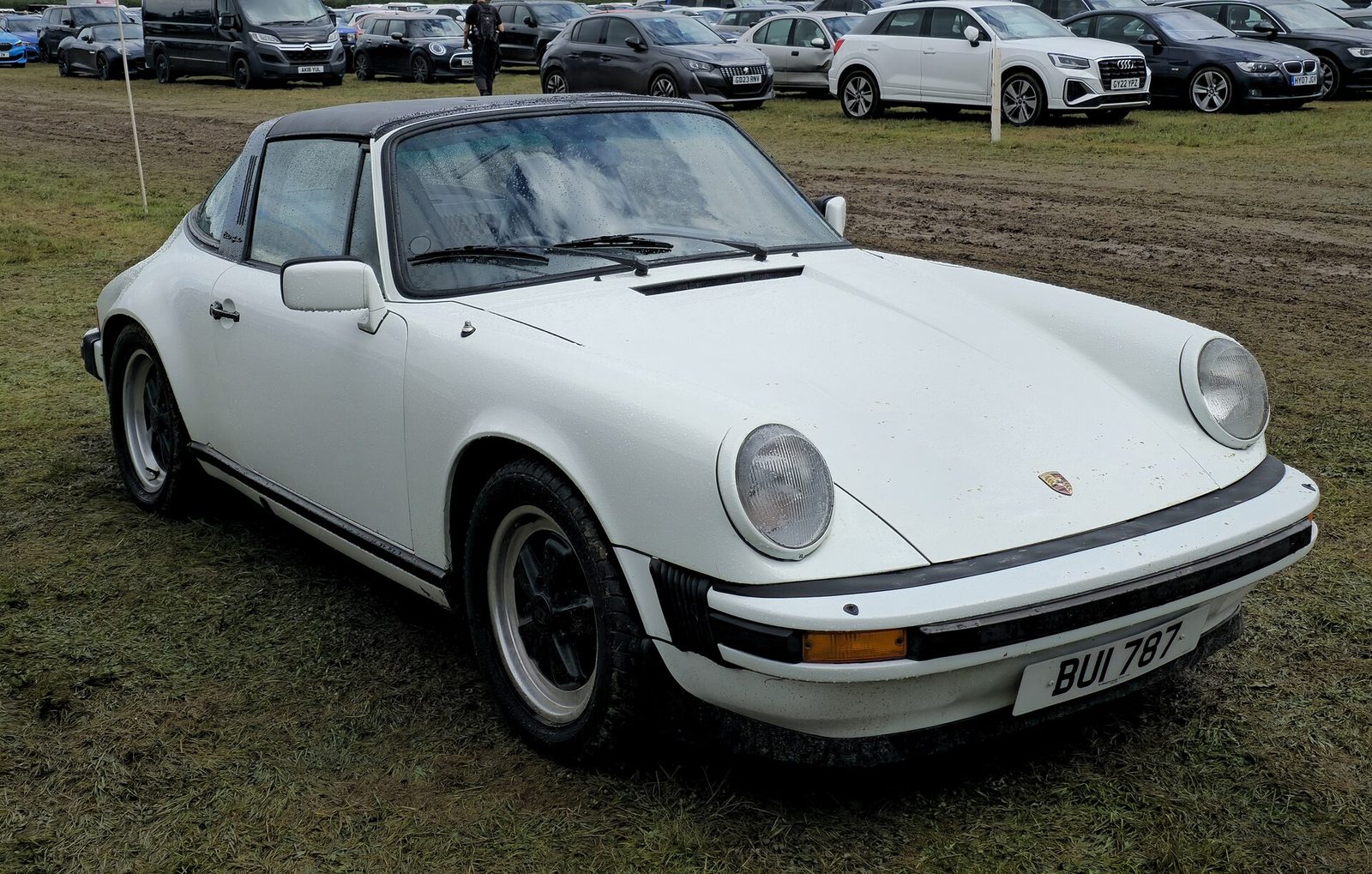
The Porsche 911 SC (1978-1983) is the car that kept the 911 alive. For the 1978 model year Porsche swept away the 2.7-liter 911 and the Carrera 3.0 and offered two models only: the SC and the Turbo. Its 2,994 cc flat-six carried a pressure-cast aluminum crankcase in place of the magnesium that had made the 2.7 fragile, and output climbed in two steps from 178 hp to 188 and then 204 for markets outside the United States and Japan. Management had intended the SC as the 911's last generation before the front-engined 928 took over; instead it outsold the 928 by a wide margin and, in 1981, a new chief executive extended the production plan indefinitely. The 1983 model year brought the first fully open 911, a cabriolet with a manually operated three-bow hood. Somewhere between roughly 58,900 and 60,300 cars were built, depending on which source is consulted. Today the SC sits between the fragile 2.7 and the more developed Carrera 3.2 as the least expensive air-cooled 911 that can be used properly.
911 SC
G-series (impact bumper)
History
Rationalization, 1977
For the 1978 model year Porsche collapsed a sprawling 911 range into two cars. The 2.7-liter 911 and 911 Lux and the 3.0-liter Carrera all disappeared; what remained was the 911 SC and the 911 Turbo. Porsche's own account of the G-series describes the SC as adopting the Carrera's widened rear wings along with its three liters of displacement, and Motor Sport's May 1978 test framed the change plainly: the SC replaced a 165 hp 2.7 Lux and a 200 hp Carrera 3.0 with a single 180 hp car that gave away peak power to the Carrera but beat it on flexibility and driveability. That trade - less headline output, more usable engine - is the whole argument for the SC, and it has not changed in fifty years.
The Aluminum Three-Liter
The engine is where the SC earns its reputation. Displacement is 2,994 cc from a 3.7 in (95 mm) bore and 70.4 mm stroke, with a single overhead camshaft per bank, two valves per cylinder, Nikasil-lined barrels, dry-sump lubrication and Bosch K-Jetronic continuous injection. The significant change was the crankcase: pressure-cast aluminum in place of the magnesium used since 1968. Magnesium cases were light but soft, and the head studs passing through them had a habit of pulling their threads out, which is the defining structural weakness of the 2.7. Aluminum did not eliminate head-stud trouble; specialist accounts note that it moved the failure from the case threads to the studs themselves. It did produce an engine that tolerates mileage and heat in a way the 2.7 does not, and that is the single reason the SC is the cheapest air-cooled 911 an owner can reasonably use hard.
Three Power Steps, and a Market Split
Output rose twice. Porsche Classic gives 178 hp for the 1978 and 1979 model years, 185 hp for 1980 and 201 hp from 1981 to the end, while Porsche's G-series press kit dates the same two increases to late 1979 and 1980 - the same sequence expressed as production timing rather than model years. The 185 hp engine brought a compression rise to 8.6:1, revised valves and cam timing, a new oil cooler and a revised timing-chain tensioner idler arm; the 201 hp engine went to 9.8:1. Cars for the United States and Japan did not follow. What American engines actually produced is not agreed: Wikipedia states they kept the lower-compression 178 hp unit throughout, an RM Sotheby's catalog for a 1983 United States cabriolet quotes 180 hp, and the Porsche Club of America states that emissions equipment and a restricted intake manifold cut output to 172 hp from 1980. A buyer comparing a European 201 hp car with a federal one is comparing two quite different machines.
The Model That Was Meant to Be the Last
Under Ernst Fuhrmann the SC was intended as the 911's closing chapter, with the front-engined 928 taking over as flagship. It did not work out that way. The SC outsold the 928 heavily - Supercar Nostalgia puts the ratio at roughly twenty to one - and in 1981 Peter Schutz arrived as chief executive and reversed the decision, by the widely repeated account extending the 911's production line on Helmuth Bott's wall chart out past the edge of the paper. Porsche's own retrospective is drier, noting only that some of the press read the two-model range as the end of the sports car and were wrong. Either way, the SC is the car that was still selling while the argument was being had.
Open Air, and the Handover
The last act was a roof, or the removal of one. A cabriolet prototype on the wide Turbo body, with four-wheel drive, appeared at the 1981 Frankfurt show; the production car was shown at Geneva in March 1982 and built from that October at $34,450 in the United States and DM 64,500 in Germany, the first fully open 911 and the first Porsche convertible in nearly two decades. Its three-bow hood used panel elements covering about half the roof area rather than narrow steel bows, and Porsche rated the structure to 152 mph. It sold immediately. For 1984 the 3.2-liter Carrera replaced the SC and brought with it the pressure-fed chain tensioners that were the fix for the SC's most quoted mechanical anxiety.
Common Problems
The airbox is the fault the SC is known for. A backfire through the Bosch K-Jetronic intake raises pressure inside the plastic airbox and splits it or tears out its self-tapping screws; the resulting vacuum leak stops the engine starting, and a dealer replacement can pass 1,000 dollars before labor. The standard remedy is a spring-loaded pop-off valve fitted to the box to vent the pressure, and cars from 1980 to 1983 with the internal metal manifold are more awkward to modify. Head studs are the second recurring theme. Porsche adopted Dilavar studs from 1977 and issued a technical bulletin covering their fitment; on the SC's aluminum case the failure mode moved from thread pull-out to outright stud breakage, and the symptom is persistent oil weeping at the head joint. Timing-chain tensioners are not oil-pressure fed. The idler arms were revised for 1983 and the problem was only fully resolved by the Carrera-style pressure-fed units of 1984, which are routinely retrofitted. Early rubber-centered clutches fail around 45,000 miles and can take other parts with them. The 915 gearbox balks when worn, and a rebuild is an expensive job. Beyond that: heat exchangers rot, the auxiliary air valve and the K-Jetronic metering head suffer from ethanol in modern fuel, fuel-pump relays fail, and the ceramic fuses corrode.
What to Look For
Structure first. SC shells are galvanized but less thoroughly than the later Carrera 3.2, and the areas that matter are the sills, the bottom rear corners of the door apertures, the A-pillars and windshield surround, the jacking points, the front wing tops, the rear torsion-bar housing and the so-called kidney bowls behind the B-pillars. A leaking windshield seal drains into the pedal box, so lift the carpet. Serious corrosion work runs to five figures. Then establish which car it is. European 201 hp cars, 185 hp 1980 cars and federal cars are three different propositions, and 1981-on cars carry the 17-digit VIN that makes identification straightforward. Ask which timing-chain tensioners are fitted and whether the Carrera pressure-fed conversion has been done, since the answer sets the maintenance horizon. Ask for head-stud history: most cars have either broken studs or receipts for fixing them, and the receipts are worth money. Look for a pop-off valve on the airbox, and check the airbox self-tapping screws are seated rather than standing proud, which indicates a past backfire. Drive it for the gearbox. A 915 that baulks into second when warm, or refuses lower gears, is telling you about linkage, oil and synchros; a properly rebuilt one shifts cleanly, but rebuilds run to four or five figures. Check the clutch has been converted from the rubber-centered original. On a cabriolet, work the hood through its full travel and inspect the frame and rear window.
Market Notes
As of August 2026, classic.com's Porsche 911 SC market benchmark stands at $63,732, with the coupe at $64,811, the Targa at $55,375 and the cabriolet at $49,927. That ordering is worth noting: the cabriolet is the rarest of the three bodies and the cheapest to buy. The recorded spread is very wide. As of August 2026 classic.com's high for the SC market is $515,000 for a 1982 car sold in November 2025, an outlier it does not characterize, against a low of $2,016 for a 1981 Targa in October 2024. Auction evidence sits in a far narrower band. RM Sotheby's sold a 9,230-mile United States cabriolet from the Taj Ma Garaj collection for $52,640, and Gooding sold a European-specification 204 hp cabriolet at Amelia Island in 2025 for $62,720. For position, as of August 2026 the Carrera 3.2 coupe benchmark is $83,205 and the 930 Turbo averages $171,008 across 740 recorded sales, so the SC remains the cheapest way into the impact-bumper era.
Where sources differ
Output for the United States market is not agreed between sources: it is stated either as 180 hp for the whole run or as 180 hp until 1979 falling to 172 hp from 1980.
Wikipedia states that United States cars retained the lower-compression 178 hp engine throughout the run, and an RM Sotheby's catalog for a 1983 US-market cabriolet quotes 180 hp. The Porsche Club of America's model guide states that emissions equipment and a constricted intake manifold reduced US output to 172 hp from 1980. Supercar Nostalgia lists a separate US engine type, 930/07, without quoting a figure. Not resolved by any source consulted here.
Published totals for 911 SC production disagree, ranging from 58,914 to 60,625 cars, and no single figure is asserted here.
Wikipedia states 58,914. StuttCars states 60,625. Supercar Nostalgia's text says approximately 58,000. StuttCars and Supercar Nostalgia publish an identical year-by-year table by body style which sums to 60,265, agreeing with neither of the totals printed beside it. Nothing consulted here explains the roughly 1,350-car gap, so it is not resolved and productionTotal is left null.
First-year 911 SC Cabriolet production is given as either 4,214 or 4,187 cars worldwide, of which the United States share is consistently reported at approximately 1,700 to 1,718.
Wikipedia gives 4,214 cabriolets sold in the introductory year. The production tables published by StuttCars and Supercar Nostalgia both give 4,187 for 1983. RM Sotheby's states 1,718 were built for the United States and the Porsche Club of America gives approximately 1,700 for that market, so the American share is broadly consistent while the world total is not. The 27-car difference is not resolved by any source consulted here.
Counts for the two SC special editions differ between sources: the 1980 Weissach Edition for North America is given as 400, 408 or 468 cars, and the 1982 Ferry Porsche Edition as either 200 or 266.
The Porsche Club of America and Wikipedia both state 408 Weissach Edition cars, Wikipedia identifying the option code as M439; Supercar Nostalgia states 400 and StuttCars states 468. For the Ferry Porsche Edition, the Porsche Club of America, Wikipedia and Supercar Nostalgia all state 200 while StuttCars states 266. The sources also describe the anniversary being marked differently. Not resolved by any source consulted here.
The 911 SC/RS (Type 954) was built in 1984 as a Group B homologation evolution with 935 cylinder heads, Kugelfischer mechanical injection, roughly 255 hp on the road and around 2,330 lb, in a run reported as either 20 or 21 cars.
The Porsche Club of America's model guide states 20 SC/RS cars. Supercar Nostalgia states 21, and cites chassis numbers WP0ZZZ91ZES110001 to 021 invoiced between 11 January and 24 April 1984. The one-car difference is not resolved by any source consulted here.
What the letters SC stand for is contested, with 'Super Carrera' the most widely repeated expansion but no period documentation from the production years supporting any reading.
The Porsche Club of America's model guide states plainly that SC stands for Super Carrera, and forum members quote German Porsche copy saying the letters recall a 356 of the same designation and mean roughly 'Super Carrera'. Wikipedia and Elferspot note only that the designation had not been used since the 356 SC, without expanding it. Other readings offered include Sport Coupe, and forum contributors object that the Porsche text is retrospective. Not resolved by any source consulted here.
Sources
- Porsche 911 SC (G Series, 1978-1983), StuttCars · specialist
- Model 911 SC, Porsche AG (Porsche Classic) · manufacturer
- 50 years of the Porsche 911 (G-Series) - the evergreen Porsche sports car, Porsche AG · manufacturer
- From the 356 'No. 1' Roadster to the 911 SC Cabriolet, Porsche AG · manufacturer
- The Porsche 911SC Sport, Motor Sport · journalism
- Model Guide: 911 SC - The beginning of another air-cooled golden era, Porsche Club of America · club-forum
- Porsche 911 SC (1978 - 1983), StuttCars · specialist
- Porsche 911 SC Guide, Supercar Nostalgia · specialist
- Porsche 911 SC RS (954) Guide, Supercar Nostalgia · specialist
- Porsche 911 (classic), Wikipedia · encyclopedia
- Tips for Buying a Porsche 911 SC: The Definitive Guide, 9WERKS · specialist
- Porsche 911 SC Buyer's Guide - allegedly the last 911er, Elferspot · specialist
- The 911 Head Stud, Klassik ATS · specialist
- Porsche 911 CIS Pop-Off Valve Installation, Pelican Parts · specialist
- 'SC' DOES stand for Super Carrera: The Official Document, Pelican Parts Forums · club-forum
- Porsche 911 SC Market, classic.com · market-data
- Porsche 911 Carrera - 3.2 Liter Market, classic.com · market-data
- Porsche 911 Turbo - 930 Market, classic.com · market-data
- 1983 Porsche 911 SC Cabriolet, The Taj Ma Garaj Collection, RM Sotheby's · auction-house
- 1983 Porsche 911 SC Cabriolet, Gooding Christie's · auction-house
Synthesized from the sources above and cross-checked. We cite and link out; we do not republish other databases verbatim.
Fully Sorted is an independent publisher and is not affiliated with, endorsed by or sponsored by Dr. Ing. h.c. F. Porsche AG. Porsche and the model names on this page are trademarks of Dr. Ing. h.c. F. Porsche AG and are used here only to identify the cars being described.
Chassis register
Nobody has recorded a car here yet. Own one, or know one? Chassis number, what you can prove about it, and a source if there is one. Every entry is reviewed before it appears.
Nerd Notes
What owners know that the sources don't. Every note is read and checked before it appears here.
Key Specs
- Power
- 178 hp (1978-1979), 185 hp (1980), 201 hp at 5,900 rpm (1981-1983) per Porsche Classic; United States output stated as either 180 hp throughout or 172 hp from 1980, depending on source
- Brakes
- Ventilated discs front and rear with servo assistance
- Engine
- 2,994 cc air-cooled SOHC flat-six, two valves per cylinder, pressure-cast aluminum crankcase, Nikasil cylinders, dry-sump lubrication
- Layout
- Rear-mounted longitudinal air-cooled flat-six, rear-wheel drive
- Torque
- 195 lb-ft at 4,200 rpm on the 180 and 185 hp engines; 197 lb-ft at 4,300 rpm on the 201 hp engine
- Weight
- Approximately 2,557 lb (coupe) and 2,668 lb (Targa) per Supercar Nostalgia; United States cars roughly 66 lb heavier
- Wheels
- 15-inch ATS cast aluminum standard from 1978; forged Fuchs standard from 1982
- Chassis
- Galvanized steel unitary body; MacPherson-strut front with longitudinal torsion bars, semi-trailing-arm rear with transverse torsion bars, anti-roll bars front and rear
- Fuel tank
- 80 liters, mounted under the front lid
- Top speed
- Approximately 140 mph; Motor Sport recorded over 140 mph in period
- Bore stroke
- 95.0 mm x 70.4 mm
- Compression
- 8.5:1 (1978-1979); 8.6:1 (1980); 9.8:1 (1981-1983, markets outside the US and Japan)
- Fuel system
- Bosch K-Jetronic continuous injection; United States cars from 1980 with Lambda sensor and three-way catalytic converter
- Acceleration
- 6.4 s to 62 mph quoted; 6.5 s to 60 mph and 18 s to 100 mph recorded by Motor Sport in May 1978 on a 180 hp car
- Transmission
- Type 915 five-speed manual transaxle
- Fuel consumption
- 16-18 mpg recorded in period, against 21-plus mpg for the superseded 2.7
Notable Variants
911 SC (1978-1979, 178 hp)
The launch specification, with chrome window surrounds and headlight rings for 1978 only; black anodized surrounds and body-colored rings arrived for 1979. The least powerful SC and the one closest in character to the outgoing 2.7.
911 SC (1980, 185 hp)
A single-year engine, Type 930/09, with revised valves and cam timing, 8.6:1 compression, a new oil cooler and a revised timing-chain tensioner idler arm. Sold outside the United States and Japan only.
911 SC (1981-1983, 201 hp)
The 9.8:1 Type 930/10 engine, the most powerful standard SC and the specification most European buyers seek. Cars from 1981 also carry the 17-digit VIN and front wing side repeaters; Fuchs forged wheels became standard for 1982.
911 SC Targa
Available throughout the run and, on classic.com's August 2026 figures, consistently valued below the coupe. Targa output fell sharply in 1983 as the cabriolet arrived, from 4,163 cars to 2,688.
911 SC Cabriolet (1983)
Built for one model year only, making it the sole fully open G-series 911 before the Carrera 3.2 took over. Reinforced shell, manual three-bow hood, right-hand drive from February 1983. Rarest of the three bodies, and the cheapest to buy.
Weissach Edition (M439, 1980)
A North American special in Platinum or Black Metallic with gray leather, fog lamps, Bilstein dampers, electric sunroof and Fuchs wheels. Numbers are given variously as 400, 408 or 468 cars.
Ferry Porsche Edition (1982)
Meteor Metallic with burgundy leather and Turbo-pattern spoilers, built to mark a company anniversary the sources describe inconsistently. Numbers are given as either 200 or 266.
911 SC/RS (Type 954, 1984)
A Group B homologation evolution built after standard SC production ended: 935 heads, Kugelfischer injection, 255 hp on the road and around 270 in rally trim, aluminum doors and front lid, thin glass, roughly 2,330 lb. Twenty or twenty-one cars.
Value Trajectory
The SC spent decades as the cheap way into an air-cooled 911, which is why so many were modified, backdated or run to destruction. That position has eroded steadily since the air-cooled market re-rated in the mid-2010s, and the current picture is of a car that has stopped being the bargain without yet becoming expensive. As of August 2026 classic.com shows the SC coupe benchmark at $64,811 against $83,205 for the Carrera 3.2 coupe - a discount of roughly a fifth for a car that is a year or two older, one gearbox generation behind and down on power. The 930 Turbo, at an average of $171,008 across 740 recorded sales as of August 2026, is a different market entirely. Within the SC range the coupe leads, the Targa follows and the 1983 cabriolet trails despite being the scarcest body, which suggests the open cars are the part of the range with the most room left. The recorded extremes, from $2,016 for a 1981 Targa to $515,000 for a 1982 car, describe a market that pays for documentation and originality and almost nothing for a tired shell.
Market Snapshot
Range $46,000 – $214,000
Next
Shopping for one?
Browse Porsche listings, or decode a VIN before you buy.