
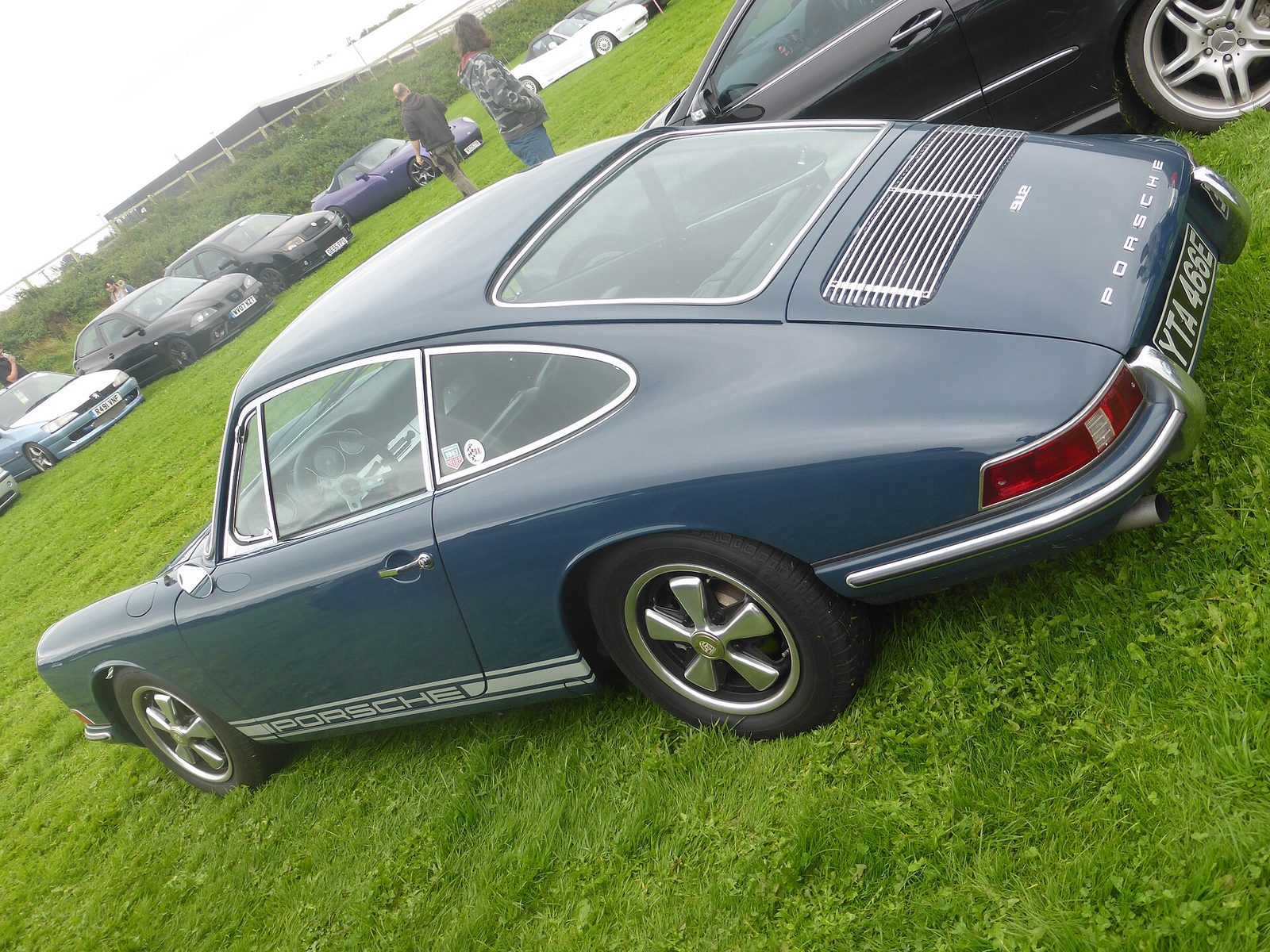
The Porsche 912 (1965-1969) was the four-cylinder answer to a commercial problem: the new 911 was too expensive for many of the customers who had kept the 356 in production, particularly in the United States. Porsche put the 356 SC's 1.6-liter Type 616 pushrod flat-four, detuned from 95 to 89 hp, into Butzi Porsche's 911 body, stripped some trim, and sold it from April 1965 at $4,700 in America and DM 16,250 in Germany. It outsold the 911 by around two to one through 1967, and Road & Track found that the lighter engine cured the tail-happiness the swing-axle 356 had been known for. A Targa followed in December 1966 and a long-wheelbase 1969 model closed the run before the 914 took over the entry-level job. Porsche's current figure is 30,745 cars; other sources say 30,000, or more than 32,000, and the disagreement is set out below. The 912E, a one-year 1976 car for North America built on the G-body 911 shell with the 914's fuel-injected 2.0-liter Volkswagen engine, revived the badge as a stop-gap before the 924; 2,092 or 2,099 were built depending on the source.
912
912 and 912E
History
The Problem the 912 Solved
When the 911 went on sale in 1964 it was, by the Porsche Club Great Britain register's account, not well received in America because it was regarded as too expensive. Porsche's own history describes the 912 as a bridge between two models, built for customers who preferred the four-cylinder engine over the 911's six, and closing the price gap between the 356, still in production, and the new car. The solution was direct. The 1,582 cc Type 616 flat-four of the 356 SC was reduced from 95 to 89 hp at 5,800 rpm, mounted in the 911's steel body, and sold with reduced cabin trim as a cost measure. The result weighed around 2,127 lb, roughly 250 lb less than a 911, and listed at $4,700 in the United States in 1965 and DM 16,250 in Germany.
Launch and Reception
Production began in April 1965, Conceptcarz giving 5 April, with European customers served from June and the US market from September of that year according to the Porsche Club GB register. The Porsche Vehicle Research Department kept a small block of early chassis numbers for its own use; Wikipedia records 13328, 13329, 13330, 13352 and 13386 to 13397, and the oldest known survivor is serial 13394. Road & Track tested a five-speed car in 1966 at $4,690 and recorded 0-60 mph in 11.6 seconds, the quarter mile in 18.1 seconds at 78 mph and 119 mph flat out, under the headline that oversteer was a thing of the past: the lighter engine had shifted the weight distribution very much in the 912's favor. The magazine's only real complaint was the five-speed's dog-leg pattern with first on the left and down. Stuttcars records that through 1967 the 912 outsold the 911 by two to one, and Renndriver gives 6,401 912s against 3,390 911s in 1965 alone. Silodrome notes that some historians credit the car with keeping the company solvent.
Targa, Rallying and Yearly Change
The Targa, with its brushed stainless roll hoop, removable roof panel and a heavy plastic rear window that unzipped, entered production in December 1966 as a 1967 model. Porsche later called it Version I; enthusiasts call it the soft-window car. In January 1968 a Version II with a fixed glass rear window was added and most buyers chose it, which is why soft-window Targas are now the scarce body. In 1967 Sobieslaw Zasada won the European Rally Championship for Group 1 series touring cars in a 912. The PCA model guide tracks the small changes: block-script badging and the last year of 4.5-inch wheels in 1967; for 1968 the US safety package of dual-circuit brakes, a collapsible steering column, winged door handles, side reflectors and a padded dash, plus 5.5-inch wheels. Carburation is described differently by different sources, with Gooding and Stuttcars listing twin Solex 40 PII-4 units and Porsche's newsroom naming Weber 40 IDF downdraughts.
The Long-Wheelbase Year
For 1969 the 912 received the 911's revised platform, with the rear wheels moved back about 2.5 inches to a 2,268 mm wheelbase, flared arches, improved ventilation and an electric rear-window defroster. It was the last year. Wikipedia attributes the end to the reallocation of production facilities to the new 914-6 and to tightening emissions regulations; the mid-engined 914 became the four-cylinder Porsche from 1970. Porsche says 30,745 912s had been built by July 1969; other sources put it at 30,000 or more than 32,000, as the production notes explain.
The 912E Interlude
Porsche's newsroom says internal discussions about reviving the 912 began in 1972. By 1975 the 914 was ending and the 924 was, in PCA's words, still nearly a year away, so Porsche mated the G-body 911 shell to the 914's 2.0-liter Volkswagen Type 4 flat-four with Bosch L-Jetronic injection, secondary air injection, thermal reactors and exhaust gas recirculation. The prototype, car number 0, received its California Clean Air Act certificate on 30 July 1975 after covering 59,323 miles. Sold only in North America for 1976 at $10,845, $3,000 under a 911S, the 912E was the only 912 with a galvanized shell. Car and Driver recorded 9.8 seconds to 60 mph and preferred it as a daily driver, but the badge acquired a reputation it has taken decades to shed.
Common Problems
Corrosion dominates. The 1965-1969 shells were unprotected steel and Renndriver names the floors, front trunk, battery box, windshield surround and headlight bowls as the recurring sites; Stuttcars notes that the 912E's galvanized chassis was specifically intended to overcome the common 912 rust problem. The Type 616 flat-four is a 356 engine and shares that car's needs: it is a pushrod unit with a 9.3:1 compression ratio, and it responds badly to neglect of valve clearances and to overheating from missing or damaged cooling tin, though none of the sources fetched here gives a systematic fault list. Carburetor wear on the twin Solex or Weber units shows up as poor idle and flat spots, and the split-shaft Solex arrangement mentioned by Stuttcars for 1968 has its own linkage issues. The dog-leg five-speed gearbox is a 901-family unit and worn synchromesh on second is common to the type. The early three-gauge dash cars have a water-bladder washer reservoir that perishes. On the Targa the plastic rear window yellows and the zip fails. The 912E has its own list, drawn from owners rather than published guides because the 912BBS forum threads on 912E engine issues and thermal reactor replacement were not retrievable here: the thermal reactors run hot and are frequently removed, the Bosch L-Jetronic air-flow meter and its wiring age, and Heacock Classic's observed 23.0 mpg against the 30 mpg claim suggests how sensitive the injection is to condition. Rennlist's owners report close to 25 mpg in traffic and over 30 mpg on the highway from cars in good order.
What to Look For
The body is the car. Renndriver lists the floors, the front trunk, the battery box and the areas around the windshield and headlights as the primary rust sites, and none of the 1965-1969 cars was galvanized; only the 912E was. A 912 that has been on the road for sixty years will have been welded somewhere, and the question is whether the repairs were done to the original panel lines and whether the suspension pick-up points and the front pan were addressed rather than skinned over. Targas add the roll-hoop base and the rear deck seams. Matching numbers can be established against the factory record: Gooding's 2023 catalog cites the Porsche Factory Record for the engine and gearbox of chassis 454553, and a Porsche Certificate of Authenticity or Kardex copy is the usual document. A great many 912s have lost their 616 engines to 911 sixes or to larger four-cylinder builds; Gooding's 1969 Targa carried a 1,720 cc unit, honestly described. Whether that matters depends on the buyer, but the price should reflect it. Year-specific details are worth checking against the PCA model guide: non-adjustable front strut towers and a water bladder for washer fluid on the earliest cars, a three-gauge dash on 1965-1966 coupes, block-script badging from 1967, the 1968 US safety items, and the flared arches and defroster of the 1969 long-wheelbase car. On a soft-window Targa the zip-out plastic rear window and the rear shelf are the parts most often replaced or converted, and the Version II glass window was offered from January 1968, so an early car with glass may not be original. The five-speed was optional and its presence should be confirmed rather than assumed. On a 912E, look for the thermal reactors and emissions plumbing still in place, the L-Jetronic in working order, the factory sunroof if claimed, and the galvanized shell free of accident repair; the North American-only market means most are still in the United States.
Market Notes
As of September 2026, classic.com carries the 912 in three groups. The short-wheelbase 1965-1968 car shows an average price of $51,371, with a coupe benchmark of $57,391 on an upward trend and a Targa benchmark of $47,058; recent results it records are $47,500 for a 1966 coupe on 8 August 2026, $55,000 for a 1968 coupe on 7 August 2026 and $56,201 for a 1965 coupe on 24 July 2026, all online auction sales. The 1969 long-wheelbase group averages $51,791, with a coupe benchmark of $55,186 and a Targa benchmark of $67,292, and recent results of $40,000 on 28 August 2026, $57,912 on 13 July 2026, $59,950 on 20 April 2026 and $64,000 on 6 April 2026. The 912E group as of September 2026 shows a benchmark of $45,705 trending upward and an average of $43,965, a high of $125,912 on 24 January 2025, a low of $26,000 for a cabriolet conversion in April 2023, and recent sales of $60,000 on 18 August 2026, $56,000 on 14 May 2026, $47,500 on 16 June 2026 and $50,000 through PCARMARKET on 6 October 2025. The very low figures classic.com lists as record lows ($17, $258 and $358 on 28 October 2024) are data errors rather than transactions. For the top of the market, Gooding sold a restored Bahama Yellow 1967 coupe for $114,400 against a $60,000-80,000 estimate at Scottsdale in January 2017, an unrestored 1969 Targa for $60,500 at Pebble Beach in August 2017, and a mechanically restored, matching-numbers 1966 coupe for $53,200 without reserve at Pebble Beach in August 2023 against an $80,000-100,000 estimate. All Gooding figures are as published by the house, which does not state on the lot page whether premium is included.
Where sources differ
Sources describe the 912's carburation differently: Gooding's catalogs and Stuttcars list twin Solex 40 PII-4 units, while Porsche's newsroom names two Weber 40 IDF double downdraft carburetors; Stuttcars also mentions split-shaft Solex carburetors introduced in 1968.
Porsche Newsroom's Klassik feature states two Weber 40 IDF carburetors. Stuttcars' specification sheet and Gooding's 1969 Targa catalog state Solex 40 PII-4; Gooding's 1966 catalog says twin Solex. None of the sources fetched here sets out a changeover by model year, so the discrepancy is not resolved.
The 912E's 1,971 cc Volkswagen Type 4 engine, 3.7 in (94 mm) x 71 mm with Bosch L-Jetronic, is rated at 86 hp at 4,900 rpm by Stuttcars and Heacock and at 89 hp at 4,900 rpm with 101 lb-ft by the Porsche newsroom; the gearbox is described as a five-speed by Porsche and as a four-speed by Heacock Classic.
Porsche Newsroom states the 912E prototype's engine was paired with a five-speed gearbox. Heacock Classic's article on a production 912E states a four-speed manual gearbox. The power figures (86 hp SAE against 89 hp) are reconcilable as different rating systems, but the gearbox description is not, and no source fetched here resolves it.
The 1965-1969 production total is disputed: Porsche states 30,745, Wikipedia and Renndriver say more than or roughly 32,000, the Porsche Club GB register says 30,000, and Conceptcarz prints 21,600 in a table that contradicts its own text.
Porsche AG's corporate page and its Klassik newsroom feature state 30,745. Wikipedia states 'more than 32,000' built April 1965 to July 1969. Renndriver states 'roughly 32,000'. Porsche Club Great Britain's register states 'only 30,000'. Conceptcarz prints 21,600 in its data table while its text gives nearly 30,000 coupes plus around 2,500 Targas. Drive Patina reproduces year figures summing to about 36,300 and warns they are sales, not production. Not resolved by any source consulted here.
The coupe and Targa split is not established: Wikipedia and Renndriver give nearly 30,000 coupes and about 2,500 Targas, while Drive Patina gives roughly 27,738 coupes and 2,562 Targas and says there is no reliable public figure for soft-window Targas.
Wikipedia, Renndriver and Conceptcarz give nearly 30,000 coupes and about 2,500 Targas, which sums above Porsche's 30,745. Drive Patina gives roughly 27,738 coupes and 2,562 Targas, which sums to about 30,300. Not resolved by any source consulted here.
The 912E total is given as 2,099 by Porsche and Heacock Classic and as 2,092 by Wikipedia, Stuttcars, classic.com and Renndriver, built between May 1975 and July 1976 for the US market only.
Porsche AG's corporate page, the Porsche Newsroom prototype feature and Heacock Classic state 2,099. Wikipedia's main text, Stuttcars, classic.com and Renndriver state 2,092; Wikipedia uses 2,099 in a separate passage. PCA says 'almost 2,100' and Rennlist 'only 2,100 were said to be built'. Not resolved by any source consulted here.
Sources
- What is the Porsche 912?, Porsche AG · manufacturer
- A Sensitive Transition (Porsche Klassik), Porsche Newsroom · manufacturer
- Golden hour: the car that adds color to a blank page of Porsche history, Porsche Newsroom USA · manufacturer
- Model 912 | Porsche Great Britain, Porsche Cars Great Britain · manufacturer
- Porsche 912, Wikipedia · encyclopedia
- Vintage Road & Track Review: 1966 Porsche 912 - Oversteer Is A Thing Of The Past, Curbside Classic (reproducing Road & Track, 1966) · journalism
- Porsche 912, Silodrome · journalism
- Porsche 912 (1965 - 1969), Stuttcars · specialist
- Porsche 912 (1965 - 1969) - Specifications & Performance, Stuttcars · specialist
- Porsche 912 E (1976), Stuttcars · specialist
- Porsche 912 - Model Information, Conceptcarz · specialist
- Porsche 912 Production Numbers by Year (1965-1969 & 912E), Drive Patina · specialist
- Porsche 912 Guide: Specs, History, the 912E, and Values, Renndriver · specialist
- PORSCHE 912 (901) Specs, Performance & Photos - 1965, 1966, 1967, 1968, 1969, autoevolution · specialist
- 1976 Porsche 912E Coupe, Heacock Classic · specialist
- Model Guide: Porsche 912 and 912E, Porsche Club of America · club-forum
- 912E and 924: The real story of two of Porsche's most maligned entry-level cars, Porsche Club of America · club-forum
- 8 Facts about the 1976 Porsche 912e, Rennlist · club-forum
- Porsche 912 register | Porsche Club GB | Classic, Porsche Club Great Britain · registry
- Porsche 912 - SWB Market, classic.com · market-data
- Porsche 912 - LWB Market, classic.com · market-data
- Porsche 912E Market, classic.com · market-data
- 1967 Porsche 912 | Scottsdale Auctions 2017, Gooding & Company · auction-house
- 1969 Porsche 912 Targa | Pebble Beach Auctions 2017, Gooding & Company · auction-house
- 1966 Porsche 912 | Pebble Beach Auctions 2023, Gooding & Company · auction-house
Synthesized from the sources above and cross-checked. We cite and link out; we do not republish other databases verbatim.
Fully Sorted is an independent publisher and is not affiliated with, endorsed by or sponsored by Dr. Ing. h.c. F. Porsche AG. Porsche and the model names on this page are trademarks of Dr. Ing. h.c. F. Porsche AG and are used here only to identify the cars being described.
Chassis register
Nobody has recorded a car here yet. Own one, or know one? Chassis number, what you can prove about it, and a source if there is one. Every entry is reviewed before it appears.
Nerd Notes
What owners know that the sources don't. Every note is read and checked before it appears here.
Key Specs
- Power
- 89 hp DIN (89 hp) at 5,800 rpm per Porsche; 102 hp SAE gross quoted in the United States and by Road & Track in 1966. 912E: 86 hp SAE net at 4,900 rpm (Stuttcars, Heacock) or 89 hp (Porsche newsroom)
- Brakes
- Discs all round, 9.26 in front and 9.6 in rear per Stuttcars; dual-circuit system mandated for 1968 US cars
- Engine
- 1,582 cc Type 616/36 pushrod flat-four from the 356 SC, detuned from 95 to 89 hp; 2.9 in (74 mm) x 82.5 mm; 9.3:1; twin twin-choke carburetors, Solex 40 PII-4 per Gooding and Stuttcars, Weber 40 IDF per the Porsche newsroom (see claims). 912E: 1,971 cc VW Type 4, 3.7 in (94 mm) x 71 mm, Bosch L-Jetronic
- Layout
- Rear-mounted air-cooled flat-four behind the rear axle, rear-wheel drive; unitary steel body shared with the contemporary 911 (F-body 1965-1969, G-body for the 912E)
- Torque
- 90 lb-ft at 3,500 rpm; Stuttcars quotes 98 lb-ft at 3,500 rpm. 912E: 98 lb-ft at 4,900 rpm
- Weight
- 2,127 lb curb per Wikipedia, Renndriver and Silodrome; 2,194 lb DIN per the Porsche newsroom; 2,138 lb per autoevolution; 2,095 lb dry per Stuttcars. 912E: 2,395 lb per Heacock, 'about 2,200 lb' per Rennlist, 'under 2,400 lb' per PCA
- Chassis
- Steel monocoque, bodies built by Porsche and by Karmann of Osnabruck; wheelbase 87.0 in (2,211 mm) (87 in) 1965-1968 and 2,268 mm (89.3 in) for 1969; the 912E used the 911's 2,271 mm (89.4 in) G-body shell with a galvanized structure
- Price new
- $4,700 in the US in 1965, $4,690 as tested by Road & Track in 1966, $5,235 coupe and $5,615 Targa in 1969; 912E $10,845 in 1976
- Top speed
- 114 mph per Porsche; 119 mph recorded by Road & Track in 1966; 115 mph per Stuttcars. 912E: about 115-120 mph depending on source
- Dimensions
- Length 162.8-163.9 in (4,135-4,163 mm), width 63.0-63.4 in (1,600-1,610 mm), height 52.0 in (1,320 mm) depending on source; wheelbase 87.0 in (2,211 mm) (1965-1968) or 89.3 in (2,268 mm) (1969)
- Suspension
- MacPherson-type struts with longitudinal torsion bars at the front, semi-trailing arms with transverse torsion bars at the rear, as on the 911; non-adjustable front strut towers on 1965-1966 cars, adjustable from 1966 US models
- Acceleration
- 0-60 mph in 11.6 s (Road & Track, 1966, five-speed car); 0-62 mph in 13.5 s per Porsche; 0-62 mph 11.8 s per autoevolution; standing quarter mile 18.1 s at 78 mph (Road & Track). 912E: 9.8 s to 60 mph per Car and Driver as quoted by PCA, 11.3 s per Heacock, 13.0 s per Stuttcars
- Fuel economy
- Up to 30 mpg (US) claimed for the 912; 912E quoted at around 30 mpg highway with a 600-mile range from its 20-plus gallon tank, 23.0 mpg observed by Heacock
- Transmission
- Four-speed manual standard, five-speed manual optional ($35 in the US per Stuttcars), dog-leg first on five-speed cars. 912E: five-speed per the Porsche newsroom; Heacock Classic describes a four-speed (see claims)
- Wheels tires
- 15 x 4.5 in steel wheels 1965-1967, 15 x 5.5 in from 1968, 165 HR 15 tires; Road & Track's 1966 test car ran 6.95 x 15 Goodyear Grand Prix tires on 5.5 in wheels. 912E: 14 in Fuchs alloys optional
Notable Variants
912 coupe, short wheelbase (1965-1968)
The core car: 87.0 in (2,211 mm) wheelbase shared with the early 911, three-gauge dashboard on 1965-1966 cars, 4.5-inch wheels to 1967 and 5.5-inch from 1968. The earliest cars with painted dash and 356-style details are the ones registries and auction houses single out.
912 Targa 'soft window' (December 1966-early 1968)
Version I Targa with a zip-out plastic rear window, introduced as a 1967 model. Most buyers moved to the glass-window Version II once it was offered in January 1968, which makes the soft-window cars the scarcest body of the run; Gooding describes them as one of the rarest models of the period.
912 Targa 'Version II' hard window (1968-1969)
Fixed glass rear window on the brushed stainless roll hoop. Quieter and more usable than the soft-window car; on classic.com the 1969 long-wheelbase Targa carries the highest benchmark of any 912 body as of September 2026.
912 long wheelbase (1969 only)
Rear wheels moved back about 2.2 in (57 mm) (2.5 inches) to 2,268 mm (89.3 inches), with the flared arches, improved ventilation and electric rear-window defrost of the 1969 911. One model year only before the 914 took the entry-level slot, and the model year most often quoted with the higher 102 hp SAE rating.
912 five-speed
The four-speed was standard; the five-speed was a $35 option according to Stuttcars, and Road & Track tested a five-speed car in 1966. Its first-on-the-left dog-leg pattern drew criticism in period but the option is now the one buyers ask for first.
912E (1976, North America only)
G-body 911 shell with the fuel-injected 2.0-liter Volkswagen Type 4 flat-four from the 914, thermal reactors, a galvanized shell and a 20-plus gallon tank. Built as a one-year stop-gap between the 914 and the 924 and priced at $10,845, $3,000 under a 911S. Not a 1965-1969 car in any mechanical sense, and traded separately.
Value Trajectory
The 912 listed at $4,700 in 1965 and $5,235 for a 1969 coupe, always the cheapest Porsche, and for decades it traded as one. Rennlist's piece on the 912E, written when a good example was worth $21,000 against $16,000 for a 911 of the same year, and the PCA author who bought a 912E for $6,500 in 2006 show how low the floor sat. Long-hood 911 values pulled the 912 up behind them in the 2010s: Gooding's $114,400 for a restored 1967 coupe at Scottsdale in January 2017 was nearly double its top estimate and remains the highest 912 result among the sources fetched here. The market then settled. Gooding's 2023 Pebble Beach 1966 coupe made $53,200 against an $80,000-100,000 estimate, and as of September 2026 classic.com's benchmarks sit at $57,391 for a short-wheelbase coupe, $47,058 for a short-wheelbase Targa, $55,186 and $67,292 for the 1969 coupe and Targa, and $45,705 for the 912E, with the coupe and 912E indicators trending up and recent sales clustering between $40,000 and $64,000. The spread between an ordinary driver and the best restored or preserved car, six figures at the top according to Renndriver, is wider than the averages suggest, and originality of engine and shell is what separates the two.
Next
Shopping for one?
Browse Porsche listings, or decode a VIN before you buy.