
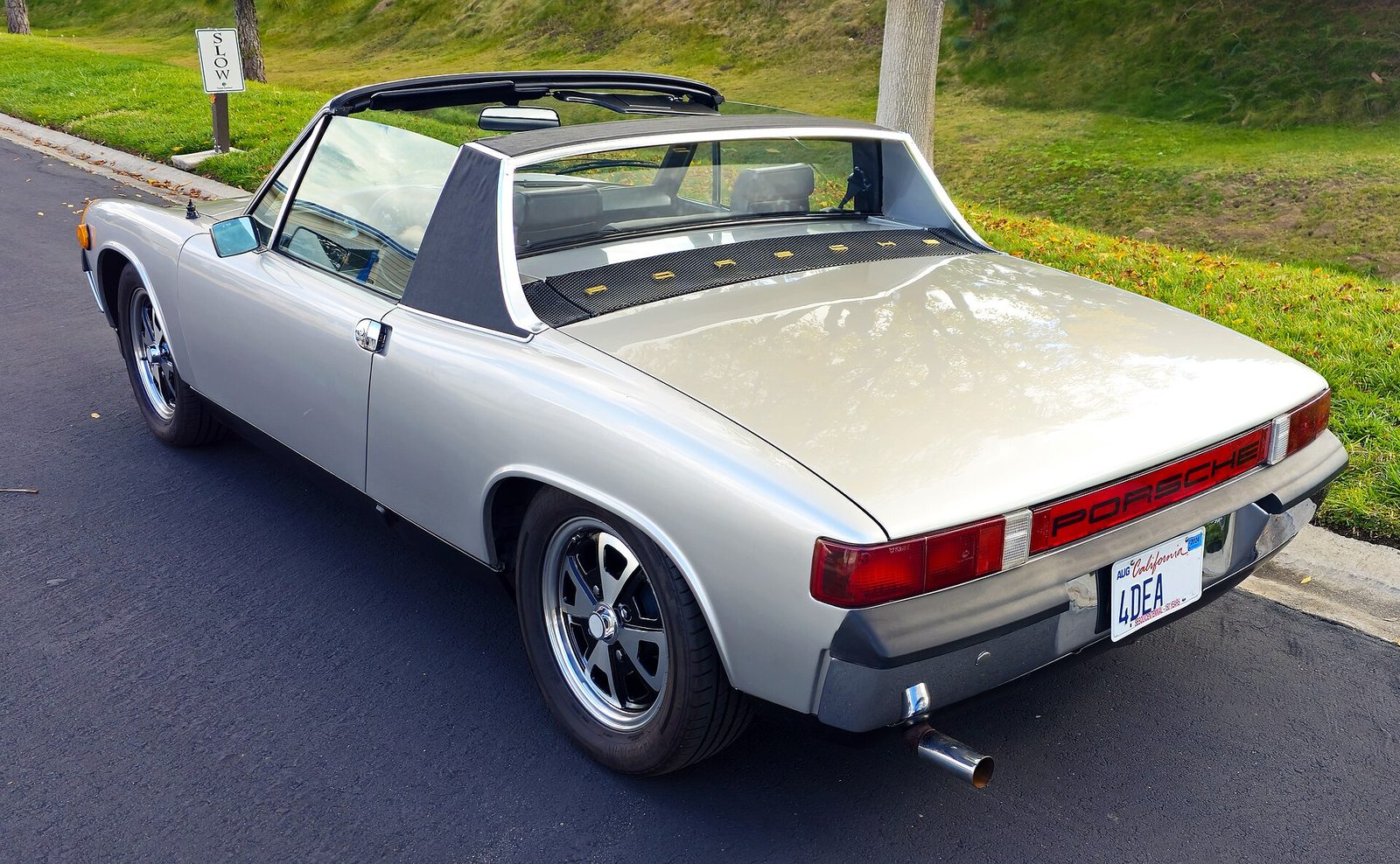
The Porsche 914 (1969-1976) was the mid-engined, targa-roofed two-seater that Porsche and Volkswagen built together: Porsche designed and engineered it, Karmann in Osnabrück assembled the bodies, and a jointly owned sales company sold it in Europe as the VW-Porsche while in the United States it wore Porsche badges alone. The base 914/4 used Volkswagen's fuel-injected 1,679 cc flat-four with 79 hp at 4,900 rpm; the 914/6, finished at Zuffenhausen, carried the 1,991 cc, 108 hp flat-six from the 911 T and cost so much more that it was dropped after 1972. The four-cylinder car grew to 1.8 and 2.0 liters from 1973 and outsold the 911 through its run, with a little under 119,000 built in total; the six-cylinder figure is given as anywhere between 3,332 and 3,360 depending on the source. Motor Trend's Import Car of the Year for 1970, a GT-class winner at Le Mans the same year and for decades dismissed as the People's Porsche, the 914 has since been re-read as the beginning of the idea that became the Boxster.
914
914/4 and 914/6
History
A Handshake Between Stuttgart and Wolfsburg
Volkswagen wanted a successor to the Type 34 Karmann Ghia; Porsche wanted something cheaper than the 912 beneath the 911. In 1967 Ferry Porsche and Volkswagen's Heinz Nordhoff agreed, by most accounts on a handshake, that Porsche would design a mid-engined sports car which Volkswagen would build and sell with its own four-cylinder engine, while Porsche took the same body for a six-cylinder version. Ferdinand Piech handled the mechanical layout and the first prototype ran on 1 March 1968. Nordhoff died weeks later and his successor Kurt Lotz raised the price Porsche paid for each body; the two companies then formed the VW-Porsche Vertriebsgesellschaft to sell the car in Europe as the VW-Porsche. In the United States, which took the great majority of production, it was simply a Porsche. Curbside Classic records the venture DM 200 million in the red by the end of 1970.
Four Cylinders From Osnabruck, Six From Zuffenhausen
Shown at the Frankfurt IAA in September 1969, the car reached America early in 1970. Karmann built every body at Osnabruck and completed the 914/4 there around Volkswagen's 1,679 cc Type 4 engine from the 411, with Bosch D-Jetronic injection and 79 hp at 4,900 rpm; Porsche claimed 13 seconds to 62 mph and 110 mph. The 914/6 bodies went to Zuffenhausen for the 1,991 cc flat-six of the 1969 911 T on twin Webers, 108 hp at 5,800 rpm, with 911 brakes and five-stud hubs. Both shared the removable fiberglass roof stowed in the rear boot, pop-up headlamps and a five-speed transaxle with a dog-leg first and a tail-shift linkage whose two right-angle turns gave the early cars their vague gearchange. Motor Trend named the 914 its Import Car of the Year for 1970; Road & Track called it unpretty and timed the four at almost 14 seconds to 60 mph, though its 914/6 test produced 8.7 seconds and 123 mph.
The 914/6 Problem, the 916 and the 914/8
The six was the better car and the worse proposition. In the United States it cost $5,999 against $3,495 for the four, and in Germany DM 19,980 against DM 11,955, close enough to a 911 T that most buyers took the 911. Porsche's figure for the run is exactly 3,338 cars between 1969 and 1972, other sources say 3,332, 3,351 or 3,360, and every breakdown agrees that the great majority were built in 1970. Competition kept the six's name alive: a Sonauto-entered 914/6 GT won the GT class and finished sixth overall at Le Mans in 1970, the works took a triple victory in the Marathon de la Route the same year, and Brumos won the 1971 IMSA GTU championship. Two further directions were abandoned: the 916, a fixed-roof car with 911 S or Carrera RS power aimed at the Dino 246, reached eleven prototypes before its projected price ended it, and two 914/8s with 908 flat-eights were built in 1969, one for Ferry Porsche.
1973: The Car It Should Have Been
The 1973 model year fixed the 914's two real faults. Porsche enlarged the Type 4 engine to 1,971 cc with a 3.7 in (94 mm) bore and 71 mm stroke, giving 99 hp in Europe and 95 hp in American trim; Road & Track recorded 10.3 seconds to 60 mph and 119 mph, with the early cars' oversteer replaced by steady understeer. The Type 914/12 side-shift gearbox replaced the tail-shift linkage, 5.5-inch wheels and matt-black bumpers became standard, and a center console with extra gauges was offered. 1973 was also the peak year, with more than 27,000 cars by Stuttcars' count.
Bumpers, Emissions and the End
For 1974 a 1,795 cc engine with L-Jetronic injection replaced the 1.7 in America at only 76 hp, and rubber bumper guards and the Bumblebee and Creamsicle Limited Editions arrived. 1975 brought heavy federal impact bumpers, California catalytic converters and a relocated fuel pump. The 1976 cars, 2.0 only, were sold in the United States alone with the badge reduced to a decal. Production ended in spring 1976 as the front-engined 924, the next joint project, approached. Just under 119,000 had been built, more than the 911 in the same years, and for four decades they were the cheapest way into a Porsche badge, which is why so many were rusted, converted or raced into the ground.
Common Problems
Rust is the 914's defining weakness and every ownership source consulted says so. The battery tray in the engine bay leaks acid onto the boxed sheet metal that carries the right-rear suspension, and the resulting hell hole is the single most common structural failure; the longitudinals, jacking points, floors, rear trunk floor, cowl and firewall follow. On early cars the battery also sits above the fuel lines, and corroded lines combined with a hot engine bay created a fire risk that owners address with braided stainless lines and by moving the fuel pump forward, a change the factory itself made from 1975. The Bosch D-Jetronic injection on the 1.7 and 2.0 is sound when its vacuum sensors and wiring are good, but many components are no longer available and harnesses grow brittle with heat, which is why so many cars were converted to carburetors; the L-Jetronic on the 1.8 is considered more tolerant. Oil leaks concentrate at the pushrod tubes and at the engine-to-gearbox joint, where a failed flywheel seal will contaminate the clutch. The clutch cable tube can break free from its welds at the rear bulkhead, leaving the clutch unable to disengage fully. The early tail-shift linkage gives a vague change and worn first and second synchromesh is common in the five-speed; seized rear calipers are found on cars left standing. Six-cylinder conversions with front engine mounts transmit noise into the cabin, and the 2.0's heads and oil coolers are getting hard to find. None of this is exotic, but the sum of it is why the Porsche Club of America's guide observes that all Porsches end up costing about the same.
What to Look For
The 914 is a unitary steel body whose strength lives in the boxed longitudinal sills, and every specialist guide starts there. The battery sits on a tray in the engine bay above the right-rear suspension console, and decades of leaking acid and trapped water rot the tray and the boxed structure beneath it, the area owners call the hell hole; a car with a poorly repaired tray or a soft right-hand suspension mount is a structural rather than cosmetic proposition. Inner and outer longitudinals, especially behind the side jacking points, floor pans, the rear trunk floor and its trailing edge, the firewall behind the sound insulation, the front trunk floor, the cowl at the base of the windshield and the door bottoms complete the list. One simple check is to remove the roof and look at the door gaps at the top rear of each door: a car whose sills have gone will sag and close the gaps. Front-end collision damage is the other structural hazard; Classic Motorsports notes that a 914 hit hard at the front rarely tracks straight again. On the six, five-stud hubs and the left-hand dash ignition are original features, and a warranty booklet or Porsche production record establishing the matching Type 901/36 engine matters because so many fours have been converted; the Porsche Club of America's guide holds that a converted four is worth less than a genuine six however good the work. On the fours, engine codes should be checked against the car, since twin carburetors can mean either a deliberate conversion from injection or a replaced engine, and the 2.0's cylinder heads and oil coolers are increasingly scarce. A 1973 or later side-shift gearbox is the one most guides prefer; the earlier tail-shift can be lived with but should shift cleanly. Roof and body seals, suspension bushes and heat-embrittled wiring harnesses are the common consumables. Because a proper repaint means complete disassembly, a car in an acceptable original color is worth more than one that needs paint.
Market Notes
As of September 2026 classic.com tracks the 914/6 and 914/4 as separate markets. The 914/6 benchmark stands at $83,279 with a downward trend indicator, against an average recorded sale of $85,140; the lowest tracked result is $33,000 for a 1970 car in September 2022 and the highest recent one is $95,200 for a 1970 car at Gooding Christie's Pebble Beach sale on 14 August 2026, with other 2026 results for 1970 and 1971 cars recorded at $52,500, $70,000 and $80,000 through online auctions. The 914/4 benchmark is $23,916 on an upward trend, with an average sale of $24,769, a floor of $728 for a 1970 project in October 2024 and August 2026 results of $43,000 for a 1976 car and $38,750 and $8,750 for two 1974 cars, the spread illustrating how much condition drives this market. Exceptional cars sit far above the benchmarks: Gooding's Pebble Beach 2024 sale took a Ravenna Green 1970 914/6 fitted with a 3.2-liter 911 engine and 915 gearbox, restored at a documented cost above $300,000, to $173,600 against a $100,000 to $150,000 estimate, and RM Sotheby's sold a 1972 914/6 with FIA papers and a 200 hp engine for EUR 73,600 at Monaco in May 2018. None of those lot pages states whether the figure includes buyer's premium, so they are quoted as published. classic.com's own caveat is that many 914s have been through engine conversions and modifications, and its listings include six-cylinder tributes built on four-cylinder shells; separating a genuine 914/6 from a converted car is the first job in reading any result.
Where sources differ
The 914/4 launched with Volkswagen's 1,679 cc Type 4 flat-four from the 411 sedan with Bosch D-Jetronic injection, rated at 79 hp at 4,900 rpm, for which Porsche claimed 13 seconds to 62 mph; Porsche quotes a 110 mph top speed while Volkswagen's newsroom gives 115 mph.
Porsche Newsroom states the 1.7-liter car 'topped out at 110 mph'. Volkswagen Newsroom states '79 hp and a top speed of 115 mph' for the same engine. Both are manufacturer sources and neither explains the difference; it may reflect different model years or test methods. Not resolved by any source consulted here.
The 914/6 used the 1,991 cc Type 901/36 flat-six of the 911 T on two Weber triple-choke carburetors, rated at 108 hp at 5,800 rpm and 118 lb-ft at 4,200 rpm with 8.6:1 compression, and carried 911-derived brakes on five-stud hubs; several US-market sources quote 125 hp for the same engine.
Porsche Newsroom, Volkswagen Newsroom, Porsche Classic and Wikipedia all give 108 hp at 5,800 rpm. Heritage Parts Center gives 125 hp at 5,800 rpm, the Porsche Club of America model guide gives 125 hp and Stuttcars' table gives 125 hp. The higher figure is consistent with a period US SAE gross rating but none of the sources labels it as such. Not resolved by any source consulted here.
The number of four-cylinder 914s built is stated as 115,631 by Porsche and Volkswagen, 115,646 by Wikipedia, Stuttcars and Nine Motoring, and 115,596 by Hagerty's market analysis and Classic Motorsports, giving overall totals variously reported as 118,969, 118,976, 118,978 and 118,992.
Porsche Newsroom and Volkswagen Newsroom state 115,631 four-cylinder cars; Hagerty's 2019 profile repeats it. Wikipedia's infobox, Stuttcars and Nine Motoring (citing Ludvigsen) state 115,646. Hagerty Insider and Classic Motorsports state 115,596. Totals follow: 118,978 (Wikipedia, Stuttcars), 118,992 including 916 and 914/8 prototypes (Nine Motoring), 118,976 (Classic Motorsports), and 118,969 by adding Porsche's own two figures. Not resolved by any source consulted here.
The number of 914/6s built between late 1969 and 1972 is given as exactly 3,338 by Porsche, 3,332 by Wikipedia's infobox, Stuttcars and Nine Motoring, 3,351 by the body of the same Wikipedia article, classic.com, Curbside Classic and Hagerty Insider, and 3,360 by Wikipedia's 914/6 GT article and p914-6info.net, which includes the 916 prototypes in that figure.
Porsche Newsroom states 'exactly 3,338 units were produced between 1969 and 1972'. Wikipedia's infobox, Stuttcars and Nine Motoring state 3,332. Wikipedia's article body, classic.com, Curbside Classic and Hagerty Insider state 3,351. Wikipedia's 914/6 GT article states 3,360 and p914-6info.net states 3,360 including the 916 prototypes. Gooding Christie's catalog says 'approximately 3,300' and RM Sotheby's 'just over 3,000'. Not resolved by any source consulted here.
Year-by-year 914/6 output is given as 2,789 in 1970, 306 in 1971 and 237 in 1972 by Nine Motoring, but as 2,668, 434 and 260 by p914-6info.net; both agree that the overwhelming majority were built in 1970.
Nine Motoring, citing Ludvigsen, gives model-year figures of 2,789, 306 and 237 (total 3,332) and warns that cars were often built in the autumn before their model year. p914-6info.net gives 2,668, 434 and 260 (total 3,362, stated as 3,360 including 916 prototypes) without stating its method. The Porsche Club of America guide adds that about 200 rest-of-world cars were made in 1972. Not resolved by any source consulted here.
The number of factory-built 914/6 GTs is given as eleven by Hagerty and as about 20 by Classic Motorsports, and the 1974 Limited Edition run is given only as 'about 1,000' cars by Nine Motoring.
Hagerty's 2019 profile states eleven original 914/6 GTs were built by the factory. Classic Motorsports states about 20 914/6 GTs. Neither gives a source for the figure. Not resolved by any source consulted here.
Sources
- 50 Years of the Porsche 914, Porsche AG (Porsche Newsroom) · manufacturer
- VW Porsche 914 (1969-1975), Volkswagen AG (Volkswagen Newsroom) · manufacturer
- Model Overview 914 | Porsche Classic | Porsche USA, Porsche Cars North America (Porsche Classic) · manufacturer
- Porsche 914, Wikipedia · encyclopedia
- Porsche 914-6 GT, Wikipedia · encyclopedia
- Porsche 914 - Ultimate Model Guide, Stuttcars · specialist
- 914 History: The Production Numbers - 7 Years and 118,992 914s, Nine Motoring · specialist
- 914/6 Odd Statistics, p914-6info.net (enthusiast archive) · specialist
- Model Guide: 914 - The VW-Porsche, Porsche Club of America · club-forum
- Porsche 914 Buying Guide, Heritage Parts Centre · specialist
- Stuck in the Middle: The Mid-Engine Porsche 914, Ate Up With Motor · journalism
- Curbside Classic: 1970 VW-Porsche 914/6 - Piech de Resistance, Curbside Classic · journalism
- Vintage Review: 1973 Porsche 914 2 Liter - Bigger 4-Cylinder Engine Gives The Popular 914 A Boost, Curbside Classic (reproducing Road & Track) · journalism
- Porsche 914 | Articles | Classic Motorsports, Classic Motorsports · journalism
- After 50 years, the Porsche 914 will only get better, Hagerty Media · journalism
- The 914 Is No Longer Porsche's Ugly Duckling, Hagerty Media (Hagerty Insider) · market-data
- Porsche 914/6 Market, classic.com · market-data
- Porsche 914/4 Market, classic.com · market-data
- 1970 Porsche 914/6 | Pebble Beach Auctions 2024 | Gooding Christie's, Gooding Christie's · auction-house
- 1972 Porsche 914/6 FIA | Monaco 2018 | RM Sotheby's, RM Sotheby's · auction-house
Synthesized from the sources above and cross-checked. We cite and link out; we do not republish other databases verbatim.
Fully Sorted is an independent publisher and is not affiliated with, endorsed by or sponsored by Dr. Ing. h.c. F. Porsche AG. Porsche and the model names on this page are trademarks of Dr. Ing. h.c. F. Porsche AG and are used here only to identify the cars being described.
Chassis register
Nobody has recorded a car here yet. Own one, or know one? Chassis number, what you can prove about it, and a source if there is one. Every entry is reviewed before it appears.
Nerd Notes
What owners know that the sources don't. Every note is read and checked before it appears here.
Key Specs
- Power
- 79 hp at 4,900 rpm (1.7); 108 hp at 5,800 rpm (914/6, DIN; 125 hp in some US sources); 99 hp European or 95 hp US at 4,900 rpm (2.0, 88 hp in 1976 US trim); 76 hp US or 84 hp European (1.8). All manufacturer ratings
- Brakes
- Discs all round; 10.0 in (255 mm) front and 11.1 in (282 mm) rear on the 914/4 per Wikipedia; 914/6 uses 911-derived brakes on five-stud hubs
- Engine
- 914/4: 1,679 cc (1.7), 1,795 cc (1.8) or 1,971 cc (2.0) Volkswagen Type 4 air-cooled flat-four with Bosch electronic injection; 914/6: 1,991 cc Porsche Type 901/36 air-cooled flat-six with two Weber triple-choke carburetors
- Layout
- Longitudinal mid-mounted engine ahead of the rear axle, rear-wheel drive; transaxle behind the engine
- Torque
- 98 lb-ft at 2,700 rpm (1.7); 118 lb-ft at 4,200 rpm (914/6); 116 lb-ft at 3,500 rpm (2.0); 100 lb-ft at 3,400 rpm (1.8), as quoted by Stuttcars and Wikipedia
- Weight
- 2,072 lb (1.7) and 2,094 lb (2.0) per Stuttcars; Wikipedia gives a 2,072-2,194 lb range; US impact bumpers from 1975 added 49 lb according to Classic Motorsports
- Chassis
- Steel unitary body built by Karmann at Osnabrück for all cars, with 914/6 final assembly at Zuffenhausen; boxed longitudinal sills carry the structure, so their condition determines the car
- Price new
- $3,495 for the 914 and $5,999 for the 914/6 in the United States in 1970, rising past $5,000 for the four-cylinder car by 1974
- Top speed
- 110 mph claimed for the 1.7 by Porsche (Volkswagen's newsroom says 115 mph); over 124 mph claimed for the 914/6, 123 mph recorded by Road & Track; 119 mph recorded for the 1973 2.0
- Dimensions
- Length 156.9 in (3,985 mm), width 65.0 in (1,650 mm), height 48.4 in (1,230 mm), wheelbase 96.5 in (2,450 mm)
- Suspension
- Front: MacPherson-type struts with longitudinal torsion bars from the 911; rear: semi-trailing arms with coil springs; anti-roll bars optional from 1971
- Fuel system
- Bosch D-Jetronic electronic injection on the 1.7 and 2.0 fours, L-Jetronic (AFC) on the US 1.8, twin carburetors on the European 1.8 and on the 914/6; fuel pump relocated by the factory from 1975
- Acceleration
- 1.7: 0-62 mph in 13 s claimed by Porsche, Road & Track recorded almost 14 s to 60 mph; 914/6: under 9 s claimed, 8.7 s to 60 mph in Road & Track's test; 2.0 (1973): 10.3 s to 60 mph per Road & Track
- Transmission
- 5-speed manual transaxle: Type 914/11 tail-shift (four-cylinder to 1972), Type 914/01 (914/6), Type 914/12 side-shift (1973 on); dog-leg first gear; four-speed Sportomatic Type 914/05 optional on the 914/6
- Wheels tires
- 15-inch wheels, 4.5 J steel on early four-cylinder cars rising to 5.5 J in 1973, with 155 SR then 165 SR tires; 4 x 130 mm bolt pattern on the 914/4 and 5 x 130 mm on the 914/6, which could carry Fuchs alloys
Notable Variants
914/6 (1970-1972)
The Porsche-engined car: 1,991 cc 911 T flat-six on Webers, 108 hp, five-stud 911 hubs, Zuffenhausen final assembly and a price close to a 911 T. Between 3,332 and 3,360 built depending on the source, and the one the market treats as a proper Porsche; classic.com's benchmark sits at $83,279 as of September 2026.
914/6 GT and M471 option
Factory competition variant with steel flared arches, wider Fuchs wheels and race-tuned six quoted at up to 207 hp at 8,000 rpm; a Sonauto-entered car won the GT class and finished sixth overall at Le Mans in 1970, and the model won the 1971 IMSA GTU title with Brumos. Factory GT numbers are disputed (eleven or about twenty) and period conversions and modern tributes far outnumber originals.
914/4 1.7 (1970-1973)
The launch car and the bulk of early production: 79 hp Volkswagen 411 engine, D-Jetronic injection, tail-shift gearbox, 0-60 mph in about 13 to 14 seconds in period tests. Robust rather than quick; valued now for originality and color rather than performance.
914 2.0 (1973-1976)
Porsche's own enlargement of the Type 4 to 1,971 cc, 99 hp in Europe and 95 hp in the United States, paired from 1973 with the side-shift gearbox that cured the early linkage. Road & Track recorded 0-60 mph in 10.3 seconds. The four-cylinder car most guides single out, and classic.com's 914/4 benchmark of $23,916 as of September 2026 is led by these cars.
914 1.8 (1974-1975)
Replaced the 1.7 as the base engine with L-Jetronic injection in the US (76 hp) and twin carburetors in Europe (84 hp). Generally the least sought-after variant; the Porsche Club of America's model guide ranks it last among the four-cylinder options.
914 Limited Edition, 1974 (Can-Am)
US-market appearance package in two schemes, black with yellow trim (Bumblebee) and white with orange (Creamsicle), with front spoiler and 2.0 engine. 'About 1,000' built according to Nine Motoring; regularly faked with paint, so the factory build record matters.
916 and 914/8 prototypes
The 916 was a fixed-roof, 911 S or Carrera RS-engined luxury version intended to rival the Dino 246; eleven were built in 1971-1972 before the price killed it. Two 914/8s with flat-eight 908 engines of around 296 hp were made in 1969, one for Ferry Porsche. Neither trades in the same market as the production car.
Value Trajectory
The 914 was the cheap Porsche for most of its life. It listed at $3,495 in the United States in 1970, rose past $5,000 by 1974, and for decades afterwards traded as a budget entry to the marque: Classic Motorsports' 2004 guide put a good 1973 2.0 at $8,000 to $12,000, half the price of a comparable 911, and Hagerty's market analysis recalls really good four-cylinder cars at well under $20,000 and drivers at barely $10,000 in 2009. Hagerty records prices roughly doubling over the following decade, a surge from mid-2018 to late 2021, and a condition-two 914/6 value of $120,000 that placed the six above a 911 T coupe; its 2019 profile gave the 914/6 median in excellent condition as having moved from $32,100 to $82,000 since September 2006. As of September 2026 classic.com's 914/6 benchmark is $83,279 and trending down, while its 914/4 benchmark of $23,916 is trending up, which suggests the six has settled after its run and the four is still catching up; outliers such as the $173,600 restored, 3.2-liter-engined 914/6 at Pebble Beach in 2024 reflect restoration cost and specification rather than the model's general level. The four-cylinder market remains wide, from sub-$1,000 projects to the mid-$40,000s for the best 1973-1976 2.0 cars, and condition rather than year does the work.
Next
Shopping for one?
Browse Porsche listings, or decode a VIN before you buy.