
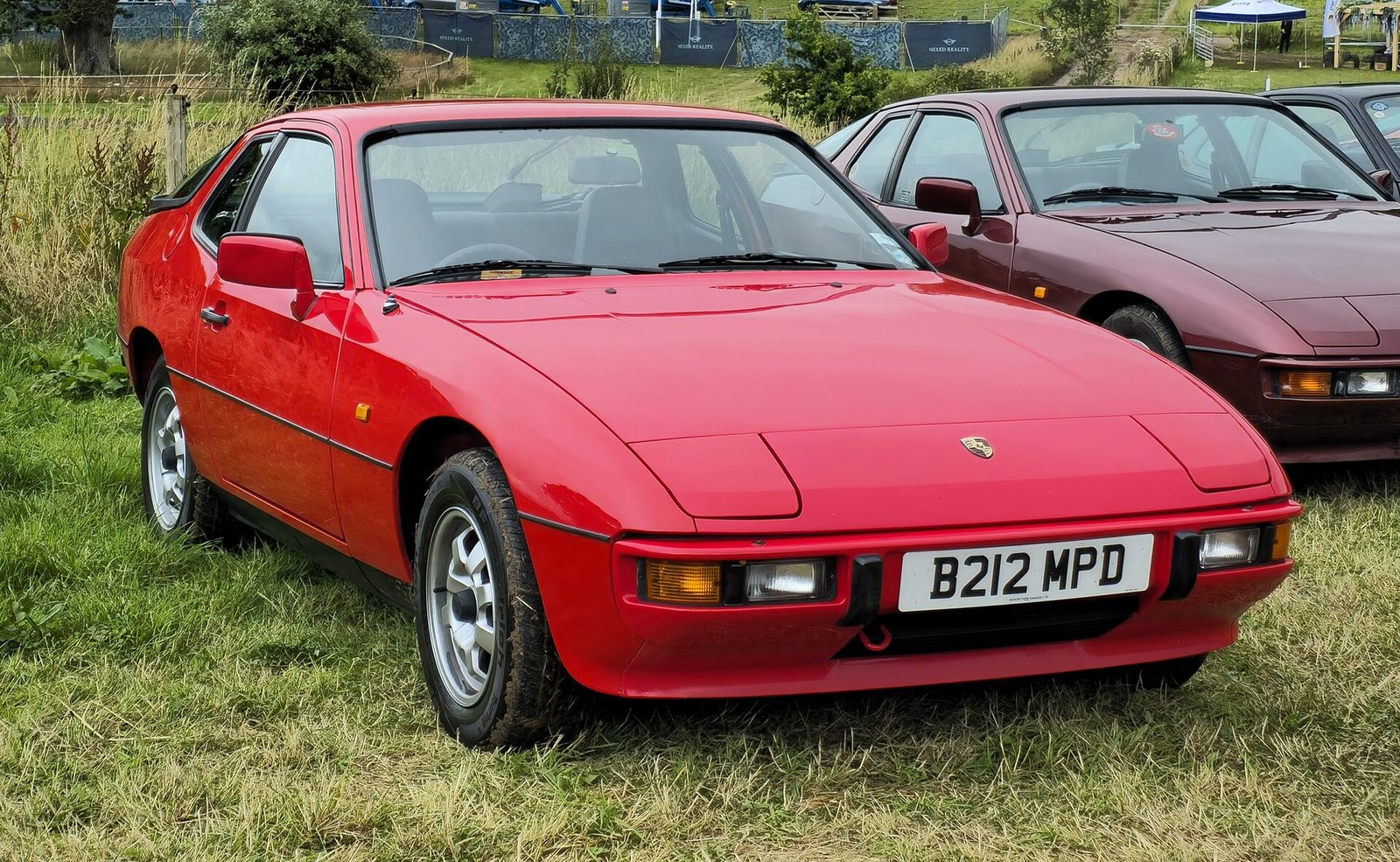
The Porsche 924 (1976-1988) began life in March 1972 as Volkswagen's development order EA 425, a Porsche-engineered successor to the 914 that Wolfsburg canceled in late 1974 under new management. Porsche bought the design back and launched it in early 1976 as its first front-engined, water-cooled car, built at the former NSU plant in Neckarsulm around a 1,984 cc Audi-derived four-cylinder and a rear transaxle. At $9,395 in the United States and DM 23,240 in Germany it was the cheapest Porsche by a distance and it sold accordingly: within a year every second Porsche built was a 924, the 100,000th car came in 1982 and the run ended in 1988 at 150,684 by Porsche's count or over 152,000 by the Porsche Club of America's. The critics were less kind than the customers, Motor Sport calling the 123 hp car harsh and characterless in 1977, and the answer came in stages: the 168 hp Turbo of 1979, the 207 hp Carrera GT homologation car of 1980 with its 242 hp GTS and 370 hp GTR offspring, and finally the 924S of 1986 with the 944's all-Porsche 2.5-liter engine in the narrow shell.
924
924, Turbo, Carrera GT
Production by variant
How the 924run breaks down, and which variants are the scarce ones. Approximate figures from this model’s cited sources.
Rarest of the bunch: the 924 Carrera GTS and GTS Clubsport (1981), only about 15 built, roughly 1 in every 9,248 924s. If provenance and rarity drive your buy, this is the one to hunt.
Figures approximate; see Sources below.
History
A Volkswagen That Became a Porsche
In March 1972 Volkswagen placed development order EA 425 with Porsche for a successor to the VW-Porsche 914. Porsche's proposal, a water-cooled four-cylinder in the nose driving a gearbox at the rear axle, was accepted, and the package was fixed early enough that the young designer Harm Lagaaij, working under Anatole Lapine, had to draw a body around production parts already chosen; the glass hatch came from a rival proposal by Dick Soderberg and the interior was Hans Braun's. Then VW's new chairman, Toni Schmuecker, canceled the project in late 1974 on grounds of product policy. Porsche bought the rights and tooling in January 1975, showed the car to the press at La Grande-Motte in the Camargue that November, and put it on sale in early 1976 as the Type 924, built for Porsche at the Audi plant in Neckarsulm. The base price was $9,395 in the United States and DM 23,240 in Germany, made possible by the VW and Audi components inside it.
The Cheap Porsche
The engine was the EA831, a 1,984 cc single-cam four with an iron block shared with the VW LT van, giving 123 hp at 5,800 rpm on Bosch K-Jetronic in Europe and a meager 95 hp in the United States, where the car arrived in July 1976 as a 1977 model at $9,395. An Audi four-speed gearbox sat at the back as a transaxle, the brakes were Audi discs and drums, and the rear suspension used Beetle-derived trailing arms on torsion bars. Motor Sport's May 1977 test found the chassis exceptionally good and the rest of the car blandly unexciting, harsh all the way to its 6,500 rpm limit and not fully developed. None of it dented sales. A year into production every second Porsche built was a 924, the Martini edition celebrated the 1976 championship, and the 100,000th car was completed in 1982.
Turbo, Then Carrera GT
Porsche closed the gap to the 911 and 928 with the 924 Turbo for 1979: a Porsche-designed head, a KKK K26 blowing at 0.7 bar into a 7.5:1 engine, 168 hp at 5,500 rpm, four-wheel discs and 140 mph. A Series 2 with DME ignition and 175 hp followed for 1981, and North America got an introductory edition of 600 cars. The Turbo was also the basis of a Targa study, job 927/57, run from May 1977 to February 1980 and dropped on cost and body stiffness. In 1980 came the Carrera GT, a Group 4 homologation special with an intercooler, larger turbocharger, raised compression, polyurethane arches and 207 hp at 2,471 lb; 400 had to be built in two years and 250 were sold before the line started. Its evolutions were the 1981 GTS, 50 series cars in Guards Red at 110,000 marks with 240 or 242 hp depending on whose figure is used, and the 370 hp GTR. Three works cars finished sixth, twelfth and thirteenth at Le Mans in 1980, Al Holbert and Derek Bell taking the thirteenth-placed GTP as high as sixth by the thirteenth hour; Walter Roehrl won four German rallies in a GTS prototype in 1981.
Fuhrmann, Schutz and the 944
The 924 was central to chairman Ernst Fuhrmann's belief that the 911 was on its way out, a view his successor Peter W. Schutz reversed in his third week in 1981. The four-cylinder line nevertheless continued: the wide-bodied 944 arrived in 1982 with an all-Porsche 2.5-liter engine, and the 924 was withdrawn from the United States after that year while soldiering on in Europe. The Turbo ceased in 1982 except in Italy, where tax rules kept it going to 1984.
The 924S and the End
For 1986, or 1985 by Porsche's own timeline, the 2.0 gave way to the 924S: the narrow 924 shell with the 944's balance-shaft 2.5-liter four, 148 hp at first and 158 hp for 1988, returning to America at under $20,000 as a car the PCA describes as quicker than the dearer base 944. Production ended in June 1988. By Porsche's account 150,684 had been built, almost as many as the 911 over the same twelve years, and the transaxle line it started ran to nearly 400,000 cars by 1995.
Common Problems
The 2.0 EA831 is robust but crude. Blue smoke on start-up is common because the pistons lack oil scraper rings, radiators get holed by stones and the fuel system in a barn-found car is best cleaned before any attempt to start it; new tanks come only from Porsche. Motor Sport's 1977 test car used two pints of oil in a thousand miles. The timing belt is due every 30,000 miles or three to four years but the engine survives a snapped belt. The 924S engine does not: it is an interference unit whose valves and pistons share space, so a failed belt bends valves, and its cam and balance belts, rollers, tensioners and water pump all have fixed intervals. Its Bosch airflow meter and DME relay both give trouble. The Turbo adds a turbocharger with no post-shutdown cooling, so bearing life depends on how the car was driven, and Porsche Club GB expects failure around 50,000 miles. Across the range the transaxle layout means clutch replacement is expensive, worn synchromesh and a sloppy lever from a worn ball joint are ordinary, torque-tube bearings fail, and automatics announce trouble with black fluid and a burning smell. Steering universal joints rattle, the power-steering hose seeps, and front discs and pads last about 25,000 miles on a 924 and less on a Turbo or 924S. Electrical faults are almost always earths, corroded terminals, tired hazard and light switches, a failed headlamp-motor switch or a bodged repair; the battery light needs a filament bulb, not an LED, or the alternator will not excite. Dashboards crack, seat seams split and Grassroots Motorsports owners add that VW-grade interior plastics and Audi-badged parts priced as Porsche parts are the daily realities.
What to Look For
Year and shell first. Porsche Club GB records zinc coating of specific areas for the 1977 model year and the entire bodyshell from 1978, while Classics World says pre-1981 cars were galvanized only on the lower half; either way, an early car needs closer scrutiny of sills, the battery tray, rear suspension mounts, floors and arches, and the 924S sills are singled out as more rust-prone. Panel gaps are a large 0.28 in (7 mm) from new, so what matters is whether they are even and whether the paint matches at the front. Water is the recurring enemy: a hatch seal, blocked sunroof drains and the battery area all let it in, and wet or crusty carpet in the passenger footwell tells the story. On a 2.0, ask for oil pressure of 5 to 6 bar at cold idle and 2 to 3 bar warm, expect some blue smoke on start-up from the design's lack of oil scraper rings, and ask when the belt was last done; it is non-interference, so neglect is cheap here but not on the interference 2.5 in the 924S, where the US specialist Atlantic Motorcar works to 30,000 miles or three to five years and replaces the water pump, tensioners and seals with the belts. A hot-start problem should have been cured, not lived with. On a Turbo, listen to the turbocharger; there is no cooling after shutdown and Porsche Club GB puts bearing failure at around 50,000 miles, with replacement a major line item. Check gear engagement and the clutch pedal, because the torque-tube layout makes a clutch a complicated job that owners on Grassroots Motorsports advise avoiding altogether, and listen for torque-tube bearing noise. Inside, the dashboard top cracks in sun, seat seams and the driver's bolster split, and the electrics suffer from bad earths and baked battery-to-starter cable; on a 924S the DME relay is a known weakness. A Carrera GT should carry its build certificate and a numbers-matching engine, and its chassis number should sit in the WP0ZZZ93ZBN700 range quoted on the cars sold at Paris in 2017 and Silverstone in 2024.
Market Notes
As of September 2026, classic.com puts the average sale across the whole 924 line at $26,015, a figure pulled upward by the competition cars, with model benchmarks of $10,440 for the base 924, $11,384 for the 924S, $17,139 for the 924 Turbo, $72,175 for the Carrera GT, $318,214 for the Carrera GTS and $370,857 for the GTR and GTP. The Turbo's own classic.com page gives a benchmark of $17,213 and an average of $17,287 as of September 2026, and the spread behind that average is wide: a 94,000-mile 1982 car at $13,000 in May 2026 and an 88,000-mile 1981 at $9,540 in June 2026, against $77,000 in March 2026 for the Holbert Racing widebody out of Magnus Walker's collection at RM Sotheby's, where a standard 50,512-mile 1980 Turbo in the same sale made $14,850. Ordinary road cars sit in the teens, classic.com recording a 1988 924S at $18,900 in August 2026 and a 1978 924 at $15,935 in September 2026, both fixed-price. The competition cars run on a separate ladder: RM Sotheby's sold the ex-works Le Mans 924 GTP, chassis 924003, for $423,000 at Arizona in January 2026, and Broad Arrow sold the Brumos Le Mans class-winning Carrera GTR for $375,000 at the Quail in August 2026 against the $600,000 to $800,000 estimate the Porsche Club of America reported before the sale. Carrera GT money is thinner than the benchmark suggests, classic.com's average standing at $63,388 as of September 2026, and Sports Car Market valued a Paris car at $71,934 when it sold for $58,360 with premium at Artcurial in November 2017. None of the aggregator pages fetched states whether buyer's premium is included in the figures they publish.
Where sources differ
The 924 Carrera GTS road car is quoted at 242 hp by Wikipedia and Porsche Club GB but at 237 hp by Porsche's own 2021 account, and the Clubsport at 266 hp by Wikipedia and RM Sotheby's but 271 hp by Porsche.
Porsche Newsroom (2021) states 237 hp for the standard GTS and 271 hp for the Clubsport. Wikipedia and Porsche Club GB state 242 hp for the GTS; Wikipedia and RM Sotheby's Monaco 2024 state 266 hp for the Clubsport. Not resolved by any source consulted here.
Porsche states that 150,684 cars had been built when 924 production ended in 1988, and Stuttcars repeats that figure, but the Porsche Club of America states that over 152,000 were built.
Porsche Newsroom's press kit states 150,684 built by the end of production in 1988; Stuttcars gives approximately 150,684. The Porsche Club of America states over 152,000. Wikipedia, classic.com and Porsche's transaxle timeline say only 'just over' or 'more than' 150,000. Not resolved by any source consulted here.
924 Turbo production is given as 13,616 by Stuttcars and as only about 12,000 by FrazerPart, while RM Sotheby's states that 600 introductory-edition Turbos were built for North America.
Stuttcars states approximately 13,616 924 Turbos built 1979-1982. FrazerPart states only about 12,000 were built. Neither cites a factory document, and neither addresses RM Sotheby's separate figure of 600 North American introductory-edition cars. Not resolved by any source consulted here.
The Carrera GT total is given as 406 by Porsche's transaxle timeline, Stuttcars, Wikipedia, RM Sotheby's and Iconic Auctioneers, with Wikipedia and RM stating that this includes prototypes, and as 400 by the Porsche Museum press kit, Porsche Club GB and FrazerPart; 75 cars were right-hand drive for Britain and 250 were sold before production began.
Porsche Newsroom timeline, Stuttcars, RM Sotheby's Paris 2017 and Iconic Auctioneers state 406. Porsche Museum press kit, Porsche Club GB and FrazerPart state 400. Wikipedia gives both, 406 including prototypes and 400 road cars, which would reconcile them, but the two Porsche pages do not say so themselves. Not resolved by any source consulted here.
Sources
- Porsche 924 - Porsche Newsroom (Forever Young. Celebrating Transaxle press kit), Porsche AG · manufacturer
- When the 924 redefined Porsche's DNA - Porsche Newsroom, Porsche AG · manufacturer
- Time lapse: Porsche's transaxle models - Porsche Newsroom, Porsche AG · manufacturer
- Porsche 924 Carrera GT - Porsche Newsroom (Porsche Museum press kit), Porsche AG · manufacturer
- Feasibility study: Porsche 924 Turbo Targa prototype - Porsche Newsroom, Porsche AG · manufacturer
- Reunion after 40 years: Walter Röhrl and the 924 Carrera GTS Rallye - Porsche Newsroom, Porsche AG · manufacturer
- Porsche 924, Wikipedia · encyclopedia
- Porsche 924 - Ultimate Model Guide, Stuttcars · specialist
- Happy 924 Day! Here's a little history - The Porsche Club of America, Porsche Club of America · club-forum
- The 10 Rarest Porsches Up For Grabs at 2026 Monterey Car Week - The Porsche Club of America, Porsche Club of America · club-forum
- Porsche 924 buyers guide - Porsche Club GB 924 register, Porsche Club Great Britain · registry
- Porsche 924 buyer's guide - Classics World, Classics World (Kelsey Media) · journalism
- Porsche 924 Buyer's Guide - History, Servicing and Specs - FrazerPart, FrazerPart · specialist
- Porsche 944 and 951 Timing Belt Service - Doing It Right - Atlantic Motorcar Center, Atlantic Motorcar Center · specialist
- Porsche's 924: a disappointment (May 1977) - Motor Sport Magazine archive, Motor Sport · journalism
- Educate me on Porsche 924's - Grassroots Motorsports forum, Grassroots Motorsports · club-forum
- Porsche 924 Market - CLASSIC.COM, classic.com · market-data
- Porsche 924 Turbo Market - CLASSIC.COM, classic.com · market-data
- Porsche 924 Carrera GT Market - CLASSIC.COM, classic.com · market-data
- Porsche 924 GTR / GTP Market - CLASSIC.COM, classic.com · market-data
- 1980 Porsche 924 GTP - Arizona 2026 - RM Sotheby's, RM Sotheby's · auction-house
- 1980 Porsche 924 Turbo 'Holbert Racing' Widebody - Magnus Walker: The Outlaw Collection - RM Sotheby's, RM Sotheby's · auction-house
- 1980 Porsche 924 Turbo - Magnus Walker: The Outlaw Collection - RM Sotheby's, RM Sotheby's · auction-house
- 1981 Porsche 924 Carrera GT - Paris 2017 - RM Sotheby's, RM Sotheby's · auction-house
- 1981 Porsche 924 Carrera GTS Club Sport 'Group B' - Monaco 2024 - RM Sotheby's, RM Sotheby's · auction-house
- c. 1981 Porsche 924 Carrera GTR IMSA - The Woodcote Park Auction 2026 - RM Sotheby's, RM Sotheby's · auction-house
- 1981 Porsche 924 Carrera GT - Sold - Iconic Auctioneers, Iconic Auctioneers · auction-house
- 1981 Porsche 924 Carrera GT Coupe - Sports Car Market, Sports Car Market · journalism
- The Overlooked Porsche - So Far - Sports Car Market, Sports Car Market · journalism
Synthesized from the sources above and cross-checked. We cite and link out; we do not republish other databases verbatim.
Fully Sorted is an independent publisher and is not affiliated with, endorsed by or sponsored by Dr. Ing. h.c. F. Porsche AG. Porsche and the model names on this page are trademarks of Dr. Ing. h.c. F. Porsche AG and are used here only to identify the cars being described.
Chassis register
Nobody has recorded a car here yet. Own one, or know one? Chassis number, what you can prove about it, and a source if there is one. Every entry is reviewed before it appears.
Nerd Notes
What owners know that the sources don't. Every note is read and checked before it appears here.
Key Specs
- Power
- 123 hp at 5,800 rpm (924 Europe); 95 hp at 5,500 rpm then 110 hp (924 US); 168 hp at 5,500 rpm and 175 hp Series 2 (Turbo); 207 hp at 6,250 rpm (Carrera GT); 148 hp and 158 hp (924S), all manufacturer figures
- Brakes
- Front discs and rear drums of Audi sedan origin on the 2.0; four-wheel discs on the Turbo, ventilated discs on the Carrera GT
- Engine
- 1,984 cc EA831 SOHC inline-four (86.5 x 84.4 mm) shared in block with the VW LT van, Bosch K-Jetronic; turbocharged for the 931 and 937; 2.5-liter Porsche M44/40 with balance shafts in the 924S
- Layout
- Front-mounted longitudinal engine, rear-mounted transaxle gearbox joined by a rigid torque tube, rear-wheel drive; near 50/50 weight distribution
- Torque
- 121.5 lb-ft at 3,500 rpm (924 2.0, Motor Sport 1977); 181 lb-ft at 3,500 rpm (924 Turbo, Wikipedia)
- Weight
- 2,738 lb curb (Wikipedia, base 924); Stuttcars gives 2,623 lb for the 924, 2,822 lb for the Turbo and 2,734 lb for the 924S; 2,471 lb Carrera GT, 2,337 lb GTS Clubsport, 2,050 lb GTR
- Chassis
- Steel unitary body built at the former NSU plant in Neckarsulm; lower half galvanized on pre-1981 cars, entire shell zinc-coated from the 1978 model year per Porsche Club GB, with a six-year perforation warranty
- Steering
- Unassisted rack and pinion; power assistance later optional, the hose being a known seeper
- Price new
- $9,395 in the United States in 1976; $9,395 base price in the United States and DM 23,240 in Germany at launch
- Top speed
- 125 mph 924 (Motor Sport); 140 mph Turbo claimed by Porsche, 142 mph tested by Motor; 149 mph Carrera GT claimed; 134 mph 924S per Stuttcars
- Dimensions
- Length 165.4 in (4,200 mm), width 66.3 in (1,685 mm), height 50.0 in (1,270 mm), wheelbase 94.5 in (2,400 mm); drag coefficient 0.35 with 1.79 m2 frontal area on the Turbo
- Suspension
- MacPherson struts and wishbones front; semi-trailing arms with transverse torsion bars rear; anti-roll bars optional on early cars
- Compression
- 9.3:1 naturally aspirated 2.0; 7.5:1 on the Turbo, raised again for the intercooled Carrera GT
- Acceleration
- 0-60 mph 9.9 s claimed for the 123 hp car (Motor Sport, 1977); 6.9 s Turbo (Motor magazine via Wikipedia); 6.5 s Carrera GT and 7.5 s 924S (Stuttcars)
- Fuel economy
- 23 to 28 mpg (Imperial) recorded by Motor Sport in 1977 on four-star fuel
- Transmission
- Audi-sourced 4-speed manual or 3-speed automatic at launch; Porsche Type 016/G31 5-speed dog-leg from 1978; Audi H-pattern 5-speed from 1980; single dry-plate clutch, no limited-slip differential as standard
Notable Variants
924 2.0 (1976-1985)
The volume car, around 121,000 built by Stuttcars' count, with 123 hp in Europe and 95 or 110 hp in the United States. Pre-1981 cars were galvanized only on the lower half of the shell; later cars were fully galvanized, which is why a survivor's year matters more than its mileage.
924 Martini Edition (1977)
White with Martini stripes to mark the 1976 World Championship of Makes, built December 1976 to March 1977. FrazerPart puts the run at 3,000; no second source fetched here confirms the figure, so treat it as single-sourced.
924 Turbo (Type 931, 1979-1982)
The first serious 924, with a Porsche-designed cylinder head, KKK K26 turbocharger, four-wheel disc brakes and 168 hp, rising to 175 hp with DME ignition for the 1981 Series 2. Production is given as 13,616 by Stuttcars and about 12,000 by FrazerPart, with RM Sotheby's putting the North American introductory edition at 600 cars. The turbo has no post-shutdown cooling, which shapes what survives.
924 Le Mans Edition (1980)
Limited edition on the naturally aspirated car marking the 1980 Le Mans entry; FrazerPart records 1,030 built of which 100 were right-hand drive. Porsche Club GB confirms the edition without a figure.
924 Carrera GT (Type 937, 1980-1981)
Group 4 homologation car with intercooler, larger turbocharger, raised compression, polyurethane flared arches and 207 hp at 2,471 lb. 400 road cars or 406 including prototypes depending on the source; 75 in right-hand drive for Britain. 250 were sold before production started.
924 Carrera GTS and GTS Clubsport (1981)
Evolution of the Carrera GT: 50 series cars plus prototypes, all left-hand drive and Guards Red, 242 hp (Porsche says 240) and 15 built as 270 or 271 hp Clubsports at 2,337 lb. Priced at 110,000 marks, the dearest Porsche of 1981. The Roehrl Rallye car was the fifth of nine prototypes.
924 Carrera GTR and GTP (1980-1981)
Competition versions: the GTR at 370 hp and 2,050 lb, 17 complete customer cars, and the three works GTPs built for Le Mans in 1980, where they finished sixth, twelfth and thirteenth. RM Sotheby's offered GTR006 at Woodcote Park in 2026 and it did not sell; Broad Arrow sold the Brumos Le Mans class-winning GTR at the Quail in August 2026 and RM Sotheby's sold the ex-works GTP at Arizona in January 2026.
924S (1986-1988)
The narrow 924 shell with the 944's 2.5-liter all-Porsche engine, 148 hp then 158 hp for 1988, 16,669 built by Stuttcars' count. Lighter and slipperier than the 944 and, in the PCA's words, quicker than the base 944 that cost more. It is an interference engine with a four-year belt interval.
Value Trajectory
The 924 was the entry to the marque for twelve years, from $9,395 in the United States and DM 23,240 in Germany at launch to a 924S returning to America at under $20,000 in 1987, and for decades afterward it was the Porsche the press loved to hate, which kept it cheap. Sports Car Market's affordable-classics column describes asking prices as high as $5,000 for a well-kept ordinary 924 and 924S auction results running from $7,370 to $34,416, while as of September 2026 classic.com's benchmarks stand at $10,440 for the 924, $11,384 for the 924S and $17,139 for the Turbo. The homologation and competition cars move on a different line: a Carrera GT that made $58,360 with premium at Artcurial in November 2017 sits against a $72,175 benchmark as of September 2026, the ex-works Le Mans GTP made $423,000 at RM Sotheby's Arizona in January 2026, and the Brumos GTR made $375,000 at Broad Arrow in August 2026, well under the $600,000 to $800,000 the Porsche Club of America reported as its estimate. Stuttcars argues the 924S and Turbo have the most room as 911 prices push buyers toward lighter cars; the GTR that went unsold at RM Sotheby's Woodcote Park in 2026 and the shortfall at the Quail suggest the top of the line is priced by the seller's hopes more than by the room.
Next
Shopping for one?
Browse Porsche listings, or decode a VIN before you buy.