
The Porsche 928 was conceived as the car that would replace the 911. Ernst Fuhrmann's management believed the rear-engined car had run out of development after thirteen years, and from 1971-72 Porsche drew a clean-sheet grand tourer: a water-cooled all-aluminum V8 at the front, a transaxle at the back, close to 50:50 weight distribution, and a new passive-steering rear suspension christened the Weissach axle. It was shown at Geneva in March 1977, sold as a 1978 model, and won European Car of the Year - still the only sports car ever to do so. The succession never took place. Peter Schutz kept the 911 in production, the expected legislation against rear engines never arrived, and the 928 was discontinued in 1995 while the 911 continued. Across seventeen years the engine grew from 4.5 to 5.4 liters and from 240 to 345 hp through the S, S2, S4, GT and GTS. Porsche gives the total as 61,056 cars; other tabulations do not agree.
928
928 (front-engine transaxle V8)
Production by variant
How the 928run breaks down, and which variants are the scarce ones. Approximate figures from this model’s cited sources.
Rarest of the bunch: the 928 GT (1989-1991), only about 2,078 built, roughly 1 in every 10 928s. If provenance and rarity drive your buy, this is the one to hunt.
Figures approximate; see Sources below.
History
The Car Meant to Replace the 911
Ernst Fuhrmann took charge of Porsche in 1972 holding that the 911, then thirteen years old, was at the end of its development. Design studies for a successor began in 1971 and the project hardened in February 1972. Anatole Lapine styled it, Wolfhelm Gorissen directed the project, Hans Clausecker ran the suspension testing and Hans-Georg Kasten drew much of the interior and exterior detail. The brief was a fast, comfortable, roomy car with a sports car's responses and none of the rear-engine layout's inherited habits. A prototype was running by 1973, but the oil crisis pushed the launch back to the Geneva show of March 1977, with deliveries beginning that autumn as 1978 models. The succession never happened: Peter Schutz, who took over in 1981, chose to sell both cars, the anticipated legislation against rear-engined vehicles never materialized, and the 911 outlived the 928. Porsche's own accounts are not quite consistent on the original intent - its transaxle press kit states the 928 was designed as the 911's replacement, while the Christophorus anniversary feature prefers to describe it as Porsche's first Gran Turismo rather than a direct successor.
Alloy V8, Rear Transaxle, Weissach Axle
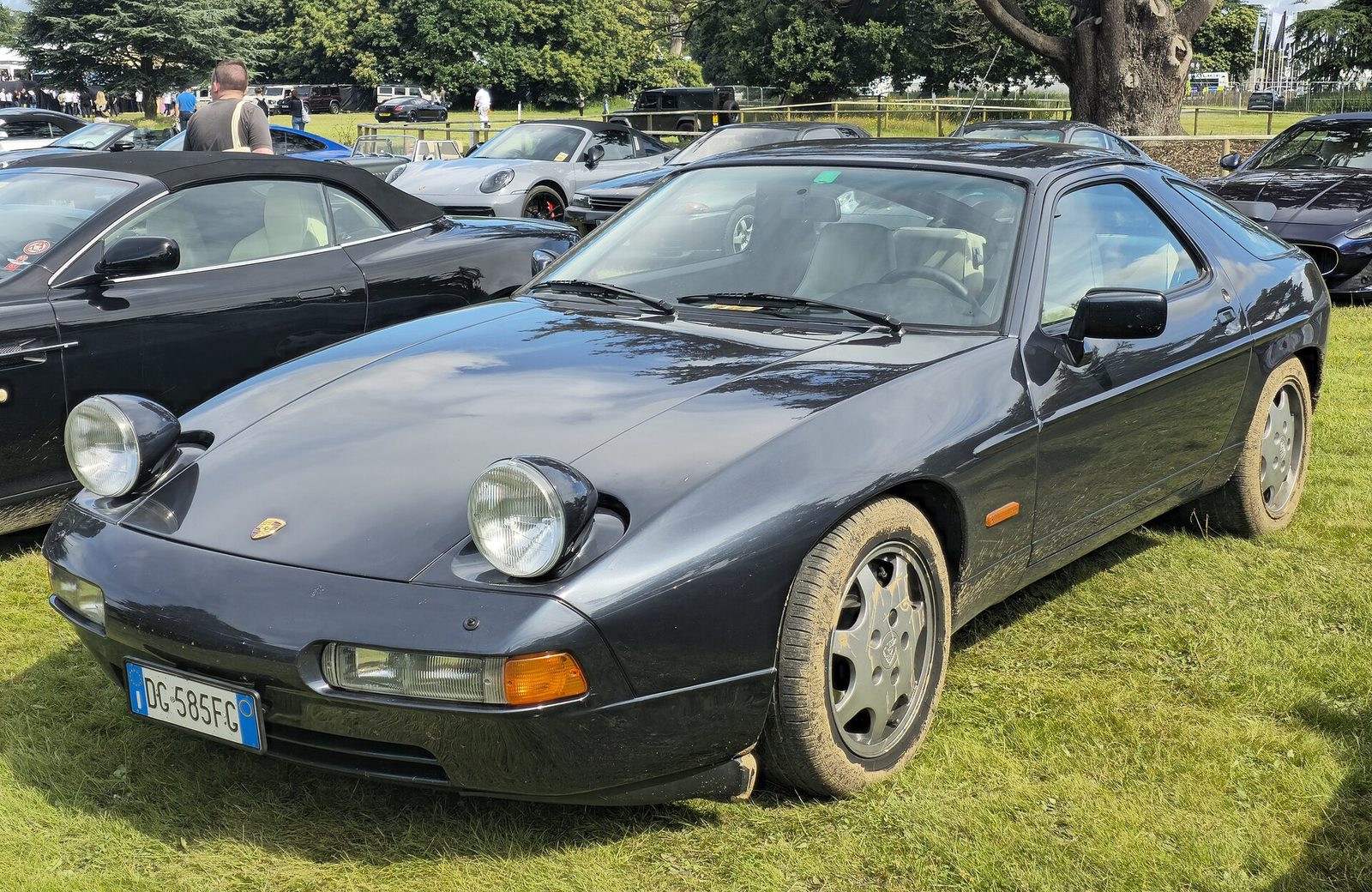
The engine was a water-cooled, all-aluminum 90-degree V8 of 4,474 cc, the first V8 in a road-going Porsche and, by the company's account, the first water-cooled V8 in a European production car. It drove a rear-mounted transaxle through a rigid torque tube - Porsche called the shaft inside it the fast shaft - producing close to 50:50 weight distribution. The body was a galvanized steel monocoque with aluminum doors, hood and front wings, and the polyurethane-faced bumpers were engineered to shrug off impacts at up to 5 mph without denting. The rear suspension was the car's most durable engineering idea. A semi-trailing arm layout will toe-out under the forward weight transfer of a lifted throttle, which is exactly when a driver least wants it; Porsche replaced the forward bushing of each arm with a short link so that the same loads pull the hub into toe-in instead. The effect was to blunt lift-off oversteer without raising cornering speed, and versions of the idea reached the 993-generation 911 and, in active form, much later cars.
Car of the Year 1978
The 928 won European Car of the Year for 1978, an award that normally goes to mass-market family cars, and it remains the only sports car to have taken it. That verdict has aged better than the launch reception did. Porsche's own customers were skeptical of a Porsche neither air-cooled nor rear-engined, and the first American cars had a difficult year: the federal recall record lists nine campaigns against 1978 model-year 928s, six of them opened on a single day, 2 June 1978, from cracking front suspension adjusters to loose roof moldings.
Seventeen Years of Increments
The 928 was never redesigned, only enlarged. The 928 S of 1980 took the engine to 4,664 cc and 296 hp and added front and rear spoilers; the S2 of 1984 raised it to 306 hp and offered ABS. For 1985 North America received a 5.0-liter 32-valve four-cam engine, which reached the rest of the world in 1987 as the S4 at 316 hp with a smoothed nose and new tail. From 1985 the belt drove only the exhaust camshafts, the intakes taken off them by roller chain. Porsche then withdrew the manual gearbox from the S4 for 1990 and answered the complaints with the GT: manual only, 325 hp, a 40 per cent ZF limited-slip differential as standard, 2,078 built.
The GTS and the End of the Line
The last car was the best. The GTS of 1992 stretched the V8 to 5,397 cc and 345 hp, widened the rear arches and fitted larger front brakes and a new wheel design. It also arrived into a collapsing market: sales had fallen since 1989 and did not recover, at 955 cars in 1992, then 811, 645 and 476 before production stopped in 1995. Of 2,904 GTS built, 406 came to the United States. The car meant to succeed the 911 was withdrawn while the 911 carried on, and the model line spent two decades known as the cheapest way into a V8 Porsche - a reputation from which the GTS has now separated itself.
Common Problems
The defining liability is the timing belt, which on all 928s also drives the water and oil pumps. Published intervals do not agree: Classic & Sports Car and Classics World both give four years or 60,000 miles, StuttCars gives four to five years or about 40,000 miles, and the Rennlist 928 engine FAQ reports a factory recommendation of 50,000 miles or five to seven years with many owners working to a shorter cycle on the grounds that belts age whether or not the car is driven. Where the engine is an interference design a failure bends valves; the Rennlist FAQ places the boundary at the 1985 32-valve engines and describes the earlier 16-valve units as non-interference, while Petrolicious puts piston-to-valve contact as far back as the 1980 4.7-liter S. The tensioner is itself a service item, oil-filled and prone to false warnings when empty or when its boot has cracked. Beyond the belt: engine mounts collapse and cause vibration; radiators corrode and are costly to replace; head bolt failures affected 1986-1989 S4 engines before a thicker casting and longer bolts arrived for 1989; some early GTS engines suffered cylinder liner problems; and oil smoke on start-up or overrun points at valve guides or bores. Automatics need their fluid changed and will slip or engage late if they have not been. Manuals suffer worn synchromesh. NHTSA recorded a catalytic converter heat-shield fire risk campaign in 1989 and a cracking plastic fuel gauge mounting nut campaign in 1990.
What to Look For
Documentation of the cambelt and water pump service is the first thing to establish, in writing and with dates, because the interval is time-based as much as mileage-based and a low-mileage car that has sat is not exempt. On 32-valve engines the consequence of getting this wrong is bent valves rather than a tow home. Establish which engine the car actually has and whether it matches the claimed year and market; North American cars ran materially lower outputs than European ones in the early years, and engine swaps are not unknown. The torque tube and its flex plate reward an annual check: incorrect flex plate tension loads the crankshaft thrust bearing, and any fore-and-aft movement in the crankshaft points at a rebuild rather than a repair. Cooling is expensive to neglect, so receipts for coolant changes and radiator work count for more than they look. On 1987-on cars the LH-Jetronic 2.3 ECU, EZK ignition unit and mass airflow sensor are the usual sources of poor running, and the fuseboard, relays and ECUs live in the passenger footwell where water ingress finds them. Test every electrical function individually. The shell is galvanized and resists corrosion better than most of its contemporaries, but sills, subframe mountings, wheel arches, the tailgate aperture and screen surrounds still repay close inspection. Early cars with the checkered Pasha trim split at the seams. Where a car is presented as a Club Sport, SE or GT, the small production numbers make verification of chassis and option codes proportionate rather than fussy.
Market Notes
The 928 market is not one market. As of August 2026, classic.com's benchmarks read: 928 S2 at $12,637; 928 S4 at $30,434 overall, splitting to $26,187 for automatics and $38,713 for manuals; 928 GT at $46,710 and trending down; and 928 GTS at $57,432 for automatics but $137,775 for manuals, both trending up. The recorded extremes for the model line run from $2,050 for a 1985 S2 in June 2025 to $269,000 for a 9,000-mile 1994 GTS manual in October 2025, with the manual GTS average sale sitting at $138,441 as of August 2026. An S4 outlier - $162,400 in August 2026 for a 1987 Club Sport prototype campaigned by Jochen Mass - shows that provenance can override variant, but only occasionally. Auction evidence tracks the same split. RM Sotheby's sold a 1995 GTS five-speed with fewer than 16,650 miles for $406,500 at Monterey in 2022 - one of the 26 manual GTS delivered to the United States for that model year, and the house's published sold-for figure rather than a hammer price. An automatic 1995 GTS with about 12,000 miles had made $89,600 at Amelia Island in 2019. The distance between the manual and automatic figures is consistent across both the benchmark data and the auction record.
Where sources differ
Porsche's own retrospectives characterize the original intent differently: the transaxle press kit says the 928 was designed as the 911's replacement, while the Christophorus fortieth-anniversary feature presents it as Porsche's first Gran Turismo rather than a direct successor.
The Porsche transaxle press kit states the 911 was held to have reached the end of its development after 13 years and that the 928 was designed as its replacement. The Christophorus fortieth-anniversary feature describes the car as Porsche's first Gran Turismo and 'a new continent in the Porsche world' rather than a direct 911 replacement. Both are Porsche corporate publications and neither addresses the other; the difference is not resolved by any source consulted here.
The 928 was offered with a five-speed manual or a Mercedes-Benz-sourced automatic, and the automatic dominated sales, but estimates of the split differ: Wikipedia gives about 40 per cent manual for 1978-1979 and an average of 34 per cent thereafter, Classic & Sports Car puts manuals at roughly 20 per cent of the run, and Classics World says over 80 per cent were automatic.
Wikipedia states 1978-79 cars were 60 per cent automatic and that 1980-1995 averaged 34 per cent manual. Classic & Sports Car states manuals were about 20 per cent of production. Classics World states over 80 per cent were automatic. The three cannot all be correct and no source consulted here reconciles them.
The total number of 928s built is not agreed: Porsche states 61,056 and StuttCars publishes a year-by-year table totalling 60,870.
Porsche's transaxle press kit and its Christophorus fortieth-anniversary feature both state 61,056, and Wikipedia's variant table resolves to the same figure, as does Classics World. StuttCars states 60,870 and supports it with a year-by-year table. The 186-car difference is not explained on either side and is not resolved by any source consulted here, so productionTotal is left null.
Published timing-belt intervals for the 928 do not agree, ranging from four years or about 40,000 miles to four years or 60,000 miles to a factory figure of 50,000 miles or five to seven years; the belt also drives the water and oil pumps, and its oil-filled tensioner is a service item in its own right.
StuttCars gives four to five years or approximately 40,000 miles. Classic & Sports Car and Classics World both give four years or 60,000 miles. The Rennlist 928 engine FAQ reports a factory recommendation of 50,000 miles or five to seven years while noting that many owners work to a four-to-five-year cycle because belts deteriorate with age irrespective of mileage. No source consulted here reconciles the published intervals.
Sources also disagree about which 928 engines are interference designs, and therefore about when a belt failure bends valves rather than merely stopping the car.
The Rennlist 928 engine FAQ states that pre-1985 16-valve engines are non-interference and that the 1985-on 32-valve engines are interference and will bend valves. Petrolicious states that from 1980 onward, on the 4.7-liter S engine, valves can contact pistons. Classics World limits the risk to 5.0-liter and larger engines, and StuttCars describes the 928 engine as an interference design without qualification. The boundary is not resolved by any source consulted here.
Sources
- The Porsche 928, Dr. Ing. h.c. F. Porsche AG · manufacturer
- Porsche Takes the Plunge, Christophorus / Dr. Ing. h.c. F. Porsche AG · manufacturer
- Porsche 928, Wikipedia · encyclopedia
- Weissach axle, Wikipedia · encyclopedia
- Porsche 928 Production Numbers, StuttCars · specialist
- Porsche 928 Buyer's Guide: Everything You Need to Know, StuttCars · specialist
- Porsche 928 Guide, Supercar Nostalgia · specialist
- Porsche 928 Engine FAQ, Rennlist · club-forum
- Porsche 928 buyer's guide: what to pay and what to look for, Classic & Sports Car · journalism
- Porsche 928 buyer's guide, Classics World · journalism
- Porsche 928 Buying Guide, Petrolicious · journalism
- NHTSA recallsByVehicle: Porsche 928, National Highway Traffic Safety Administration · government
- Porsche 928 Market, classic.com · market-data
- Porsche 928 GTS - Manual Market, classic.com · market-data
- Porsche 928 GTS - Automatic Market, classic.com · market-data
- Porsche 928 GT Market, classic.com · market-data
- Porsche 928 S4 Market, classic.com · market-data
- 1995 Porsche 928 GTS, Monterey 2022, RM Sotheby's · auction-house
- 1995 Porsche 928 GTS, Amelia Island 2019, RM Sotheby's · auction-house
- 1995 Porsche 928 GTS, Iconic Auctioneers · auction-house
Synthesized from the sources above and cross-checked. We cite and link out; we do not republish other databases verbatim.
Fully Sorted is an independent publisher and is not affiliated with, endorsed by or sponsored by Dr. Ing. h.c. F. Porsche AG. Porsche and the model names on this page are trademarks of Dr. Ing. h.c. F. Porsche AG and are used here only to identify the cars being described.
Chassis register
Nobody has recorded a car here yet. Own one, or know one? Chassis number, what you can prove about it, and a source if there is one. Every entry is reviewed before it appears.
Nerd Notes
What owners know that the sources don't. Every note is read and checked before it appears here.
Key Specs
- Power
- Scoped by variant: 237 hp (928, Europe), 296 hp (S, 1980-1983), 306 hp (S2, 1984-1986), 316 hp (S4, 1987-1991), 325 hp (GT, 1989-1991), 345 hp / 345 hp (GTS, 1992-1995); North American outputs are lower throughout and sources differ on the 1978-1979 US figure
- Brakes
- Ventilated discs all round, ABS optional from the 1983 S2; larger front brakes on the GTS
- Engine
- All-aluminum water-cooled 90-degree V8, front-mounted; 4,474 cc SOHC (1978-1982), 4,664 cc SOHC (1980-1986), 4,957 cc DOHC 32-valve (1985-1991), 5,397 cc DOHC 32-valve (1992-1995)
- Layout
- Front-mounted longitudinal engine, rear-mounted transaxle joined by a rigid torque tube, rear-wheel drive, approximately 50:50 weight distribution
- Torque
- 257 lb-ft at 3,600 rpm on the 4.5-liter European car; 362 lb-ft at 4,250 rpm on the GTS
- Weight
- Approximately 3,197 lb for the European 4.5-liter car; 3,243-3,527 lb across the range per Classic & Sports Car
- Chassis
- Galvanized steel monocoque with aluminum doors, hood and front wings; polyurethane-faced integrated bumpers rated to withstand 5 mph impacts without denting
- Dimensions
- 178.0 in (4,520 mm) long at launch, 178.1 in (4,524 mm) from 1988; 72.3 in (1,837 mm) wide 1987-1992 and 74.4 in (1,890 mm) from 1993 with the GTS arches
- Valvetrain
- Two valves per cylinder to 1984; from 1985 four valves per cylinder with the timing belt driving the exhaust camshafts and a simplex roller chain driving the intake camshafts from them
- Acceleration
- 6.8 seconds to 62 mph for the European 4.5-liter manual; 0-60 mph quoted between 7.0 and 5.4 seconds across the run depending on variant
- Transmission
- Five-speed manual (dog-leg first on early cars) or Mercedes-Benz-sourced three-speed automatic, replaced by a four-speed automatic from 1983 in North America; the manual was withdrawn from the S4 for 1990, which is why the GT is manual-only
- Fuel injection
- Bosch K-Jetronic on early cars; LH-Jetronic with EZK ignition on 1987-on 32-valve engines
- Cambelt service
- Belt also drives the water and oil pumps; published intervals range from four years or 40,000-60,000 miles to Porsche's 50,000 miles or five to seven years
- Rear suspension
- Weissach axle - semi-trailing arm layout in which the forward trailing-arm bushing is replaced by a short link, so that lift-off and braking loads pull the hub into toe-in rather than toe-out
- Transmission mix
- Estimates vary: Wikipedia gives about 40 per cent manual for 1978-1979 and an average of 34 per cent thereafter, Classic & Sports Car puts manuals at about 20 per cent of the run
- Top speed claimed
- 143 mph for the European 4.5-liter manual, rising to about 170 mph for the GTS - manufacturer and press figures, not independently verified here
Notable Variants
928 (1978-1982)
The original 4.5-liter SOHC car, 237 hp in European tune and lower in North America. No front or rear spoilers, the lightest and most analogue of the range, and the only cars offered with the checkered Pasha velour interior that now carries its own following.
928 S / S2 (1980-1986)
4.7 liters and 296 hp from 1980, rising to 306 hp for 1984-1986. Front and rear spoilers arrive, ABS becomes available from the 1983 S2, and the North American market gets the S only from 1983.
928 S4 (1987-1991)
The 5.0-liter 32-valve DOHC engine at 316 hp with the smoothed nose and revised tail. The volume car of the later run at 15,682 built, and the point at which the engine becomes an interference design in most accounts.
928 Club Sport and 928 SE (1988-1989)
Nineteen Club Sports, stripped of up to 220 lb, and 42 UK-market SE cars sitting between the Club Sport and the standard S4. The rarest road 928s by a wide margin and the reason a lightweight S4 shell warrants close verification.
928 GT (1989-1991)
Manual only, 325 hp, ZF 40 per cent limited-slip differential as standard. 2,078 built, 396 of them for the United States and Canada. It exists because Porsche dropped the manual gearbox from the S4 and the demand did not disappear with it.
928 GTS (1992-1995)
5.4 liters, 345 hp, widened rear arches, larger front brakes and a distinct wheel design. 2,904 built, 406 of them American. The manual cars are the ones the market has separated out: 26 five-speed GTS were delivered to the United States for the 1995 model year against 47 automatics.
Weissach Edition and 50th Jubilee (1982)
Two commemorative runs: a North American Weissach Edition in champagne gold metallic with matching wheels, numbered plaque and luggage, given as 202 cars by Wikipedia and 205 by Supercar Nostalgia; and 141 European 50th Jubilee cars in meteor metallic with burgundy leather.
Value Trajectory
For most of its afterlife the 928 was the cheapest route to a V8 Porsche, and it was priced as a depreciating luxury coupe with an intimidating service schedule rather than as a collector car. That is still broadly true of the S, S2 and S4, which as of August 2026 carry classic.com benchmarks of $12,637, and $26,187 to $38,713 respectively depending on transmission, with a recorded floor of $2,050 for an S2 in June 2025. The GTS has left that market. Its manual benchmark of $137,775 as of August 2026 is close to five times the automatic S4 figure and more than double the $57,432 benchmark for an automatic GTS, and the manual line is trending up while the GT, at $46,710, is trending down. The RM Sotheby's Monterey result of $406,500 in 2022 for a low-mileage 1995 manual car sits well above the benchmark and reflects how few of them exist: 26 were delivered to the United States for that model year, against 47 automatics. The pattern is a market sorting on three things at once - the final engine, three pedals, and mileage - and paying comparatively little for anything that lacks all three.
Next
Shopping for one?
Browse Porsche listings, or decode a VIN before you buy.