
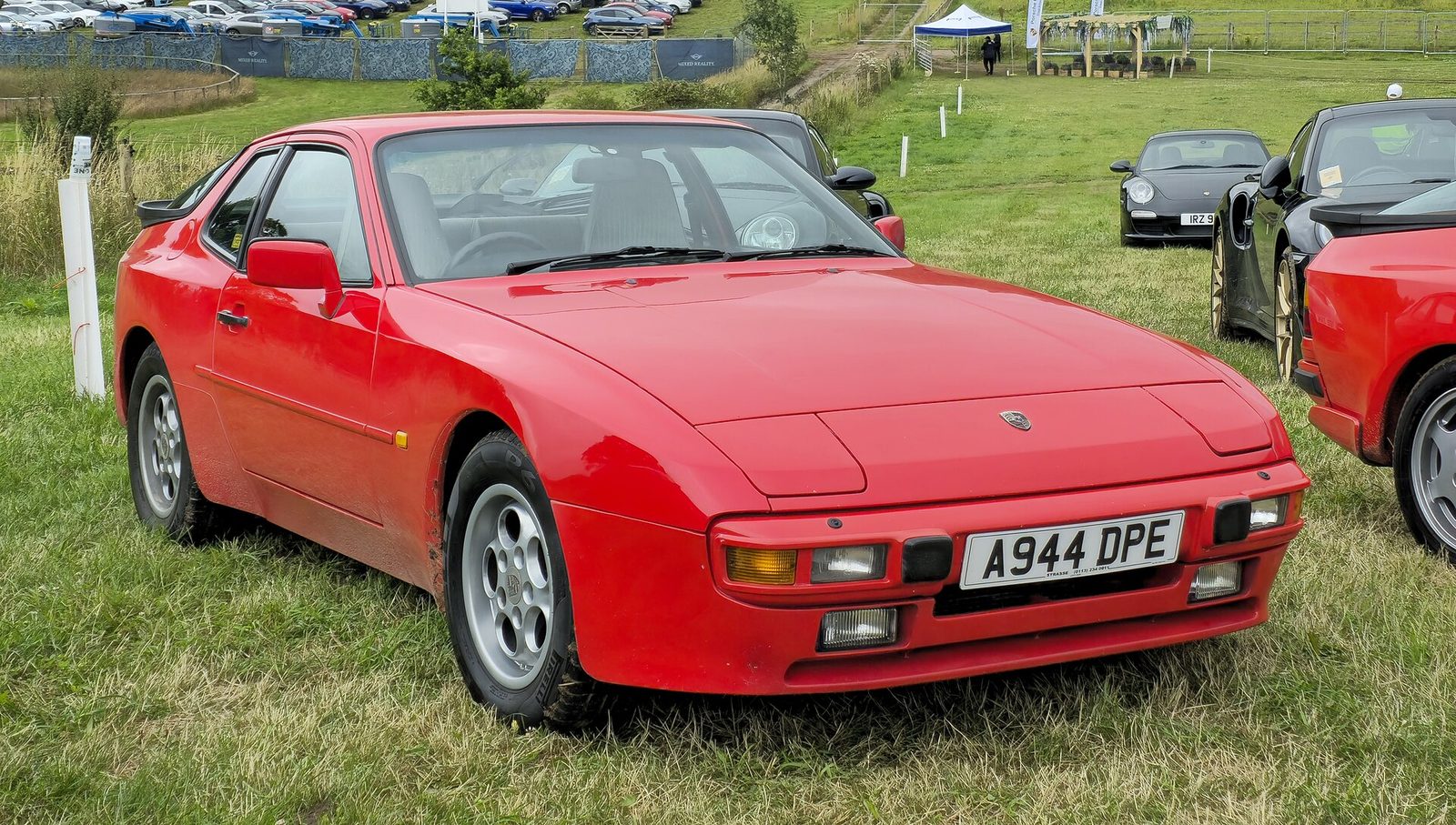
The Porsche 944 (1982-1991) was the car that turned the transaxle experiment into a commercial success. It kept the 924's platform, Neckarsulm assembly and front-engine, rear-gearbox layout, but replaced the Audi-sourced four with a Porsche engine that was, in effect, half of the 928's V8: 2,479 cc, all alloy, with twin balance shafts licensed from Mitsubishi to make a large four acceptable in a sports car. Shown at Frankfurt in September 1981 at $18,980 in the US against DM 38,900 in Germany, it drew 30,000 orders in its first year and was about 51 percent of Porsche's output by 1983. The line then grew in three steps: a mid-1985 interior and electrical revision, the 16-valve 944 S of 1987 with 187 hp, and the 1989 944 S2, whose 2,990 cc twin-cam four was the largest in a production car at the time and carried the Turbo's bodywork, brakes and suspension. An 8-valve 2.7 filled the base slot for 1989 and an ASC-converted Cabriolet joined the S2. Production ended in July 1991 ahead of the 968. Sources disagree on how many were built, particularly S2s, and this page records the disagreement rather than choosing a figure.
944
944, S, S2 (naturally aspirated)
Production by variant
How the 944run breaks down, and which variants are the scarce ones. Approximate figures from this model’s cited sources.
Rarest of the bunch: the 944 S2 Cabriolet (1989-1991), only about 6,980 built, roughly 1 in every 3 944s. If provenance and rarity drive your buy, this is the one to hunt.
Figures approximate; see Sources below.
History
Half a 928
The 924 had kept Porsche solvent through the 1970s, but its Volkswagen-Audi engine was always a reproach and VW's plans for it were finite. Porsche's answer was a four-cylinder of its own, conceived as one bank of the 928's all-alloy V8 and first raced in the 924 GTP that finished seventh at Le Mans in June 1981 with only 21 fuel stops. In road trim it displaced 2,479 cc on a 3.9 in (100 mm) bore and 78.9 mm stroke, with a single overhead camshaft, two valves per cylinder and Bosch Digital Motor Electronics. Its distinguishing feature was a pair of counter-rotating balance shafts to cancel the secondary vibration of a large four; Porsche paid Mitsubishi a per-engine royalty for the patent. Engines were built at Zuffenhausen and trucked to the former NSU works at Neckarsulm for assembly.
Frankfurt 1981 and Neckarsulm
The 944 was unveiled at Frankfurt in September 1981 wearing a productionized version of the 924 Carrera GT's flared arches, from Anatole Lapine's studio, and listed at $18,980 in the United States against DM 38,900 in Germany. European cars had 161 hp at 5,800 rpm; American cars, sold from May 1982 as early 1983 models at $18,980, had 143 hp by most accounts, although PCA and Pelican Parts give 150 hp. Britain took its first cars at Easter 1982. Motor Sport's 1983 test of a Lux recorded 0-60 mph in under 7.5 seconds, 0-100 mph in 21 seconds and 137 mph, found the gearbox impeccable and the steering a little low-geared, and returned about 26 mpg. America was warmer still: Car and Driver put the 944 on its Ten Best list from 1983 to 1985 and in August 1984 named it the best-handling car in the country over the Quattro, the Esprit and the C4 Corvette. Dealers took 30,000 orders in the first year and by 1983 the model was about 51 percent of everything Porsche built.
The Oval Dash and the Sixteen-Valve S
Power steering became standard for 1984, and midway through 1985 came the revision that divides 944s in the market: a new oval dashboard with a raised wheel, new door panels, an antenna embedded in the windshield, a 115-amp alternator in place of the 90-amp unit, a larger fuel tank, a flush-mounted windshield and phone-dial wheels in place of the cookie-cutters. The 944 Turbo arrived the same year and is covered separately. For 1987 Porsche added the 944 S, the first Porsche four with twin overhead camshafts and four valves per cylinder, a layout taken from the Le Mans engines; with hydraulic lash adjusters and knock sensors it made 187 hp to a 6,800 rpm redline, and PCA quotes Road & Track's 7.2-second 0-60 mph. ABS and airbags arrived the same year. The S was short-lived: 12,936 were built in two model years, and its small displacement left it short of the 8-valve car's low-speed flexibility. For 1988 the base engine's compression went from 9.5:1 to 10.2:1 for 158 hp, and a Celebration edition marked the 100,000th 944.
Three Liters: the S2
The 1989 model year reset the range. The 8-valve car was bored to 104 mm for 2,681 cc and 163 hp, a single-year engine, while the S became the S2 with the twin-cam head on a block bored and stroked to 104 x 88 mm for 2,990 cc, the largest four in any production car at the time. It made 208 hp at 5,800 rpm and 207 lb-ft at around 4,000 rpm, most of it low in the range, and inherited the Turbo's rounded nose, integrated bumpers, rear valance, brakes and suspension apart from slightly smaller front springs. Porsche quoted 0-62 mph in 6.8 seconds and 149 mph; Excellence records 6.9 seconds to 60 mph and 2,998 lb. Motor Sport lapped Snetterton in one in October 1989 in 1m 19.64s, four seconds quicker than a 928, and noted that it cost thousands less than a 911 with a better-balanced chassis. In the United States the coupe passed $45,000 and the Cabriolet approached $53,000.
Cabriolet and Run-out
The S2 Cabriolet, converted from coupe shells by American Sunroof Corporation, entered production in May 1989 per Wikipedia; PCA and Ate Up With Motor say 1990. Porsche states 6,980 were built through 1991. The S2 and Turbo stopped in July 1991, with a UK-only S2 SE of fifteen cars at 222 hp closing the account, and the 968 replaced the line for 1992 with the three-liter engine carried forward.
Common Problems
The pattern is consistent across the American, British and German guides. Belts head every list: the timing belt and the separate balance-shaft belt age as well as wear, the water pump, rollers and tensioner are usually changed with every second belt, and worn tensioner pads produce an audible rattle. Stuttcars quotes $1,200 to $1,800 for a full belt and water-pump service in 2026, while Pelican Parts puts the belt alone at about $300 with parts and labor. The 16-valve S and S2 add the cam-chain tensioner, which is oil-pressure controlled and can, in Porsche-Mania's account, throw the timing or crack a head when its guide rails or oil pipe fail. Oil leaks are chronic rather than serious: front crankshaft seal, balance-shaft seals and O-rings, cam-tower seals and, worst to fix, the oil pan gasket, which Pelican Parts puts at around $600 with $500 of that labor. The oil cooler seals and the oil-to-coolant heat exchanger can put oil into the coolant. Cooling systems suffer from tired radiators, lazy fans and corroded thermostats, and Porsche Club GB warns that the alloy engine wants a top-end rebuild from around 120,000 miles and a full rebuild from 150,000. The DME relay is a $20 part that stops the car dead. Power-steering pumps and pipes leak. Transaxles whine on worn pinion and differential bearings, torque-tube bearings whir, and gear linkages go vague. Clutch replacement is quoted at $1,500 to $2,500 by Stuttcars and $1,200 to $1,500 by Pelican Parts; the transaxle makes it a long job. Dashboards crack, hatches and sunroofs leak, starter motors are impossibly lethargic in Porsche Club GB's words, and cruise control fails often enough that owners stop repairing it.
What to Look For
The belt history comes first. Every source consulted puts the timing and balance-shaft belts on a four-year or 30,000 to 48,000-mile cycle depending on who is asked, and on the 16-valve S and S2 a broken belt puts valves into pistons; Pelican Parts adds that a fresh belt should be re-tensioned after about 1,000 miles and then every 15,000, which needs a factory tool. Receipts, not assurances. On the S and S2 the chain and tensioner between the camshafts is a separate item, oil-pressure controlled and worn by 100,000 miles by Porsche-Mania's reckoning; a rattle from the head on start-up is the warning. Oil should be checked for milkiness, because a failed oil-to-coolant heat exchanger will mix the two long before a head gasket does, and the expansion tank examined for crazing or warping that betrays past overheating. Underneath, look for a dented sump from careless jacking, weeping seals near the belt covers, and a whine from the rear that Pelican Parts and Porsche Club GB both trace to pinion or differential bearings; a whirring under load points to torque-tube bearings. Bodies were galvanized, so rust in the sills, the rear suspension mountings or anywhere other than the battery tray suggests accident repair or salt exposure, and a paint-depth gauge earns its keep. The hatch seal, sunroof drains and rear lamp seals all let water into the trunk. Inside, the post-1985.5 oval dash cracks and the odometer stops if the trip reset was pressed on the move; early cars have trim that is harder to replace. On S2s the Turbo-derived aluminum wishbones carry non-replaceable ball joints, so a knock over bumps means new arms. The clutch pedal should be firm with no free play; a soft pedal points at the master or slave cylinder and a high biting point at a disc, with the rubber-centered original disc and its damper wearing sooner than the plates. A car with a complete belt service, a documented cam-chain tensioner and a recent clutch is a different proposition from one with none.
Market Notes
As of September 2026, classic.com prices the naturally aspirated 944s as four separate submarkets. The standard 944 carries a benchmark of $14,485 against an average of $14,334 across 336 recorded sales, in a range from $1,000 to $105,000, with a 17,000-mile 1985.5 car at $36,000 in July 2025 showing what a low-mileage original will do. The Celebration edition sits lower at $10,363. The 944 S benchmark is $16,729 on a downward trend, with an average of $16,715, a floor of $2,200 for a project car in July 2026 and a tracked high of $25,000 in January 2026; recent results run $18,850 in July 2026, $14,369 in April 2026 and $11,500 in October 2025. The S2 coupe is the strongest of the four: benchmark $25,015 on an upward trend, average $26,607, a low of $4,944 for a 1989 car in November 2023 and, at the top, $50,000 in August 2026, $45,944 in February 2026 and a tracked high of $78,800 in April 2026. The S2 Cabriolet sits at $18,866 and trending down, with an average of $21,503, a $5,720 low in March 2025 and a $44,988 high for a 30,000-mile 1990 car in June 2026. Across the whole 944 family classic.com's average is $23,510, though that figure includes Turbos. Auction-house results are consistent with the benchmarks: RM Sotheby's Miami sale in February 2025 sold a 16,434-mile Alpine White S2 Cabriolet for $34,720, and its online Driving into Summer sale in 2020 took a 45,000-mile 1991 S2 coupe to $25,850; neither lot page states whether the price includes premium. Renndriver's June 2026 guide bands good to excellent cars at $10,000 to $22,000 for a 2.5, $15,000 to $30,000 for a 944 S and $20,000 to $45,000 for an S2.
Where sources differ
European 944s were rated at 161 hp at 5,800 rpm, but the US launch output is given as 143 hp by Wikipedia, Ate Up With Motor and Car and Driver and as 150 hp by the Porsche Club of America and Pelican Parts.
Wikipedia gives 143 hp for US cars from 1982 to 1985; Ate Up With Motor gives 143 hp SAE; Car and Driver gives 143 hp for 1983. The PCA model guide gives 150 hp and 142 lb-ft, and Pelican Parts gives 150 hp for 1983-1985. The 161 hp European figure is consistent across Porsche, Motor Sport and Wikipedia. Not resolved by any source consulted here.
S2 production is disputed: Wikipedia and Stuttcars give around 14,071 coupes and 5,656 Cabriolets, while Elferspot gives 9,352 coupes and 6,980 Cabriolets and Porsche's own transaxle history states 6,980 Cabriolets were built through 1991.
Wikipedia states 'around 14,071' S2 coupes and 5,656 S2 Cabriolets; Stuttcars' table states 14,071 and 5,656. Elferspot states 9,352 coupes and 6,980 convertibles. Porsche's 2026 newsroom chronology states 'a total of 6,980 units' of the 944 Cabriolet through 1991, which matches Elferspot and contradicts Wikipedia's Cabriolet figure. No source consulted reconciles the coupe figures. Not resolved by any source consulted here.
The total for the whole 944 family, Turbos included, is given as 163,302 by Porsche, 163,192 by Wikipedia, approximately 157,000 by Ate Up With Motor, and Stuttcars' variant table sums to 173,238; Car and Driver gives 88,765 US sales through 1991.
Porsche's press kit and newsroom state 163,302. Wikipedia states 163,192. Stuttcars states 'a total of 173,238 cars' and its per-variant figures sum to that number. Ate Up With Motor states approximately 157,000. Not resolved by any source consulted here.
Sources
- Porsche 944, Wikipedia · encyclopedia
- Everything about the Porsche 944, Porsche AG · manufacturer
- Porsche 944 - Forever Young. Celebrating Transaxle (press kit), Porsche AG · manufacturer
- Porsche transaxle models: 944 cutaway model, Porsche AG · manufacturer
- Porsche transaxle models: history, Porsche AG · manufacturer
- Porsche 944 Production Numbers, Stuttcars · specialist
- Porsche 944 Buyers Guide, Stuttcars · specialist
- Porsche 944 Buyer's Guide, Pelican Parts · specialist
- Model Guide: Front-engined, four-cylinder Porsche sports cars - Part I, Porsche Club of America · club-forum
- Model Guide: Front-engined, four-cylinder Porsche sports cars - Part II, Porsche Club of America · club-forum
- Yuppie Sports, Part 2: The Porsche 944 and 968, Ate Up With Motor · journalism
- Porsche 944 (May 1982), Motor Sport Magazine · journalism
- The Porsche 944 Lux (June 1983), Motor Sport Magazine · journalism
- Track test: Porsche track tests (October 1989), Motor Sport Magazine · journalism
- 1989 944 S2 Coupe (944) | Specs, Excellence, The Magazine About Porsche · specialist
- Porsche 944 buyer's guide, Classics World · journalism
- Porsche 944 Buyers Guide, Porsche Club Great Britain · club-forum
- Porsche 944 S2 - For sale & Buyer's Guide, Elferspot · specialist
- Differences Between 944S and S2?, Rennlist · club-forum
- The 5 Most Common Porsche 944 Problems, Porsche-Mania · specialist
- What to Buy: 1983-1991 Porsche 944, Car and Driver (syndicated via AOL) · journalism
- Porsche 944 Market, classic.com · market-data
- Porsche 944 (base model) Market, classic.com · market-data
- Porsche 944 S Market, classic.com · market-data
- Porsche 944 S2 Coupe Market, classic.com · market-data
- Porsche 944 S2 Cabriolet Market, classic.com · market-data
- Porsche 944 Guide - Turbo, S2, Specs, History and Values, Renndriver · specialist
- 1985-88 Porsche 944, Sports Car Market · journalism
- 1990 Porsche 944 S2 Cabriolet, Miami 2025, RM Sotheby's · auction-house
- 1991 Porsche 944 S2 Coupe, Driving into Summer, RM Sotheby's · auction-house
Synthesized from the sources above and cross-checked. We cite and link out; we do not republish other databases verbatim.
Fully Sorted is an independent publisher and is not affiliated with, endorsed by or sponsored by Dr. Ing. h.c. F. Porsche AG. Porsche and the model names on this page are trademarks of Dr. Ing. h.c. F. Porsche AG and are used here only to identify the cars being described.
Chassis register
Nobody has recorded a car here yet. Own one, or know one? Chassis number, what you can prove about it, and a source if there is one. Every entry is reviewed before it appears.
Nerd Notes
What owners know that the sources don't. Every note is read and checked before it appears here.
Key Specs
- Power
- 161 hp at 5,800 rpm European 2.5 (143 hp US at launch, 147 hp 1985-1987, 158 hp from 1988); 163 hp 2.7; 187 hp 944 S; 208 hp at 5,800 rpm S2 - all manufacturer ratings; see claims for the disputed US launch figure
- Brakes
- Ventilated discs all round; ABS optional from the 1987 model year and standard on the S2, which carries the Turbo's four-piston fixed calipers per Excellence
- Engine
- 2,479 cc M44/40 all-alloy inline-four derived from half of the 928 V8, with twin counter-rotating balance shafts under a Mitsubishi patent license; 2,681 cc M44/12 for 1989; 2,479 cc 16-valve for the 944 S; 2,990 cc M44/41 16-valve for the S2
- Layout
- Front-mounted longitudinal engine, rear-mounted transaxle joined by a torque tube; rear-wheel drive; Porsche quotes a driveshaft of 0.79 to 0.98 in (20 to 25 mm) diameter and about 59 in (1.50 m) long
- Torque
- 142 lb-ft base 2.5 per PCA, 155 lb-ft from 1988, 166 lb-ft for the 2.7; 170 lb-ft 944 S; 207 lb-ft (207 lb-ft at 4,100 rpm per Excellence, 4,000 rpm per Elferspot) S2
- Weight
- 2,601 lb pre-1988 and 2,932 lb from 1988 per Wikipedia; 944 S 2,857 lb; S2 2,998 lb curb per Excellence, 3,219 lb quoted by Motor Sport for a track-test car in 1989
- Chassis
- Steel unitary body on the 924 platform, galvanized; 94.5 in (2,400 mm) wheelbase; PCA describes a 50/50 front/rear weight balance shared with the Turbo, S2 and 968
- Dimensions
- Length 170.0 in (4,318 mm) (1986-1988) or 168.9 in (4,290 mm) (1989-1991); width 68.3 in (1,735 mm); height 50.2 in (1,275 mm)
- Suspension
- MacPherson struts with aluminum wishbones at the front, semi-trailing arms with transverse torsion bars at the rear; S2 shares Turbo springs and dampers except for slightly smaller-diameter front springs (Rennlist)
- Valvetrain
- Single overhead camshaft, two valves per cylinder (944); twin overhead camshafts, four valves per cylinder with hydraulic lash adjusters and a chain between the camshafts (944 S and S2)
- Bore stroke
- 100 x 78.9 mm (2.5); 104 x 78.9 mm (2.7); 104 x 88 mm (3.0)
- Compression
- 9.5:1 to 1987, 10.2:1 from 1988 (8-valve); 10.9:1 (944 S and S2)
- Acceleration
- 0-60 mph under 7.5 s for a 1983 UK 944 Lux per Motor Sport; 7.2 s for the 944 S per Road & Track via PCA; 6.9 s per Excellence and 6.0-6.8 s per Wikipedia for the S2; 0-62 mph in 6.8 s S2 claimed
- Transmission
- 5-speed manual transaxle at the rear axle, or 3-speed automatic; Motor Sport in 1983 called the manual 'impeccable'
- Wheels tires
- Cookie-cutter alloys to 1985, phone-dial from 1985.5; S2 on 16 x 7 and 16 x 8 wheels with 205/55 VR16 and 225/50 VR16 tires per Excellence; 2.0 in (52 mm) offset from 1987 with ABS
- Top speed claimed
- 137 mph European 2.5 (about 125 mph US per Ate Up With Motor); 142-144 mph 944 S; 149 mph S2 - manufacturer figures, with only Motor Sport's 137 mph recorded as a road-test observation
Notable Variants
944 2.5 (1982-1985, early dashboard)
The original 161 hp European and 143 hp US car with the 924-derived instrument binnacle and fender-mounted antenna. Simplest of the line, and the interior parts are the hardest to find; Stuttcars notes pre-1985.5 trim is unique to these cars.
944 2.5 'oval dash' (1985.5-1988)
Mid-1985 update with the new dashboard and door panels, 115-amp alternator, larger fuel tank, flush windshield and phone-dial wheels. Car and Driver's guide singles out these cars for improved interiors and suspension; from 1988 compression rose to 10.2:1 for 158 hp.
944 Celebration (1988 model year)
Special edition marking the 100,000th 944, recorded by Porsche Club GB's guide. classic.com tracks it as a separate submarket with a benchmark of $10,363 as of September 2026, below the standard car.
944 2.7 (1989 model year)
One-year 8-valve car with the 2,681 cc M44/12 engine, 163 hp and, per PCA, 0-60 mph in 7.5 seconds. The last of the 8-valve cars and, with the 1988 head, the most flexible of them; scarce because it was sold for a single year.
944 S (1987-1988)
First twin-cam, 16-valve Porsche four; 187 hp, 6,800 rpm redline, 12,936 built. Standard 944 body with '16 Ventiler' badging on the side moldings. Road & Track's 7.2-second 0-60 mph time is quoted by PCA; the cam-chain tensioner between the camshafts is its particular liability.
944 S2 coupe (1989-1991)
Three-liter 16-valve, 208 hp, Turbo bodywork, brakes and suspension without the turbocharger. Porsche Club GB calls it 'arguably the best all round 944'; classic.com's benchmark of $25,015 as of September 2026 is the highest of the naturally aspirated cars. Production is disputed at 14,071 or 9,352.
944 S2 Cabriolet (1989-1991)
Coupe shells converted by American Sunroof Corporation; 6,980 built per Porsche and Elferspot, 5,656 per Wikipedia. Trades below the coupe: classic.com's benchmark is $18,866 as of September 2026, on a downward trend.
944 S2 SE (UK, 1991-1992)
Fifteen cars for the UK market with 222 hp, adjustable Koni suspension, sports steering wheel and sports suspension, described by Porsche Club GB as the run-out model. Never sold in the United States, and no market data was fetched for it.
Value Trajectory
The 944 was a volume car from the start: $18,980 in the United States and DM 38,900 in Germany in 1982, rising to over $45,000 for an S2 coupe and nearly $53,000 for a Cabriolet by 1989. Because so many were built, it spent two decades as an inexpensive used Porsche; Pelican Parts' older guide quoted $4,000 to $15,000 for good examples and warned against expecting appreciation, and Sports Car Market's 2003 profile put the range at $4,000 to $20,000. That has changed unevenly. As of September 2026 classic.com's benchmarks are $14,485 for a standard 944, $16,729 for a 944 S, $25,015 for an S2 coupe and $18,866 for an S2 Cabriolet, and the trends diverge: the S2 coupe is rising, with a $50,000 result in August 2026 and a tracked high of $78,800 in April 2026, while the S and the Cabriolet are marked down. Car and Driver's June 2024 snapshot of $13,500 for a 71,000-mile 1985 car and $23,150 for a 52,000-mile 1990 S2 Cabriolet sits close to those benchmarks, and Renndriver's June 2026 bands describe the same shape. The numbers show stratification rather than a general rise: low-mileage, unmodified S2 coupes with belt and tensioner history have separated from the field, and everything else remains a car bought to drive.
Next
Shopping for one?
Browse Porsche listings, or decode a VIN before you buy.