
The Porsche 944 Turbo, built to internal type number 951, is the turbocharged development of Porsche's front-engined transaxle four-cylinder car, sold from the 1986 model year to 1991. It paired the 2,479 cc single-overhead-cam balance-shaft four with a KKK turbocharger, an intercooler and 8.0:1 compression for 217 hp, driving through a rear-mounted five-speed transaxle that gives the car close to 50/50 weight distribution. The Turbo received four-piston brakes derived from the 911, standard ABS from 1987, and a standard driver's airbag. For 1988 Porsche built 1,635 examples of the 944 Turbo S, rated at 247 hp with a larger K26-8 turbine housing, M030 suspension, a limited-slip differential and 928 S4 front brakes; from 1989 that drivetrain became the standard Turbo specification. Long treated as the cheap way into a Porsche, the 951 has spent the last decade climbing, held back mainly by the cost of its belt-driven service schedule.
944 Turbo
944
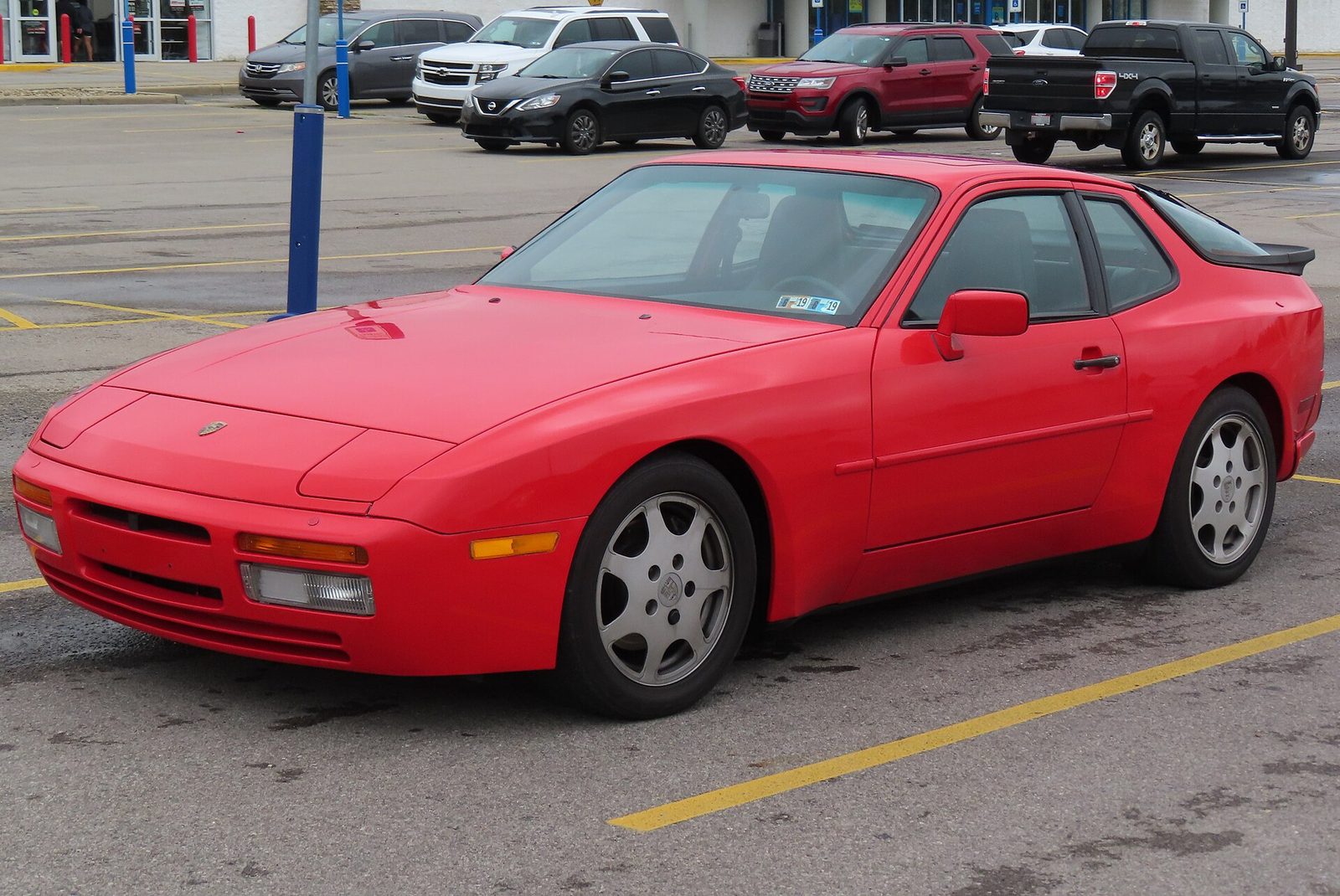
History
From 924 to 944 to 951
The 944 arrived in September 1981 as Porsche's answer to the 924's borrowed Audi-derived engine, using instead a 2.5-liter inline-four that Porsche developed in-house and which the factory describes as effectively half of the 928's V8. Like the 924 and 928 before it, the 944 used the transaxle layout: engine over the front axle, clutch at the front, a slim driveshaft running in a rigid central torque tube between the seats, and the gearbox and differential mounted at the rear axle. Porsche's stated aim for the concept was an axle load split as close as possible to 50:50, and the 944's handling reputation rests almost entirely on it. The 944 sold faster than any Porsche before it, and the factory extended it into a family: Turbo, S, S2 and Cabriolet.
The Turbo, Type 951
The turbocharged car carried the internal type number 951 and reached the market for the 1986 model year, with a short pre-production run recorded in 1985. It used the eight-valve engine with compression dropped to 8.0:1, a KKK turbocharger fed through an air-to-air intercooler, ceramic liners in the exhaust ports to keep heat in the gas rather than the head, and a water-cooled turbo bearing housing to prevent oil coking after shutdown. Output was 217 hp and 243 lb-ft, roughly a hundred horsepower more than the base 944. The gearbox was strengthened and given a different final drive, and both engine and transmission ran external oil coolers. Brakes were four-piston fixed calipers on ventilated discs, taken from the 911. ABS became standard on the Turbo for 1987, when it was also an option rather than standard equipment on the rest of the range, and the Turbo was among the first cars anywhere to carry a driver's airbag as standard.
The 1988 Turbo S
For 1988 Porsche released the 944 Turbo S. The engine, stamped M44/52, took a larger K26-8 turbine housing and revised mapping that held maximum boost to 5,800 rpm, lifting output to 247 hp and 258 lb-ft at 4,000 rpm and, on the factory's numbers, a 162 mph top speed. With it came the M030 suspension package - height-adjustable Koni dampers, progressive-rate springs, 1.06 in (27 mm) front and 0.71 in (18 mm) rear anti-roll bars and firmer bushings - along with a limited-slip differential, 928 S4 front brakes, and forged 7x16 and 9x16 Club Sport wheels. Porsche planned around 1,000 cars in Silver Rose Metallic with burgundy interiors but demand ran past that; 1,635 were built, and PCA notes that the Silver Rose color scheme covered only about the first hundred. Genuine cars are identified by option code 758 on the build sticker and the M44/52 engine stamp near the bell housing.
S Spec as Standard, and the End
For 1989 the S designation was dropped and the Turbo S drivetrain simply became the 944 Turbo, minus the M030 suspension and the forged Club Sport wheels, which reverted to the options list. The Turbo left the US market after 1989 but continued in rest-of-world markets, including Canada, until 1991, when a small run of 944 Turbo Cabriolets closed out the model. The 968 replaced the 944 for 1992. By the end of the series Porsche records 163,302 944s of all types, though independent variant tallies run higher.
Common Problems
The defining cost is belt service. The camshaft belt and the balance shaft belts must be replaced together on a mileage or time interval - published guidance ranges from 30,000-35,000 miles (Pelican Parts) to 30,000-40,000 miles or five years (stuttcars.com), while Classics World advises every four years - with the water pump, rollers and tensioners changed at least every other belt job. Belts need re-tensioning shortly after fitting. A full service commonly runs $1,200-$1,800. Oil leaks from the front crank seal, cam tower seals and oil pan gasket are routine and matter because they contaminate the belt area; the pan gasket is largely a labor charge. Head gasket failure shows as frothy oil. Turbochargers need periodic attention and eventually rebuilding. Clutches wear faster on turbocharged cars and replacement is expensive because the transaxle must come out, quoted at roughly $1,500-$2,500 in the US or GBP 1,200-1,800 and up in the UK. Elsewhere: vacuum leaks and failing air flow meters that dull performance, oil cooler failure that mixes oil and coolant, cracked plug leads, corroded battery trays, dead odometers on the oval-dash cars, speedometer pulse generator failures, and the general electrical unreliability of thirty-five-year-old grounds and connectors.
What to Look For
Service history is the single most valuable document on a 951. Ask for dated evidence of timing belt, balance shaft belt, water pump, rollers and tensioner replacement; the engine is an interference design and a belt failure destroys it. Check for oil weeping from the front crank seal and the cam tower seals, because that oil lands on the belt. Confirm the turbocharger has been serviced and listen for shaft noise or smoke on overrun. Verify a claimed Turbo S properly: option code 758 on the sticker near the spare, engine stamped M44/52 near the bell housing at the number four exhaust manifold, transmission oil cooler loop, adjustable spring perches on the front Konis, 1.06 in (27 mm) front and 0.71 in (18 mm) rear anti-roll bars, and the 7x16/9x16 forged wheels. PCA's own advice is that few of these cars have escaped modification, so a pre-purchase inspection at a specialist familiar with 944 turbos is not optional. Bodies were galvanized, so visible rust points to accident repair or long neglect rather than normal aging - check the battery tray, sills behind their covers, wheel arches and the hatch surround. Test every electrical function; a clutch that is high, slipping or hard to shift means a transaxle-out job.
Market Notes
As of August 2026, classic.com's 944 Turbo market benchmark stands at roughly $27,800 with an average sale near $28,200 and recent results spread from about $9,300 to $49,000; the benchmark trend is upward. The 944 Turbo S sits close behind on classic.com, with a benchmark near $29,800 and an average around $29,900 on a thin sample running from about $13,500 for a 155,000-mile car to $42,500 for a 51,000-mile original, and that page's data ran through late October 2025 with a downward benchmark arrow - the Turbo S sample is small enough that its benchmark should be treated as indicative rather than firm. Retail-facing guides sit above the auction averages: stuttcars.com's buyer's guide puts sorted Turbos at roughly $20,000-$35,000 and 1988 Turbo S cars at $40,000-$60,000 or more, while Classics World's 2026 UK guide quotes Turbos from around GBP 20,000 with strong examples at GBP 30,000-45,000. The spread between benchmark and best-of-market is unusually wide, which is normal for a car whose value is dominated by documented belt service history and whether it has been left standard.
Where sources differ
944 Turbo production totaled roughly 25,245 cars across 1985-1991, but sources disagree over whether the 1,635 Turbo S cars are inside that figure or additional to it, so no single total is asserted.
Wikipedia's year-by-year table sums to 25,245 and explicitly places the 1,635 Turbo S inside the 1988 figure of 4,097. StuttCars lists '944 Turbo 25,245' and '944 Turbo S 1,635' as separate variant lines, which would imply about 26,880 turbocharged cars. Neither source shows its underlying factory records.
Total 944-series production across all variants is itself disputed, with Porsche stating 163,302 cars and independent variant tables summing to 173,238.
Porsche's own material gives 163,302 for the 944 series to the end of production in 1991; StuttCars' per-variant table sums to 173,238. The gap of roughly 10,000 cars likely reflects differing treatment of 924S, model-year boundaries or variant double-counting, but the reason is not documented in either source.
Sources
- Porsche 944, Wikipedia · reference-book
- Porsche 944: why the transaxle star is a rising classic sportscar, Porsche AG · manufacturer
- Porsche 944 (press kit: Forever Young - Celebrating Transaxle), Porsche Newsroom · manufacturer
- Why is the transaxle concept still so fascinating today?, Porsche Newsroom · manufacturer
- Experiencing magic with a 944 Turbo S, Porsche Newsroom / Porsche Klassik · manufacturer
- Model Guide: Front-engined, four-cylinder Porsche sports cars - Part II, Porsche Club of America · club-forum
- Tech Q&A - 88 944 Turbo S Identification, Porsche Club of America · club-forum
- 1986 944 Turbo Coupe (951) Specs, Excellence - The Magazine About Porsche · journalism
- 1989 944 Turbo Coupe (951) Specs, Excellence - The Magazine About Porsche · journalism
- Porsche 944 Production Numbers, StuttCars · reference-book
- Porsche 944 Buyer's Guide: Everything You Need to Know, StuttCars · reference-book
- Porsche 924S/944/951/968 Buyer's Guide, Pelican Parts · specialist
- Porsche 944 buyer's guide, Classics World · journalism
- Porsche 944 Turbo Market, classic.com · journalism
- Porsche 944 Turbo S Market, classic.com · journalism
- The State of the Porsche 944 Market, Classic Motorsports · journalism
- Porsche 944 Turbo Prices Are Getting Out of Hand, Gear Patrol · journalism
- 1988 Porsche 944 Turbo S, Amelia Island 2017, Lot 162, RM Sotheby's · auction-house
Synthesized from the sources above and cross-checked. We cite and link out; we do not republish other databases verbatim.
Fully Sorted is an independent publisher and is not affiliated with, endorsed by or sponsored by Dr. Ing. h.c. F. Porsche AG. Porsche and the model names on this page are trademarks of Dr. Ing. h.c. F. Porsche AG and are used here only to identify the cars being described.
Chassis register
Nobody has recorded a car here yet. Own one, or know one? Chassis number, what you can prove about it, and a source if there is one. Every entry is reviewed before it appears.
Nerd Notes
What owners know that the sources don't. Every note is read and checked before it appears here.
Key Specs
- Brakes
- Ventilated discs all round with fixed four-piston calipers derived from the 911; Turbo S adopted 928 S4 front brakes. ABS standard on the Turbo from 1987
- Engine
- 2,479 cc SOHC 8-valve turbocharged inline-4 with twin counter-rotating balance shafts
- Layout
- Front engine, rear-wheel drive, rear-mounted transaxle
- Length
- 166.5 in (4,230 mm)
- 0 60 mph
- ~5.9 s (1987 Turbo, Car and Driver); ~5.5 s (1988 Turbo S, Car and Driver); ~5.7 s (1989 Turbo)
- Top speed
- ~152 mph (1986 Turbo); ~162 mph / 162 mph (Turbo S and 1989-on Turbo)
- Wheelbase
- 94.5 in (2,400 mm)
- Compression
- 8.0:1
- Wheels 1986
- 16x7 front, 16x8 rear
- Transmission
- 5-speed manual transaxle, strengthened over the naturally aspirated 944, with external engine and transmission oil coolers
- Wheels turbo s
- 16x7 front, 16x9 rear forged Club Sport design
- Power 1986 1988
- 217 hp; 217 hp in US trim, at 5,800 rpm
- Curb weight 1986
- ~2,822 lb
- Curb weight 1989
- ~2,998 lb
- Drag coefficient
- 0.33
- Forced induction
- KKK turbocharger with air-to-air intercooler; ceramic port liners in the exhaust ports; water-cooled turbo bearing housing
- Torque 1986 1988
- 243 lb-ft at 3,500 rpm
- Weight distribution
- Close to 50/50 front/rear by design of the transaxle layout; Porsche describes the concept as giving near-perfect axle load distribution
- Power turbo s and 1989 on
- 247 hp (247 hp / 247 hp) at 6,000 rpm
- Torque turbo s and 1989 on
- 258 lb-ft at 4,000 rpm
Notable Variants
944 Turbo (951)
1986-1988 specification: 217 hp / 243 lb-ft, 8.0:1 compression, water-cooled turbo bearing, 911-derived four-piston fixed calipers. ABS standard from 1987.
944 Turbo S
1988 only, 1,635 built. 247 hp / 258 lb-ft via a larger K26-8 turbine housing holding full boost to 5,800 rpm, plus M030 suspension, limited-slip differential, 928 S4 front brakes and 7x16/9x16 forged Club Sport wheels. Option code 758; engine stamped M44/52.
944 Turbo (1989-1991)
Turbo S drivetrain became the standard Turbo specification, without the M030 suspension and forged Club Sport wheels, which reverted to options.
944 Turbo Cabriolet
1991 open Turbo, cited at 625 cars, built for rest-of-world markets only. The rarest 951 body style.
Value Trajectory
The 951 spent most of its life as the underpriced Porsche and has been correcting for about a decade. Classic Motorsports tracked Hagerty's condition-1 944 Turbo value from north of $40,000 in 2017 to roughly $49,000 by 2019, with the Turbo S moving from a $46,200 auction result at RM Sotheby's Amelia Island in 2017 to close to $69,000 in 2019. Gear Patrol documented the same inflection on Bring a Trailer: through the end of 2018 only four of eighty-five 944 Turbos had passed $30,000 and none had reached $40,000, yet during 2019 four cars cleared $58,000, with a 1989 example at $74,000 and a Gooding sale at $72,600 in 2018. The car's long-standing discount was partly cultural, front-engined and water-cooled being held against it by 911 buyers. As of August 2026 the broad market has settled well below those headline results - classic.com's benchmark near $27,800 with an upward trend - which suggests the appreciation has been in the best, most original, best-documented cars rather than across the board. Mileage, belt history and originality now separate a $10,000 951 from a $50,000 one.
Next
Shopping for one?
Browse Porsche listings, or decode a VIN before you buy.