
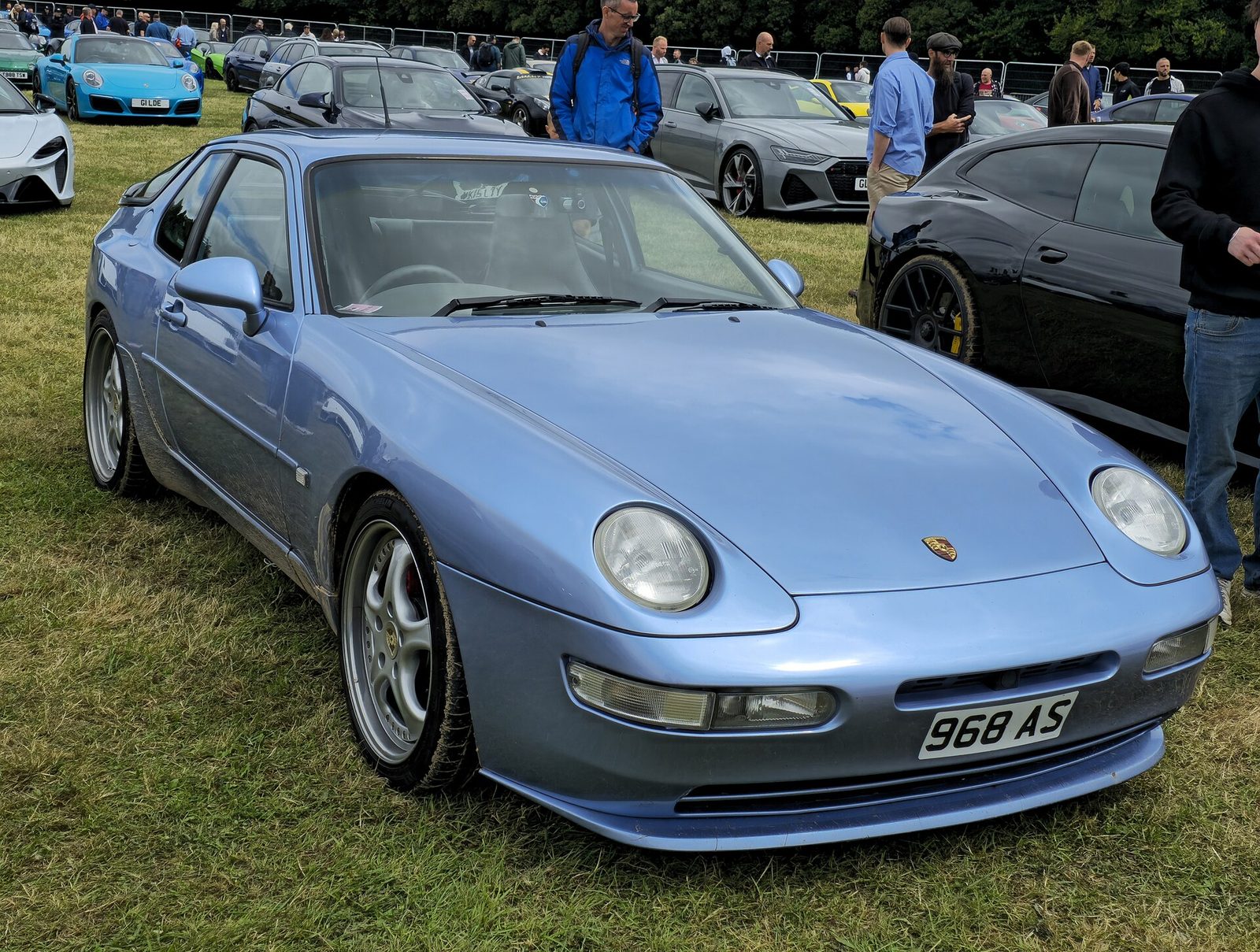
The Porsche 968 (1991-1995) was the last of the front-engined, rear-transaxle four-cylinder line that began with the 924. Money was short after the 1987 stock market crash, so Harm Lagaay's studio reworked the 944 S2 rather than replacing it, with new panels and exposed pop-up lamps, and Porsche claimed more than 80 percent of the car was new. Underneath sat a 2,990 cc four with VarioCam variable intake timing making 237 hp at 6,200 rpm and 225 lb-ft at 4,100 rpm, which Porsche called the highest-torque naturally aspirated four-cylinder in the world, driving through a Getrag six-speed or the new four-speed Tiptronic. Assembly moved from Neckarsulm to Zuffenhausen. The car was well reviewed and sold poorly: 5,353 in its first year and 1,156 in its last, with the total itself disputed between about 11,245 and 12,776. The lightened Club Sport of 1993, the British-market Sport, and a run of between 10 and 16 hand-built Turbo S homologation cars with 301 hp from an eight-valve turbo four now carry most of the interest, and the Club Sport is the one whose values have moved.
968
968, CS, Turbo S
Production by variant
How the 968run breaks down, and which variants are the scarce ones. Approximate figures from this model’s cited sources.
Rarest of the bunch: the 968 Turbo S, only about 16 built, roughly 1 in every 626 968s. If provenance and rarity drive your buy, this is the one to hunt.
Figures approximate; see Sources below.
History
Evolution Not Revolution
Motor Sport summarized the plan in September 1991 as evolution not revolution, and the reason was money. Ate Up With Motor traces the 968 to the collapse in Porsche's finances after the 1987 stock market crash: Harm Lagaay did not have the budget for a clean-sheet replacement for the 944, so an extensive facelift with exposed flip-up headlamps took a new name from its internal type number, to put distance between it and falling 944 sales. Porsche stated that more than 80 percent of the car was new. The car had its world premiere at the Frankfurt IAA in September 1991, and assembly moved from the Audi plant at Neckarsulm to Zuffenhausen because building through Audi or Volkswagen factories had become too expensive.
The Big Four
The engine was the substance of the change. The 2,990 cc M44/43 kept the 944 S2's 4.1 in (104 mm) bore and 88 mm stroke but gained VarioCam, which varied the timing of the intake valves, forged oil-cooled pistons, a larger-bore exhaust and a revised manifold, and compression rose to 11.0:1. Output went from the S2's 208 hp to 237 hp at 6,200 rpm with 225 lb-ft at 4,100 rpm, which Porsche's press material called the highest-torque naturally aspirated four-cylinder in the world. A Getrag six-speed transaxle was standard and the four-speed Tiptronic, co-developed with ZF and Bosch and costing $3,465 or DM 5,850, was the option; Porsche's 2026 timeline calls the 968 the first Porsche with Tiptronic. The 1992 US coupe was $41,605 with luxury tax and freight, against German launch prices of DM 89,800 for the coupe and DM 99,800 for the cabriolet.
Well Reviewed, Barely Bought
The road tests were kind, with reservations. Jeremy Walton in Motor Sport found the engine not the smoothest of units; Georg Kacher in Automobile called the delivery creamy and progressive; Wes Raynal in Autoweek found it faster than the 944 and better in ride, handling and braking, with steering of unmatched feel. Porsche's own retrospective admits it never attained the emotional appeal of the 911, and the sports car market was collapsing as it arrived: 5,353 were built in 1992, 3,783 in 1993, 2,484 in 1994 and 1,156 in 1995, and only 156 British customers bought one in 1992.
Club Sport and Sport
The answer, shown at the Paris Salon in October 1992 and sold from 1993, was to take things out. The Club Sport lost its rear seats, air conditioning, electric windows, radio, alarm, central locking, rear wiper, most of the sound insulation and the electric Recaros, replaced by fixed-back buckets; it sat 0.79 in (20 mm) lower on 17-inch wheels, and listed in Britain below the standard coupe. Porsche quotes a saving of around 220 lb; Supercar Nostalgia, evo and Adrian Flux put the official figure at 110 lb. Performance Car made it Car of the Year for 1993, and Walter Rohrl called it the best-handling car Porsche had built to that date. It was never sold in the United States. For Britain in 1994 Porsche added the 968 Sport, a Club Sport chassis with the windows, locking, alarm, sunroof and rear seats put back, priced under the standard coupe.
Turbo S and Turbo RS
In 1993 Weissach built a homologation special for the ADAC GT series by fitting the 944 Turbo's eight-valve head and a KKK K27 at 1.0 bar to the 3.0-liter block. The Turbo S made 301 hp and 369 lb-ft, ran to about 174 mph, carried NACA hood ducts, an adjustable rear wing, Koni dampers, a 40 percent limited-slip differential and 18-inch three-piece Speedlines, and was hand-assembled under Gerd Schmid and Jurgen Barth. RM Sotheby's records that 100 were planned and the program stopped in 1994 on cost; CAR called it too wild for public roads. A prototype and three track-only Turbo RS cars followed, at 332 hp or more; one retired from Le Mans in 1994 after an accident and Erik Henriksen ran another in the 1994 BPR series.
The End of the Line
Production ended in July 1995. Porsche canceled the 968 and the 928 together without direct replacements, and the Boxster of July 1996 was priced at $39,980 and DM 76,500, well below the last 968 coupe. Ate Up With Motor's verdict is that the 968 was both the best of the 924/944/968 breed and the least successful.
Common Problems
The fault pattern is the 944 S2's with the VarioCam added. The exhaust cam belt can stretch beyond what the tensioner takes up, and if it breaks or jumps a tooth the valves meet the pistons; the balance shaft belt is replaced with it, and the 968's hydraulic tensioner, unlike the spring tensioner on the 944, can be fitted so that the belt runs off-center, which a Rennlist owner traced to a worn copper sleeve on the tensioner pivot arm, a $20 machinist's job that shows how small the margins are. VarioCam sprockets, chain and tensioner wear with age and mileage, and Octane, Stuttcars and PistonHeads all list them with the belts as one service. The rear main seal seeps and a proper fix means removing the transaxle. Clutches on higher-mileage cars slip or judder, at $2,000 to $3,000 to replace according to Stuttcars; Octane calls the dual-mass flywheel a known weak point, PistonHeads says the opposite, so read that as a check rather than a certainty. The differential pinion bearing whirrs and is replaced as a unit. Engine mounts deteriorate from heat, the clutch master cylinder leaks, and the electric radiator fan should switch off with the ignition or it flattens the battery. Electrics generally are described by Stuttcars as intermittent: lights, gauges, windows, sunroofs and climate controls. Rust is a matter of wheel arches, sills, floors, valances, hatch seams and the battery tray, worse on the un-undersealed Sport and Club Sport. Cabriolet hoods, cloudy plastic rear windows and rear hatch glass delaminating from its frame are the open-car additions. Suspension bushes make a tired car vague and clunky, and Octane recommends regular four-wheel alignment.
What to Look For
The belts come first. The exhaust camshaft is belt driven and the balance shafts have their own belt; PistonHeads gives four years or 40,000 miles, Octane five years or 60,000, and a car without a dated invoice for belts, tensioners and the VarioCam chain and tensioner should be priced as needing the job, which Stuttcars puts at $1,200 to $2,000 for a full belt, roller and water pump service. Listen at the timing cover: wear in the VarioCam sprockets, chain and hydraulic tensioner shows as noise there and as poor throttle response. On the road, a turbine-like whirr under acceleration is the differential pinion bearing, replaced as a unit and a drive-in drive-out job at a specialist, and vibration through the cabin points to engine mounts cooked by heat rather than to the engine itself. Whining from the Getrag six-speed is noted by Octane, although PistonHeads regards both gearboxes as strong. Underneath, Octane records that Sport and Club Sport cars left the factory without underseal, so wheel arches, sills, floorpans, valances and the battery tray need a proper look on those cars in particular. Pop-up headlamp mechanisms that stick want refurbishment, windshields go cloudy, and on cabriolets the hood, the plastic rear window and the seal and bonding of the rear hatch glass all age. On a Club Sport, establish what the car actually is: PCA points out that the limited-slip differential, sport suspension and larger brakes were options, the M030 pack adds 12.0 in (304 mm) discs, stiffer springs and 1.18 in (30 mm) and 0.75 in (19 mm) anti-roll bars, and Comfort and Security packs put some deleted equipment back. Color was five choices at launch and Paint to Sample later, and PCA prices color and options at 15 to 20 percent. Imported Club Sports in North America should have 25-year-rule paperwork and a European history. For a Turbo S or RS, the chassis number and Porsche's own documentation are the whole story, since the population is between 10 and 16 cars depending on who is counting.
Market Notes
As of September 2026, classic.com records an average sale of $33,528 across the 968 range, with the lowest tracked result $6,188 for a 1993 car on 29 April 2026 and 13 cars listed against 114 tracked. The benchmarks by body and gearbox are $31,495 for a manual coupe, $18,764 for a Tiptronic coupe, $25,089 for a manual cabriolet, $23,127 for a Tiptronic cabriolet, $21,087 for the British-market Sport and $52,844, trending up, for the Club Sport, whose average sale is $48,488 with a low of $18,285 on 31 October 2024. Recent entries include a 1992 manual coupe at $48,000 on 4 September 2026, a 1993 Club Sport at $84,900 in July 2026 and a 1995 Club Sport at $48,968 through PCARMARKET in June 2026. Renndriver's June 2026 guide puts coupes at $25,000 to $50,000, cabriolets at $25,000 to $45,000 and Club Sports at $50,000 to $100,000 and above, and PCA put North American Club Sport sales at $65,000 to $80,000 in November 2025. At the top, RM Sotheby's sold a Cobalt Blue six-speed cabriolet for $89,600 at Miami in 2025, Broad Arrow sold the black Turbo RS for $775,000 at Amelia in March 2026, and the ex-Helena Sukova Turbo S, estimated at $900,000 to $1,200,000 by Gooding Christie's at the same event, failed to meet reserve and was afterwards offered at $900,000; RM Sotheby's had also failed to sell a Turbo S at Miami in 2025 against $550,000 to $750,000. classic.com's $516,500 Turbo S benchmark rests on that single pending lot. Auction figures are quoted as published; none of the pages consulted states whether buyer's premium is included.
Where sources differ
The Club Sport's weight saving over the standard 968 is given as about 220 lb by Porsche and Wikipedia, 110 lb by Supercar Nostalgia, evo, Adrian Flux and Ate Up With Motor, around 187 lb by Octane and about 200 lb by PCA.
Porsche's Club Sport guide and Wikipedia state a saving of about 220 lb. Supercar Nostalgia, evo, Adrian Flux and Ate Up With Motor state 110 lb (Supercar Nostalgia gives 2,910 lb official against a 3,020 lb standard car). Octane states around 187 lb. PCA states about 200 lb. The difference may reflect whether the comparison is with a base or a fully equipped 968, but no source consulted says so, and it is not resolved here.
The Turbo S used the eight-valve SOHC head of the 944 Turbo with a single KKK K27 turbocharger at 1.0 bar for 301 hp and 369 lb-ft, on a reinforced six-speed with a limited-slip differential, Koni adjustable dampers and 18-inch three-piece Speedline wheels; the engine speed for peak power is given as 5,400 rpm by Gooding Christie's and supercars.net and 5,600 rpm by Wikipedia.
Gooding Christie's lot 148 and supercars.net state 301 hp at 5,400 rpm. Wikipedia states 301 hp at 5,600 rpm. RM Sotheby's gives 304 horsepower and 368 lb-ft without an engine speed. The output is consistent; only the rpm differs, and it is not resolved by any source consulted here.
The total number of 968s built is disputed: Porsche's own material gives 11,245 (press kit) and 11,248 (2026 timeline), Secret Classics 11,241, the 968 Register 11,763 worldwide deliveries alongside 12,776 built per Peter Morgan, and Wikipedia and Adrian Flux 12,776.
Porsche's Forever Young press kit states 11,245 cars left Zuffenhausen from 1991 to mid-1995. Porsche's transaxle timeline of 11 June 2026 states 11,248. Secret Classics states 11,241. The Porsche 968 Register states 12,776 built (attributed to Peter Morgan's Porsche 924/944/968) and, on the same page, 11,763 worldwide deliveries from Porsche Club 968 Deutschland records. Wikipedia and Adrian Flux state 12,776. Ate Up With Motor and PCA say fewer than or just under 13,000. Not resolved by any source consulted here.
The number of Club Sports built is disputed: Porsche states 1,538, which Wikipedia reaches as 1,232 CS plus 306 Sport; the 968 Register's summary says 1,743 while its year column sums to 1,923; Supercar Nostalgia and Prestige and Performance Car state 1,923; PCA says fewer than 1,600.
Porsche's Club Sport guide and 2026 timeline state 1,538 Club Sports. Wikipedia states 1,232 registered as 968 CS and 306 as 968 Sport, totalling 1,538. The 968 Register's worldwide summary states 1,743 Club Sports, while its year-by-year column of 856, 536 and 531 sums to 1,923. Supercar Nostalgia and Prestige and Performance Car state 1,923. PCA states fewer than 1,600. Whether the British-market Sport is counted, and whether the figure is builds or registrations, is not stated by any source. Not resolved here.
The number of Turbo S cars built is disputed: 14 including one prototype according to Porsche, Wikipedia, Gooding Christie's, supercars.net and the Register's data page (RM Sotheby's says 13 customer cars built from 1992 to 1994, with 100 planned), but 15 according to the Register's model page and PCA, 16 according to Ate Up With Motor and 10 according to Secret Classics.
Porsche's 2026 timeline states production was halted after 14 units. Gooding Christie's states one of only 14 including one prototype; supercars.net states 14 hand-assembled at Weissach, one prototype and 13 customer cars, 10 in 1993 and 4 in 1994; Wikipedia, the Register's production page and classic.com state 14. RM Sotheby's states 13 built from 1992 to 1994 plus a prototype. The Register's model page states 15 cars in total and PCA states only 15 were constructed. Ate Up With Motor states 16 examples. Secret Classics states only ten. Not resolved by any source consulted here.
Sources
- A guide to the Porsche 968 Club Sport. Why this lightweight driver's car is gaining cult status, Porsche AG · manufacturer
- The Porsche 968 (Forever Young. Celebrating Transaxle press kit), Porsche AG Newsroom · manufacturer
- Time lapse: Porsche's transaxle models, Porsche AG Newsroom · manufacturer
- Porsche 968, Wikipedia · encyclopedia
- Production Data - Porsche 968 Register, Porsche 968 Register · registry
- What is a 968? - Porsche 968 Register, Porsche 968 Register · registry
- Yuppie Sports, Part 2: The Porsche 944 and 968, Ate Up With Motor · journalism
- 30 Years of Porsche 968, Secret Classics · specialist
- Guide: Porsche 968 Club Sport - Historical & Technical Appraisal, Supercar Nostalgia · specialist
- 1993 Porsche 968 Turbo RS For Sale in Florida, Supercar Nostalgia · specialist
- 1993 Porsche 968 Turbo S, supercars.net · specialist
- Porsche 968 history and road tests - Cult Classics, Adrian Flux · specialist
- Porsche 968 Club Sport - behind the wheel of an icon, evo · journalism
- Porsche 968 Club Sport road test, Prestige and Performance Car · journalism
- Porsche 968 buying guide, history and model review, Octane · journalism
- Porsche 968 Buying Guide: Powertrain, PistonHeads · journalism
- 968 Timing belt tensioner problems, Rennlist · club-forum
- Porsche 968 Buyer's Guide: Everything You Need to Know, Stuttcars · specialist
- Why now might be the time to buy a Porsche 968 Club Sport, Porsche Club of America · club-forum
- Five Porsches we paid extra attention to at the 2026 Amelia Island Auctions [Updated], Porsche Club of America · club-forum
- 1993 Porsche 968 Turbo S | Gooding Christie's, Gooding Christie's · auction-house
- 1994 Porsche 968 Turbo S | Miami 2025 | RM Sotheby's, RM Sotheby's · auction-house
- 1992 Porsche 968 Cabriolet | Miami 2025 | RM Sotheby's, RM Sotheby's · auction-house
- Results: 2026 Amelia Island Auctions - Wolf and Mare, Wolf and Mare · market-data
- Porsche 968 Guide - Club Sport, Turbo S, Specs and Values, Renndriver · specialist
- What's going on with the Porsche 968 market?, Porsche Club of America · club-forum
- Porsche 968 Market - CLASSIC.COM, classic.com · market-data
- Porsche 968 Turbo S Market - CLASSIC.COM, classic.com · market-data
- Porsche 968 Clubsport Market - CLASSIC.COM, classic.com · market-data
Synthesized from the sources above and cross-checked. We cite and link out; we do not republish other databases verbatim.
Fully Sorted is an independent publisher and is not affiliated with, endorsed by or sponsored by Dr. Ing. h.c. F. Porsche AG. Porsche and the model names on this page are trademarks of Dr. Ing. h.c. F. Porsche AG and are used here only to identify the cars being described.
Chassis register
Nobody has recorded a car here yet. Own one, or know one? Chassis number, what you can prove about it, and a source if there is one. Every entry is reviewed before it appears.
Nerd Notes
What owners know that the sources don't. Every note is read and checked before it appears here.
Key Specs
- Power
- 236 hp at 6,200 rpm claimed; Turbo S 301 hp claimed, with 5,400 rpm (Gooding Christie's, supercars.net) or 5,600 rpm (Wikipedia) quoted for the peak
- Brakes
- Ventilated discs all round with Bosch ABS; Club Sport with Brembo four-piston calipers on 11.7 in (297 mm) front and 11.8 in (300 mm) rear discs, 12.0 in (304 mm) front discs with the M030 pack
- Engine
- 2,990 cc M44/43 inline-four, 4.1 in (104 mm) x 88 mm, 11.0:1 compression, four-valve head with VarioCam variable intake timing, twin counter-rotating balance shafts, dual-mass flywheel, forged pistons with oil-spray cooling; Porsche called it the highest-torque naturally aspirated four-cylinder in the world
- Layout
- Front-mounted longitudinal inline-four, rear-mounted transaxle, rear-wheel drive (the last of the 924/944/968 transaxle line)
- Torque
- 225 lb-ft at 4,100 rpm claimed; Turbo S 369 lb-ft at 3,000 rpm
- Weight
- 3,086 lb quoted by Wikipedia and Octane for the standard coupe; Club Sport 2,910 lb official; Turbo S 2,866-3,020 lb depending on options per supercars.net; Turbo RS 2,976 lb ADAC minimum or 2,672 lb in international trim per Wikipedia
- Chassis
- Steel unibody derived from the 944 S2 with new front and rear body panels and exposed pop-up headlamps; Porsche stated more than 80 percent of the car was new, and Neckarsulm assembly moved to Zuffenhausen
- Dimensions
- Length 170.1 in (4,320 mm), width 68.3 in (1,735 mm), height 50.2 in (1,275 mm), wheelbase 94.5 in (2,400 mm)
- Prices new
- $41,605 coupe and $51,700 cabriolet in the US for 1992; $41,605 coupe and $51,700 cabriolet in the United States, DM 89,800 coupe and DM 99,800 cabriolet in Germany at launch (Porsche's press kit says DM 89,900)
- Suspension
- MacPherson struts with alloy lower arms front, semi-trailing arms with transverse torsion bars rear; Club Sport 0.79 in (20 mm) lower with stiffer dampers; M030 pack adds stiffer springs, dampers and 1.18 in (30 mm)/0.75 in (19 mm) anti-roll bars; Turbo S on Koni adjustable dampers
- Acceleration
- 0-62 mph in 6.5 s for the standard car per Wikipedia (Octane quotes 6.1 s to 60 mph, Secret Classics 7.9 s for the Tiptronic); Club Sport 6.3 s claimed by Porsche, 5.8 s recorded per Supercar Nostalgia; Turbo S 4.7 s to 60 mph claimed
- Transmission
- Getrag six-speed manual transaxle standard; four-speed Tiptronic automatic optional, co-developed with ZF and Bosch, $3,465 or DM 5,850 extra; Turbo S used a reinforced six-speed with a mechanical limited-slip differential of about 40 percent
- Wheels tires
- 16-inch wheels on 205 front and 225 rear tires on the standard car (autoevolution lists 225/50 ZR16); Club Sport on 17 x 7.5 in front and 17 x 9 in rear with 225 and 255 section tires; Turbo S on 18-inch three-piece Speedline wheels
- Fuel capacity
- 74 liters under the trunk floor (Supercar Nostalgia)
- Top speed claimed
- 157 mph standard per Wikipedia; Club Sport about 160 mph claimed by Porsche, 162 mph recorded per Supercar Nostalgia; Turbo S 174-175 mph claimed; all manufacturer claims unless stated
Notable Variants
968 Coupe
The volume car, 6,045 built by the Morgan-derived Register table. Six-speed manual or four-speed Tiptronic; classic.com separates the two, and as of September 2026 the manual benchmark is $31,495 against $18,764 for the automatic, the widest gearbox gap on any 968 body.
968 Cabriolet
3,959 built by the same table, and more popular in North America than in Europe: Wikipedia has 2,248 of 4,389 convertibles going to the United States. RM Sotheby's sold a Cobalt Blue Metallic six-speed car, one of 27 North American cabriolets in that color, for $89,600 at Miami in 2025, an outlier for the body style.
968 Club Sport
Shown at Paris in October 1992 and sold from 1993 in Europe, Britain, Japan and Australia, never in the United States. Lower, stiffer, on 17-inch wheels, with fixed-back Recaros and most comfort equipment deleted; Walter Rohrl called it the best-handling car Porsche had made to that date. Cheaper than the standard car when new. Now imported to the US under the 25-year rule and the only mainstream 968 with a clearly rising market.
968 Sport (United Kingdom, 1994-1995)
A British-market compromise: Club Sport chassis and seats with electric windows and mirrors, central locking, alarm, sunroof and rear seats restored, and listed below the standard coupe in Britain. Wikipedia counts 306 registered; Adrian Flux says it outsold the standard car. classic.com's benchmark is $21,087 as of September 2026, well under the Club Sport.
968 Club Sport with M030 Sport pack
Optional stiffer springs, dampers and anti-roll bars, 12.0 in (304 mm) front discs and a 40 percent Torsen limited-slip differential. PCA notes that the limited-slip differential, sport suspension and larger brakes were not standard on the Club Sport, and prices options and color at 15 to 20 percent of value.
968 Turbo S
Hand-assembled at Weissach in 1993 and 1994 with the 944 Turbo's eight-valve head, a K27 at 1.0 bar, 301 hp, NACA hood ducts, adjustable rear wing and 18-inch three-piece Speedlines; mainland Europe only, and roughly twice the price of a standard coupe when new. Between 10 and 16 built depending on the source (see production). Estimated at $900,000 to $1,200,000 by Gooding Christie's at Amelia Island in March 2026 and unsold; as of September 2026 classic.com also tracks a 1992 prototype last advertised in Texas at $649,000 in June 2026.
968 Turbo RS
Track-only derivative for the ADAC GT series and BPR: a prototype and three production cars, raced at Le Mans in 1994 (retired after an accident) and in BPR by Erik Henriksen. The last of the three, the only black one, sold for $775,000 at Broad Arrow's Amelia sale in March 2026, the highest published 968 result found here.
Value Trajectory
New, a 968 coupe cost $41,605 in the United States and DM 89,800 in Germany, the cabriolet $51,700, and the Club Sport listed below the standard car. The model then spent two decades as the affordable Porsche. PCA's Rob Sass recorded the turn in March 2022: driver-quality six-speed manual coupes on about 100,000 miles in common colors had moved from the low twenty thousands the previous summer to around $30,000, while a 43,000-mile Riviera Blue rest-of-world coupe made $123,000 at Gooding's Amelia Island sale four months after selling for $85,000. The standard cars have barely moved since. As of September 2026 classic.com's manual coupe benchmark is $31,495, the cabriolet $25,089, the Tiptronic coupe $18,764 and the average sale across the range $33,528, with a 1993 car recorded at $6,188 in April 2026. The Club Sport is the exception, at a $52,844 benchmark trending upward with $84,900 and $89,600 results in 2026, and PCA's November 2025 view was that the best cars would move into low six figures without doubling. The Turbo cars are a separate and thin market: $775,000 for the Turbo RS at Amelia in March 2026 is the only recent completed sale found, and two Turbo S offerings in 2025 and 2026 failed against estimates of $550,000 to $1,200,000.
Next
Shopping for one?
Browse Porsche listings, or decode a VIN before you buy.