
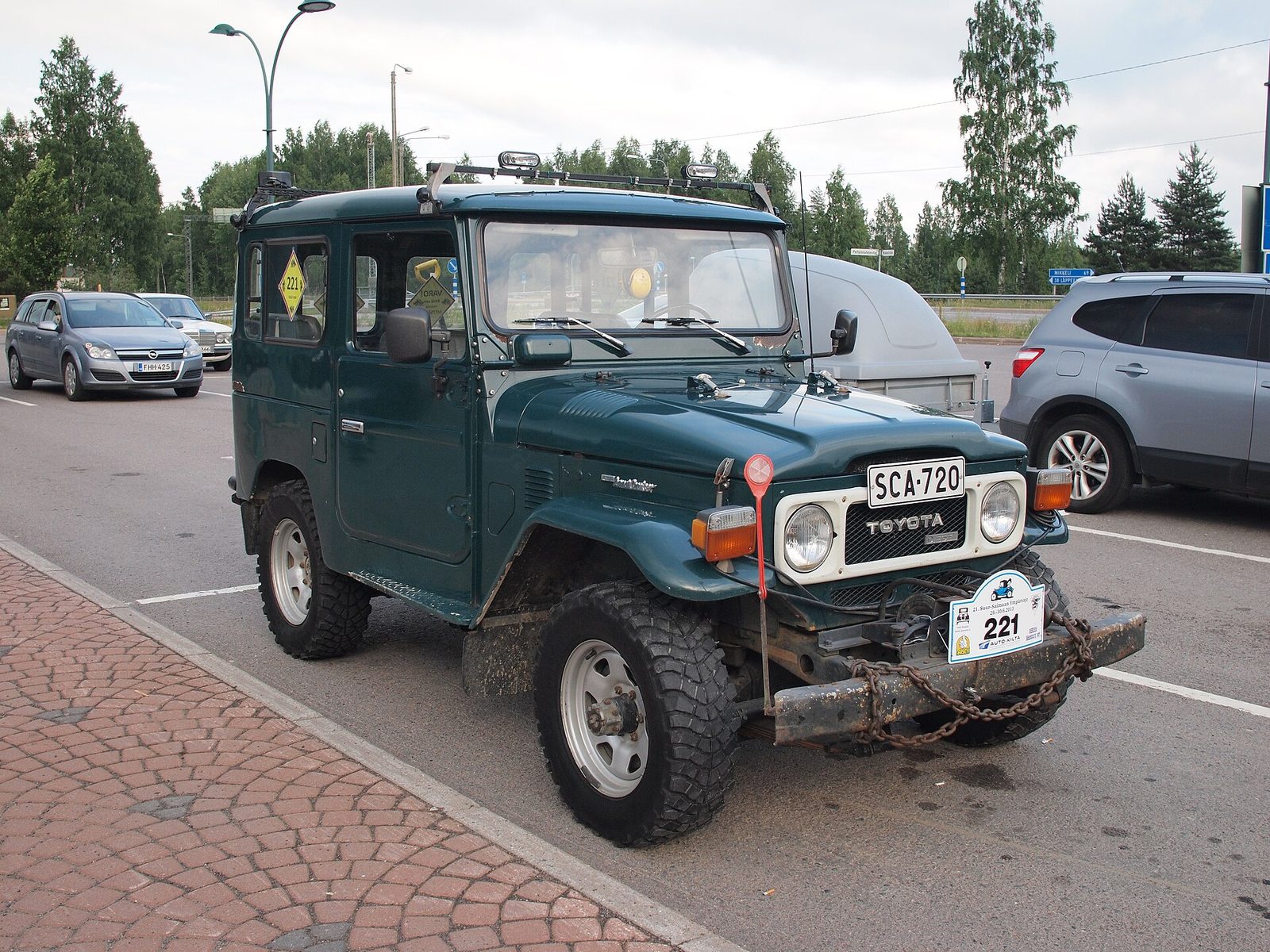
The Toyota Land Cruiser FJ40 is the archetypal Japanese off-roader: a rugged, body-on-frame 4x4 built around a stout inline-six and a reputation for going anywhere. Launched as the 40 Series in August 1960 and sold in the US through the early 1980s, it competed head-on with the Jeep CJ and Land Rover while earning a name for near-indestructible reliability. Early cars used Toyota's 3.9L F six; from 1975 the larger 4.2L 2F six (135 hp) brought more torque, front disc brakes and a 4-speed. Simple, tough and endlessly rebuildable, the FJ40 developed a devoted global following. Values climbed sharply in the 2010s as high-end restorations and restomods from firms like The FJ Company and Icon reached six figures, before the market settled in the late 2010s and 2020s. Rust is the FJ40's great enemy, making genuinely solid, original examples the ones worth chasing.
Land Cruiser
FJ40 (40 Series)
History
Origins
Toyota's Land Cruiser lineage traces to a Korean War-era military scout, but the civilian 40 Series that most people picture arrived in August 1960. Built on a simple ladder frame with a steel body, the FJ40 was the short-wheelbase wagon of a family that also included longer pickups and troop carriers.
Engines: F and 2F
Early FJ40s used the 3.9-liter F inline-six, a cast-iron pushrod engine making roughly 105-135 hp depending on market and year. In 1975 Toyota introduced the larger 4.2-liter 2F six, rated at 135 hp with strong low-rpm torque. Both engines are famous for durability, with cast-iron blocks and heads that routinely surpass 300,000 miles before a major overhaul. The trade-off was modest highway performance: superb once off-pavement, leisurely on the road.
Reputation vs Jeep and Land Rover
The FJ40 was Toyota's answer to the Jeep CJ and Land Rover, and it built its name on going anywhere and always starting. Slightly larger than a contemporary CJ, it offered a torquey six where rivals often used smaller fours, and it earned a lasting reputation for reliability that helped establish Toyota's brand credibility in export markets.
US Market and the End of the Line
The FJ40 sold in the United States from the 1960s into the early 1980s. Sources disagree on the exact final US model year, with Hagerty cataloguing a 1983 FJ40V and other references citing 1984; global 40 Series wagon production ended in 1984, while a Brazilian Bandeirante variant soldiered on until 2001.
Collector Revival and Restomods
Once cheap trail rigs, FJ40s became blue-chip classics in the 2010s. Restoration specialists such as The FJ Company and Icon, and later builders like ECD/Black Dog Traders, turned them into six-figure restomods, with premium builds starting around $240,000. That halo lifted values for stock cars too, before the market cooled from its peak.
Common Problems
Rust is the defining problem, attacking the tub floors, footwells, rear quarters, wheel arches, tailgate and frame; heavily patched or repainted bodies can conceal expensive corrosion. Mechanically the F and 2F sixes are robust but can show worn oil pressure, smoke or overheating from tired examples and neglected cooling systems. The engines are strong on torque but weak on highway speed, and early cars have drum brakes and modest gearing. Parts availability is good, but a rust-rotten tub or frame is the costliest trap for buyers.
What to Look For
Rust is the number-one issue: inspect floors and footwells, rear quarters and wheel arches, tailgate, door bottoms, windshield frame, body mounts and especially the frame and rear crossmember. Fresh paint can hide serious body rot. Mechanically, the F/2F six should start cleanly, idle steadily and show good oil pressure warm; smoke, heavy breathing, rattles or a contaminated cooling system are red flags. Later 2F cars with front disc brakes and a 4-speed are the most usable. Prioritize a solid, original body over cosmetics or paperwork, and confirm VIN/year given many US cars are private imports from Japan, the Middle East, South America or Australia.
Market Notes
As of late 2025, the FJ40 market has settled well off its mid-2010s highs but remains strong. Classic.com's market benchmark sat around $36,600, with public listings spanning roughly $12,000 for projects to over $185,000 for high-end custom/restomod builds (e.g. Icon). Hagerty had earlier flagged the market as cooling, noting #2 (excellent) condition values averaging near $47,000 in 2019 and down about 7.6 percent from 2016, even as younger-buyer interest grew. Directional read (mid-2020s): honest, rust-free stock cars hold value; restomods command large premiums; project cars are cheap but rust makes them risky. Figures are directional, not appraisals.
Where sources differ
The exact final US model year for the FJ40 is contested, with some references citing 1983 and others 1984; global 40 Series wagon production ended in 1984.
Hagerty catalogs a 1983 FJ40V as the final US listing, and some sources cite the FJ40 ending US sales in 1983; ECD/other references state production ran 1960-1984 (and into 1985 in select markets). The discrepancy reflects US-import timing versus global end-of-production. Both figures noted; not resolved to a single authoritative US end-year here.
Sources
- Toyota Land Cruiser (J40), Wikipedia · reference-book
- As the Toyota FJ40 market settles, now might be the time to buy, Hagerty Media · journalism
- Toyota Land Cruiser FJ40 Market, Classic.com · journalism
- Toyota 2F Engine - The Now Sought After 6 Cylinder Paperweight, Redline Land Cruisers · club-forum
- Toyota Land Cruiser BJ40 and FJ40 buyer's guide, Classic Car Buyer · journalism
- Restored FJ40 Land Cruisers - The FJ Company, The FJ Company · manufacturer
- How Much Does a Toyota FJ40 Restomod Cost?, ECD Automotive Design · journalism
Synthesized from the sources above and cross-checked. We cite and link out; we do not republish other databases verbatim.
Fully Sorted is an independent publisher and is not affiliated with, endorsed by or sponsored by Toyota. Toyota and the model names on this page are trademarks of their respective owners and are used here only to identify the cars being described.
Chassis register
Nobody has recorded a car here yet. Own one, or know one? Chassis number, what you can prove about it, and a source if there is one. Every entry is reviewed before it appears.
Nerd Notes
What owners know that the sources don't. Every note is read and checked before it appears here.
Key Specs
- Layout
- Front-engine, part-time 4WD, body-on-frame
- 2F output
- 135 hp; ~210 lb-ft torque (low-rpm)
- Construction
- Ladder frame, steel body
- Transmission
- 3-speed then 4-speed manual
- Brakes (late)
- Front discs on later 2F cars
- F engine displacement
- 3,878 cc (3.9L) inline-six
- 2F engine displacement
- 4,230 cc (4.2L) inline-six
Notable Variants
FJ40 hardtop
The definitive short-wheelbase wagon with removable steel top; the most collectible and reproduced body style.
Late 2F models (1975-1984)
4.2L 2F engine, front disc brakes and 4-speed gearbox make these the most usable and desirable drivers.
FJ43
Medium-wheelbase soft-top, rarer in North America and prized by enthusiasts.
Value Trajectory
FJ40 values rose dramatically through the early-to-mid 2010s as restorations and restomods reached auction prominence, then cooled and settled from roughly 2016 onward. By the mid-2020s the market is mature: stable-to-firm for genuinely good original cars, with a strong premium for quality restomods and softness/risk at the project end. Long-term the FJ40 remains a desirable, broadly appreciating classic, but the era of rapid across-the-board gains has passed.
Next
Shopping for one?
Browse Toyota listings, or decode a VIN before you buy.