
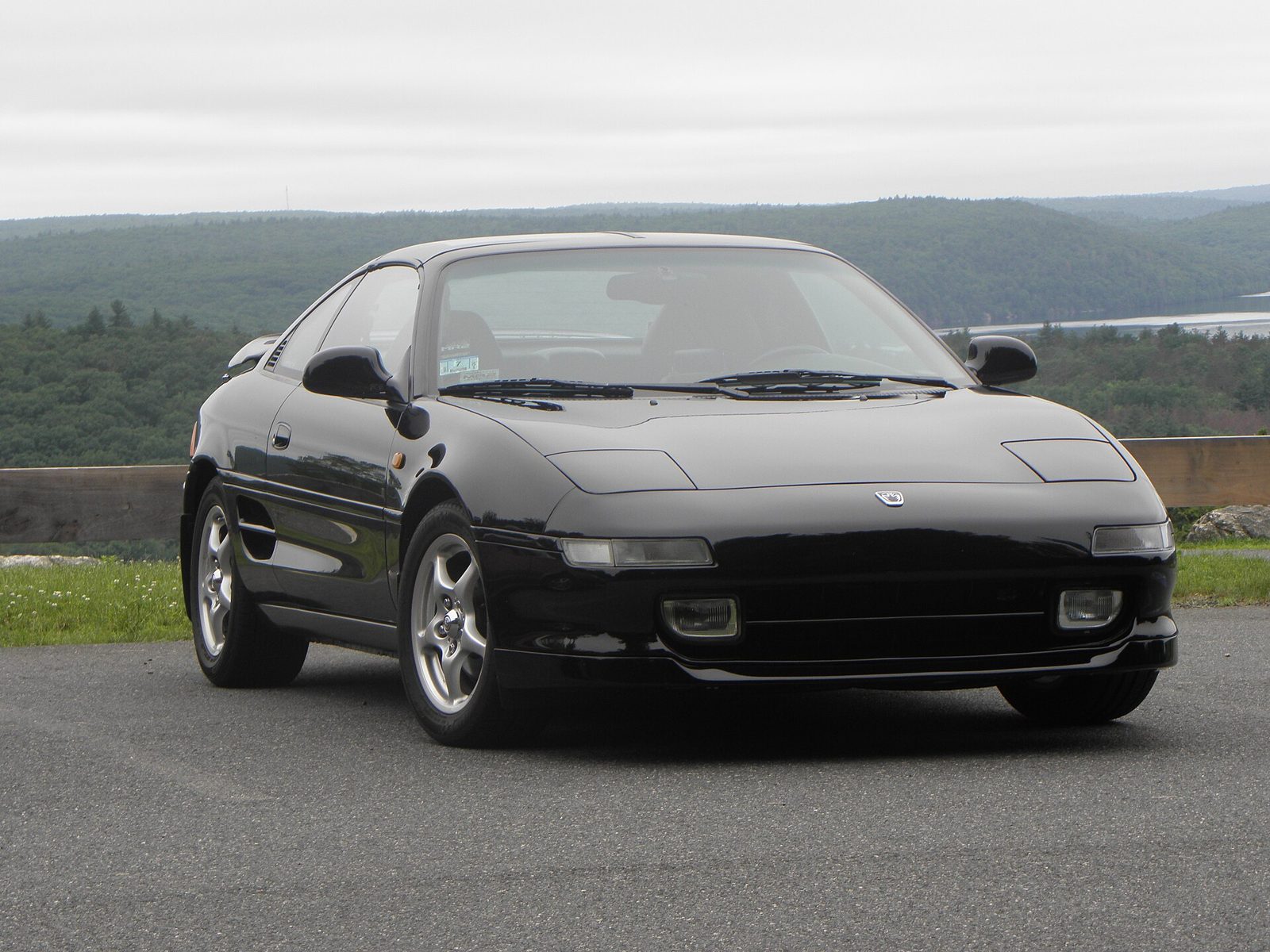
The second-generation MR2, chassis SW20, was Toyota's answer to a question almost nobody else was still asking by 1990: whether a mid-engined two-seater could be sold at a mainstream price. It reached US showrooms in spring 1990 as an early 1991 model and was sold here for the 1991 through 1995 model years, although Toyota kept building it for Japan and Europe through 1999. US cars came two ways: a base car with a 2.2-liter four rated at 130 hp, later 135 hp, with a five-speed manual or four-speed automatic, and a Turbo with the 2.0-liter 3S-GTE making 200 hp and 200 lb-ft, manual only. A T-bar roof was offered on both and became standard on the Turbo from 1993, the year a revised chassis tamed a car known for snap oversteer. Sales fell away as prices rose: by either published count, fewer than a thousand US cars a year found buyers at the end, and a 1995 Turbo listed at $28,668 against $18,228 for a 1991 Turbo, per JD Power.
History
Why it exists
By the time Toyota replaced the first MR2, the affordable mid-engined car was close to extinct. Grassroots Motorsports points out that the Pontiac Fiero and the Fiat X1/9 had both failed to reach the 1990s, which left the MR2 alone in its price class. Toyota answered with a bigger, heavier and more grown-up car rather than a lighter one. Consumer Guide measured about 1 cubic foot of space in the nose and 5.5 in the trunk, and Hagerty Media puts the Turbo at nearly 2,900 lb, 400 lb more than the heaviest first-generation trim. The supercharger of the late first-generation car was dropped in favor of a turbocharger. Hagerty credits Dan Gurney with helping Toyota's engineers tune the handling of the first two generations. The MR2 Wiki, an owner-run reference, repeats a claim that Yamaha assembled the cars for Toyota at about 2,000 a month; it hedges with "apparently," and no manufacturer source fetched here confirms it.
The US car, 1991-1992
Consumer Guide says the SW20 skipped the 1990 model year and arrived in spring 1990 as an early 1991 model; a member of the MR2 Owners Club forum working through Toyota-derived sales data dates the start to March 1990. The base car used the 2.2-liter four from the Celica GT and GT-S, rated at 130 hp; MR2 Bible identifies it as the 5S-FE, used in the MR2 only in the US. The Turbo used the 3S-GTE from the Celica All-Trac Turbo, turbocharged and intercooled, at 200 hp and 200 lb-ft. A five-speed manual was standard, and the four-speed automatic came only without the turbo. The T-bar roof was optional on either car, with a pop-up removable moonroof as the alternative, and Europe never got the Turbo at all, Hagerty notes. Grassroots Motorsports ran its own test in its March/April 1991 issue, weighed the Turbo at 2,758 lb, and rated its throttle response among the best of any turbo engine it had driven.
The 1993 revision
The early cars earned a reputation for snap oversteer: lift mid-corner and the tail comes around, and an overcorrection sends it the other way. Toyota's answer arrived in March 1992 as an early 1993 model, per Consumer Guide: lower ride height, higher-rate springs and shock absorbers, stiffer bushings, longer rear toe-control arms and wider 15-inch tires. Hagerty adds bigger brakes and a viscous limited-slip differential, which the MR2 Wiki lists as a Turbo option alongside revised second- and third-gear synchronizers; Grassroots Motorsports calls the new Turbo synchronizers dual-cone. Consumer Guide and Grassroots Motorsports both say every 1993 Turbo came with the T-bar roof, while the MR2 Wiki counts approximately 10 hardtop Turbos among 2,917 US sales that year. Some journalists thought the fix neutered the car; Toyota said the changes were for drivers whose reflexes were not those of Formula 1 drivers, as Hagerty quotes it.
The last two years
A passenger airbag joined the driver airbag for 1994, and the base car gained standard air conditioning and a one-piece rear spoiler. The 1995 base T-bar car added power windows and locks as standard. Japan got a 242 hp 3S-GTE from 1994, and MR2 Bible is emphatic that the US Turbo never did. Prices kept climbing: JD Power records an original MSRP of $18,228 for a 1991 Turbo and $28,668 for a 1995 Turbo, and Consumer Guide blames escalating prices and insurance premiums for the collapse in sales. The MR2 Wiki counts 908 US sales in the penultimate period and about 356 in the last, and says the Turbo was not offered in California-emissions states at the end. Toyota withdrew the car from the US after 1995.
Before and after: AW11 and Spyder
The first-generation AW11 was smaller, lighter, offered with a supercharger in 1989, and far more numerous: the calendar-year table reposted on the MR2 Owners Club forum puts AW-series production for the United States and Canada at 96,666, against 33,111 for the SW series. The third-generation car, which Consumer Guide notes revived the name as a midengine Spyder convertible as the new century began, weighed about 700 lb less than an SW20 Turbo, per Hagerty, and has its own page.
Common Problems
The problems cluster around age, packaging and the chassis rather than the engines. Water: T-bar seals leak, and the foam insulator behind the seats rusts the sills from within. Cooling: on the Turbo the buried coolant hoses are an engine-out job, and MR2 Bible flags the copper coolant pipes above the fuel tank as a critical item because they crack and leak onto the tank. Transaxle: synchronizer wear on the 2-3 shift, improved but not cured by the 1993 Turbo gearbox. Steering: Consumer Guide lists a power steering pump relay fault on 1991-1995 cars that can make assist excessive, and MR2 Bible describes the relay cutting assist intermittently. Idle and oil: TVIS actuator and vacuum line leaks cause rough idle, and the distributor base O-ring weeps oil, per MR2 Bible. Electrical: Consumer Guide records 1991 cars with water in the wiring harness corroding terminals and killing the dome light, door speakers or radio. Recalls: NHTSA lists one campaign for the 1991 model year, 91V223000, replacing a steering wheel and airbag that exceeded the 60g thorax criterion in crash tests, and returns none for the 1993 or 1995 model years; the MR2 Wiki also lists a 1991 air conditioning expansion valve campaign that the NHTSA query does not return. Handling: snap oversteer is the leading cause of attrition, per Hagerty Media, softened rather than removed by the 1993 revision.
What to Look For
Rust starts where it cannot be seen. Grassroots Motorsports reports that a foam sound insulator low in the body pocket behind the seats holds water and rots the sills and rockers from the inside; reproduction rockers exist because this is the most common rust area. T-bar cars leak, and a dry one is the exception, per Grassroots Motorsports; MR2 Bible calls drips at the seals very common as the rubber ages. On a Turbo, the coolant hoses buried in the engine bay, known to owners as the Hoses from Hell, are essentially an engine-out job according to Hagerty Media, so a record of their replacement carries weight. Transaxle synchronizers crunch on the 2-3 shift, and the 1993 dual-cone upgrade did not end it; Red Line MT-90 fluid is the usual first remedy before a rebuild. Hagerty calls the car extremely reliable and the engines bulletproof, but says a clean, unmodified example is hard to find and many were spun by inexperienced owners, so accident history and originality separate cars more than mileage does. Colors and paint codes, from the MR2 Wiki alone: Aquamarine Pearl (742) for 1991-1992 only; Nautical Blue (8H3), Black (202), Super White I (043), Crimson Red (3J6), Signal Yellow (567) and Steel Mist Gray (187) from launch; Blue (8J2) and Turquoise Pearl (746) for 1993 only; Super Red (3E5) and Super White (040) from 1993; Solar Yellow (576), Dark Green Pearl (6M1) and Tropical Blue (8B6) later. Maintenance and restoration costs: no US source fetched publishes a repair or restoration price. Grassroots Motorsports says mechanical parts remain available, colored interior trim has long been discontinued, and body panels are hard to source.
Market Notes
As of September 2026, the most specific US values fetched for the SW20 come from JD Power, which lists a 1991 Turbo coupe at $15,100 low retail, $27,100 average retail and $33,200 high retail; a 1995 Turbo at $14,550, $25,400 and $31,300; and a 1991 base coupe at $9,600, $18,400 and $23,300. classic.com's all-generation MR2 page gives an average price of $17,406 as of September 2026 across the AW11, SW20 and Spyder combined; its SW20 submarket page was not retrieved, so no classic.com figure specific to this car appears here. Hagerty Media's SW20 market article, written after January 2020 and not current, put a #3 non-turbo at about $8,000 and a concours Turbo at up to $35,000, a #2 1993 Turbo at $22,500 against $12,300 for a #2 base car, and a #2 post-revision Turbo at $23,800 against $18,800 for a pre-revision car. Consumer Guide's used-car page still prints an undated good-condition range of $1,200 to $4,200, which no other source fetched comes near. Modified cars trade in their own market: The Truth About Cars featured a 156,000-mile 1991 Turbo with turbo, intercooler and suspension upgrades at an $18,000 asking price, undated. The sources agree on direction if not on numbers: Turbo over base, and an unmodified car over a modified one.
Where sources differ
Worldwide SW-series production is given as 130,732 by two sources, but neither page's own rows add up to that figure: the forum table's regional split sums to 130,532 and The JDM Registry's yearly rows for 1990-1999 sum to 130,197.
The JDM Registry and the MR2 Owners Club repost both state 130,732. The forum's components (66,761 Japan, 30,660 other overseas, 33,111 USA and Canada) add to 130,532; the Registry's yearly rows add to 130,197. No source consulted here reconciles the difference; unresolved.
US sales of the SW20 are not published by Toyota in any source fetched; owner-compiled model-year figures total 21,580, while a calendar-year table for the United States and Canada gives different yearly figures, including 933 for 1995 against about 356 for the final US year.
The MR2 Wiki gives US sales of 11,211, 6,188, 2,917, 908 and about 356 by model-year period. The forum's calendar-year row for the USA and Canada reads 17,606 (1990), 9,505, 3,740, 1,742, 625 and 933 (1995), and the forum poster notes it is calendar-year data that includes leftover first-generation cars in 1990. The scopes differ and no source consulted here reconciles them; unresolved.
The MR2 Wiki counts 2,917 US sales for 1993 including approximately 10 hardtop Turbos, while Consumer Guide and Grassroots Motorsports state that every 1993 US Turbo came with the T-bar roof.
MR2 Wiki states approximately 10 hardtop Turbos were sold in the US in 1993. Consumer Guide and Grassroots Motorsports state the T-bar roof was standard on all 1993 Turbos. Not resolved by any source consulted here.
The base engine rose from 130 to 135 hp, but Consumer Guide and the MR2 Wiki place the change at the 1993 revision while Hagerty Media places it at the 1994-1995 model years.
Consumer Guide (in its 1993 entry) and the MR2 Wiki (in its 1993 revision entry) date the 135 hp rating to 1993. Hagerty Media dates the extra 5 hp to the 1994-1995 model years. No manufacturer document was fetched; unresolved.
Published Turbo weights disagree: Grassroots Motorsports weighed its 1991 test car at 2,758 lb, while Hagerty Media says the Turbo weighed nearly 2,900 lb.
Grassroots Motorsports prints 2,758 lb for its 1991 test Turbo. Hagerty Media states nearly 2,900 lb without naming a model year or equipment. Neither names a curb-weight method; unresolved.
Turbo 0-60 mph figures differ by source: 6.1 seconds per Hagerty Media, 6.9 seconds per Consumer Guide, and about 6 seconds per Grassroots Motorsports; Consumer Guide gives 8.5 seconds for a manual base car.
Hagerty Media states 6.1 seconds, Consumer Guide 6.9 seconds from its own test, Grassroots Motorsports about 6 seconds. The tests are not identified by date or car; unresolved.
EPA fuel economy figures differ between the current fueleconomy.gov listing (base 19 city, 26 highway; 1991 Turbo 18 city, 24 highway) and Consumer Guide (22/29 manual, 21/28 automatic, 20/27 Turbo).
fueleconomy.gov lists 19/26 for the base car and 18/24 for the 1991 Turbo. Consumer Guide lists 22/29, 21/28 and 20/27 as EPA figures. Neither fetched page explains the difference; unresolved here.
Current value guidance disagrees widely: Consumer Guide prints an undated good-condition range of $1,200 to $4,200, while JD Power's low retail for a 1991 base coupe is $9,600 as of September 2026.
Consumer Guide gives $1,200-4,200 for a good-condition car with no date; JD Power gives $9,600 low retail for a 1991 base coupe. Not averaged; unresolved by any source consulted here.
Sources
- 1991-95 Toyota MR2, Consumer Guide Auto · journalism
- Fuel Economy of 1991 - 1995 Toyota MR2, US Department of Energy and EPA · government
- NHTSA recalls by vehicle: 1991 Toyota MR2, National Highway Traffic Safety Administration · government
- NHTSA recalls by vehicle: 1993 Toyota MR2, National Highway Traffic Safety Administration · government
- NHTSA recalls by vehicle: 1995 Toyota MR2, National Highway Traffic Safety Administration · government
- Used 1991 Toyota MR2 2 Door Coupe Turbo Ratings, Values, Reviews & Awards, J.D. Power · market-data
- Used 1995 Toyota MR2 2 Door Coupe Turbo Ratings, Values, Reviews & Awards, J.D. Power · market-data
- Used 1991 Toyota MR2 2 Door Coupe Ratings, Values, Reviews & Awards, J.D. Power · market-data
- Toyota's 1990-99 MR2 (SW20) packs a supercar punch on a Camry budget, Hagerty Media · journalism
- SW20-Chassis Toyota MR2 | Classic Cool, Grassroots Motorsports · journalism
- Changes By Year - MR2 Wiki, MR2 Wiki (owner-run) · club-forum
- Production Numbers by Year, Color, Turbo/NA, and Roof, MR2 Owners Club Forum · club-forum
- SW20 Production Data | The JDM Registry, The JDM Registry · registry
- SW20 - MR2 Bible, MR2 Bible · specialist
- Toyota MR2 Market, classic.com · market-data
- Used Car of the Day: 1991 Toyota MR2 Turbo, The Truth About Cars · journalism
Synthesized from the sources above and cross-checked. We cite and link out; we do not republish other databases verbatim.
Fully Sorted is an independent publisher and is not affiliated with, endorsed by or sponsored by Toyota. Toyota and the model names on this page are trademarks of their respective owners and are used here only to identify the cars being described.
Chassis register
Nobody has recorded a car here yet. Own one, or know one? Chassis number, what you can prove about it, and a source if there is one. Every entry is reviewed before it appears.
Nerd Notes
What owners know that the sources don't. Every note is read and checked before it appears here.
Key Specs
- Roof
- T-bar roof optional on both cars 1991-1992, standard on the Turbo from 1993 (with a disputed handful of 1993 hardtop Turbos); pop-up removable moonroof as an alternative
- Cargo
- About 1 cu ft in the nose around the spare and 5.5 cu ft in the trunk behind the engine (Consumer Guide); 6.5 cu ft total (Hagerty Media)
- Power
- 130 hp base (1991-1992), 135 hp base later (year of change disputed, 1993 or 1994); 200 hp Turbo
- Engine
- 2.2-liter 5S-FE naturally aspirated (base); 2.0-liter 3S-GTE turbocharged and intercooled (Turbo); both DOHC 16-valve inline-fours
- Layout
- Transverse mid-mounted inline-four, rear-wheel drive, two seats
- Torque
- 140-145 lb-ft base per Consumer Guide; 200 lb-ft Turbo per Consumer Guide and Hagerty Media
- Weight
- Turbo: 2,758 lb as weighed by Grassroots Motorsports in 1991, nearly 2,900 lb per Hagerty Media (disputed); no fetched US source gives a base-car weight
- Airbags
- Driver airbag from 1991 (subject of NHTSA recall 91V223000); passenger airbag added for 1994
- Chassis
- Steel unibody coupe; US VIN prefixes SW21 and SW22 appear in the 1991 recall ranges, with SW21 the 5S-FE car per MR2 Bible; suspension revised for 1993 with lower ride height, stiffer springs and longer rear toe-control arms
- Us msrp
- $14,898 (1991 base coupe); $18,228 (1991 Turbo); $28,668 (1995 Turbo); JD Power only
- Acceleration
- 0-60 mph, Turbo: 6.1 sec (Hagerty Media), 6.9 sec (Consumer Guide), about 6 sec (Grassroots Motorsports); base manual 8.5 sec (Consumer Guide)
- Quarter mile
- 14.7 sec, Turbo (Hagerty Media; single source)
- Transmission
- Five-speed manual standard; four-speed automatic optional on the base car only; Turbo gearbox synchronizers revised for 1993
- Epa fuel economy
- fueleconomy.gov: base 19 mpg city, 26 highway, manual or automatic; Turbo 18 city, 24 highway (1991) and 18, 25 (1995). Consumer Guide prints 22/29 manual, 21/28 automatic and 20/27 Turbo; Consumer Guide averaged 19.6 mpg in a Turbo
- Wheels and tires
- 1991-1992: 195/60 on 6-inch wheels front, 205/60 on 7-inch rear, 14-inch; 1993-1995: 15-inch, 195/55 front and 225/50 rear
Notable Variants
1991-1992 Turbo (T-bar, sunroof or hardtop)
The pre-revision car: 200 hp 3S-GTE, 14-inch wheels and the original, livelier suspension tuning. The T-bar roof was an option, so sunroof and fixed-roof Turbos exist; a forum count from ToyoDIY data finds 125 black non-T-bar Turbos for 1991 in North America. $18,228 new for a 1991 Turbo, per JD Power.
1991-1992 base (manual or automatic)
The 130 hp 2.2-liter 5S-FE, a displacement used only in the US MR2, and the only SW20 offered with an automatic here. Grassroots Motorsports argues the S54 gearbox suits the lower output. $14,898 new for a 1991 coupe, per JD Power.
1993 Turbo
First year of the revision: 15-inch wheels, bigger brakes, an available viscous limited-slip differential and revised synchronizers. Two sources call the T-bar roof standard; the MR2 Wiki counts approximately 10 US hardtop Turbos among 2,917 US sales of all 1993 MR2s.
1994-1995 Turbo
Passenger airbag, redesigned taillights, one-piece spoiler and a T-bar roof on every car. Fewer than a thousand US MR2s a year were sold in this period by either published count. $28,668 new for a 1995 Turbo per JD Power. The MR2 Wiki says the Turbo was not offered in California-emissions states at the end.
1993-1995 base
135 hp, the revised chassis, standard air conditioning from 1994 and a standard Power Package on the 1995 T-bar car. Hagerty Media reported a 4 percent premium for post-revision naturally aspirated cars in #2 condition.
Japanese and European SW20s (not sold here)
Japan built the car through 1999 and got a 242 hp 3S-GTE from 1994, an engine MR2 Bible says the US never received. Europe got no Turbo at all. Hagerty says fewer than 50 TRD2000GT widebody cars were built for Japan from 1998.
Value Trajectory
The SW20 spent two decades as a cheap used car, which is how so many ended up modified or crashed. Hagerty Media reported that #2-condition Turbo values rose 25 percent in its price guide after January 2020, with price lookups up 55 percent and insurance quotes up 22 percent over a year, and millennials accounting for 55 percent of quotes. As of September 2026, JD Power's average retail for a 1991 Turbo coupe is $27,100 against an original MSRP of $18,228, while the 1995 Turbo, $28,668 new, averages $25,400, below its original sticker in nominal dollars. That ordering runs against the post-revision premium Hagerty reported earlier, and no fetched source explains it. classic.com's all-generation average of $17,406 as of September 2026 blends in the cheaper first- and third-generation cars and says little about the SW20 alone. Where the sources agree: Turbos over base cars, and unmodified cars over the rest.
Next
Shopping for one?
Browse Toyota listings, or decode a VIN before you buy.