
The Volkswagen Type 1 is the rear-engined, air-cooled sedan that became the Beetle, and the American market was nearly an afterthought for it. When the first cars arrived in 1949, two were sold. New York importer Max Hoffman took the franchise in 1950 and sold 160, Volkswagen took over the US business itself, and by 1960 annual US sales had passed 100,000 on the way to roughly three times that by the middle of the decade. US buyers got the car in stages: split rear window to March 1953, oval to 1957, then the larger-window cars, the 1500 and twelve-volt electrics around 1967, independent rear suspension on every North American car from 1969, the MacPherson-strut Super Beetle from 1971 and fuel injection from 1975. The last German sedan was built in January 1978, and the convertible carried US sales through an extended 1979 model year. Mexican production continued to 2003, but those cars were not US-specification and were not sold new here. For a buyer the questions are rust in the heater channels and floors, which year's mechanical package suits the use, and whether a restoration used good parts.
Beetle (Type 1)
History
A People's Car Nobody Wanted
The Beetle began as a state brief. Ferdinand Porsche was charged with a car that could carry two adults and three children, cruise at 62 mph on the new autobahns and return about 32 mpg, at the price of an average motorcycle. Hundreds of thousands of Germans paid into a stamp-savings scheme for it, and none received a car, because the factory switched to military vehicles. The design also carried other fingerprints: Josef Ganz's Standard Superior of 1933 and Tatra's prototypes of the same period. After the war the British Army ran the Wolfsburg plant. An official report predicted commercial failure and no British maker wanted the tooling, but Major Ivan Hirst restarted production, and series manufacture began on December 27, 1945, with 55 cars built by the end of that year.
Two Cars in 1949
The American launch was a flop. Dutch importer Ben Pon brought cars to the United States in 1949 and sold two. In 1950 Max Hoffman, the New York importer, became the sole US distributor and sold 160 that year and 320 in 1951; Hoffman then turned to Porsche, and Volkswagen took over the US business itself. US cars differed from the start in small ways: North American Beetles lost their semaphore turn signals for flashing lamps in 1955, several years before the rest of the world. The split rear window gave way to an oval on March 10, 1953, the 1,192 cc engine arrived in 1954, and a larger rectangular rear window followed in 1958. Hagerty puts US sales at roughly 9,000 in 1954.
Think Small
The US boom arrived with the Doyle Dane Bernbach campaign launched in 1959, the 'Think Small' ads later named the best of the century. The Beetle was not unchallenged; Renault's Dauphine outsold it in eleven states in 1958 before its reputation for fragility caught up with it. In 1960 US sales crossed 100,000 and by mid-decade had roughly tripled. The car changed every year. A fully synchronized four-speed arrived in 1961, larger windows in 1965, and the 1,493 cc 1500 became the standard North American engine for 1967. The 1968 cars were restyled with new bumpers, a collapsing steering column and an outside fuel filler, and a three-speed semi-automatic became available. That semi-automatic brought a trailing-arm independent rear suspension, which could be ordered on manual cars and became standard on every North American Beetle the following year. Car and Driver compared a 1967 VW 1500 with the Renault 10 that year.
Super Beetle and the Long Goodbye
For 1971 Volkswagen answered owners' complaints with the Super Beetle: MacPherson strut front suspension that freed up trunk space, a 1600 engine and larger brakes, sold alongside the standard car. On February 17, 1972, the 15,007,034th Beetle passed the Ford Model T's production record, and the record car, a Super Beetle, went to the Smithsonian. The 1303 body with its curved windshield followed in August 1972 for the 1973 model year, and US cars gained fuel injection in 1975. The water-cooled Rabbit was by then the main event. The last German-built Beetle left the line on January 19, 1978, and convertible sales carried on in the US through an extended 1979 model year. Puebla, Mexico, which had built Beetles since 1967, continued until July 30, 2003, after 21,529,464 had been made worldwide. Those later cars were not US-specification Beetles and were never sold new here.
Common Problems
The air-cooled flat-four is simple and durable but rarely dry. Some oil seepage at the pushrod tubes and brief smoke at startup are normal; persistent smoke means worn seals or rings. Crankshaft end float felt at the pulley means a rebuild is due. Carburetors go out of tune and develop flat spots, sometimes from worn throttle spindles, and old fuel lines go brittle and crack, which on a rear-engined car is a fire risk. Parts for the early 1,131 cc and 1,192 cc engines are now hard to find and do not interchange with later engines, which is why many early cars run later engines and gearboxes. In the gearbox, balking shifts point to tired synchros and chattering to worn layshaft bearings; a leaking axle boot can let the differential and gearbox run dry. Parts for the three-speed semi-automatic have all but disappeared. Brake parts for pre-1960 systems are scarce, and the all-drum setup is often upgraded to front discs on modified cars. The 1975-1979 fuel injection is understood by few specialists, and many owners replace it with carburetors. Rust remains the defining problem: heater channels, floors, the 1971-on C-pillar foam, and on Super Beetles the strut towers and inner fenders. Restorations are only as good as the parts used, and the aftermarket supply varies widely in quality by maker and country of origin.
What to Look For
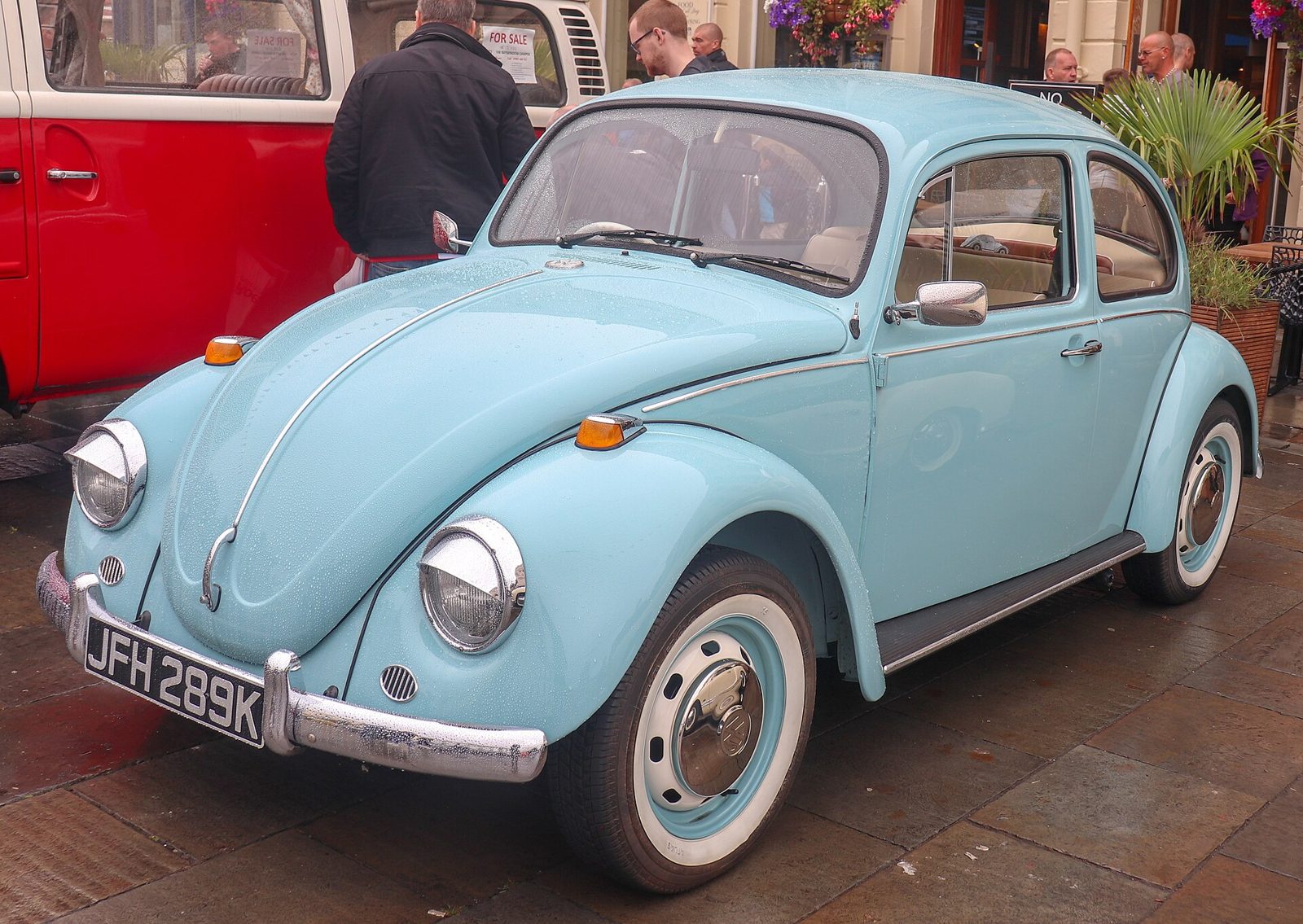
Structure comes first. The sills on a Beetle body are also the heater ducts, so the heater channels are both the strength of the body and a moisture trap for warm engine air; Hagerty names the bottoms of the heater channels and the area behind the front wheels as the usual rot points. Specialist guides add the floor pans, running boards, jacking points, the spare-tire well, bumper mounts, the area under the rear seat, the rain gutters and the rear body supports ahead of the driveshafts. Both windshields trap water, which is why the rear luggage tray is worth lifting. A door that drops when opened can mean worn hinge pins or rot at the lower hinge. On 1971 and later cars, rust bubbles on the C-pillars point to the expansion foam Volkswagen sprayed there, which holds moisture and rots the panel from inside. Super Beetles add strut top mounts, and 1972-1974 cars can show steering play when rusted inner fenders flex. On cost, owners on TheSamba reported in 2015 shop prices of $1,000 to $1,300 per side for heater channel and floor work with parts supplied, and one Maryland quote of $3,000 per side; those are forum figures, not a price guide. The year decides the mechanical package: swing axles on manual cars until the trailing-arm rear suspension became standard on North American cars for 1969, six-volt electrics until about 1967, the 1500 in 1967, and fuel injection from 1975. Convertibles built before 1972 have wooden sections in the top frame. Paint codes and original colors are not covered by the sources consulted here. Hagerty warns that budget replacement parts vary in quality, so the parts used in a restoration matter.
Market Notes
As of September 2026, classic.com gives an average price of $19,075 for its Type 1 Beetle market, which spans 1938 to 2003 and so includes non-US cars, and $18,780 across every Beetle generation including the New Beetle and the 2012-2019 car. Its lowest recorded Type 1 sale is $1,000 for a 1970 Beetle on November 13, 2025. The listing mix is informative. As of September 2026 classic.com showed 188 Type 1 cars for sale: 110 in its Beetle Coupe market, 18 in the early Beetle Convertible market (1938 to 1971), and 60 Super Beetles, of which 45 were convertibles and only 15 sedans. That skew fits Hagerty's observation that many Super Beetle sedans were scrapped as ordinary transport while convertibles were kept. classic.com did not return per-variant benchmark values or a trend reading to this research, so no split-window, oval-window or Super Beetle price is stated here. Hagerty's December 2022 buyer's guide ranks the Beetle as the 11th-most insured car in its book and the most popular non-American classic in the US, and reports convertibles as the more expensive body across the 1968-1979 cars. The top of the market sits outside ordinary cars: Volkswagen reports that one of the Herbie movie cars sold at auction for $128,700 in 2018. Bring a Trailer results were not retrievable for this draft and none are cited.
Where sources differ
Sources date several running changes differently, by a year or more: the arrival of the 1500, the switch from six-volt to twelve-volt electrics, the spare-tire-pressurized windshield washer, and rack-and-pinion steering on the 1303.
1500: Hagerty makes it the North American standard in 1967 and Petrolicious says it was offered in 1966 and 1967, while Wikipedia says it was introduced in September 1967. Twelve-volt: Petrolicious says six-volt was fitted until 1967, while Wikipedia dates the 1300's change to 1968 and the 1200's to 1969. Washer: Hagerty lists the spare-tire washer among the 1968 changes, while Wikipedia dates it to 1962. Rack-and-pinion: Petrolicious says the 1974-on 1303, Wikipedia says 1975. Some of this may be calendar year against model year, but no source consulted says so. Unresolved.
Published engine outputs differ by source: Hagerty gives 36 hp for the 1954 1200, 53 hp for the 1967 1500 and 60 hp for the Super Beetle 1600, while Wikipedia gives about 30 hp (30 PS), about 43 hp (44 PS) and about 49 hp (50 PS) for the equivalent European engines, and Petrolicious 50 hp for the 1302S.
Hagerty states 36 hp (1,192 cc), 53 hp (1,493 cc) and 60 hp (1,584 cc). Wikipedia states about 30 hp (30 PS), about 43 hp (44 PS) and about 49 hp (50 PS) for the same displacements, and Petrolicious states 50 hp for the 1,584 cc 1302S. The gap may reflect gross against net rating or US against European tune, but none of the sources says which standard it uses. Unresolved.
The Super Beetle added MacPherson strut front suspension and a larger front trunk; Hagerty says it was two inches longer than the standard car, while Wikipedia gives an overall length increase of 3.1 in (8 cm) for 1971.
Hagerty states the Super Beetle was two inches longer than the standard Type 1. Wikipedia states overall length increased by 3.1 in (8 cm) for 1971. Not resolved by any source consulted here.
The last air-cooled Beetle, built in 2003, came from Puebla, Mexico according to Hagerty and Wikipedia, but Volkswagen's own US heritage page places it in South America.
Volkswagen of America states the last air-cooled Beetle rolled off an assembly line in South America in 2003. Hagerty (2020 and 2022 articles) and Wikipedia place the final car at the Puebla plant in Mexico on July 30, 2003. Mexico is not in South America; the sources are not reconciled by any source consulted here. Unresolved.
Sources
- Celebrating 70 Years of VW in the US, Volkswagen of America · manufacturer
- A history of the Volkswagen Beetle, Volkswagen of America · manufacturer
- Celebrate the Iconic VW Beetle, Volkswagen of America · manufacturer
- 70 years after first Beetles arrived in the US, VWs live on as classics, memories, ClassicCars.com Journal · journalism
- Your handy 1949-79 Volkswagen Beetle buyer's guide, Hagerty · journalism
- 75 years ago, the beloved VW Beetle entered production, Hagerty · journalism
- Volkswagen Beetle, Wikipedia · encyclopedia
- Volkswagen Beetle Buying Guide, Petrolicious · journalism
- Vintage C/D Road Test Comparison: 1967 Renault 10 and VW 1500 - Renault's Last Shot At The Beetle, Curbside Classic · journalism
- Heater channel replacement cost, TheSamba.com forum · club-forum
- Volkswagen Beetle Market, classic.com · market-data
- Volkswagen Beetle - Type 1 Market, classic.com · market-data
Synthesized from the sources above and cross-checked. We cite and link out; we do not republish other databases verbatim.
Fully Sorted is an independent publisher and is not affiliated with, endorsed by or sponsored by Volkswagen. Volkswagen and the model names on this page are trademarks of their respective owners and are used here only to identify the cars being described.
Chassis register
Nobody has recorded a car here yet. Own one, or know one? Chassis number, what you can prove about it, and a source if there is one. Every entry is reviewed before it appears.
Nerd Notes
What owners know that the sources don't. Every note is read and checked before it appears here.
Key Specs
- Power
- From 25 hp (1,131 cc) to 60 hp (Super Beetle 1600) on Hagerty's figures; European ratings quoted by other sources are lower, see the disputed output claim
- Engine
- Air-cooled overhead-valve flat-four, 1,131 cc on the first US cars, growing through 1,192 cc (1954), 1,285 cc (1965), 1,493 cc (US standard for 1967) and 1,584 cc (Super Beetle)
- Layout
- Rear-mounted air-cooled flat-four, rear-wheel drive, two doors, seating for four
- Torque
- Not documented by the sources consulted here
- Weight
- Not documented by the sources consulted here
- Wheels
- 16 in (410 mm) wheels until 1952, then 15 in (380 mm)
- Chassis
- Nearly flat platform chassis with a central structural tunnel; the body is attached to it with eighteen bolts
- Steering
- Steering box, except rack-and-pinion on the late 1303 (dated 1974 by one source and 1975 by another)
- Electrical
- Six-volt, changing to twelve-volt around the 1967 and 1968 model years; sources date the change differently
- Fuel system
- Single carburetor; fuel injection on US cars from 1975
- Acceleration
- No period US test figure was retrievable for this draft; not stated
- Transmission
- Four-speed manual, fully synchronized from 1961; a three-speed semi-automatic was offered from 1968
- Rear suspension
- Swing axle; trailing-arm independent rear suspension on 1968 semi-automatic cars and on all North American Beetles from the following year
- Drag coefficient
- 0.48 (Wikipedia)
- Front suspension
- Torsion bars with double trailing arms; MacPherson struts on the Super Beetle from 1971
Notable Variants
Split-window sedan (US cars 1949 to March 1953)
The divided rear window of the first cars, replaced by a one-piece oval on March 10, 1953. Hagerty calls the split and oval cars the blue-chip Beetles and reports split-window values up some 300 percent over the decade to 2022.
Oval-window sedan (1953-1957)
One-piece oval rear window until the larger rectangular window of 1958. The 1,192 cc engine arrived in 1954 and North American cars lost their semaphore turn signals for flashing lamps in 1955, so the oval run straddles several identifying changes.
1967 1500
Hagerty makes the 1,493 cc 1500 the standard North American engine for 1967, the last year of the older body style. Sources disagree on when the 1500 and 12-volt electrics arrived, so a car's claimed year should be checked against its parts.
1968-1969 sedan
The 1968 restyle brought new bumpers, a collapsing steering column and an outside fuel filler. The trailing-arm independent rear suspension came first on 1968 semi-automatic cars and on every North American Beetle from the next year, which is the swing-axle dividing line.
Super Beetle sedan (1971 on)
MacPherson strut front suspension, a larger front trunk, a 1600 engine and larger brakes. From the 1973 model year the 1303 body added a curved windshield. Sold alongside the standard Beetle and preserved in smaller numbers.
Super Beetle convertible (to 1979)
The last Beetle sold new in the US, carried by convertible demand through an extended 1979 model year after German sedan production ended in January 1978. Hagerty notes convertibles were preserved in greater numbers and remain the dearer body.
Fuel-injected cars (1975-1979)
Hagerty dates fuel injection to 1975 and notes that few specialists understand it, so many owners replace it with carburetors. A car with the injection intact and working is the less common configuration.
Value Trajectory
The Beetle moved from used car to collector car late and quickly. Hagerty's December 2022 buyer's guide reports a price spike at the end of the 2010s, which it ties to the surge in air-cooled Porsche 911 values, with median condition-2 prices up 250 percent over the decade. Early split-window cars led, up some 300 percent over ten years, and Hagerty treats split and oval cars as the blue-chip Beetles. Later 1950s and early-to-mid 1960s cars rose more steadily, up 47 percent over three years. Among the 1968-1979 cars, condition-2 values rose 126 percent for convertibles and 155 percent for sedans over five years, though convertibles remained the dearer body. Boomers and Gen X accounted for about 70 percent of Hagerty's quotes, which is a question mark over the next generation of buyers. As of September 2026, classic.com shows a Type 1 average of $19,075 but returned no trend reading to this research, so whether the 2022 momentum has held is not established here. The sheer number built keeps ordinary later cars affordable; the scarcity is in early, original and correctly restored cars.
Next
Shopping for one?
Browse Volkswagen listings, or decode a VIN before you buy.