
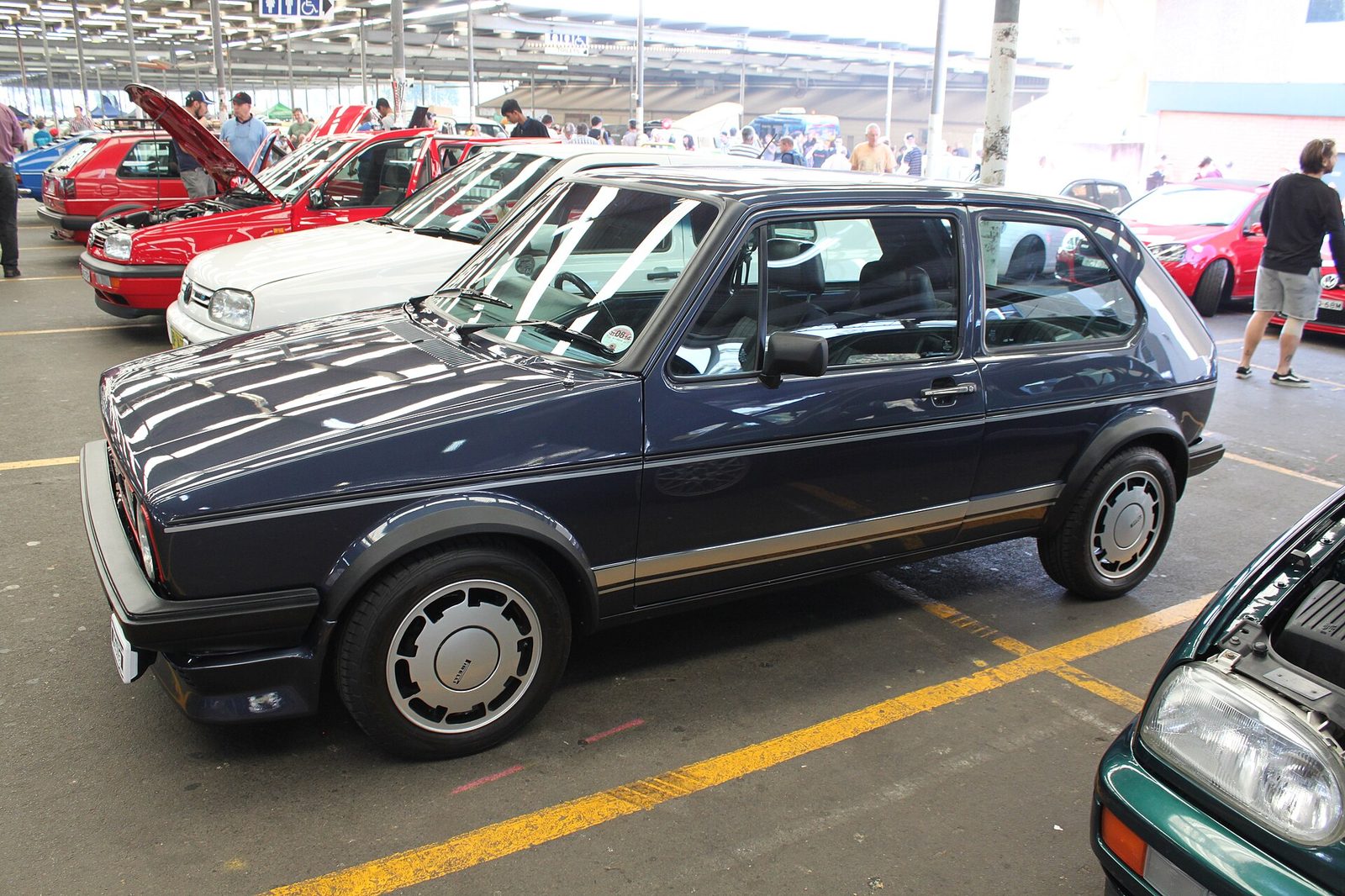
The Mk1 Golf GTI was not a product-plan car. It began around 1974 as an unofficial after-hours project by a small group at Wolfsburg - a test engineer, a press officer, a suspension man and a trim designer among them - working on a Scirocco mule under the name Sport Golf. Management sanctioned a homologation run of 5,000 cars, the number needed for Group 1 touring car eligibility, and Volkswagen built 461,690 hatchbacks instead. The recipe was the 1,588 cc Audi-derived EA827 four with Bosch K-Jetronic injection, 108 hp, a 0.39 in (10 mm) and 0.79 in (20 mm) suspension drop, tartan cloth seats and a gearknob molded like a golf ball. A 1,781 cc engine replaced it in August 1982. Britain had left-hand-drive cars only until 1979, the United States waited until the Westmoreland-built Rabbit GTI of 1983, and Karmann built a Cabriolet that outlived the hatchback by a decade.
Golf GTI
Mk1
History
An After-Hours Project at Wolfsburg
Volkswagen in the mid-1970s had no sporting reputation to defend and no budget line for building one. The Golf that replaced the Beetle was a rational, Giugiaro-drawn hatchback, and the idea of a fast version came not from the product plan but from employees working in their own time. Accounts name test engineer Alfons Loewenberg as the instigator, press chief Anton Konrad as the man who gave the project cover inside the company, and Herbert Schuster as the engineer who made the suspension work; Gunhild Liljequist, in trim, supplied the tartan cloth and the golf-ball gearknob. The working name was Sport Golf. The first mule was a Scirocco with a carbureted 1,588 cc engine and suspension stiff enough that senior management is said to have found it undriveable; the team softened it, substituted the Bosch K-Jetronic injected unit from the Audi 80 GTE, and demonstrated the result at Ehra-Lessien.
Five Thousand Cars
Approval, when it came, was for a homologation run: 5,000 cars, the number then required for Group 1 production touring car eligibility. The world premiere came at Frankfurt in September 1975 and German sales began in June 1976 at DM 13,850, against DM 11,420 for the 1.5-liter Golf GLS, and the GTI was not sold new in the US until the 1983 Rabbit GTI. Volkswagen's own history records the 5,000-car intention plainly, then records what happened: 10,366 cars in the first model year, 143,057 in the year the 1.6 and 1.8 overlapped, and 461,690 by the end of 1983.
Britain Waits Until 1979
British buyers could have a GTI from 1976 only in left-hand drive and only by special order. Motor Sport tested one in March 1977 and recorded 9.6 seconds to 60 mph and 108 mph against claims of 9.0 and 113. Twenty-two cars were sold in the United Kingdom in 1978. Right-hand-drive production followed in 1979 and the figure passed 1,500 in that year alone - a market created almost entirely by moving the steering wheel. The 1,781 cc DX engine arrived in August 1982, quoted at 110 hp but, more usefully, at 113 lb-ft at 3,500 rpm; Motor Sport's March 1983 test of the 1800 found it 1.8 seconds quicker from 50-70 mph in fifth. The run ended with the four-headlamp Campaign in Britain and the equivalent Pirelli, Trophy and 1800 Plus cars elsewhere.
Westmoreland and the Rabbit GTI
North America waited seven years. The injected 1,588 cc engine reached the US Rabbit in 1977 but at 78 hp after emissions work, and Volkswagen of America doubted that buyers who saw the Rabbit as economy transport would pay a sports-car premium for one. The Rabbit GTI that appeared for 1983 was not an import: it was assembled at Westmoreland, Pennsylvania, on 1.8 liters detuned to 90 hp SAE net, with recalibrated struts, stiffer springs, anti-roll bars at both ends, vented front discs and Pirelli P6 tires on 14-inch alloys, at around 8,000 dollars. It was slower than a European GTI and about 140 lb heavier, and it did more than any other car to establish the type in the United States.
Karmann's Cabriolet and the Question of Who Was First
Karmann took the Cabriolet from stamping to final assembly at Osnabrueck, giving it a reinforced shell and a fixed hoop above the B-pillar - the first car in its class with a permanently installed roll bar - and built it until April 1993, long after the hatchback had gone. Whether the GTI invented the hot hatch is less settled than the badge suggests: the Renault 5 Alpine reached buyers ahead of it, and the Simca 1100 Ti and Autobianchi A112 Abarth were earlier still. What the GTI did was survive, and continuity has made it the reference point against which the others are now described.
Common Problems
The EA827 is durable, and its wear is legible from the exhaust: hardened valve stem seals give a puff of blue smoke on start-up, worn guides show under acceleration, tired rings on the overrun. Radiators silt up with age, and cracked blocks are reported on 1,588 cc cars run low on coolant, so a temperature gauge that has never been trusted is itself a warning.
The Bosch K-Jetronic system is mechanical, long-lived and unforgiving of neglect, and it wants a specialist rather than a generalist. Fuel distributors, warm-up regulators, accumulators and injectors all deteriorate through long standing, and the symptoms - poor hot starting, hunting idle, uneven running under load - are frequently misdiagnosed as ignition faults. Fuel tanks and steel brake lines corrode on cars that have sat.
Gearboxes are otherwise reliable; check second-gear synchromesh specifically. Bushes and dampers are usually long past their life, and lowering springs fitted decades ago account for much of the uneven tire wear seen on these cars. The fusebox sits under the left of the dashboard, attracts damp and is the first place to look when the electrics misbehave, though on most survivors the real problem is forty years of aftermarket alarm and stereo wiring. Slow wipers and a brake pedal that wants a firm shove, particularly on right-hand-drive cars, are original characteristics. Interior trim is the hardest thing to replace.
What to Look For
Structure before everything. The inner front wings decide whether a car is worth pursuing: corrosion there is expensive, often hidden behind the arch liner on later cars, and buying guides on both sides of the Atlantic treat it as a walk-away. Work outwards to the A-pillar bases, the windshield and sunroof surrounds, the sills, the front valance seams, the wheel arches, the door bottoms, the fuel filler area, the spare wheel well and the floorpans. Cars built before the August 1980 changes had noticeably poorer factory protection; later ones gained wheel arch liners and better paint but no galvanizing.
Establish identity in documents rather than badges. The chassis prefix, the engine code - EG for the 1,588 cc car, DX for the 1,781 cc - and the interior trim code together confirm what a car left the factory as, and matter more than usual because GTI parts fit any Mk1 Golf. A Campaign should have the four-headlamp grille, the sunroof, the tinted glass and the 14-inch P-slot wheels together; a car with only some of them has been assembled rather than built.
Then judge how much of the car is still the car. Almost every survivor has been lowered, re-wheeled, re-trimmed or re-engined, and interior fabric is hard to source at any price. Check the cambelt record against the 40,000-mile or four-year interval, run the engine from cold and watch the exhaust on start-up, on acceleration and on the overrun, and treat a car that has stood as one needing fuel-system and brake work.
Market Notes
As of August 2026, classic.com's Volkswagen Golf GTI Mk1 market page shows a benchmark of approximately $19,695 on a downward trend, with an average recorded sale near $18,335 and tracked results running from $1,800 for a 1984 Rabbit GTI project in January 2024 to 29,900 euros for a 1983 Golf GTI Pirelli in July 2024. That spread is the story: condition and originality account for more of the price here than specification does. UK auction evidence sits at the upper end. A restored 1983 Campaign, black, right-hand drive, 150,618 miles and a documented 20,000-pound rebuild by a marque specialist, took an 18,000-pound hammer at the NEC Classic Motor Show Sale in November 2023, with buyer's premium charged on top of that. Sports Car Market recorded a 42,156-mile right-hand-drive 1981 1.6 at $23,281 including premium at Silverstone Auctions' Race Retro sale in February 2020, against an SCM valuation of $22,000. For the American car, Hagerty's US guidance places good-condition 1983 Rabbit GTIs below $12,000, excellent examples above $20,000 and concours cars near $35,000. Campaign and Pirelli run-out cars, unmodified tartan-trim early 1.6s and documented low-mileage examples carry the premiums; modified, re-shelled and undocumented cars trade well below the benchmark.
Where sources differ
Volkswagen sanctioned the project in 1975, but published accounts of when and by what route differ, and no source consulted here reconciles them.
Volkswagen's own GTI history states that board member Hermann Hablitzel took the project to chairman Toni Schmuecker in early March 1975 and that it was approved as development order EA195. Wikipedia dates management approval to 28 May 1975. Ate Up With Motor says May 1975 without naming a day. The three accounts are not resolved against one another by any source consulted here.
Published curb weights for the 1.6 GTI vary by roughly ninety kilograms and cannot be reconciled from the sources consulted here.
Volkswagen quotes a base weight of 1,786 lb and Wikipedia repeats it. Motor Sport's 1977 road test gives 15.9 cwt, about 1,781 lb. Auto motor und sport, weighing a car in 1976, recorded just under 1,984 lb as tested. None of the three states whether it is quoting dry, DIN unladen or as-tested weight, so the difference is not resolved here.
Published totals for the Westmoreland-built Rabbit GTI conflict, and no combined figure for the US car is asserted here.
Wikipedia and Hagerty Media both give approximately 30,000 Rabbit GTIs across the 1983 and 1984 model years. Curbside Classic estimates 15,000 to 20,000 US cars in 1983 alone, implying a materially higher two-year total. Neither figure is traced to Volkswagen of America production records in the material consulted, and the conflict is not resolved here.
Volkswagen's own accounts of the Karmann-built Golf I Cabriolet disagree on both its production total and the date production began.
Volkswagen's Golf I Cabriolet model page states production at Osnabrueck from 14 February 1979 and approximately 392,000 units to 1993. Volkswagen's own Cabriolet history page states a Geneva debut on 27 February 1979, production from June 1979 to April 1993 and 388,522 units. Two pages published by the same manufacturer give different totals and different start dates, and the difference is not resolved by any source consulted here.
The Golf GTI was not the first hot hatchback, and the claim that it was does not survive comparison with cars that reached buyers earlier.
Popular accounts, and much of Volkswagen's own marketing, treat the GTI as the first of the type. Hagerty UK dates the Renault 5 Alpine to the showroom two months ahead of it and adds the Alfasud ti of 1973, the Simca 1100 Ti of 1973 and the Autobianchi A112 Abarth of 1971. Ate Up With Motor accepts that the GTI defined the genre while stating it was not the first sporty family car. What counts as a hot hatch is definitional rather than factual, and it is not resolved here.
Sources
- 1983 Volkswagen Rabbit Price and MSRP, iSeeCars · market-data
- Golf I GTI (1976-1983), Volkswagen AG · manufacturer
- Golf GTI history, Volkswagen AG · manufacturer
- Golf I Cabriolet (1979-1993), Volkswagen AG · manufacturer
- History - Golf I, III and IV Cabriolet, Volkswagen AG · manufacturer
- Volkswagen Golf Mk1, Wikipedia · encyclopedia
- INFO GUIDE: 1976 - 1983 Volkswagen Golf MK1 GTI, Classic Register · specialist
- Volkswagen Golf GTI Mk1 buyer's guide: what to pay and what to look for, Classic & Sports Car · journalism
- Buying Guide: Volkswagen Golf GTI Mk1 (1976-1983), Hagerty UK · journalism
- Your Handy 1974-84 Volkswagen Golf/Rabbit Mk1 Buyer's Guide, Hagerty Media · journalism
- The Golf GTI, March 1977, Motor Sport · journalism
- The VW Golf GTI 1800, March 1983, Motor Sport · journalism
- Rabbit Rocket: The Volkswagen GTI and the Birth of the Hot Hatch, Ate Up With Motor · specialist
- Vintage AMS Review: 1976 Volkswagen Golf GTI, Curbside Classic · journalism
- Curbside Classic: 1983 Volkswagen Rabbit GTI - When Fun Hopped Across The Ocean, Curbside Classic · journalism
- Tested: 1983 VW Rabbit GTI Was Worth the Wait, Car and Driver (via Yahoo Autos) · journalism
- Volkswagen Golf GTI - Mk1 Market, classic.com · market-data
- 1981 Volkswagen Golf GTI Mk1, Sports Car Market · market-data
- 1983 Volkswagen Golf (Mk1) GTi Campaign, NEC Classic Motor Show Sale 2023, Iconic Auctioneers · auction-house
- 5 Contenders for the First Hot Hatch, Hagerty UK · journalism
Synthesized from the sources above and cross-checked. We cite and link out; we do not republish other databases verbatim.
Fully Sorted is an independent publisher and is not affiliated with, endorsed by or sponsored by Volkswagen. Volkswagen and the model names on this page are trademarks of their respective owners and are used here only to identify the cars being described.
Chassis register
Nobody has recorded a car here yet. Own one, or know one? Chassis number, what you can prove about it, and a source if there is one. Every entry is reviewed before it appears.
Nerd Notes
What owners know that the sources don't. Every note is read and checked before it appears here.
Key Specs
- Power
- 108 hp at 6,100 rpm (1.6) and 110 hp at 5,800 rpm (1.8), both manufacturer figures; 90 hp SAE net at 5,500 rpm for the US Rabbit GTI
- Brakes
- Ventilated front discs and rear drums; unassisted pedal effort was a common complaint, particularly on right-hand-drive cars
- Engine
- 1,588 cc EA827 SOHC four (1976-1982); 1,781 cc EA827 SOHC four (1982-1983); Bosch K-Jetronic on both
- Layout
- Transverse front engine, front-wheel drive
- Torque
- 103 lb-ft at 5,000 rpm (1.6); 109 lb-ft at 3,500 rpm (1.8)
- Weight
- 1,786 lb quoted by Volkswagen; independently recorded figures run higher and are not reconciled - see the disputed claim
- Chassis
- Unitary steel monocoque, Type 17; Cabriolet (Type 155) with reinforced structure and fixed roll-over bar
- Steering
- Rack and pinion, unassisted, 3.3 turns lock to lock
- Top speed
- 113 mph claimed for the 1.6; 108 mph recorded by Motor Sport in 1977 and around 115 mph estimated for the 1.8
- Suspension
- MacPherson struts front, torsion-beam rear axle; ride height lowered 0.39 in (10 mm) front and 0.79 in (20 mm) rear against the standard Golf, with stiffer anti-roll bars
- Bore stroke
- 79.5 x 80.0 mm (1.6); 81.0 x 86.4 mm (1.8)
- Compression
- 9.5:1 (1.6); 10.0:1 (1.8)
- Acceleration
- 0-62 mph in 9.2 s claimed for the 1.6; 9.6 s to 60 mph recorded by Motor Sport in March 1977; approximately 8 s to 60 mph for the 1.8
- Transmission
- Four-speed close-ratio manual on early cars, five-speed manual thereafter; 3.89:1 final drive on the 1.6, 3.65:1 on the 1.8
- Wheels tires
- 13-inch steel or alloy with 175/70 HR 13 at launch; 14-inch Pirelli P-slot alloys with 185/60 HR 14 on the Campaign and Pirelli editions
Notable Variants
GTI 1.6 (engine code EG, 1976-1982)
The founding specification: 1,588 cc, 108 hp, four speeds until 1979 and five after. Early cars carry the black-red or black-silver tartan that later stripe-trimmed cars lost, and pre-August 1978 cars have slim metal bumpers.
GTI 1.8 (engine code DX, August 1982-December 1983)
1,781 cc, 110 hp at 5,800 rpm but 113 lb-ft at 3,500 rpm, with a longer 3.65:1 final drive. Slower-revving and much easier to drive; period testing found it seconds quicker over fifth-gear increments than the 1.6.
Campaign (United Kingdom, 1983)
The UK run-out car, around 1,000 built and three-door only: four-headlamp grille with fog lights, 14-inch Pirelli P-slot alloys, factory sunroof, green tinted glass, matt-black A-pillars and a leather-rimmed wheel. Mechanically a standard 1.8.
Pirelli / Trophy / 1800 Plus (Continental Europe, May-October 1983)
The same run-out package under local names - Pirelli in Germany, Trophy in Switzerland, 1800 Plus in France. Volkswagen puts the special-model run at 10,500 cars in six months; the P-slot wheel is the identifying detail.
Rabbit GTI (United States, 1983-1984 model years)
Built at Westmoreland, Pennsylvania rather than imported. 1.8 liters detuned to 90 hp SAE net, about 2,100 lb, P185/60HR-14 Pirelli P6 on 14x6 alloys, vented front discs and a German close-ratio five-speed. Softer in output, broader in torque, and the car that made the badge matter in North America.
Golf Cabriolet GLi (Type 155, from 1979)
Karmann-built at Osnabrueck with a reinforced shell and a fixed hoop above the B-pillar, launched with the 108 hp 1.6 and given the 110 hp 1.8 in 1982. Heavier than the hatchback and never as sharp, but it outlived it by a decade.
GTI 16S Oettinger (France, from 1981)
A twin-cam 16-valve head on the 1.6, engineered by Oettinger and sold through French Volkswagen dealers. Not a Wolfsburg product and excluded from the factory count; genuine cars need documentation rather than assertion.
Five-door GTI (December 1981-June 1982)
A short European-only run of the four-door bodyshell in GTI specification, offered for roughly six months. Uncommon, and of interest mainly to owners who need the car to work as family transport.
Value Trajectory
For most of its life the Mk1 GTI was a cheap car, used and modified accordingly, which is why sound original examples are now scarce out of proportion to the 461,690 built. Values began separating in the 2010s as the cars aged into UK historic vehicle tax exemption. By February 2020 a preserved 42,156-mile right-hand-drive 1.6 made $23,281 with premium at Silverstone Auctions, a figure Sports Car Market treated as sensibly bought rather than exceptional, and UK results have since settled in the high teens of thousands of pounds at hammer for restored cars. As of August 2026 the classic.com benchmark of roughly $19,695 is trending downward, which is worth reading carefully: the index blends European hatchbacks with the cheaper American Rabbit GTI, and the softness sits at the project and modified end rather than in documented original cars. The gap between a rust-free, unmodified, well-papered car and a tidy-looking rebuilt one is set by the shell rather than the engine.
Next
Shopping for one?
Browse Volkswagen listings, or decode a VIN before you buy.