
The Volkswagen Type 2 is the forward-control van Volkswagen built on Beetle mechanicals, traced to a sketch Dutch importer Ben Pon made on 23 April 1947 after seeing a works Plattenwagen parts-mover at Wolfsburg. Because the Type 1 floorpan was not stiff enough on its own, the production vehicle used a unitary body-chassis, which is why corrosion in its floors, rails and outriggers is structural rather than cosmetic. Series production began on 8 March 1950 and moved to Hanover in 1956. The split-screen T1 ran to 1967 in more than 1.8 million units across Panel Van, Kombi, Microbus, Microbus Deluxe (Samba) and single- and double-cab pickup bodies; the one-piece-windshield T2 bay window followed for the 1968 model year and ran to 1979 in Germany, with Brazilian assembly continuing until 31 December 2013. Values are led by pre-1964 23-window Sambas and barndoors, and the market is heavily populated with re-creations.
Type 2
T1 Split-Screen / T2 Bay Window
History
Ben Pon's Sketch and the Type 1 Platform
The Type 2 began with Dutch Volkswagen importer Ben Pon, who visited Wolfsburg to arrange Beetle imports and saw the factory's improvised Plattenwagen, a flat parts-mover built on Beetle running gear with the driver perched over the engine at the rear. That layout could not be road-registered. On 23 April 1947 Pon sketched an enclosed box with the driver moved to the front and a payload of around 1,521 lb; the drawing is now held by the Rijksmuseum. Volkswagen developed the idea between 1947 and 1949 under the internal designation Type 29. The Type 1 floorpan was found to lack the rigidity required to carry a load-bearing van body, so the production vehicle adopted a unitary body-chassis with the frame rails and outriggers built into the structure. Prototypes were shown in 1949 and series production started on 8 March 1950 at Wolfsburg, transferring to a dedicated Hanover plant in 1956.
Body Codes: What Buyers Are Actually Searching For
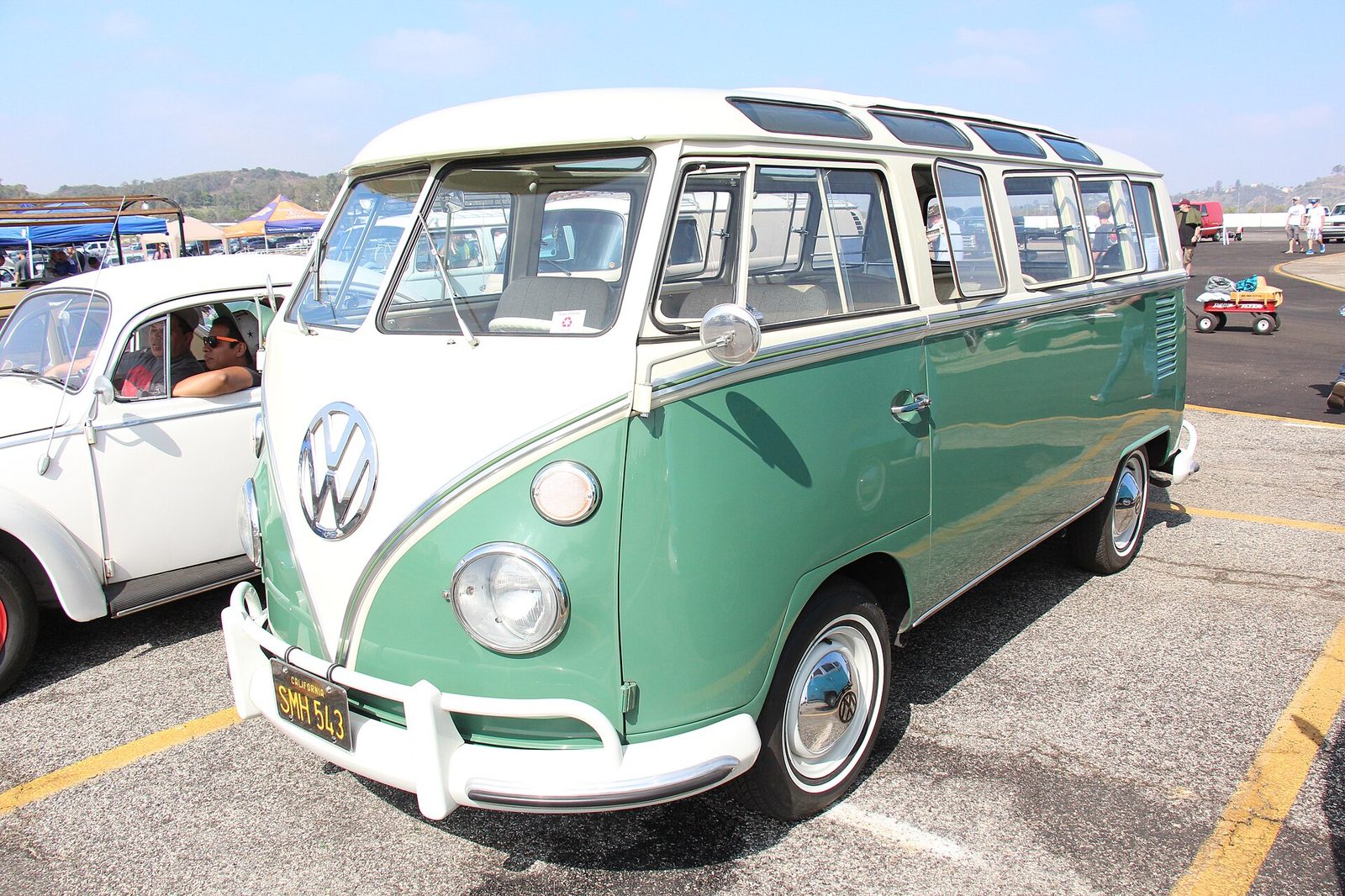
The Type 2 was sold as a range of bodies rather than trim levels, and those body names still drive the market. The Panel Van (Kastenwagen) was the windowless commercial; the Kombi added side windows and removable bench seats; the Microbus was the fully trimmed passenger bus. Above them sat the Microbus Deluxe, universally called the Samba, introduced in June 1951 with eight skylight windows set into the roof around a full-length folding canvas sunroof, extra brightwork and a full-width dashboard. Counting four side windows per side, the windshield halves, the cab door glass, the skylights and two curved rear corner windows gives the celebrated 23-window figure. From around August 1963, for the 1964 model year, the rear corner windows were deleted in favor of a single larger rear screen, so every Samba built afterwards is a 21-window. A genuine 23-window is therefore a pre-1964 car by definition, which is the whole reason the configuration commands the largest premium in the air-cooled Volkswagen world. Deluxe buses specified without the roof glass and sunroof are the 15-window and later 13-window cars. Work bodies included the single-cab dropside pickup with its lockable under-bed locker and the six-seat double cab, plus ambulances and Westfalia-trimmed campers.
Split to Bay, 1967
European split-screen production ended after the 1967 model year. Its replacement, the T2 bay window, arrived for the 1968 model year with a one-piece curved windshield, a body roughly 22.5 cm longer, a sliding side door as standard and a substantially better chassis: the swing axles and hub reduction boxes gave way to a double-jointed independent rear end using constant-velocity joints. The 1.6-liter flat-four became twin-port for 1971, the same year front disc brakes arrived, and larger Type 4 engines followed from 1972 in 1.7-, 1.8- and eventually 2.0-liter form, with Bosch L-Jetronic injection on US cars from 1975. Enthusiasts split the run into the early or 'lowlight' bay to 1971, a one-year 1972 crossover, and the late bay from 1973 with its large Europa bumpers. German production ended in 1979.
Brazil, and the Long Tail
Production outlived Germany by decades. Brazilian assembly started on 2 September 1957 and did not stop until 31 December 2013, by which time more than 1.5 million had been built there. Brazil kept the split-screen body in production until 1975, long after Europe had moved on, then built the bay window air-cooled until roughly 2005 and water-cooled thereafter. The end came not from demand but from new Brazilian safety regulation requiring airbags and anti-lock brakes, which the unitary 1950s structure could not economically meet. The final 600 vehicles were sold as a numbered Last Edition. This long tail matters to buyers in two ways: it produced a large supply of later, cheaper, non-German vehicles, and it made donor panels and complete overseas shells readily available to the restoration trade.
Common Problems
Structural corrosion is the dominant issue and the dominant cost, since labor on rails, outriggers, jacking points, sills and floors routinely exceeds the price of the panels. Battery trays and rear corners rot from leaking batteries even on otherwise clean vehicles, and blocked gutter drains take out the roof edges. Mechanically the air-cooled flat-four leaks: oil at the engine-to-gearbox joint points to a failed rear main seal, and wet pushrod tubes mean perished seals. Excessive crankshaft end float, felt as movement at the pulley, signals bearing wear and a rebuild. Blue smoke indicates worn bores and rings; the 1.6 is commonly quoted as needing a rebuild around 60,000 miles. Gearboxes jump out of gear, typically fourth or reverse, and crunch on worn synchromesh. Brakes pull under load from sticking calipers or hoses that have collapsed internally. Two safety items recur: heat exchangers corrode and can feed exhaust fumes into the cabin through the heating system, and old cotton-braided fuel hose perishes and leaks gasoline over a hot engine. Early split-screens also demand far more maintenance than later vehicles, with chassis greasing intervals as short as around 1,200 miles.
What to Look For
Treat the structure first and everything else second. This is a unitary vehicle, so the chassis rails, outriggers, jacking points, cross members and heater tubes are the vehicle, and specialist guides name them as the main offenders. Get it on a lift with a torch. Check the floors, particularly where dried window seals have let water into the cab and cargo area, and the inner as well as outer sills; the sill on the cargo-door side is almost always the worse of the two. A line of paint bubbles at the rear corner usually means the battery tray beneath has rotted through. Also check the front valance behind the bumper, the roof gutters and their blocked drain holes, the leading edge of the roof, the panel below the windshield, wheel arches and door bottoms. Carry a magnet and use it. Be actively suspicious of a very shiny vehicle: specialist buyers' guides advise that an honest, tatty, unrestored bus is often the safer purchase than a cosmetically restored one hiding substandard repairs, and that a restoration without bare-metal photographs from the process is not a documented restoration. On any Samba, verify authenticity through documents and chassis number rather than window count, since a standard Microbus roof can be cut and glazed to Samba specification and the market prices re-creations far below genuine cars. Check the chassis number to establish German versus overseas origin: Brazilian and South African CKD assembly continued after 1967 and those vehicles, sometimes sold as 'Fleetlines', are worth less and frequently mix components from several model years. Confirm the claimed year matches the configuration - 23-window means pre-1964, barndoor means before March 1955, disc brakes and twin-port mean 1971 or later.
Market Notes
Values are led decisively by the split-screen, and within it by the Samba. As of August 2026, classic.com carried a T1 Samba market benchmark of roughly $90,700 with an average sale near $96,000 and a benchmark trend arrow pointing down, on a thin pool of around six live listings; recent results spanned roughly $26,500 for a project to about $159,900 for a strong original. The wider T1 market averaged around $52,900, with a Panel Van benchmark near $31,900. Bay windows are an order cheaper: the T2 market averaged around $22,200, with benchmarks around $18,300 for a single cab, $23,200 for a double cab, $17,200 for a panel van and about $42,000 for a Deluxe Microbus. The clone question shows up directly in the data, because classic.com maintains a separate Samba Re-Creation market for converted Microbuses; as of August 2026 that market held around 21 listings against roughly five genuine Sambas, at an average sale of about $55,200 - a very large discount to genuine-Samba money. Auction ceilings were set in an earlier cycle: Hagerty's Type 2 valuation feature (undated, citing results through 2020) records $302,500 for a modified 1965 21-window Deluxe at Barrett-Jackson Scottsdale in 2017, $291,500 for an unmodified restored 1961 23-window at Barrett-Jackson Palm Beach in 2017, and $161,700 for a 1967 double-cab pickup at Scottsdale in 2020. The same source, using its own condition ladder, put a 1951 23-window Samba at $198,000 in #1 concours condition, $111,000 in #2 excellent, $60,600 in #3 good and $39,000 in #4 fair, and noted a 21-window in #2 condition worth about 16 percent less than a 23-window, with a 15-window a further 42 percent below the 21-window.
Where sources differ
Mexican assembly of the Type 2 continued after German production ended, but the dates are reported inconsistently and no figure is asserted here.
Volkswagen's own anniversary release states the Puebla plant built the T2 until 1987. Heritage Parts Center states Mexican production ran to 1996 followed by imported Brazilian vehicles to 2001. Wikipedia states Puebla built Combi and Panel variants until 1994 with imported Brazilian vehicles to 2002. The three cannot be reconciled from the available sources, so no Mexican production date is asserted.
Sources
- 75 years of the VW Bus - Volkswagen Commercial Vehicles is celebrating the birthday of its biggest icon, Volkswagen Commercial Vehicles (press release, via Automotive World) · manufacturer
- The Volkswagen Type 2 at 75, Hagerty UK · journalism
- 1950-67 Volkswagen bus values continue to impress, Hagerty · journalism
- 1950-1979 Volkswagen Type 2 Splitscreen and Bay Window, Magneto · journalism
- Goodbye, T2: Volkswagen to end Brazilian Kombi production, Classic Driver · journalism
- Volkswagen Type 2, Wikipedia · encyclopedia
- BenPon.nl - History, Pon (Ben Pon family/company site) · manufacturer
- The History of The VW Samba Splitscreen Bus, Cool Air VW · specialist
- VW Split Bus Buying Guide, Heritage Parts Centre · specialist
- Volkswagen T2 Split Buyer's Guide, Just Kampers Insurance · specialist
- The History of the VW Bay Window Type 2, Heritage Parts Centre · specialist
- VW Type 2 Bay Bus Buying Guide, Heritage Parts Centre · specialist
- Volkswagen Type 2 Buying Guide, Petrolicious · journalism
- Volkswagen Type 2 Samba - T1 Market, classic.com · market-data
- Volkswagen Type 2 Samba Re-Creation - T1 Market, classic.com · market-data
- Volkswagen Type 2 - T1 Market, classic.com · market-data
- Volkswagen Type 2 - T2 Market, classic.com · market-data
Synthesized from the sources above and cross-checked. We cite and link out; we do not republish other databases verbatim.
Fully Sorted is an independent publisher and is not affiliated with, endorsed by or sponsored by Volkswagen. Volkswagen and the model names on this page are trademarks of their respective owners and are used here only to identify the cars being described.
Chassis register
Nobody has recorded a car here yet. Own one, or know one? Chassis number, what you can prove about it, and a source if there is one. Every entry is reviewed before it appears.
Nerd Notes
What owners know that the sources don't. Every note is read and checked before it appears here.
Key Specs
- Layout
- Rear-mounted air-cooled flat-four, rear-wheel drive, forward-control (cab-over) layout
- Origin
- Derived from the Type 1 (Beetle) running gear; the stock Type 1 floorpan proved insufficiently rigid, so a unit-body structure was developed for the Type 29 prototype
- Brakes t1
- Drums front and rear
- Brakes t2
- Drums to 1970; front discs from 1971
- Engine t1
- 1.1L (1,131 cc) at launch, growing through 1.2L and 1.5L during the 1950s and 1960s
- Fuel system
- Solex carburetors throughout; Bosch L-Jetronic fuel injection on US-market Type 4 engines from 1975
- Construction
- Unitary body-chassis with integrated longitudinal rails, outriggers and cross members; no separate frame
- Transmission
- 4-speed manual; 3-speed automatic optional on later bay-window models
- Samba glazing
- 23 windows to the 1964 model year; 21 windows thereafter, the two rear corner windows deleted in favor of a larger rear screen
- T2 dimensions
- Bay-window body approximately 22.5 cm longer than the split-screen
- Engine t2 1971
- 1.6L twin-port air-cooled flat-four, approx. 50 hp
- Engine t2 early
- 1.6L (1,584 cc) single-port air-cooled flat-four from the 1968 model year
- Engine t2 type4
- 1.7L (approx. 65 hp) from 1972, 1.8L from 1974, 2.0L (approx. 69 hp) from 1976
- Rear suspension t1
- Swing axles with reduction gearboxes at the hubs
- Rear suspension t2
- Double-jointed independent rear suspension with constant-velocity joints; reduction boxes deleted
Notable Variants
Barndoor (T1a)
1950 to March 1955 cars, named retrospectively for the very large rear engine lid and the absence of a tailgate. The most valuable and most heavily restored split-screens.
Panel Van (Kastenwagen)
Windowless commercial body. Cheapest entry point into a split-screen; classic.com carried a T1 Panel Van benchmark of roughly $31,900 as of August 2026.
Kombi
Windowed body with removable bench seats, sold as a dual-purpose van. The name later became the generic Brazilian term for the whole model.
Microbus
Fully trimmed passenger body with fixed seating and a finished interior; the standard-roof, standard-glass passenger bus.
Microbus Deluxe / Samba
Top passenger model from June 1951: eight roof skylights around a full-length folding canvas sunroof, extra brightwork and a full-width dashboard. 23 windows to the 1964 model year, 21 thereafter. The most valuable configuration and the most widely faked.
Single Cab Pickup (Pritschenwagen)
Dropside pickup with a lockable treasure-chest locker under the load bed.
Double Cab Pickup (Doka)
Six-seat crew-cab pickup, scarcer than the single cab. A 1967 example set a $161,700 auction result at Barrett-Jackson Scottsdale in 2020.
Westfalia camper
Factory-approved camping interiors offered across T1 and T2. Camper conversions remain the most sought-after bay-window configuration.
Early Bay (T2a, 1968-1971)
Low front indicators, small rear lamps, rounded bumpers and half-moon rear vents. The collectible end of the bay-window range.
Late Bay (T2b, 1973-1979)
Large 'Europa' bumpers, square rear vents and the larger Type 4 engines. The cheapest and most usable way into an air-cooled bus.
Value Trajectory
The split-screen bus completed the transition from cheap counterculture transport to established collectible during the 2010s, with Hagerty reporting Type 2 median condition-#2 values up 9 percent year on year and 46 percent over five years at the time of writing, and the 23-window up 73 percent over the same five-year window. Auction ceilings were set in 2017 and have not been beaten since, and as of August 2026 classic.com's T1 Samba benchmark of roughly $90,700 carried a declining trend arrow, which suggests the top of the market has cooled from its peak rather than continuing to climb. Bay windows remain far cheaper and have not repeated that run; early lowlight bays and camper conversions hold the strongest values within the generation, while late bays remain the accessible entry point. Two structural factors should temper any appreciation assumption: the enormous supply of overseas-built and overseas-restored vehicles, and the fact that re-creation Sambas trade at roughly half genuine-Samba money, meaning provenance and documentation now account for more of the price than the vehicle itself.
Next
Shopping for one?
Browse Volkswagen listings, or decode a VIN before you buy.