
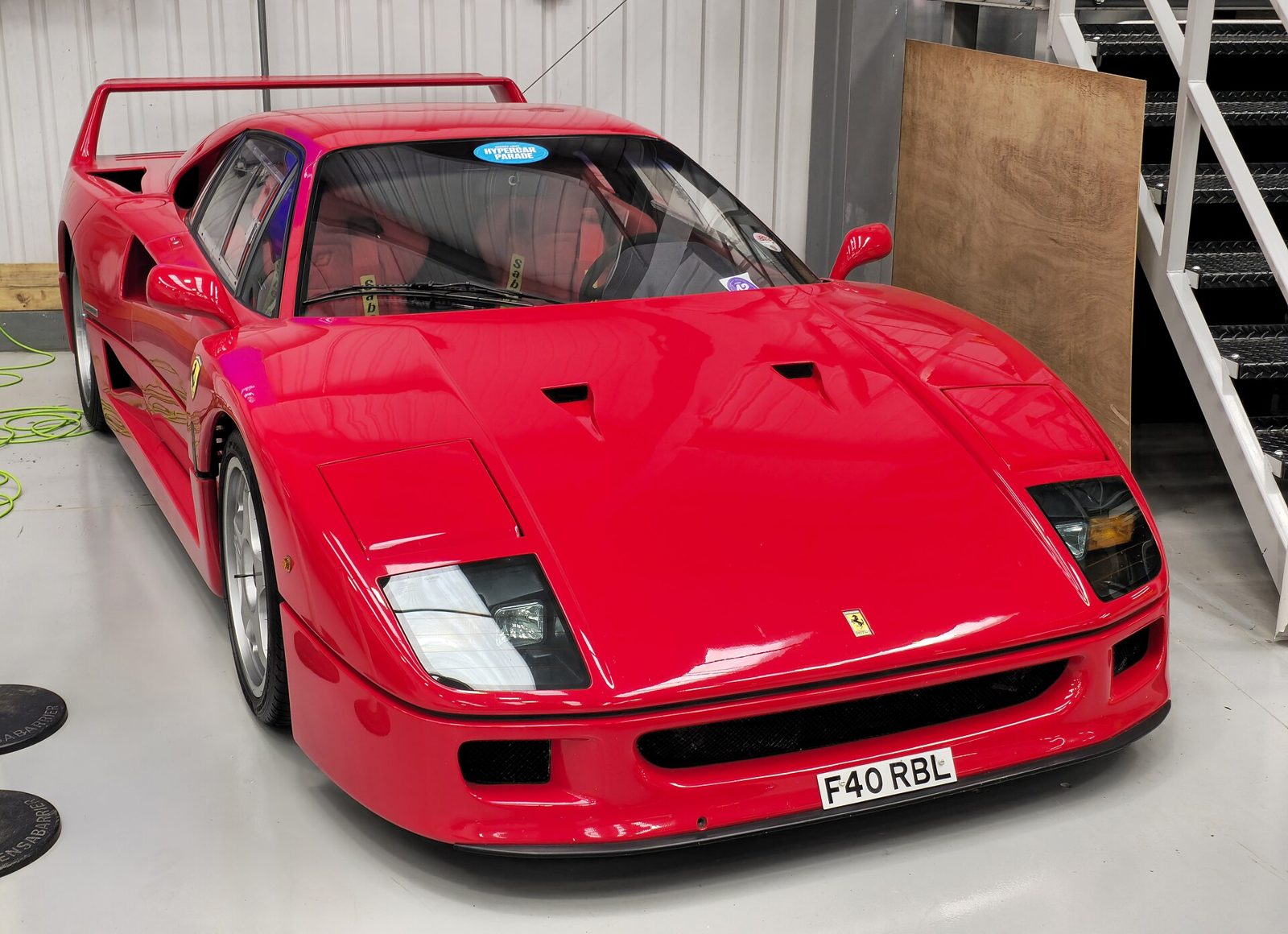
The Ferrari F40 (1987-1992) was built to mark the marque's fortieth year and was the last new model Enzo Ferrari personally approved and presented before his death in August 1988. It descended directly from the stillborn 288 GTO Evoluzione, the Group B program abandoned when the FIA canceled the category, and carried that car's engineering into a road-legal berlinetta developed in under a year. A 2,936 cc twin-turbocharged V8 producing a claimed 478 hp sat in a tubular steel spaceframe clothed in Kevlar, carbon fiber and aluminum; inside there were no carpets, no door trim, no stereo and, on the first cars, sliding Lexan windows. Ferrari claimed 201 mph, a figure independent testers never quite matched. Around 400 cars were planned and roughly three times that many built, 213 of them federalized for the United States. The car became the emblem of the late-1980s speculative supercar bubble, changing hands at many times list before the market collapsed, and remains a benchmark analogue Ferrari today.
History
The Fortieth-Anniversary Brief
Ferrari turned forty as a car manufacturer in 1987, and the F40 - F for Ferrari, 40 for the anniversary - was the commemoration. Ferrari's own account is that Enzo Ferrari granted the development team an unusual degree of latitude, and that the finished car was the last new model presentation he attended before his death in August 1988. The nuance matters: the F40 was signed off and shown while Enzo was alive, and production continued for four years after he had gone. Development took less than a year, which is visible in the car's directness and in the shortcuts taken with trim and refinement.
Group B Inheritance
The F40 is not a clean-sheet design but the surviving output of a canceled racing program. The 288 GTO had been homologated for Group B; when the FIA abandoned the category for 1986, Ferrari was left holding a handful of 288 GTO Evoluzione development cars with nowhere to race. Rather than write off the work, the engineering was redirected into a road car, and the F40 took both its mechanical philosophy and a good deal of its shape from the Evoluzione. The engine is the clearest evidence: an enlarged, more heavily boosted version of the GTO's twin-turbocharged V8, at 2,936 cc with twin IHI turbochargers, Behr intercoolers and Weber-Marelli engine management.
Construction and Deliberate Deprivation
A tubular steel spaceframe carried bonded composite panels in Kevlar, carbon fiber and aluminum; the doors, hood and trunk lid were carbon fiber. Ferrari quotes 2,756 lb dry. The interior was stripped to a degree that no manufacturer would attempt today: no carpets, no door panels, no glovebox, no sound system, no conventional door handles, and on the first cars sliding Lexan side windows in place of glass. Air conditioning was fitted, in a limited form. Ferrari claimed 201 mph and presented the car as the first road Ferrari past 200; independent measurement was less generous, with period tests recording figures in the 196-199 mph range and neither of Ferrari's two cars exceeding 199 mph at the Nardo comparison against the Porsche 959 and Ruf CTR. The claim is a manufacturer claim, and should be read as one.
Four Hundred Planned, Three Times That Built
The original plan was for roughly 400 cars. Demand made a nonsense of that, and the run continued until 1992 at somewhere between 1,311 and 1,315 units depending on which source is consulted. Two specification changes divide the run for collectors: catalytic converters and an optional hydraulically adjustable ride height, both arriving in 1991, which is why 'non-cat, non-adjust' has become auction shorthand. The 213 US federalized cars carried reinforced structure, heavier bumpers, side impact bars and automatic belts, with a corresponding performance penalty, and used aluminum fuel tanks rather than the rubber cells fitted elsewhere. In parallel, Michelotto built a small series of competition cars - LM, then Competizione, later GT and GTE - which raced in IMSA GTO and European GT categories with modest success and are now valued far above the road cars.
Bubble, Crash and Rehabilitation
The F40 arrived at the peak of the late-1980s classic and supercar speculation. Cars were traded rather than driven; contemporary reporting suggested prices reached several times the roughly US$400,000 list by 1989, that a Nigel Mansell car made around one million pounds in 1990, and that by that year only about a tenth of delivered F40s were being used as cars at all. The market then collapsed, taking F40 values down with it and leaving a generation of owners badly burned. That episode is directly relevant to how the car is read now: the current market treats mileage, originality and unbroken history with unusual seriousness, in part because so many early cars were stored rather than run, and storage does its own damage.
Common Problems
The engine itself has a strong reputation and the turbochargers are generally reliable unless the car has been tracked, but oil leaks from the cam covers and turbo cooling pipework are routine. The rubber fuel cells are the defining maintenance liability: replacement is recommended every ten years, factory bladders are among the most expensive consumables on the car, and a degraded cell is a fire risk as well as a running problem, which is why aftermarket alloy tank conversions are widely fitted. US cars, which used aluminum tanks from new, avoid this. The cam-belt service is short-interval and labor-heavy. Brakes are widely described as the car's weakest area, and many track cars have been upgraded away from standard. The five-speed gearbox is reliable, though clutch replacement is labor-heavy. The engine cover is prone to stress fractures. Air conditioning was weak when new and often does not work now. Interior trim is expensive and slow to source through Ferrari. On adjustable-suspension cars the hydraulic front lift system is an additional wear item.
What to Look For
Documentation first. Ferrari Classiche certification verifies the original chassis and matching engine, transaxle and bodywork, and Ferrari issues a Certificate of Authenticity signed by Piero Ferrari; its presence or absence moves money on this car. Establish the fuel cell history in writing - the factory rubber bladders carry a ten-year replacement recommendation and a car with no record of replacement should be assumed to need it. Confirm the cam-belt service is current; the interval is short, quoted at around two years regardless of mileage, and an engine-out service is expensive. Establish the specification precisely and check it matches the claimed year: non-catalyzed versus catalyzed, fixed versus adjustable suspension, sliding Lexan versus wind-down windows, European versus US federalized. Inspect paintwork closely, as almost every car other than the very lowest-mileage examples has been resprayed at some point, and check headlight covers and the nose for stone chipping as evidence of real use. Look for stress cracking around the engine cover. Verify the air conditioning works, since it was marginal when new. Confirm mileage against service records and independent history rather than the odometer alone. Long-term static storage is not automatically a virtue: perished rubber, fuel system contamination and seized components are common in cars that sat.
Market Notes
As of August 2026, classic.com's Ferrari F40 market benchmark stands at approximately $3.59 million with an average recorded sale around $3.05 million, on a rising trend, with tracked results spanning roughly $1.41 million (November 2022) to $8.365 million. Recent auction evidence supports that spread and shows how sharply specification and provenance separate cars. RM Sotheby's sold a European-market non-cat, non-adjustable example with approximately 224 miles from new for $3,855,000 at Monterey in August 2025, and a Ferrari Classiche-certified US-specification car showing 3,435 miles for $3,580,000 at Miami in 2025. At the top of the range, a US-market car delivered new to Lee Iacocca and showing 320 miles achieved $8,365,000 at RM Sotheby's Monterey in August 2026 - an outlier driven by named ownership and near-zero mileage rather than by specification alone. Competition cars occupy a different market entirely: a 1993 F40 LM by Michelotto realized $11,005,000 at Monterey in 2025. Premiums attach to pre-1991 non-catalyzed cars, fixed-height suspension, the earliest sliding-window examples, documented low mileage and Ferrari Classiche certification; repainted, heavily driven, track-modified or poorly documented cars sit materially below benchmark.
Where sources differ
Production was originally planned at around 400 cars and expanded to roughly three times that as demand escalated, running until 1992; total road-car production is stated as either 1,311 or 1,315 cars depending on the source, and no single figure is asserted here.
Ferrari's own model page (with chassis range 76624-95317) and Supercar Nostalgia both state 1,311. RM Sotheby's catalog entries, Auto Express and classic.com all state 1,315. The discrepancy is not explained by any source consulted, so productionTotal is left null.
Michelotto prepared a small series of competition F40s - LM, then Competizione, later GT and GTE - with the LM commissioned by French importer Charles Pozzi for IMSA GTO and commonly cited at 19 cars, though published counts for the racing variants differ substantially.
RM Sotheby's and Supercar Nostalgia both state 19 Michelotto-built LMs. Wikipedia describes 19 race cars in total across LM, Competizione and GTE. Rosso Automobili gives 46 LM (19 Michelotto plus 27 private), 8 Competizione, 7 GT and 7 GTE. These are not reconcilable from public sources; no variant total is asserted.
Sources
- Ferrari F40 (1987), Ferrari S.p.A. · manufacturer
- Lasting Legacy: The Ferrari F40, Ferrari S.p.A. · manufacturer
- Ferrari F40, Wikipedia · encyclopedia
- Ferrari F40 Guide, Supercar Nostalgia · specialist
- Ferrari F40: Buying guide and review (1987-1992), Auto Express · journalism
- Ferrari F40 Market, classic.com · market-data
- 1991 Ferrari F40, The Monterey Auction 2026, RM Sotheby's · auction-house
- 1990 Ferrari F40, Monterey 2025, RM Sotheby's · auction-house
- 1991 Ferrari F40, Miami 2025, RM Sotheby's · auction-house
- 1993 Ferrari F40 LM by Michelotto, Monterey 2025, RM Sotheby's · auction-house
- One to Buy: last of 19 built 1994 Ferrari F40 LM, Supercar Nostalgia · specialist
- What's The Difference Between All The Ferrari F40 Race Cars?, Rosso Automobili · journalism
- Ferrari F40 fuel tank replacement, GTO Engineering · specialist
- Ferrari Classiche: Certification, Ferrari S.p.A. · manufacturer
Synthesized from the sources above and cross-checked. We cite and link out; we do not republish other databases verbatim.
Fully Sorted is an independent publisher and is not affiliated with, endorsed by or sponsored by Ferrari S.p.A.. Ferrari and the model names on this page are trademarks of Ferrari S.p.A. and are used here only to identify the cars being described.
Chassis register
124 cars recordedCars tracked by chassis number, with what the record shows and where it came from. Own one, or know one? Add what you can prove.
Open the registerNerd Notes
What owners know that the sources don't. Every note is read and checked before it appears here.
Key Specs
- Power
- 478 hp at 7,000 rpm claimed; ~484 hp quoted for the catalyzed Tipo F120 D from 1991
- Tires
- Pirelli P Zero, developed specifically for the car
- Engine
- 2,936 cc Tipo F120 90-degree V8, twin IHI water-cooled turbochargers at 1.1 bar, twin Behr intercoolers
- Layout
- Mid-mounted longitudinal engine, rear-wheel drive
- Torque
- Approximately 426 lb-ft; quoted rpm peak varies by source and engine specification
- Weight
- 2,756 lb dry per Ferrari; US-specification cars approximately 3,018 lb curb
- Chassis
- Tubular steel spaceframe with bonded composite panels
- Bodywork
- Kevlar, carbon fiber and aluminum composite panels; carbon-fiber doors, hood and trunk lid
- Valvetrain
- Twin overhead camshafts per bank, four valves per cylinder
- Bore stroke
- 81.9 mm x 69.5 mm
- Compression
- 7.7:1
- Lubrication
- Dry sump
- Acceleration
- 4.1 s to 62 mph claimed; 4.7 s recorded in the first independent test, September 1988
- Transmission
- 5-speed all-synchromesh manual; non-synchromesh sports gearset available as an option
- Fuel ignition
- Weber-Marelli IAW combined ignition and fuel injection
- Chassis numbers
- 76624 to 95317 per Ferrari
- Top speed tested
- Approximately 196-199 mph in period independent tests
- Top speed claimed
- 201 mph - manufacturer claim, not an independently verified figure
Notable Variants
F40 (European, non-cat / non-adjust)
Pre-1991 specification without catalytic converters or ride-height adjustment. Regarded as the purist configuration and priced accordingly.
F40 (US federalized)
213 cars built for the United States, with reinforced chassis, larger bumpers, side impact bars, marker lights and automatic belts. The added mass blunted the claimed performance; US cars used aluminum fuel tanks rather than rubber cells.
F40 with adjustable suspension
Introduced 1991, using hydraulic lift chambers in the front dampers to raise ride height by roughly 0.79 in (20 mm). Useful in daily use; generally valued below fixed-height cars.
F40 LM
Michelotto-prepared competition car commissioned by French importer Charles Pozzi for IMSA GTO. Nineteen are commonly cited as Michelotto-built, though counts differ between sources.
F40 Competizione
Renamed continuation of the LM program after buyers sought competition-specification cars for collections rather than racing. Small number built.
F40 GT / F40 GTE
Later Michelotto racing evolutions for Italian GT and FIA GT competition, with revised aerodynamics and, on the GTE, enlarged displacement. Built in single figures each.
Value Trajectory
The F40's value history is unusually cyclical. It launched at roughly US$400,000, was traded at several times that during the 1989 speculative peak, and then fell hard when the bubble burst at the start of the 1990s. Recovery was slow through the mid-1990s and 2000s, followed by sustained appreciation from the early 2010s as the analogue supercar cohort re-rated and the F40's position as the last Ferrari signed off by its founder became the dominant part of its story. As of August 2026 the classic.com benchmark of roughly $3.59 million is trending upward, and 2025-26 auction results at $3.5-3.9 million for good ordinary cars, with an $8.365 million outlier for a low-mileage car with named provenance, indicate a market that is still stratifying rather than flattening. The practical consequence is that the gap between a documented, certified, correctly specified car and an undocumented one has widened considerably, and is likely to keep widening. Competition variants have decoupled from the road car entirely.
Next
Shopping for one?
Browse Ferrari listings, or decode a VIN before you buy.