
The Lancia Flaminia was the company's flagship from 1957 to 1970, the first new model after the Pesenti family took control in 1955 and the first Lancia engineered from the start under Antonio Fessia. It kept the Aurelia's all-aluminum V6, rear transaxle and De Dion rear axle, dropped the old sliding-pillar front suspension for double wishbones, and used disc brakes, inboard at the rear. Lancia built only the Pininfarina-styled Berlina itself; Pininfarina, Touring and Zagato built the coupes and the convertible, and the coachbuilt two-doors outsold the sedan. The 3C cars, on three Weber carburetors, arrived around 1961-62, and a 2,775 cc engine followed. Sources agree on about 12,600 cars in all and 180 Touring convertibles with the 2.8 triple-carburetor engine, but disagree on the overall total, the body splits and the 2.8's output. Few came to the US new, and no verified US list price has been found. Today the Touring and Zagato cars carry the market; the Berlina and Pininfarina coupe trade for much less.
Production by variant
How the Flaminiarun breaks down, and which variants are the scarce ones. Approximate figures from this model’s cited sources.
Rarest of the bunch: the Zagato Sport 2.8 3C and Super Sport, only about 132 built, roughly 1 in every 2 Flaminias. If provenance and rarity drive your buy, this is the one to hunt.
Figures approximate; see Sources below.
History
A new owner and a new flagship
The Flaminia exists because Lancia changed hands. Sports Car Market recounts that the company's racing program of the early 1950s brought fame but little fortune, and that in 1955 Gianni Lancia and his mother sold out to the industrialist Carlo Pesenti. A modernization followed, and the Flaminia was its first product and the first Lancia designed entirely under the new technical chief, Professor Antonio Fessia. Fessia kept what worked on the Aurelia, the all-aluminum V6, the rear-mounted transaxle and the De Dion rear axle, and threw out the sliding-pillar front suspension Lancia had used since the 1922 Lambda, replacing it with double wishbones and coil springs. The styling came from Pinin Farina's two Aurelia-based Florida show cars of 1955 and 1956; Battista Farina drove the Florida II coupe as his own car.
One chassis, four builders
The Berlina went on sale in 1957 and was the only body Lancia built itself, at the old Borgo San Paolo works. Everything else was coachbuilt. Pininfarina built a 2+2 coupe on a shorter steel chassis; Touring built an aluminum two-seat GT from 1959, a convertible from 1960 and the 2+2 GTL later; Zagato built the Sport, a double-bubble aluminum coupe first shown at Turin in 1958. The first 99 Zagato cars had faired-in headlights, which Sotheby's says were soon outlawed in Italy. The coachbuilt coupes outsold the sedan, which Wikipedia and the Lancia Motor Club both note as unusual given their higher price. Zagato Sports won the Coppa Intereuropa outright in 1960 and 1963 and took class wins in the Targa Florio, per RM Sotheby's.
The 3C and the 2.8
The single-carburetor 2.5 gave the two-door cars about 117-119 hp. The 3C, for tre carburatori, put three Weber twin-choke downdraft carburetors on the V6 and raised output to 140 hp; RM Sotheby's dates it to 1961 for the Touring and Zagato cars, Curbside Classic to 1962. A 2,775 cc engine followed, in 1962 per Wikipedia or 1963 per RM Sotheby's and Curbside, quoted at 146 hp by Gooding and at 150 hp by RM Sotheby's and Curbside. Curbside's point is that the 2.8 was less about peak output than smoothness and torque. Bernard Cahier, testing a 3C Zagato in 1961, found its acceleration close to an Aston Martin DB4 and a Ferrari 250 GT.
The convertible
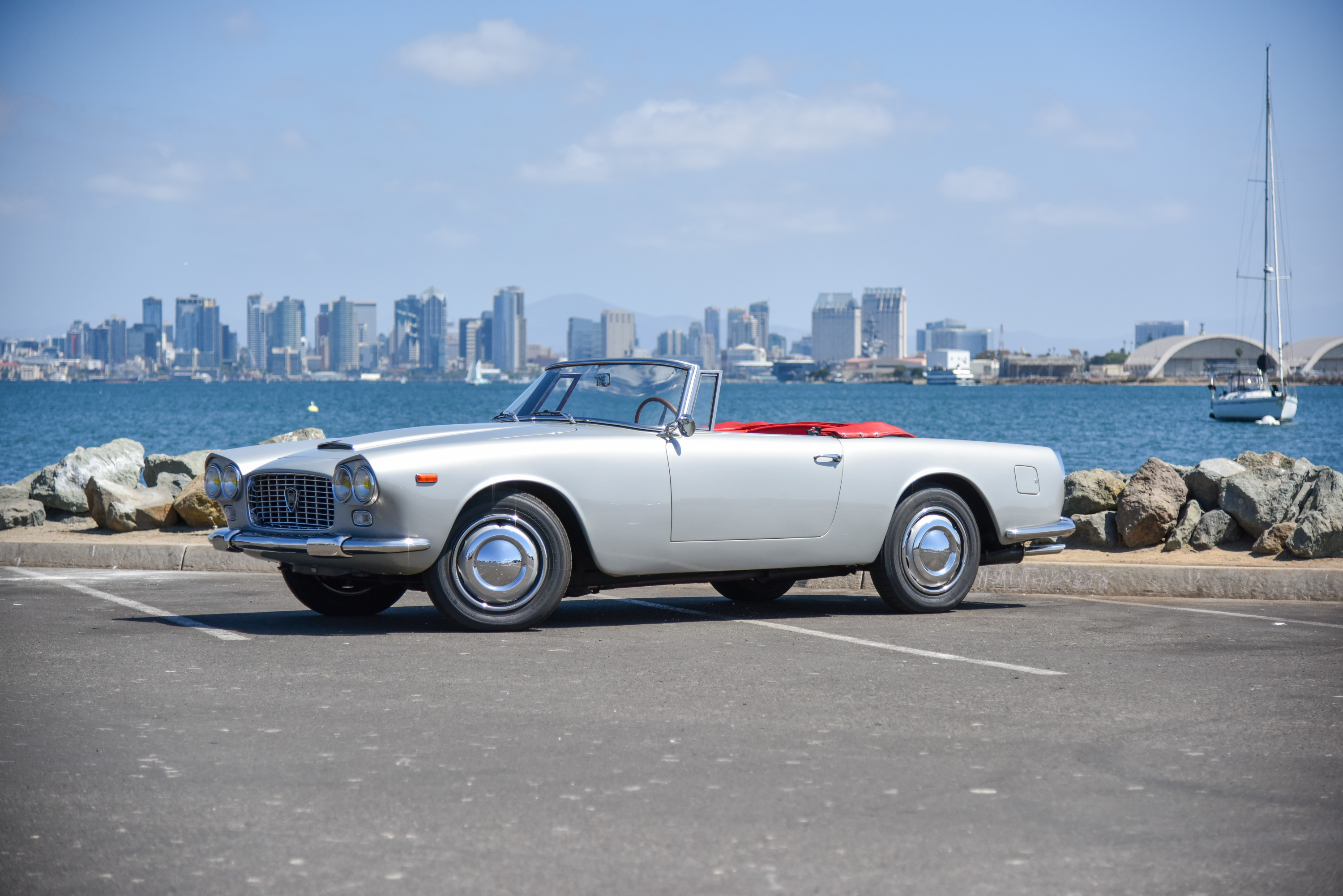
Touring's Convertibile was the soft-top version of the two-seat GT, with the same four-headlight nose and a short wheelbase. Wikipedia and classic.com put production at 847, of which 180 had the 2.8 3C engine. Curbside notes that convertible production ended in 1964 but that stocks, both 2.5 and 2.8, lasted until 1968-69. Fantasy Junction documented one such car: a 2.8 3C completed on December 10, 1963, then stored at the Lancia factory until its French owner collected it in the spring of 1968.
Slow sales and a quiet end
The Flaminia was expensive and sold slowly. Curbside records only a few dozen Berlinas a year from 1966 to 1969, Touring went bankrupt in 1966, and Lancia passed to Fiat in 1969. The Berlina stayed on the price list to 1970, and no direct successor arrived until the Gamma.
In America
No source consulted here documents a US importer's volume or a US list price. What the sources do show is Flaminias arriving in the US early and staying: Fantasy Junction sold a 1960 Touring coupe whose first owner lived in Oakland and which carried California black plates for 50 years. Sports Car Market observed in the 1990s that Lancias in America tend to be owned by enthusiasts with engineering backgrounds.
Common Problems
The sources consulted document repair work rather than failure statistics. The recurring items on US cars are the brakes and the fuel system. Fantasy Junction's 1968 convertible needed its front calipers, brake servo and master cylinder rebuilt or replaced, its fuel pump replaced, carburetors rebuilt, fuel tank boiled out and fuel level sender rebuilt, plus driveline doughnuts, tie-rod ends, shocks and external oil lines, for a bill just short of $16,000. The same dealer's 1960 Touring coupe had an engine rebuild and clutch in 2009 with receipts over $17,000, and a brake service in October 2016 replacing all wheel cylinders at $3,200. The inboard rear discs sit next to the transaxle, so brake work there is more involved than on a conventional axle. The driveline rubber couplings (doughnuts) between engine and rear transaxle are a wear item that shows up in these records. Corrosion is the other theme: Fantasy Junction describes splash-area corrosion as typical of Italian cars of the era. Parts support in the US is specialist and small; the California coupe was restored with the help of Dino Motors and other Northern California specialists over many years, which is a fair picture of how these cars are kept running here.
What to Look For
Engine specification first. The 2.8 3C is the configuration the market pays for, and the chassis and engine type numbers say which car you have: RM Sotheby's and Gooding convertibles carry 826.134 chassis numbers with 826 engines, while the RM Sotheby's Zagato records type 826.132 for the 2.8 3C Sport and 826.232 for the Super Sport. A Lancia certificate of origin, as on the RM Sotheby's Ponder car, records the completion date; on convertibles, expect it to differ from the title year, because some cars sat in factory stock for years. Look for original paperwork: the Fantasy Junction 1968 convertible came with its 1968 sales documents, and the 1960 coupe with 47 years of service records. Body construction matters. The Touring cars are aluminum panels over a steel frame and the Zagato cars are aluminum, so corrosion shows up where steel and aluminum meet and underneath; Fantasy Junction noted corrosion in the splash areas of an otherwise good California car and called it typical of Italian cars of the era. Check the details that separate a correct car from a tidied one: the thermostatically controlled radiator louvers and the external oil cooler that Fantasy Junction describes, the triple Weber setup on a claimed 3C, and whether a convertible still has its hardtop, which Gooding listed as a feature. On Zagato cars, confirm headlight type and engine against the chassis type, since RM Sotheby's records 37 Sports converted to Super Sport by Zagato itself.
Market Notes
As of September 2026, classic.com puts the average Lancia Flaminia sale at $119,848 across all bodies, with its lowest recorded sale $1,500 for a 1962 Berlina in December 2022. Its body-level market benchmarks, as of September 2026, run from about $29,651 for the Pininfarina coupe to $97,571 for the Touring GT, $108,313 for the Touring convertible, $208,450 for the Zagato Super Sport, $308,953 for the second-series Zagato Sport and $438,132 for the first-series covered-headlight Sport. Individual US results show how wide the convertible spread is. Gooding sold a 1966-titled 2800 3C convertible (chassis 826.134-1098) at its 2025 Pebble Beach Auctions for $128,800, without reserve, against a $180,000-$220,000 estimate. RM Sotheby's sold a 1964 2800 3C convertible (826.134-1052, titled as a 1963) from the Gene Ponder Collection for $225,500; the lot page does not print the sale date. classic.com records a 1961 convertible sold at auction for $75,500 in November 2025, a 1963 car bid to $139,000 without selling in May 2026, and a low of $40,500 for a 1962 Touring convertible in February 2025. Every one of these convertibles was sold with its own mix of restoration and documentation, so the spread reflects condition and engine as much as body.
Where sources differ
Total Flaminia production is given as 12,633 by Wikipedia, the Lancia Motor Club and classic.com, and as 12,400 by Curbside Classic.
Wikipedia, the Lancia Motor Club and classic.com state 12,633. Curbside Classic states 12,400. The three agreeing sources may share one origin (Jean de Barsy's pages, cited by Wikipedia but not fetched here). Not resolved by any source consulted here.
Pininfarina coupe production is given as 5,236 (4,151 2.5 and 1,085 2.8) by Wikipedia and as 5,282 by Sports Car Market, both ending in 1967.
Wikipedia states 5,236 Pininfarina coupes. Sports Car Market states 5,282. Both agree production ended in 1967. Not resolved by any source consulted here.
Zagato Sport and Super Sport production is given as 593 by Wikipedia (99 covered-headlight cars, 344 Sports, 150 Super Sports) and as 526 built between 1959 and 1967 by Sotheby's; RM Sotheby's calls Zagato production records less than perfectly reliable.
Wikipedia states 593 Zagato cars. Sotheby's states 526. RM Sotheby's gives no total and says the records are imperfect. All three agree on about 99 covered-headlight cars. Not resolved by any source consulted here.
The 3C triple-Weber 2.5 liter engine raised output to 140 hp; RM Sotheby's dates its introduction to 1961 while Curbside Classic dates it to 1962 for the Touring second series.
RM Sotheby's (two lots) gives 1961, the Ponder lot saying for the 1961 model year on the Touring cars. Curbside Classic gives 1962 for the Touring second series. Sotheby's says the triple Weber engine was standard on the Zagato by 1962, which fits either. All agree on 140 hp. The year is not resolved by any source consulted here.
Output of the 2,775 cc 2.8 3C engine is quoted at 146 hp by Gooding and RM Sotheby's Gene Ponder lot, and at 150 hp by RM Sotheby's Villa Erba lot and Curbside Classic.
Gooding states 146 hp at 5,400 rpm; RM Sotheby's Ponder lot states six more than the 140 hp 2.5 3C, which is 146. RM Sotheby's Villa Erba lot and Curbside Classic state 150. Wikipedia's table gives 150 metric horsepower. Not resolved by any source consulted here.
The 2,775 cc engine was introduced in 1962 according to Wikipedia and RM Sotheby's Ponder lot, and in 1963 according to RM Sotheby's Villa Erba lot and Curbside Classic.
Wikipedia gives 1962; RM Sotheby's Ponder lot says a year after the 1961 3C, which is 1962. RM Sotheby's Villa Erba lot and Curbside Classic give 1963. Introduction may have differed by body, but no source consulted says so. Not resolved.
Published weights differ: Wikipedia gives 3,175 lb curb for the coupe, while the July 1960 Autocar test reported by Sports Car Market weighed a Pininfarina coupe at 3,602 lb ready for the road.
Wikipedia states 3,175 lb curb for the coupe. Sports Car Market, citing Autocar's 1960 test, states 3,602 lb ready for the road. The two may use different definitions, but no source consulted says which figure is correct.
Sources
- Lancia Flaminia, Wikipedia · encyclopedia
- Lancia Flaminia, Lancia Motor Club · club-forum
- Car Show Classic: 1964 Lancia Flaminia 3C GT Convertibile 2.8 - Buon Appetito, Curbside Classic · journalism
- 1962 Lancia Flaminia Coupe 2.5, Sports Car Market · journalism
- 1961 Lancia Flaminia 3C Convertible, Sports Car Market · journalism
- 1964 Lancia Flaminia 2800 3C Convertible by Touring | Gene Ponder Collection, RM Sotheby's · auction-house
- 1966 Lancia Flaminia 2800 3C Convertible, Gooding Christie's · auction-house
- 1963 Lancia Flaminia Sport by Zagato | Villa Erba 2015, RM Sotheby's · auction-house
- Lancia Vintage Flaminia Sport By Zagato Available For Immediate Sale At Sotheby's, Sotheby's · auction-house
- 1968 Lancia Flaminia 3C 2.8 Convertible by Touring, Fantasy Junction · specialist
- 1960 Lancia Flaminia Superleggera Coupe by Touring, Fantasy Junction · specialist
- Lancia Flaminia Market, classic.com · market-data
- Lancia Flaminia Convertible Market, classic.com · market-data
Synthesized from the sources above and cross-checked. We cite and link out; we do not republish other databases verbatim.
Fully Sorted is an independent publisher and is not affiliated with, endorsed by or sponsored by Lancia. Lancia and the model names on this page are trademarks of their respective owners and are used here only to identify the cars being described.
Chassis register
Nobody has recorded a car here yet. Own one, or know one? Chassis number, what you can prove about it, and a source if there is one. Every entry is reviewed before it appears.
Nerd Notes
What owners know that the sources don't. Every note is read and checked before it appears here.
Key Specs
- Power
- About 101 hp (early Berlina) to 140 hp (2.5 3C); 146 hp or 150 hp for the 2.8 3C depending on source
- Tires
- Pirelli Cinturato radials from new per Wikipedia
- Brakes
- Four-wheel discs, inboard at the rear, servo-assisted; a few early Berlinas had drums
- Engine
- All-aluminum 60-degree V6, 2,458 cc (1957-1962) or 2,775 cc (from 1962 or 1963); 3C cars on three Weber twin-choke downdraft carburetors
- Layout
- Front-mounted longitudinal V6, rear-mounted transaxle, rear-wheel drive
- Torque
- Not reliably documented in the sources consulted here
- Weight
- 3,153 lb Berlina and 3,175 lb coupe curb per Wikipedia; 3,602 lb ready for the road for the Pininfarina coupe per the 1960 Autocar test reported by Sports Car Market
- Chassis
- Steel unit structure (Berlina and Pininfarina coupe); Touring Superleggera aluminum panels over a steel frame; Zagato aluminum body
- Top speed
- 103 mph Berlina and 107 mph Touring GT per Sports Car Market; 107 mph for the Pininfarina coupe in the July 1960 Autocar test
- Wheelbase
- 113.0 in (2,870 mm) Berlina; 99.0 in (2,515 mm) Pininfarina coupe, per Wikipedia; Touring GT, Convertibile and Zagato shorter still
- Acceleration
- 0-60 mph in 15.5 s (Berlina) and 13.7 s (Touring GT), single-source figures reported by Sports Car Market
- Transmission
- 4-speed manual, fully synchronized, in a rear transaxle; Saxomat semi-automatic listed by Wikipedia as an option
- Carburetors 3c
- Three Weber 35DCNL twin-choke downdraft on the 2.8 3C Zagato Sport per RM Sotheby's; larger 40 mm (1.6 in) Webers on the Super Sport per Sotheby's
- Rear suspension
- De Dion axle with semi-elliptic leaf springs and Panhard rod
- Front suspension
- Double wishbones, coil springs, telescopic shocks, anti-roll bar
Notable Variants
Touring Convertibile 2.8 3C
The convertible most US buyers are shopping for. 180 were built with the 2,775 cc triple-Weber engine, per RM Sotheby's, Gooding and Curbside Classic. Some were completed in 1963-64 but sat in factory stock and were delivered as late as 1968, which is why titles and chassis dates on these cars often disagree.
Touring Convertibile 2.5 (single carburetor and 3C)
The bulk of the roughly 847 convertibles. First-series cars ran the single-carburetor 2.5; the 3C triple-Weber 2.5 followed. Same body and aluminum Superleggera construction as the 2.8 cars, and priced below them.
Zagato Sport, covered-headlight pre-series
The first 99 Zagato cars had faired-in headlights, a detail Sotheby's says was outlawed in Italy early in the run. Nearly all used the single Solex 2.5; Sotheby's records five fitted to special order with a competition triple-Weber engine.
Zagato Sport 2.8 3C and Super Sport
RM Sotheby's records 70 Sports of type 826.132 built in 1963-64, of which Zagato converted 37 to Super Sport specification, leaving 33 open-headlight 2.8 3C Sports. The Super Sport added a Kamm tail and faired headlight casings.
Touring GT and GTL
The Touring two-seat coupe (GT) and its 2+2 derivative (GTL, from 1962-63). Same four-headlight nose as the convertible. Wikipedia puts the GTL at 300 cars, nearly all 2.8, which makes a 2.8 GTL scarcer than a 2.8 convertible on paper.
Pininfarina Coupe
The volume Flaminia and the only coupe built on a slightly shortened steel chassis by Pininfarina itself. More were built than Berlinas, and it trades for a fraction of the Touring and Zagato cars.
Berlina
The only body Lancia built in-house and the only one offered for the whole 1957-1970 run. The earliest cars could be had with drum brakes before Dunlop discs, inboard at the rear, were adopted.
Value Trajectory
For most of their life Flaminias were cheap. The 1960 Touring coupe Fantasy Junction sold changed hands in California in 1969 for $1,284. Sports Car Market wrote in the mid-1990s that the best Touring 2.8 3C in the world could break the $20,000 level, and that Lancias, with only a cult following, were unlikely to appreciate significantly. That call was wrong for the Touring and Zagato cars. As of September 2026, classic.com benchmarks the Touring convertible at $108,313 and the first-series Zagato Sport at $438,132, while the Pininfarina coupe sits near $29,651. The recent trend is mixed: classic.com marks most Flaminia body benchmarks as trending down as of September 2026, with the Touring GT the exception, and a 2025 Gooding 2.8 3C convertible sold without reserve at $128,800 against a $180,000 low estimate. The spread between a documented 2.8 3C Touring or Zagato car and a Berlina has become the defining feature of the market.
Next
Shopping for one?
Browse Lancia listings, or decode a VIN before you buy.